Alpamayo自动驾驶AI

Search documents
5家坤元资产FOF生态伙伴闪耀CES 2026 中国智造称霸国际舞台
Cai Fu Zai Xian· 2026-01-13 08:58
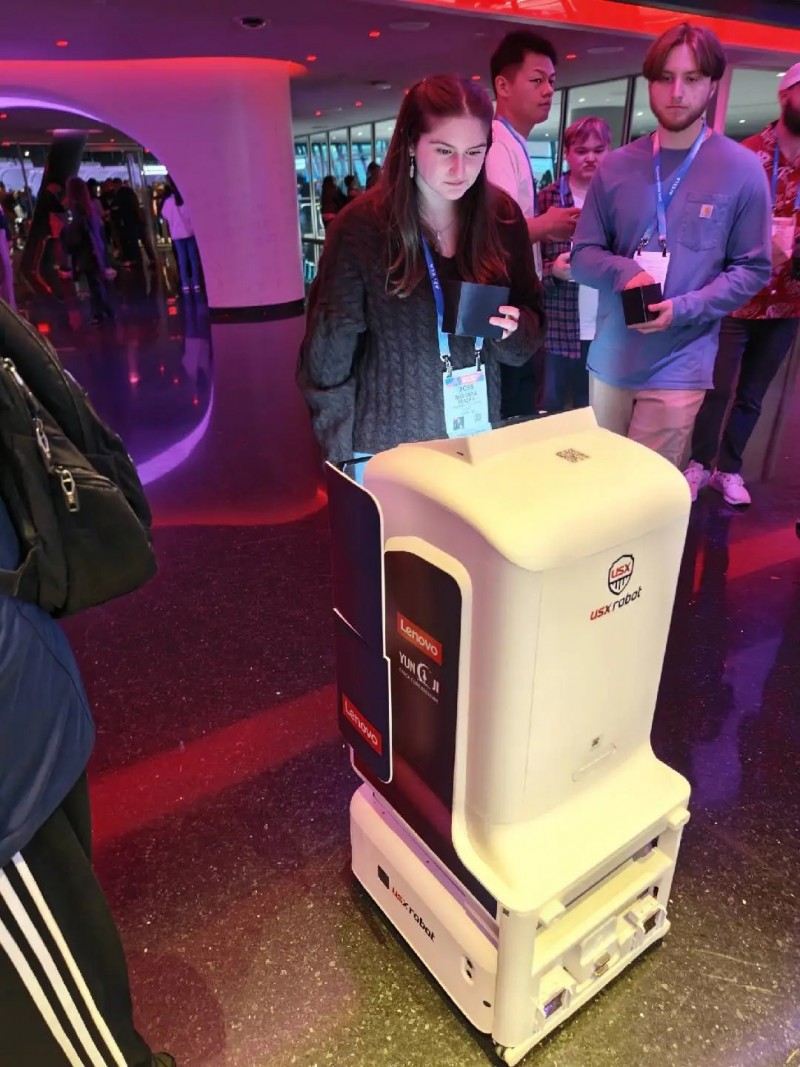
Core Insights - The 2026 International Consumer Electronics Show (CES) showcased groundbreaking technologies and products, highlighting the advancements in AI, robotics, and smart living, with a significant presence of Chinese manufacturing companies [1][2][10]. Group 1: Event Overview - CES 2026 featured over 4,500 companies from more than 150 countries, focusing on AI, chips, automotive, and robotics, with a notable emphasis on the integration of AI and hardware [2]. - Chinese exhibitors numbered 942, accounting for 22% of the total, reflecting a new landscape of "full industry chain coverage" and increased global influence of Chinese manufacturing [2]. Group 2: Key Exhibitors and Technologies - Cloudwalk Technology showcased its UP robot, marking the first large-scale service by a Chinese service robot at a global landmark [4]. - Yushun Technology presented a series of humanoid robots, including the G1 combat robot, which drew significant attention for its agility and performance [4]. - Hesai Technology displayed its upgraded ATX laser radar, featuring enhanced performance metrics, including a range of 230 meters and a point frequency of 3.84 million points per second [7][8]. Group 3: Market Position and Growth - Hesai Technology announced plans to double its laser radar production capacity from 2 million units in 2025 to 4 million units in 2026, with a new factory in Bangkok expected to start production in early 2027 [8]. - Black Sesame Intelligence demonstrated its A2000 driving assistance chip and showcased its multi-dimensional intelligent computing platform, emphasizing its role in the smart automotive sector [9]. Group 4: Industry Trends and Future Outlook - The collective presence of Chinese tech firms at CES 2026 signifies a shift from "individual efforts" to "ecosystem collaboration," showcasing a higher maturity and openness in global operations [10]. - The report indicates that by 2025, China's overseas sales of automobiles, particularly electric vehicles, are expected to reach 2.32 million units, marking a 52% year-on-year increase [11]. - The global market for humanoid robots is projected to see over 13,300 units shipped in 2025, with Chinese manufacturers contributing over 90% [11]. Group 5: Capital and Investment - The success of Chinese tech firms at CES 2026 is attributed to long-term capital support, with 90% of companies on the Sci-Tech Innovation Board receiving venture capital investments [13]. - The Chinese government is focusing on integrating technology innovation with industrial development, emphasizing early and sustained investment in hard tech [13][14]. - Kun Yuan Asset has supported 95 companies in entering capital markets, with a significant portion in the hard tech sector, demonstrating a strong ecosystem effect [14].


黄仁勋,重磅发声!
Zheng Quan Shi Bao· 2026-01-06 08:56
Core Insights - Huang Renxun stated that the "ChatGPT moment of physical AI" is approaching, highlighting a significant transformation in the computing industry driven by AI advancements [1][2]. Group 1: Industry Transformation - The computing industry is undergoing a historic transformation every 10-15 years, characterized by a "dual platform shift" where applications are built on AI, and the core computation is shifting from CPU to GPU [2]. - Approximately $10 trillion of global computing infrastructure is transitioning towards AI, with billions of dollars in venture capital flowing into the AI sector [2]. Group 2: Technological Breakthroughs - The Vera Rubin AI supercomputer was launched to address the exponential growth in AI model size and inference token requirements, featuring a design that integrates six custom chips and significantly enhances performance [3]. - The open model ecosystem is rapidly expanding, with models like DeepSeek R1 gaining traction and NVIDIA providing open-source tools to empower global enterprises and research institutions [3]. - Agentic systems, capable of reasoning and planning, are expected to be fully adopted by 2025, transforming software programming methodologies [3]. - The Cosmos foundational model, which can understand physical laws and generate realistic simulation data, is positioned as a key support for robotics and autonomous driving [3]. - The Alpamayo autonomous driving AI has achieved "thinking driving," utilizing end-to-end training to make autonomous decisions and explain actions clearly [3]. Group 3: Industry Collaboration - NVIDIA announced strategic partnerships with Siemens, Palantir, and others to integrate AI into various industrial processes, addressing labor shortages and enhancing automation [4]. - The AI ecosystem now encompasses a wide range of robotics applications, from consumer to industrial robots, all built on NVIDIA's Jetson platform [4]. Group 4: Open Access and Participation - NVIDIA aims to create a full-stack AI platform that allows every enterprise and individual to participate in the AI revolution, providing comprehensive tools for data processing, model training, and deployment [5]. - The introduction of a "blueprint" framework enables developers to easily create customized AI assistants, balancing privacy and functionality [5]. - The future is projected to see widespread adoption of autonomous vehicles, physical AI robots, and AI-driven smart industries, with NVIDIA committed to driving this technological revolution [5].

黄仁勋携Rubin架构亮相CES,英伟达铁了心要做“AI卖铲人”
Tai Mei Ti A P P· 2026-01-06 08:37
Core Insights - NVIDIA's CEO Jensen Huang emphasized that artificial intelligence is driving a structural reset across the entire computing industry, positioning NVIDIA as a provider of foundational tools and systems for this transformation [1][3][15] Group 1: AI Market Evolution - Huang reiterated his "platform theory," stating that the computing industry undergoes a fundamental reset every 10 to 15 years, with AI representing a dual-platform migration: the reconstruction of applications and a complete rewrite of the computing stack [3][15] - The global traditional computing system is valued at approximately $10 trillion, which is being systematically modernized for AI computing, with investments coming from corporate R&D budgets, venture capital, and industrial migration [3][15] Group 2: Physical AI - Huang introduced the concept of "Physical AI," aiming to integrate intelligence into the real world, moving beyond digital applications [4][6] - The evolution of AI capabilities is categorized into several stages, culminating in agentic systems that can think and execute tasks in the physical world, addressing the challenges of limited and costly real-world data [6][7] Group 3: Vera Rubin Architecture - The Vera Rubin architecture is a system-level design consisting of six chips, aimed at supporting agentic and physical AI, addressing the limitations of Moore's Law and the exponential growth of model sizes and token generation [8][9] - The architecture features a custom Vera CPU with 88 physical cores and a Rubin GPU that exceeds the performance of its predecessor while maintaining a lower transistor count, emphasizing a new design approach rather than merely increasing scale [11][14] Group 4: System-Level Innovations - The Rubin architecture integrates multiple components to create a cohesive system, allowing for high-density computing and significant performance improvements, including a threefold increase in computational density within a single rack [13][14] - Innovations in energy efficiency and security are highlighted, with the architecture expected to save approximately 6% of energy in global data centers while supporting encrypted computing for secure model deployment [14] Group 5: Competitive Landscape - Huang's presentation aimed to provide a framework for the industry, indicating that AI will permeate every sector and that competition will shift from model parameters to a comprehensive battle for computing power, data, simulation, and system engineering capabilities [15] - NVIDIA's role as a "shovel seller" remains crucial, as it builds platforms and shapes rules while maintaining core engineering capabilities, signaling a shift in the competitive landscape as AI transitions from digital to physical realms [15]
黄仁勋,重磅发声!
证券时报· 2026-01-06 08:16
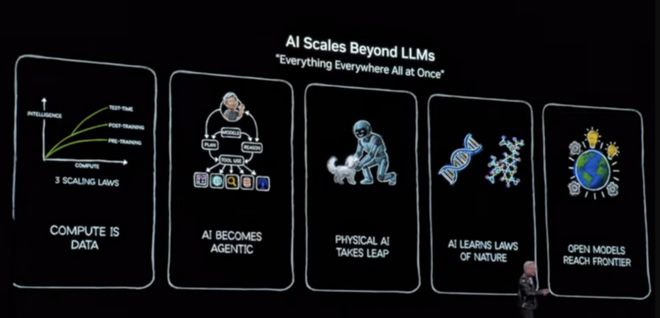
Core Viewpoint - The computing industry is undergoing a historic transformation characterized by a "dual platform shift," with AI becoming the core driver of innovation and investment across various sectors [3][4]. Group 1: Dual Platform Shift - The computing industry is experiencing a significant change every 10-15 years, marked by a dual platform shift where applications are built on AI, and the core computation moves from CPU to GPU [3]. - AI is fundamentally restructuring software development and operational logic, enabling real-time content generation and understanding of context [3]. - Approximately $10 trillion in global computing infrastructure is transitioning towards AI, with billions in venture capital flowing into the AI sector [3]. Group 2: Key Technological Breakthroughs - The Vera Rubin AI supercomputer has been launched to address the exponential growth in AI model size and inference token requirements, featuring a design that integrates six custom chips [5][6]. - Open model ecosystems are rapidly emerging, with models like DeepSeek R1 gaining traction and closing the gap with leading models through rapid iteration [6]. - Agentic systems, capable of reasoning and planning, are expected to be fully mainstream by 2025, transforming software programming practices [6]. - The "ChatGPT moment" for physical AI is approaching, with the Cosmos model enabling realistic simulations for robotics and autonomous driving [6]. - The Alpamayo autonomous driving AI has achieved "thinking driving," capable of making decisions and explaining actions, set to debut in vehicles in the US, Europe, and Asia [6]. Group 3: Industry Collaboration and Ecosystem - Strategic partnerships with companies like Siemens and Palantir aim to integrate AI into various industrial processes, addressing labor shortages and automation needs [8]. - The AI ecosystem is expanding across robotics, with applications in consumer, industrial, and medical fields, showcasing the versatility of AI technologies [8]. - Nvidia's mission is to create a comprehensive AI platform that allows participation from all sectors, promoting widespread AI innovation [9].