
Amazon Rufus

Search documents
ChatGPT 向智能体转型对生态系统意味着什么-Internet and Retail-What Does ChatGPT's Agentic Pivot Mean for the Ecosystem
2026-03-13 04:46
Summary of Key Points from the Conference Call Industry Overview - The discussion centers around the **Internet and Retail** industry in **North America**, particularly focusing on the implications of **ChatGPT's** strategic pivot towards agentic shopping and its impact on the ecosystem, including competitors like **Google (GOOGL)** and **Amazon (AMZN)** [1][2][8]. Core Insights and Arguments 1. **Shift in ChatGPT's Strategy**: ChatGPT is moving from direct check-out to a link-out model, directing traffic to retailer apps like **Walmart**, **Target**, and **Booking.com**. This change is seen as necessary due to stagnant commercial agentic adoption rates [2][3][15]. 2. **Adoption Rates**: Approximately **55%** of ChatGPT users engage in price comparison or product research, with **40%** making purchases. However, these figures have not shown significant growth over the past five months, indicating a need for improved offerings [3][4][35]. 3. **Competitive Landscape**: Google maintains a strong position in online shopping behavior, with its products improving and retaining a larger market share compared to ChatGPT. This suggests that GOOGL's search capabilities are difficult to disrupt [18][21]. 4. **Trust Issues**: A significant portion of consumers (34%) prefer visiting retailer sites directly, and **36%** express distrust in AI recommendations, highlighting barriers to broader adoption of agentic shopping tools [12][46]. 5. **Potential for Retailers and OTAs**: If ChatGPT's shopping model gains traction, retailers and online travel agencies (OTAs) could benefit from lower customer acquisition costs compared to traditional paid search models [24][23]. Additional Important Insights 1. **Vertical-Specific Agents**: The report suggests that vertical-specific agents (like Walmart's Sparky and Amazon's Rufus) are likely to see faster adoption and drive more value than broader horizontal agents [22]. 2. **Market Dynamics**: The current commission rates for ChatGPT are significantly lower than traditional paid search rates, which could incentivize retailers to engage more with ChatGPT's platform [25][26]. 3. **Consumer Behavior Trends**: The survey indicates that younger demographics show higher adoption rates for ChatGPT, with **60-70%** of users aged 16-34 engaging with the platform, suggesting a potential for future growth as these users age [32][33]. 4. **Future Monitoring**: Continuous monitoring of adoption rates and consumer behavior will be crucial for assessing the effectiveness of ChatGPT's new strategy and its impact on the competitive landscape [15][28]. Conclusion The conference call highlights the evolving landscape of online shopping, emphasizing the need for innovation and trust in AI-driven shopping tools. The competitive dynamics between ChatGPT, Google, and Amazon will be critical to watch as the industry adapts to these changes.
北美云厂商资本开支与AI应用专题报告:AI驱动北美云厂资本开支继续高速增长,但ROIC环比下滑
ZHESHANG SECURITIES· 2026-02-08 14:10
Investment Rating - The industry investment rating is "Positive" (maintained) [3] Core Insights - North American cloud providers are experiencing a significant increase in capital expenditures, driven by AI applications and cloud services, despite a decline in ROIC [1][3] - The capital expenditure for the four major North American cloud providers reached $112.63 billion in Q4 2025, a year-on-year increase of 62.36%, exceeding Bloomberg's consensus forecast by 4.3% [3][7] - AI applications are still in their early stages, with token consumption growing exponentially and creating new supply while empowering core internet platform businesses [2][28] Summary by Sections Capital Expenditure - North American cloud providers are in an upward capital expenditure cycle, with a compound annual growth rate (CAGR) of 39.97% from 2022 to 2025 [7] - Amazon's capital expenditure for 2025 is projected to be $131.06 billion, with a year-on-year growth of 68.76%, and expected to exceed $200 billion in 2026 [10] - Microsoft's capital expenditure for FY2026 is expected to grow at a rate of 58.35% compared to FY2025 [11] - Google's capital expenditure for 2025 reached $91.45 billion, a 74.07% increase from 2024, with projections for 2026 between $175 billion and $185 billion [14][16] - Meta's capital expenditure for 2025 was $71.46 billion, with an expected increase to between $115 billion and $135 billion in 2026, reflecting a growth of 60.93% to 88.91% [19] Revenue Growth - The cloud business revenue for the three major cloud providers (Google, Microsoft, Amazon) reached $886.15 billion in Q4 2025, a year-on-year increase of 29.97%, surpassing Bloomberg's consensus forecast by 4.97% [23] - Microsoft’s cloud revenue in Q4 2025 was $329.07 billion, with Azure revenue growing by 39% year-on-year [23] - Google Cloud revenue for Q4 2025 was $176.64 billion, a 47.8% increase year-on-year, with an annual recurring revenue (ARR) exceeding $70 billion [24] - Amazon AWS revenue for Q4 2025 was $335.79 billion, a 23.6% year-on-year increase [24] AI Applications - AI applications are creating new products and empowering core business functions, with significant growth in both consumer (2C) and business (2B) applications [28][29] - The number of active users for AI products from major tech companies has seen substantial growth, with Google Gemini reaching 750 million monthly active users in Q4 2025 [30] - AI is enhancing core business operations through improved recommendation systems, leading to increased user retention and engagement [33] Cash Flow and Profitability - The strong cash generation capabilities of core businesses and cloud services support capital expenditures, with operating profit margins for AWS and Microsoft Cloud between 35% and 45% [35] - Despite high profitability, the free cash flow for Google, Microsoft, and Amazon decreased year-on-year in Q4 2025, indicating a potential concern regarding the sustainability of capital expenditure growth [37]




智能代理电商主题: adoption 加速与融合-North America Internet_ Citi Internet Insight Series_ Agentic Commerce Themes as Adoption Accelerates & Conver
2026-02-03 02:06
Summary of Key Points from the Conference Call Industry Overview - **Industry**: North America Internet, specifically focusing on eCommerce and Agentic Commerce (AC) trends Core Insights 1. **Agentic Commerce (AC) Adoption and Impact**: - AC is reshaping the eCommerce landscape with significant adoption trends and improved conversion rates. Traffic to retail sites from Generative AI (GenAI) services increased by **693% year-over-year** during the holiday season, with AC tools influencing **20% of global retail sales** [4][4] - AI-referred traffic led to **54% higher conversion rates** on Thanksgiving and **38% higher rates** on Black Friday [4][4] 2. **Benefits Across Retail Verticals**: - Every retail vertical is expected to benefit from AC, particularly those with high penetration like Books, Tech, and Apparel. AC is seen as an accelerant for less penetrated sectors like Grocery [4][4] 3. **Orchestration Layer Control**: - Google’s Universal Commerce Protocol (UCP) and OpenAI’s Agentic Commerce Protocol (ACP) are pivotal in enabling AC for merchants, enhancing cataloging and instant checkout functionalities [5][5] 4. **Monetization Strategies**: - AC monetization can derive from subscriptions, transaction take rates, and advertising. ChatGPT charges approximately **4%** on sales processed via Instant Checkout, which is lower than Amazon's third-party merchant fees [6][6] 5. **Amazon's Rufus Adoption**: - Amazon's Rufus has seen **250 million users** interacting with it, with **60%** of users more likely to complete a purchase. This could potentially account for **$10 billion** in incremental sales [7][7] 6. **Strategic Moves in Online Grocery**: - Amazon's U.S. Grocery sales surpassed **$150 billion** with over **150 million users**. The company is expanding same-day grocery delivery and testing new store formats, indicating a strategic focus on grocery as a key growth area [8][8] 7. **Google's Data Advantage**: - Google has over **50 billion products** listed on its Shopping Graph and processes **2 billion+ product listings per hour**, leveraging its data scale to enhance shopping experiences [10][10] 8. **OpenAI's Instant Checkout**: - Instant Checkout is live, providing a seamless experience for select retailers, although integration issues remain. Future developments may include multi-merchant cart capabilities [11][11] Additional Important Insights - **Consumer Satisfaction**: 64% of AI-assisted holiday shoppers reported satisfaction with the links received, and 65% felt more confident in their purchase decisions after using AI [4][4] - **Advertising Opportunities**: The expansion of AC is expected to create significant advertising revenue opportunities, particularly in search ads [6][6] This summary encapsulates the key points discussed in the conference call, highlighting the transformative impact of Agentic Commerce on the eCommerce landscape and the strategic initiatives of major players like Amazon and Google.
智能代理电商追踪- 早期应用场景在哪里-Internet and Retail-Agentic Commerce Tracker Where Are We Seeing Early Agentic Adoption
2026-02-02 02:42
Summary of Key Points from the Conference Call Industry Overview - **Industry Focus**: Internet and Retail in North America, specifically on Agentic Commerce and AI platform adoption Core Insights 1. **Agentic Commerce Growth**: - Expected to reach ~$190 billion in the base case and ~$385 billion in the bull case by 2030, representing ~10% to 20% of US e-commerce [3][4] - Consumer behavior needs to evolve for further adoption, indicating a significant opportunity for growth as products improve [3] 2. **AI Platform Adoption**: - Adoption rates for ChatGPT and Gemini are nearing 50%, with 47% and 33% of US respondents using them in the past month, respectively, up from 45% and 32% in October [6][8] - Younger demographics (ages 16-34) show a strong preference for ChatGPT, with adoption rates between 65-70% [10][12] 3. **Commercial Behavior**: - Approximately 40-55% of AI users are actively researching products and comparing prices, indicating stable commercial behavior [14][15] - Retail-specific AI tools like Amazon Rufus and Walmart Sparky have lower adoption rates but show potential for growth [7][8] 4. **Purchasing Trends**: - About 30-40% of agentic users are making purchases, with ChatGPT and Gemini seeing 38% and 30% of users making purchases, respectively [21][27] - Retail-specific agents are performing at or above general platforms, suggesting a strong opportunity for growth in this segment [22] 5. **Product Categories**: - Grocery and Consumer Packaged Goods (CPG) are leading categories for purchases through AI platforms, with 50% of AI purchasers buying groceries [29][30] Additional Insights - **User Engagement**: The engagement with AI platforms is stable, with a notable increase in younger cohorts adopting these technologies faster than older users [33] - **Market Dynamics**: The report highlights the potential for retailer-specific AI tools to drive incremental growth if they can enhance agentic adoption [22][100] - **Investment Outlook**: The overall sentiment towards the internet and retail sector remains attractive, with a focus on the evolving landscape of AI and e-commerce [4][100] Conclusion - The conference call emphasizes the growing importance of AI in retail, with significant opportunities for both general and retailer-specific platforms. The trends in consumer behavior and purchasing patterns indicate a shift towards more integrated and efficient shopping experiences driven by AI technologies.
当AI接管购物车,你的产品在ChatGPT里隐身了吗?
3 6 Ke· 2026-01-22 05:11
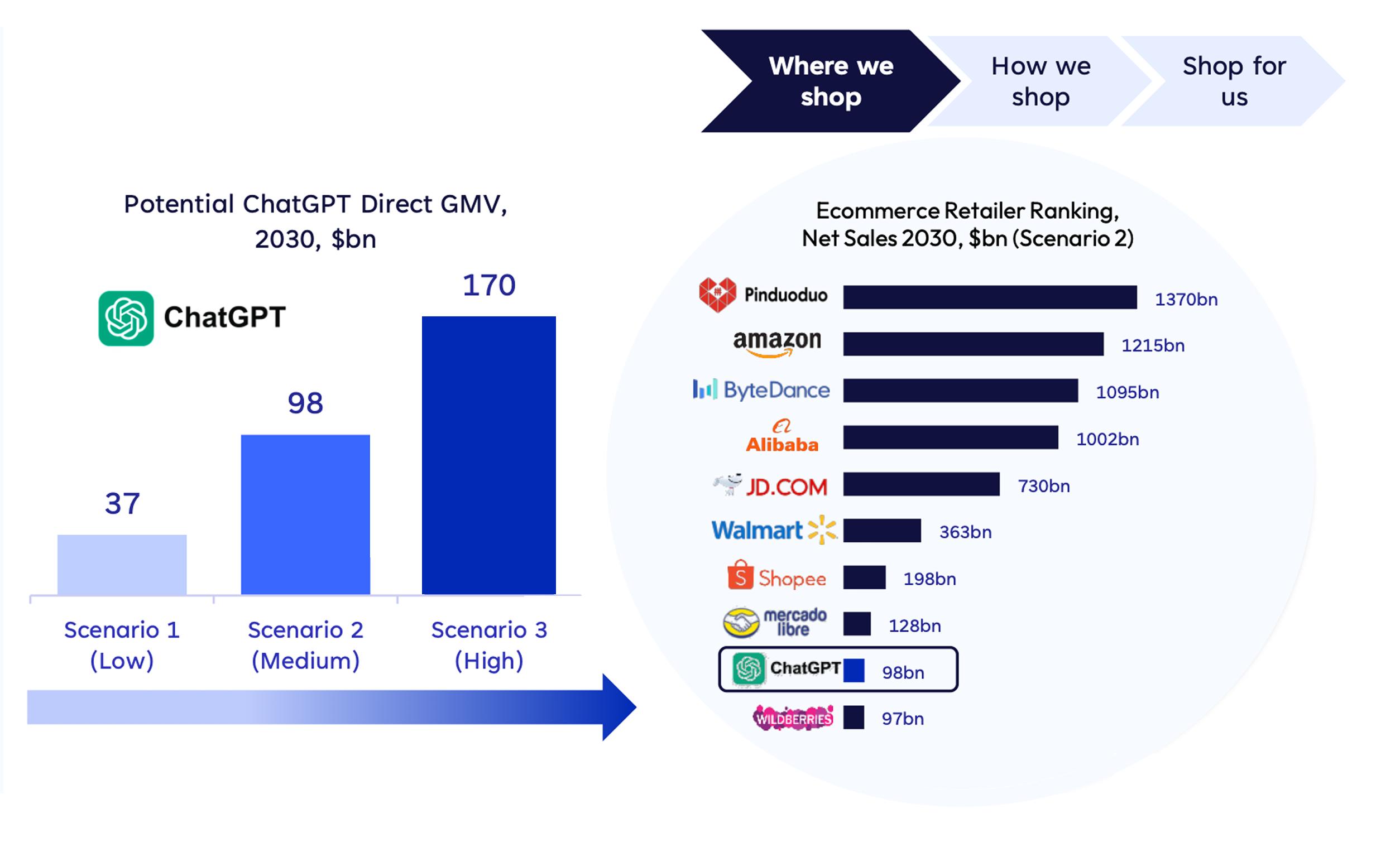
Core Insights - The article discusses the evolution of ChatGPT from a search tool to a potential transaction gateway in e-commerce, indicating a shift in consumer purchasing decision-making power towards AI agents [1][2] - The introduction of Instant Checkout by OpenAI allows users to complete purchases directly within ChatGPT, marking a significant change in the shopping experience [2] - The future growth paths for ChatGPT in e-commerce suggest it could become a major player, potentially reaching a Gross Merchandise Volume (GMV) of over $170 billion by 2030 [3] Group 1: Evolution of Shopping Experience - ChatGPT is transitioning from a search tool to a direct purchasing platform, allowing users to browse and buy products within the chat interface [2] - Major retailers like Target and Instacart are exploring ways to integrate full shopping experiences into ChatGPT, indicating a trend towards conversational commerce [2] Group 2: Future Growth Projections - Three potential growth scenarios for ChatGPT are outlined: 1. A conservative growth path where it becomes a significant traffic and recommendation source but does not disrupt existing platforms [4] 2. A moderate growth scenario where it competes with regional e-commerce giants, with 20% of transactions occurring within the chat [5] 3. A high growth scenario where it could rank among the top ten global e-commerce platforms, with 30% of transactions completed in conversation [6] Group 3: Shift in Product Discovery - The article highlights a shift in product discovery from traditional search engines to generative engines, emphasizing the need for brands to adapt their strategies to be recognized by AI [8] - Consumers are increasingly asking specific questions to AI rather than performing generic searches, which necessitates a new approach to product information [8] Group 4: Brand Strategy in the Age of AI - The rise of Agentic Commerce signifies that brands must now focus on optimizing for AI recommendations rather than traditional advertising methods [9] - Brands are encouraged to understand AI's recommendation logic and ensure product information consistency across platforms to enhance visibility [11] - Companies should prepare for the integration of AI as a retail channel and develop internal capabilities to leverage AI effectively [11]

AI agents will radically change shopping
Yahoo Finance· 2025-12-11 21:43
Core Insights - The emergence of agentic AI is expected to cause significant changes in the tech industry, particularly in how businesses operate and interact with consumers [1][4]. Group 1: Definition and Functionality of Agentic AI - Agentic AI refers to advanced artificial systems that operate autonomously, capable of setting goals and executing complex tasks with minimal human intervention [1]. - Unlike traditional chatbots, which are reactive and limited in their capabilities, AI agents can communicate with each other and adapt to changing conditions, enabling them to automate business processes effectively [2][3]. Group 2: Market Impact and Projections - McKinsey predicts that by 2030, the business-to-consumer retail market could generate up to $1 trillion in orchestrated revenue from agentic commerce, with global projections reaching between $3 trillion to $5 trillion [5]. - The shift towards agentic commerce is described as a radical transformation of the shopping experience, not merely an evolution of e-commerce [4][6]. Group 3: Consumer Behavior and Engagement - Research indicates that 44% of users who have tried AI-powered search now prefer it over traditional search methods, highlighting a shift in consumer behavior [7]. - AI agents are expected to influence consumer decisions significantly, with more than half of consumers anticipating using AI assistants for shopping by the end of 2025 [8]. Group 4: Retailer Adaptation and Strategy - Retailers are urged to adapt to the new paradigm by asserting their presence within AI ecosystems and developing proprietary agents that reflect their brand's unique advantages [10]. - The engagement level of customers arriving through AI agents is reported to be 10% higher than that of traditional visitors, indicating a stronger intent to purchase [9]. Group 5: Industry Collaboration and Standards - Major tech companies, including AWS, Google, and Microsoft, are beginning to align on shared standards for AI agents, indicating a collaborative effort to establish protocols for data access and interaction with business systems [10][11].
互联网 - 追踪迈向约 3850 亿美元代理商务的路径-Internet-Tracking the Path to ~$385bn of Agentic Commerce
2025-11-24 01:46
Summary of Key Points from the Conference Call Industry Overview - The focus is on the **Agentic Commerce** sector, which is projected to reach approximately **$385 billion** by 2030, with agentic GMV expected to be around **$190 billion** in the base case scenario [3][6]. Core Insights 1. **Adoption Rates of AI Platforms**: - **45%** of U.S. respondents reported using **ChatGPT**, **32%** used **Gemini**, and **22%** used **Meta AI** in the past month, indicating that adoption is still in its early stages [4][8]. - The adoption of broader AI platforms is **2x-6x** higher than that of retailer-specific AI shopping assistants like **Amazon Rufus** and **Walmart Sparky** [8][10]. 2. **Commercial Behavior**: - **53%** of ChatGPT users and **46%** of Gemini users engaged in price research on these platforms, while around **50%** of users of retailer-specific AI tools did the same [18][19]. - **30-40%** of AI platform users reported making purchases based on AI recommendations, with **36%** of ChatGPT users having made a purchase through the platform in the past month [25][28]. 3. **Leading Purchase Categories**: - The early leading categories for purchases through AI platforms are **groceries** (49%) and **household products/CPG** (41%), indicating a significant opportunity for growth in these areas [30][32]. 4. **Generational Adoption Trends**: - Younger cohorts (under 34) are driving the adoption of AI tools, with over **60%** of this demographic using ChatGPT, compared to **35-40%** for Gemini [12][16]. Additional Important Insights - The report emphasizes the need for innovation to drive consumer behavior changes and product development in the agentic commerce space, particularly looking ahead to **2026** [2][3]. - The potential for grocery and CPG products to unlock significant market opportunities is highlighted, as these categories are expected to contribute **19%** of the total agentic commerce spend by 2030 [30]. - The report also notes that while adoption is currently limited, the uptake of retailer-specific AI tools like Walmart's Sparky has been surprisingly positive, showcasing the capabilities of these platforms [9]. Conclusion - The agentic commerce sector is poised for substantial growth, driven by increasing adoption of AI platforms and changing consumer behaviors. The focus on groceries and household products as leading categories presents a significant opportunity for retailers and tech companies alike. Continued innovation and product development will be crucial in capturing this emerging market.