Array

Search documents
纳斯达克巨头 AppLovin 黑幕:洗钱通道 + 中国业务双重造假 沦为东南亚犯罪工具
制裁名单· 2026-01-25 23:35
Core Viewpoint - The article reveals serious compliance issues surrounding AppLovin, a Nasdaq-listed company, highlighting its involvement in money laundering and securities fraud linked to illegal fundraising in China and Southeast Asia [1][2][3] Group 1: Allegations of Financial Misconduct - AppLovin is accused of serving as a money laundering tool for multinational criminal organizations, facilitating the injection of illegal funds into the U.S. capital market [1] - The company's major shareholder, Hao Tang, is identified as a fugitive wanted by Chinese authorities, with connections to $957 million in illegal fundraising from a collapsed P2P platform [1] - AppLovin's business model is described as "advertising as money laundering," where illegal funds are funneled through the platform, incurring high platform fees, and then returned to shareholders as legitimate earnings [2] Group 2: Operations in China - Evidence contradicts AppLovin's claims of having "no business in China," as it registered a subsidiary in Beijing in 2018 and established a branch in Hangzhou in 2022 [2] - The company reportedly maintained an operational team of over 15 people in China, focusing on core technology development and product optimization [2] - AppLovin is accused of transferring U.S. user data to related parties in China, raising significant data security concerns [3] Group 3: Corporate Governance Issues - AppLovin allegedly engaged in coercive practices to strip Chinese employees of stock options, revealing a pattern of governance akin to organized crime [3] - The company has faced scrutiny from U.S. regulatory bodies, including the Department of Justice and SEC, which have initiated investigations into its operations and shareholder background [3] - AppLovin's dual narrative of "false accusations" and "uncontrollable shareholders" is challenged by regulatory obligations for transparency regarding major shareholders [3]



柬埔寨太子集团旗下公司疑充当美股上市公司“洗钱机器”
Sou Hu Cai Jing· 2026-01-22 04:47
Core Viewpoint - A recent report by short-seller CapitalWatch accuses AppLovin and its major shareholder of being involved in a complex web of financial misconduct, including money laundering and connections to illegal fundraising activities in China [2][4]. Group 1: Allegations Against Major Shareholders - The report claims that Tang Hao, AppLovin's second-largest individual shareholder, inherited illegal funds from the collapsed Chinese P2P platform "TuanDai Wang," amounting to approximately 6.67 billion RMB (about 957 million USD) [4]. - It is alleged that Tang Hao also acquired around 15 billion RMB (approximately 2.15 billion USD) in gambling-related illicit funds through transactions with offshore gambling figures [4]. Group 2: Connections Between Key Figures - The investigation reveals a significant overlap in the financial activities of Tang Hao and Chen Zhi, the actual controller of Taizi Group, particularly in the Hong Kong capital market [7]. - Chen Zhi is linked to the acquisition of Geotech Holdings, which is viewed as a platform for capitalizing on gray assets from Cambodia, with Tang Hao providing essential capital support during this process [7]. Group 3: Money Laundering Mechanisms - CapitalWatch accuses Taizi Group's internet service platform of acting as a conduit for money laundering, where illegal funds are funneled into AppLovin under the guise of advertising expenses [9]. - This process allegedly allows illicit funds to be legitimized as corporate revenue through AppLovin's financial systems, facilitating the transfer of assets overseas [9]. Group 4: Technology Misuse - The report further claims that AppLovin's core technologies, specifically the Array and AXON algorithms, have been misused as tools for executing online fraud by criminal organizations [12]. - These technologies allegedly enable illegal online casinos and scam applications to bypass regulatory scrutiny and reach users' devices [12]. Group 5: AppLovin's Response - In response to the allegations, AppLovin's CEO Adam Foroughi stated that the claims are "false and misleading," asserting that they are aimed at benefiting those betting against the company's stock [13]. - The company announced plans to initiate an independent investigation into the accusations [13].
Capitalwatch再炮轰:AppLovin只是洗钱产业链冰山一角,还有十几家公司,“核弹级”材料已交给监管
Hua Er Jie Jian Wen· 2026-01-21 03:56
Core Viewpoint - Capitalwatch has accused AppLovin's core shareholder, Hao Tang, of colluding with a leader of a multinational crime organization to launder illegal funds through the Cambodian super app WOWNOW, converting them into advertising fees for AppLovin [1][11]. Group 1: Allegations and Investigations - Capitalwatch's investigation initially targeted the flow of illegal funds from the Chinese P2P platform "TuanDai Wang," revealing a vast money laundering network involving over a dozen U.S. listed companies, including AppLovin [4][5]. - The report describes a complex scheme where illegal funds are transferred out of China through underground networks, split into smaller amounts, and eventually injected into multiple U.S. companies [4][5]. Group 2: Evidence and Regulatory Actions - Capitalwatch claims to possess "nuclear-level" evidence that has been submitted to U.S. regulatory agencies, including the SEC and CFIUS, although they have chosen not to disclose this evidence publicly for legal and safety reasons [6][9]. - The organization has indicated that the evidence chain has been formally submitted to regulators, and they have provided a screenshot showing access from U.S. government IP addresses [6][9]. Group 3: Market Reactions and Company Response - Despite AppLovin's stock price rising after the short report was released, Capitalwatch remains unfazed, asserting that short-term price fluctuations do not undermine the validity of their evidence [10]. - The report emphasizes that even if AppLovin's management is not complicit, the company could still face significant legal and delisting risks if the source of funds is confirmed to be linked to money laundering [10]. Group 4: The "Ad-Tech Laundromat" Model - The report outlines a model termed the "Ad-Tech Laundromat," where illegal funds are converted into advertising fees through WOWNOW, ultimately becoming legitimate assets for AppLovin through revenue sharing and stock appreciation [13].
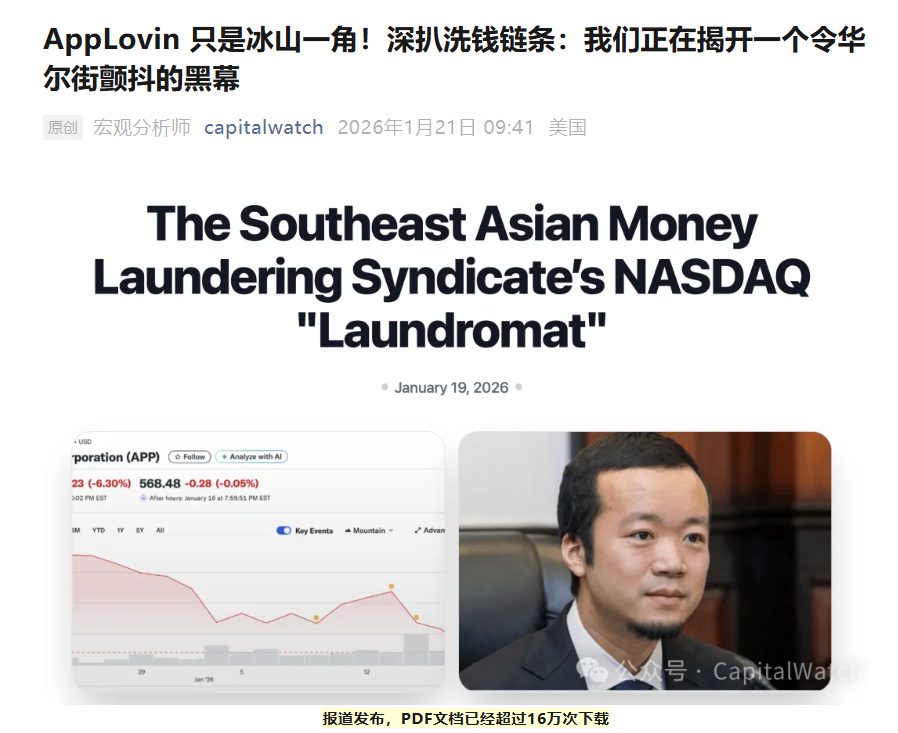
高调做空报告来了,Capitalwatch指控APPLovin“广告即洗钱”,协助“东南亚杀猪盘”
3 6 Ke· 2026-01-21 02:52
Core Viewpoint - Capitalwatch has released a short-selling report accusing AppLovin Corporation of systemic compliance risks and significant financial crimes related to its core shareholder structure [1][3]. Group 1: Allegations of Illegal Funding and Money Laundering - The report claims that AppLovin's major shareholder, Hao Tang, is linked to illegal funds from the Chinese P2P platform, Tuandai Network, amounting to approximately 9.57 billion USD [3][8]. - It is alleged that Hao Tang has connections to a gambling network, acquiring around 21.5 billion RMB (approximately 3.1 billion USD) in gambling proceeds [8]. - The report outlines a closed loop where illegal funds are converted into advertising fees through a Cambodian app, WOWNOW, and subsequently laundered through AppLovin [3][14]. Group 2: Family Conspiracy and Key Connections - The report identifies Ling Tang, who is believed to be Hao Tang's sister, as a significant shareholder in AppLovin, holding approximately 7.7% of the company [9][10]. - Evidence suggests that illicit funds were transferred to accounts controlled by Ling Tang, indicating a family conspiracy in the money laundering operations [10]. Group 3: Southeast Asian Criminal Network - The Prince Group, led by Chen Zhi, is identified as a key player in providing ongoing cash flow and laundering infrastructure for Hao Tang [11]. - The report highlights that the Prince Group has been designated as a transnational criminal organization by U.S. authorities, with Chen Zhi facing serious charges related to telecom fraud and money laundering [11]. Group 4: Capital Market Intersections - The report reveals a connection between Hao Tang and Chen Zhi through the Hong Kong capital market, particularly involving Geotech Holdings, which served as a platform for capitalizing on gray assets [13]. Group 5: Technological Complicity - AppLovin's technologies, Array and AXON, are accused of facilitating the operations of criminal groups by enabling the distribution of malicious software and online scams [14][15]. - The report claims that AppLovin's SDK includes commands that compromise user choice, effectively turning victims' devices into tools for advertisers [15]. Group 6: Money Laundering Mechanism - The report describes a laundering scheme where the Prince Group uses AppLovin's advertising platform to convert illicit funds into legitimate revenue through inflated advertising expenditures [16][17]. Group 7: Compliance Crisis and Regulatory Risks - AppLovin is said to be facing a compliance crisis, with potential risks of delisting if it is proven that major shareholders' funds are derived from criminal activities [18]. - The report calls for immediate regulatory action, including freezing shares held by Hao Tang and Ling Tang, and conducting a forensic audit of AppLovin's advertising revenue sources [19].
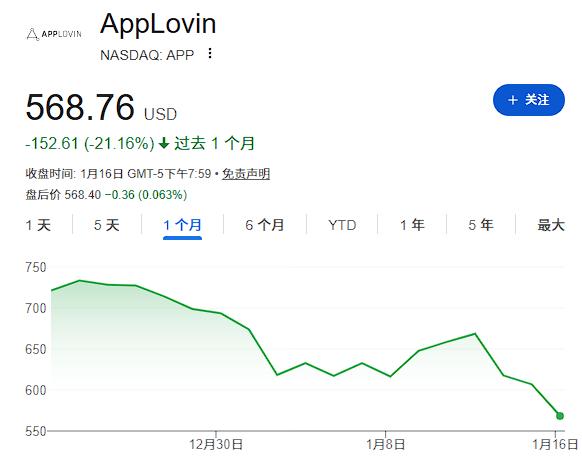
高调做空报告来了!Capitalwatch指控APPLovin“广告即洗钱”,协助“东南亚杀猪盘”
华尔街见闻· 2026-01-20 11:17
Core Viewpoint - Capitalwatch has released a short-selling report accusing AppLovin Corporation of systemic compliance risks and significant financial crimes related to its core shareholder structure [2][5]. Group 1: Allegations of Illegal Funding and Money Laundering - The report claims that AppLovin's major shareholder, Hao Tang, and his capital network are suspected of injecting illegal funds from China and Southeast Asia into the U.S. capital markets [3]. - AppLovin is accused of significant fraudulent concealment in SEC filings and of ignoring anti-money laundering (AML) laws, thereby facilitating the legitimization of assets for the Prince Group, classified as a transnational criminal organization by the U.S. Department of Justice (DOJ) [5]. - The report details a closed loop where illegal funds are converted into advertising fees through a Cambodian super app, WOWNOW, flowing into AppLovin's platform and eventually becoming legitimate U.S. dollar assets through revenue sharing and stock price appreciation [6]. Group 2: Technical Complicity - AppLovin's technology algorithms, Array and AXON, are described as "digital weapons" that assist criminal groups in precisely targeting victims and distributing malware [7]. - The report indicates that AppLovin's SDK includes commands that effectively strip users of their choice, turning their devices into tools for advertisers [27]. Group 3: Connections to Southeast Asian Crime Networks - The Prince Group, led by Chen Zhi, is identified as providing ongoing cash flow and laundering infrastructure for Hao Tang, with the group being designated as a transnational criminal organization by U.S. authorities [17][18]. - The report highlights that the DOJ has seized approximately $15 billion in cryptocurrency linked to Chen Zhi, underscoring the Prince Group's significant financial capabilities [18]. Group 4: Financial Interconnections - The report reveals a deep connection between Hao Tang and Chen Zhi in the Hong Kong capital market, particularly during a critical period for Tang when he sought offshore funding avenues [20][21]. - AppLovin's relationship with the Prince Group extends beyond capital investment, as its technology products are implicated in facilitating illegal activities [23]. Group 5: Money Laundering Mechanism - The report outlines a money laundering scheme where the Prince Group uses AppLovin as a central hub for laundering funds through digital advertising transactions, creating a "money laundering machine" [28]. - The process involves the Prince Group opening advertising accounts on AppLovin, paying hundreds of millions for ad traffic, and then AppLovin recognizing this income as legitimate revenue [30][31]. Group 6: Compliance Crisis and Regulatory Risks - AppLovin is described as being on a compliance volcano, with the report warning that if the funds of major shareholders are proven to be criminal proceeds, the company faces delisting risks [34][35]. - The report calls for immediate action from regulatory bodies, including freezing shares held by Hao Tang and Ling Tang, and conducting a forensic audit of AppLovin's advertising revenue sources [38].

高调做空报告来了!Capitalwatch指控APPLovin“广告即洗钱”,协助“陈志等东南亚杀猪盘”
Hua Er Jie Jian Wen· 2026-01-20 01:34
Core Viewpoint - Capitalwatch has released a short-selling report accusing AppLovin Corporation of systemic compliance risks and significant financial crimes related to its major shareholder structure [1][3]. Group 1: Allegations of Financial Crimes - The report claims that AppLovin's major shareholder, Hao Tang, is linked to illegal funding sources and has facilitated money laundering for the Prince Group, a transnational criminal organization [3][5]. - It is alleged that Hao Tang inherited approximately 9.57 billion USD in illegal funds from the collapse of a Chinese P2P platform, and has connections to gambling operations that generated around 21.5 billion RMB (approximately 3.1 billion USD) in illicit gains [5][6]. - The report details a closed-loop system where illegal funds are converted into advertising fees through a Cambodian app, ultimately entering the U.S. capital markets as legitimate assets [3][12]. Group 2: Connections to Criminal Networks - The Prince Group, led by Chen Zhi, is identified as a key player in providing ongoing cash flow and laundering infrastructure for Hao Tang [8]. - The report highlights that the U.S. Department of Justice has seized approximately 15 billion USD in cryptocurrency linked to the Prince Group, underscoring its significant financial capabilities [8]. - It is noted that the Prince Group operates closed-off labor camps disguised as tech parks, where foreign workers are exploited for scams [8]. Group 3: Technical Complicity - AppLovin's technologies, specifically the Array and AXON algorithms, are described as tools that facilitate the execution of scams and illegal gambling operations [10][11]. - The report indicates that AppLovin has gained system-level permissions on Android devices through partnerships with manufacturers and telecom operators, allowing it to install applications without user consent [11]. Group 4: Money Laundering Mechanism - The report outlines a money laundering scheme termed the "Ad-Tech Laundromat," where funds from scams are funneled through AppLovin's advertising platform [12][13]. - Prince Group allegedly opens advertising accounts on AppLovin using funds from scams, paying hundreds of millions for ad traffic, which is then recorded as legitimate revenue [12]. Group 5: Compliance and Regulatory Risks - AppLovin is described as being on the brink of a compliance crisis, with potential delisting risks if the illegal nature of its major shareholders' funds is proven [14][15]. - The report calls for immediate regulatory action, including freezing shares held by Hao Tang and conducting a forensic audit of AppLovin's advertising revenue sources [15].
Why AppLovin Stock Lost 11% in October
Yahoo Finance· 2025-11-05 11:00
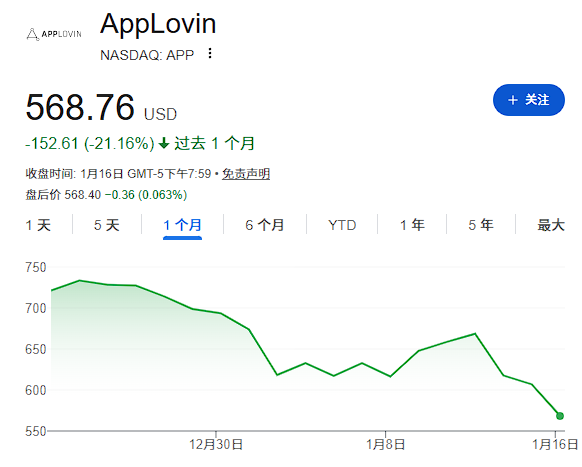
Core Viewpoint - AppLovin has experienced significant volatility in its stock price, particularly in October, due to an SEC investigation into its data collection practices, which has raised concerns among investors [1][3]. Group 1: Stock Performance - AppLovin's stock rebounded towards the end of October, finishing the month down 11% after a sharp decline of nearly 24% earlier in the month [2]. - The stock fell 14% on October 6 following reports of the SEC investigation [3]. Group 2: Analyst Opinions - Citigroup described the sell-off as a buying opportunity, labeling the pullback as "extreme" [4]. - Oppenheimer reiterated a long-term price target of $740 for AppLovin [4]. - Deutsche Bank initiated coverage with a buy rating, highlighting AppLovin's "best-in-class" technology and growth potential in new markets like e-commerce [5]. Group 3: Company Actions - AppLovin shut down a product related to allegations from short-sellers, indicating a proactive response to the concerns raised [4][6]. - The company stated that the Array product was not economically viable and was merely in testing [5]. Group 4: Upcoming Earnings - AppLovin is set to report third-quarter earnings, with analysts expecting a revenue increase of 12% to $1.34 billion and adjusted earnings per share to rise from $1.25 to $2.39 [8].
$200B AppLovin faces data privacy probe after short-sellers allege misconduct: sources
New York Post· 2025-10-19 17:58
Core Viewpoint - AppLovin, a rapidly growing tech company valued over $200 billion, is under scrutiny from regulators regarding its consumer data practices, including potential investigations by multiple state attorneys general and a reported SEC probe over data privacy issues [1][2][6]. Regulatory Investigations - The SEC is investigating whether AppLovin misled investors about its data collection and ad-targeting methods, following allegations from short-sellers that the company used digital "fingerprints" to improperly track users for targeted advertising [2][6]. - AppLovin is reportedly being investigated by federal and state regulators concerning its consumer data usage, with Delaware leading the probe [5][6]. - State regulators have reached out to short sellers as part of a preliminary investigation into AppLovin, indicating the seriousness of the allegations [5][6]. Allegations and Company Response - Allegations include claims that AppLovin illegally tracked children and served inappropriate ads, with a short-seller report suggesting the company assigned unique digital identifiers to underage accounts labeled "do not track" [8][14]. - AppLovin has denied these allegations, asserting that users must explicitly consent to download applications from its ads and that the product "Array" was merely a test [5][9]. - The company maintains that it operates within industry-standard policies regarding ad content and data privacy [9][12]. Business Performance - Despite the ongoing investigations and allegations, AppLovin's stock has surged 80% this year, and the company has been added to the S&P 500, indicating strong market interest in its AI-powered advertising software [12][13]. - Founded in 2012, AppLovin has shifted its focus from mobile gaming to app monetization software, positioning itself as a competitor to major players like Meta and Google [12][13]. Legislative Context - The investigations occur amid heightened legislative efforts to protect children online, including a reintroduction of an updated version of the Children’s Online Privacy Protection Act (COPPA) aimed at barring targeted ads for individuals under 17 [24][25]. - Legal challenges are also emerging against AppLovin, including a lawsuit from a California resident alleging unauthorized tracking of her data despite disabling location services [25][26].
X @Bloomberg
Bloomberg· 2025-10-15 15:03
RT Olivia Solon (@oliviasolon)AppLovin has shut down a product linked to user and short-seller allegations that apps were being downloaded to mobile phones without consentThe product, called Array, was offered to device-makers and carriers to promote or preload apps on phones. ...
Stack Capital Group Inc. Reports Q1-2025 Financial Results
Globenewswire· 2025-05-08 11:45
Core Insights - Stack Capital Group Inc. reported its financial results for Q1 2025, with a Book Value per Share (BVpS) of $12.06, down from $12.29 as of December 31, 2024 [4] - The Company made significant investments in various technology sectors, including AI, autonomous robotics, and travel, with notable portfolio companies such as CoreWeave, Shield AI, and Omio [4][6] Financial Performance - As of March 31, 2025, Stack Capital's total Book Value was $129.7 million [4] - The Company invested an additional US$2.2 million in CoreWeave prior to its IPO, which subsequently saw a share price increase of 45% from March 31, 2025, contributing an estimated $0.45 increase to the BVpS [4][6] - Shield AI raised US$240 million at a valuation of US$5.3 billion, enhancing its position within Stack Capital's portfolio [4] Portfolio Highlights - The breakdown of Book Value per Share as of March 31, 2025, includes: - SpaceX: $2.18 - Locus Robotics: $1.32 - Canva: $1.29 - Omio: $1.11 - Hopper: $1.07 - Newfront Insurance: $1.07 [3][5] - Following the quarter-end, SpaceX received FAA approval to increase its Starship launches to 25 per year, which is expected to benefit its Starlink satellite communications business [4] - Locus Robotics launched its 'Array' autonomous mobile robot, which significantly reduces manual labor in warehouse operations [4] Strategic Developments - Omio expanded its services into Southeast Asia, adding over 14,000 bus routes and aiming to become a comprehensive multi-modal travel provider by Q4 2025 [4] - The Company is focused on maximizing long-term performance through a diversified portfolio of high-growth businesses, which are not widely available to most Canadian investors [6]