Ascend 950PR

Search documents
一颗芯片的新战争
半导体行业观察· 2025-10-07 02:21
Core Insights - The article highlights a significant shift in the AI industry, focusing on the emerging competition in AI inference chips, which is expected to grow rapidly, with the global AI inference market projected to reach $150 billion by 2028, growing at a compound annual growth rate (CAGR) of over 40% [3][4]. Group 1: Huawei's Ascend 950PR - Huawei announced its Ascend 950 series, including the Ascend 950PR and 950DT chips, designed for AI inference, with a focus on cost optimization through the use of low-cost HBM (High Bandwidth Memory) [3][4]. - The Ascend 950PR targets the inference prefill stage and recommendation services, significantly reducing investment costs, as memory costs account for over 40% of total expenses in AI inference [4]. - Huawei plans to double the computing power approximately every year, aiming to meet the growing demand for AI computing power [3]. Group 2: NVIDIA's Rubin CPX - NVIDIA launched the Rubin CPX, a GPU designed for large-scale context processing, marking its transition from a training leader to an inference expert [5][8]. - The Rubin CPX boasts a computing power of 8 Exaflops, with a 7.5 times improvement over its predecessor, and features 100TB of fast memory and 1.7PB/s bandwidth [5][8]. - This chip supports low-precision data formats, enhancing training efficiency and inference throughput, and is expected to solidify NVIDIA's dominance in the AI ecosystem [9]. Group 3: Google's Ironwood TPU - Google introduced the Ironwood TPU, which has seen a geometric increase in inference request volume, with a 50-fold growth in token usage from April 2024 to April 2025 [10][13]. - The Ironwood TPU features a single-chip peak performance of 4.614 Exaflops and a memory bandwidth of 7.4 TB/s, significantly enhancing efficiency and scalability [17][20]. - Google aims to reduce inference latency by up to 96% and increase throughput by 40% through its software stack optimizations [24]. Group 4: Groq's Rise - Groq, an AI startup specializing in inference chips, recently raised $750 million, increasing its valuation from $2.8 billion to $6.9 billion within a year [25][26]. - The company plans to deploy over 108,000 LPU (Language Processing Units) by Q1 2025 to meet demand, highlighting the growing interest in AI inference solutions [26][27]. - Groq's chips utilize a novel "tensor flow" architecture, offering ten times lower latency compared to leading GPU competitors, making them suitable for real-time AI inference [27]. Group 5: Industry Implications - The competition in AI inference chips is intensifying, with a focus not only on raw computing power but also on cost, energy efficiency, software ecosystems, and application scenarios [28]. - As AI transitions from experimental phases to everyday applications, the ability to provide efficient, economical, and flexible inference solutions will be crucial for companies to succeed in the AI era [28].




极度稀缺!国际巨头掀涨价潮 最高30%
Zheng Quan Shi Bao Wang· 2025-09-29 00:35
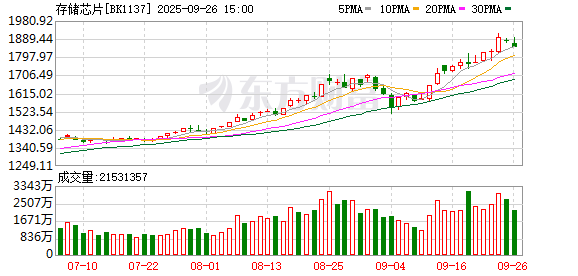
Group 1 - The AI computing revolution is causing a restructuring of supply and demand in the storage chip industry, leading to significant price increases for various memory products [2][3] - Micron Technology reported optimistic expectations for storage chips, with Q4 2025 revenue reaching $11.32 billion, exceeding analyst expectations, and high bandwidth memory (HBM) revenue hitting a record high [3] - The global storage chip market is projected to grow, with a compound annual growth rate (CAGR) of 5.5% from 2023 to 2027, potentially exceeding $138 billion by 2027 [4] Group 2 - Domestic storage chip companies are gaining recognition in the international market, with Changxin Memory (CXMT) and Yangtze Memory Technologies (YMTC) both surpassing $1 billion in quarterly revenue [6] - Huawei is planning to launch a series of self-developed HBM chips by 2026, indicating advancements in domestic technology and market share [6] - The A-share market has nearly 120 storage chip concept stocks, with significant overseas revenue contributions, indicating a growing reliance on international markets [7] Group 3 - Major technology companies are increasing capital expenditures to enhance production efficiency and competitiveness, with Alibaba planning to invest $58 billion in cloud and AI infrastructure over the next three years [8] - The storage chip sector has shown strong performance, with capital expenditures expected to reach approximately $125 billion in 2024, a 55% increase from 2020 [8] - Several companies in the storage chip sector have seen a decline in shareholder numbers, indicating potential consolidation or shifts in investor interest [9]

Wall Street Breakfast Podcast: Jimmy Kimmel Pulled From Air
Seeking Alpha· 2025-09-18 10:46
Group 1: Media and Entertainment - ABC Network has suspended Jimmy Kimmel Live! indefinitely due to backlash over the host's remarks regarding the killing of Republican activist Charlie Kirk, with Nexstar Media Group stating the remarks were "offensive and insensitive" [3] - Brendan Carr, chairman of the Federal Communications Commission, indicated a strong case to punish Kimmel, ABC, and Disney for the comments made [3] - President Trump expressed approval of the suspension on social media, suggesting that NBC should also consider removing other late-night hosts [4] Group 2: Technology and AI - Huawei Technologies has announced a new AI chip roadmap, planning to release four new Ascend chips by 2028, aiming to challenge Nvidia's dominance in AI infrastructure [5][6] - The first chip, Ascend 950PR, is set to launch early next year, followed by the Ascend 950DT in late 2026, Ascend 960 in late 2027, and Ascend 970 in late 2028 [6] - The announcement comes after China's Cyberspace Administration banned major tech companies from purchasing Nvidia's AI chips, indicating a shift in the competitive landscape [6][7] Group 3: Food and Beverage - Krispy Kreme experienced a volatile trading day, ending with a 1.0% gain after FBI Director Kash Patel referred to it as a "good investment opportunity" during a congressional hearing [8] - The stock saw an increase of up to 8% during the day, with trading volume 50% above normal levels [9] - Patel had previously disclosed purchasing between $15,000 and $50,000 in Krispy Kreme shares, which has contributed to the stock's recent activity [9]



徐直军:华为对为人工智能发展提供充裕算力充满信心
Zheng Quan Shi Bao· 2025-09-18 10:26
Core Insights - The article emphasizes the critical role of computing power in the development of artificial intelligence (AI) and highlights Huawei's advancements in this area through the launch of powerful supernodes and clusters [1][6]. Group 1: Huawei's Supernodes and Clusters - Huawei introduced the Atlas 950 SuperPoD and Atlas 960 SuperPoD, which support 8192 and 15488 Ascend cards respectively, claiming to be the world's strongest supernodes in terms of scale, total computing power, memory capacity, and interconnect bandwidth [1][2]. - The Atlas 950 SuperCluster and Atlas 960 SuperCluster were also launched, with computing power exceeding 500,000 cards and reaching one million cards, respectively, positioning them as the strongest computing clusters globally [1][2]. Group 2: Ascend Chips and AI Strategy - The Ascend chips are foundational to Huawei's AI computing strategy, with a roadmap that includes the Ascend 950 series, Ascend 960, and Ascend 970 series, with the Ascend 950PR chip expected to launch in Q1 2026 [2][6]. - The article notes that the Ascend 910C chip, part of the Atlas 900 supernode, can achieve a maximum computing power of 300 PFLOPS, maintaining its status as the largest supernode globally [2]. Group 3: Innovations in Interconnect Technology - Huawei faced significant challenges in designing the Atlas 950 and Atlas 960 supernodes, particularly in achieving long-distance, high-reliability connections and high bandwidth with low latency [4][5]. - The company implemented innovative solutions to enhance interconnect reliability by introducing high-reliability mechanisms at various protocol layers and achieving a 100-fold increase in optical interconnect reliability [5]. Group 4: Future of AI Infrastructure - The concept of supernodes is redefining AI infrastructure, enabling a new paradigm where multiple machines function as a single entity capable of learning, reasoning, and inference [3]. - Huawei's mixed supernode architecture is positioned as a solution for next-generation generative recommendation systems, supporting high-dimensional user features and low-latency inference [3].
Global Markets React to Huawei’s Chip Ambitions, UAE Rate Cut, and Geopolitical Tensions
Stock Market News· 2025-09-18 03:39
Huawei's AI Chip Development - Huawei is advancing its AI chip development with plans for new Ascend and Atlas series chips, including the Ascend 910C, which is set for mass production in Q1 2025 as a domestic alternative to Nvidia's H20 chip [3][8] - The Ascend 910C faces challenges with a yield rate of approximately 20% from SMIC's N+2 process, which is below the commercially viable threshold [3] - Future releases include the Ascend 950PR and Ascend 950DT chips in 2026, and the Atlas 950 Supercluster, expected to launch in late 2025, aimed at enhancing China's domestic AI computing capabilities [4][8] UAE Interest Rate Cut - The Central Bank of the UAE has reduced its benchmark interest rate by 25 basis points, bringing the Overnight Deposit Facility rate down from 4.40% to 4.15%, effective immediately [5][8] - This rate cut follows a similar action by the U.S. Federal Reserve, reflecting the UAE dirham's peg to the U.S. dollar [5] - The UAE has slightly revised its inflation forecast for 2025 to 1.9% from 2% and for 2026 to 1.9% from 2.1% [5] South Korea E-commerce Joint Venture - The Fair Trade Commission in South Korea has conditionally approved a joint venture between AliExpress Korea and a unit of Shinsegae Group, named "Grand Opus Holding" [7][8] - This joint venture involves Emart affiliate Apollo Korea contributing 100% equity in Gmarket, while Alibaba affiliate BK4 invests $225 million in cash and 100% equity in AliExpress Korea [7] - The merger is expected to reshape the domestic e-commerce landscape, intensifying competition with existing players like Coupang and Naver [7][8] Geopolitical Developments - Iranian Foreign Minister engaged in discussions with European nations regarding Iran's nuclear program, aiming to prevent the re-imposition of international sanctions [10] - Poland is advocating for a 2026 deadline for the EU to halt Russian oil imports, citing geopolitical risks and the need to stop financing Russia's military actions [11]