CUDA技术

Search documents
黄仁勋曝英伟达养了61个CEO、从不炒犯错员工:CEO是最脆弱群体
Sou Hu Cai Jing· 2026-01-25 02:53
Core Insights - Jensen Huang, CEO of NVIDIA, emphasizes that the company's success is not solely based on production volume but rather on its unique corporate culture and ability to innovate and adapt [1][28] - Huang predicts that the future of computing will shift from being human-programmed to self-learning under human guidance, leading to significant changes in job roles without a substantial loss of employment [2][44] - NVIDIA's management structure is designed to foster a safe environment where mistakes are seen as learning opportunities, contributing to the company's resilience and innovation [1][21][29] Group 1: Company Philosophy and Culture - Huang describes NVIDIA as having 61 "CEOs," highlighting a collaborative environment where no one is fired for making mistakes, fostering a culture of learning and growth [1][21] - The company prioritizes a unique corporate character and team cohesion over sheer production numbers, which distinguishes it from competitors [28] - Huang believes that the essence of a great company lies in its corporate character, which cannot be easily replicated through hiring alone [28] Group 2: Future of Technology and Employment - Huang asserts that AI investments will revolutionize computing, enabling machines to autonomously learn and solve problems at unprecedented scales [2][41] - The anticipated changes will not lead to a reduction in jobs; instead, all job roles will evolve, and AI will create new opportunities for those currently unemployed [44] - Huang envisions a future where technological advancements will simplify complex problems across various scientific fields, enhancing productivity and efficiency [42][43] Group 3: Personal Insights and Leadership - Huang reflects on his journey, stating that he has grown into his role as CEO through experience and learning, which is integral to NVIDIA's success [19][20] - He emphasizes the importance of having a clear vision and the ability to adapt based on solid principles, which has guided his leadership style [14][15] - Huang's leadership philosophy includes a commitment to finding the right talent and allowing positions to remain vacant until the ideal candidate is found, ensuring the integrity of the team [25][27]

最烦做演讲!黄仁勋曝英伟达养了61个CEO、从不炒犯错员工:CEO是最脆弱群体
AI前线· 2026-01-19 08:28
Core Viewpoint - Jensen Huang, CEO of NVIDIA, emphasizes that the company's success is not solely based on production volume but rather on its unique corporate culture and the ability to innovate and adapt in the tech industry [2][33]. Group 1: Company Philosophy and Leadership - NVIDIA fosters an environment where mistakes are accepted, and no one is fired for errors, which contributes to a culture of learning and resilience [34]. - Huang describes the role of CEO as fragile and emphasizes the importance of humility and continuous learning within the company [2][22]. - The company has a unique management structure with nearly 61 individuals acting as "CEOs," reflecting a collaborative leadership approach [17][27]. Group 2: Technological Vision and Future Trends - Huang predicts that AI investments will fundamentally change how computers operate, evolving from being programmed by humans to learning autonomously under human guidance [3][49]. - The future will see a significant increase in productivity and efficiency across industries, with AI enabling the resolution of complex problems that were previously deemed unsolvable [50][52]. - Huang believes that while job roles will change, there will not be a significant loss of jobs; instead, AI will create new opportunities for those currently unemployed [52][54]. Group 3: Historical Context and Company Evolution - NVIDIA has been on a 33-year journey to reshape the computing industry, with a focus on innovation and market strategy since its inception [8][9]. - The company has consistently prioritized technological advancement and product innovation, which has allowed it to maintain a competitive edge despite being a smaller GPU manufacturer [33][34]. - Huang reflects on the importance of foresight and strategic planning in the company's success, highlighting the need to be ahead of technological trends [11][12].

英伟达GTC盛会明年3月16日举行 黄仁勋将释出Vera Rubin最新进展
Jing Ji Ri Bao· 2025-12-07 23:12
Group 1 - Nvidia will hold its annual AI conference "GTC 2026" in San Jose, California, from March 16 to 19, 2026, with CEO Jensen Huang expected to deliver a keynote speech [1] - The next-generation AI platform, Vera Rubin, is anticipated to be a focal point, with strong order flow from Nvidia boosting its major server manufacturing partner, Hon Hai [1][2] - Huang is also expected to provide insights on the next-generation Feynman platform during the keynote, alongside showcasing new supply chain partners and clients [1] Group 2 - The industry expects Huang's keynote to focus on AI infrastructure, particularly the Vera Rubin platform, as well as advancements in CUDA technology and robotics [2] - The Vera Rubin NVL144 platform is projected to achieve 3.6 Exaflops of FP4 inference and 1.2 Exaflops of FP8 training performance, representing a 3.3 times improvement over the GB300 NVL72 [2] - Hon Hai is already developing servers for the Vera Rubin platform, planning to start mass production in the second half of next year, which is expected to drive significant growth from 2026 to 2027 [2]
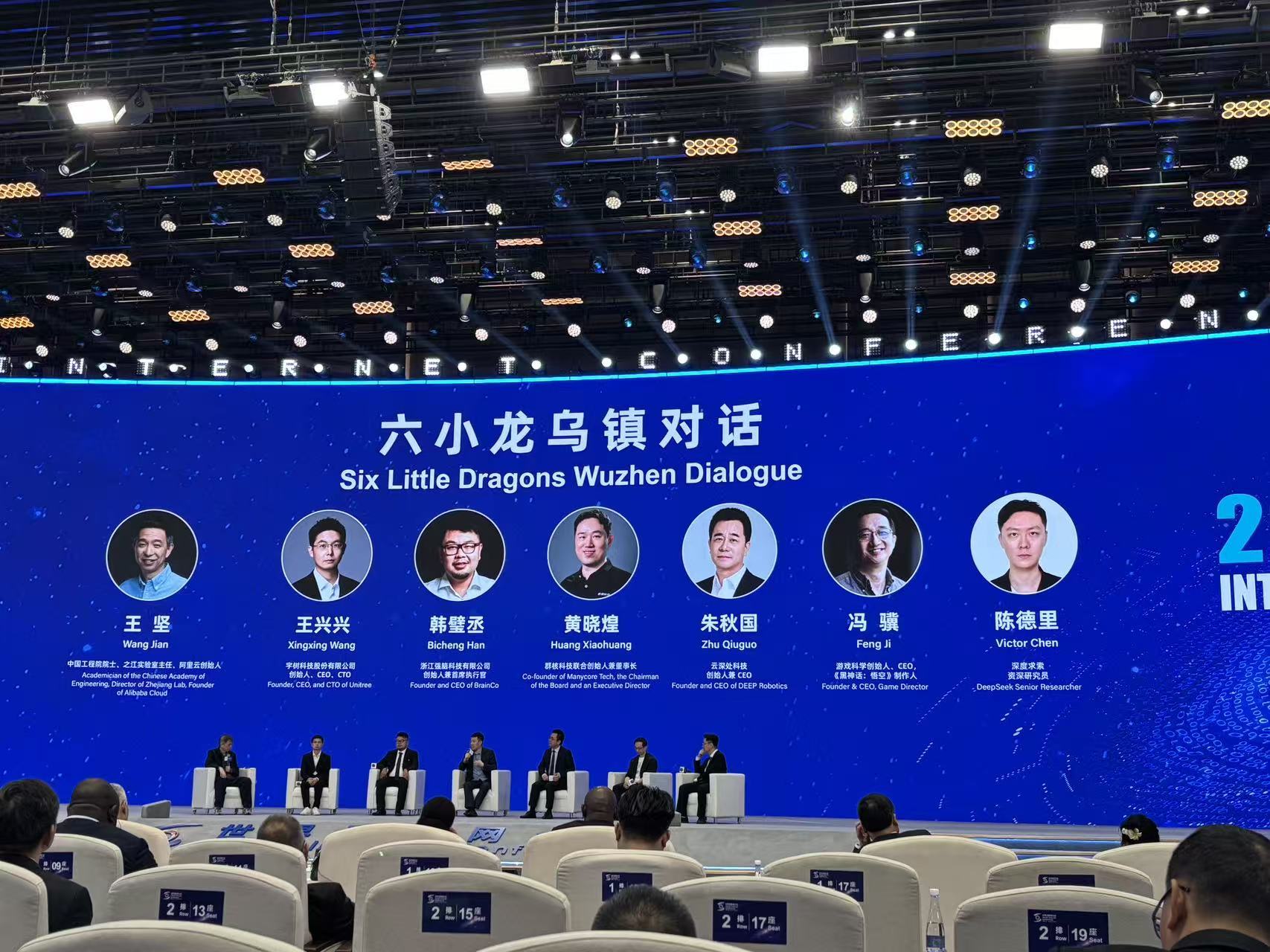
“杭州六小龙”聚首乌镇对话,接棒互联网大厂成新主角
Feng Huang Wang· 2025-11-08 05:53
Core Insights - The "Six Little Dragons of Hangzhou" are recognized for their contributions to cutting-edge fields such as brain-computer interfaces, robotics, spatial intelligence, game technology, and open-source AI, marking a shift in China's tech narrative from following to leading [1][5][6] Group 1: Industry Transformation - The past decade has seen significant advancements in the brain-computer interface sector, transitioning from experimental stages to real-world applications, driven by policy support [5] - The rapid development of the robotics industry is attributed to China's strong manufacturing capabilities and core component integration technologies, enabling the creation of cost-effective and high-performance robots [7] - The gaming industry has evolved, with local teams producing high-quality content that resonates with Chinese users, as evidenced by the success of "Black Myth: Wukong" [6] Group 2: Technological Challenges and Innovations - The lack of unified data standards in embodied intelligence poses challenges for the robotics sector, with varying data collection methods across manufacturers [9] - The complexity of human brain signal interpretation in brain-computer interfaces presents significant hurdles, with AI being utilized to address these challenges [9][10] - Companies are facing dual challenges of computational power and scene adaptation in robotics, necessitating innovative approaches to reduce data and computational requirements [12] Group 3: Strategic Shifts - Companies are shifting their business models from serving human clients to focusing on machine clients, anticipating a future where the number of machines may exceed that of humans [10][11] - The introduction of Spatial AI and digital twin products aims to enhance collaboration with industrial robots, reflecting a strategic pivot towards advanced technology solutions [11] - The emphasis on open-source models and collaborative development is seen as a way to democratize access to advanced AI technologies, mitigating risks of technological monopolies [12]
黄仁勋最新演讲(全文)
财联社· 2025-07-16 07:58
Core Viewpoint - NVIDIA is positioned as a driving force behind the global AI ecosystem, showcasing its significant contributions to various industries and its collaboration with leading Chinese companies [3][4]. Group 1: Company Overview - NVIDIA was founded in 1993 with a vision to revolutionize PC gaming through 3D graphics technology, becoming a key player in the gaming industry [1]. - The company developed the first programmable graphics processing unit (GPU) in 1999, paving the way for accelerated computing [2]. - The introduction of CUDA technology in 2006 transformed GPUs into general-purpose computing engines, laying the groundwork for the AI era [2]. Group 2: AI Development and Impact - The success of AlexNet on NVIDIA GPUs ten years ago triggered an explosive growth in artificial intelligence [2]. - NVIDIA has expanded AI computing applications significantly, achieving a performance increase of 100,000 times, which is 1,000 times faster than Moore's Law [2]. - AI is transforming every industry, including scientific research, healthcare, energy development, transportation, and logistics [4]. Group 3: Collaboration with Chinese Companies - AI powers major Chinese platforms such as Tencent WeChat, Alibaba Taobao, and ByteDance Douyin, enhancing their capabilities [5]. - Over 1.5 million developers in China are utilizing NVIDIA's platform to bring their innovations to life [6]. - Chinese-developed open-source AI models like DeepSeek and Baidu Ernie Bot are contributing to the rapid advancement of global AI [6]. Group 4: Future of AI and Robotics - AI is reshaping supply chains and changing production and logistics methods, with hundreds of projects using NVIDIA Omniverse for digital twin simulations [7]. - The next wave of AI will involve robotic systems capable of reasoning and executing tasks, leading to AI-driven factories and human-robot collaboration [7].