
ChatGPT3.5

Search documents
2026,关于赚钱、AI与竞争逻辑的展望和预判
虎嗅APP· 2026-01-29 10:16
Core Insights - The article discusses the future of AI and its implications for investment opportunities, emphasizing that the current technological explosion is just the beginning of a significant societal transformation [4]. - It highlights that while the U.S. has led the AI technology in the first half of the cycle, China is expected to gain an advantage in the latter half, particularly through the integration of AI with hardware [4]. - The competition between the U.S. and China in AI will ultimately hinge on two critical factors: energy and data, with the nation that secures a long-term advantage in these areas likely to emerge victorious [4]. Group 1: AI Development and Investment Logic - The current AI wave is unprecedented, with four major historical peaks, including breakthroughs in facial recognition, AlphaGo, AI in drug discovery, and the rise of large models [7][10]. - The article outlines a clear pattern where each AI breakthrough coincides with structural changes in relevant industries, leading to significant investment opportunities [10]. - The investment logic in the AI era will shift from a focus on technological innovation to practical applications that generate revenue, particularly in the latter half of the technology cycle [23][28]. Group 2: China's Strategic Opportunities in AI - AI combined with hardware presents a strategic opportunity for China, leveraging its manufacturing capabilities to achieve industrial transformation and upgrades [4][38]. - The article emphasizes that China's strong supply chain and technological advancements in sensors, chips, and algorithms position it well to capitalize on AI applications [40][44]. - The development of AI hardware is seen as a critical area for China, with the potential for significant advancements in various industries through the integration of AI and manufacturing [38][46]. Group 3: Macro Outlook for 2026 - The article predicts a strategic window for China as the U.S. reduces its military presence globally, allowing China to enhance its international influence and pursue international business opportunities [52][54]. - It discusses the potential for the Chinese yuan to appreciate, driven by a shift in the structure of foreign trade towards high-value products, although it will not experience a dramatic increase [55][56]. - The competition between the U.S. and China will increasingly focus on data governance, with the nation that effectively manages and utilizes data likely to gain a competitive edge in the long term [62][68].


李丰:2026,关于赚钱、AI与竞争逻辑,我的展望和预判
3 6 Ke· 2026-01-29 01:31
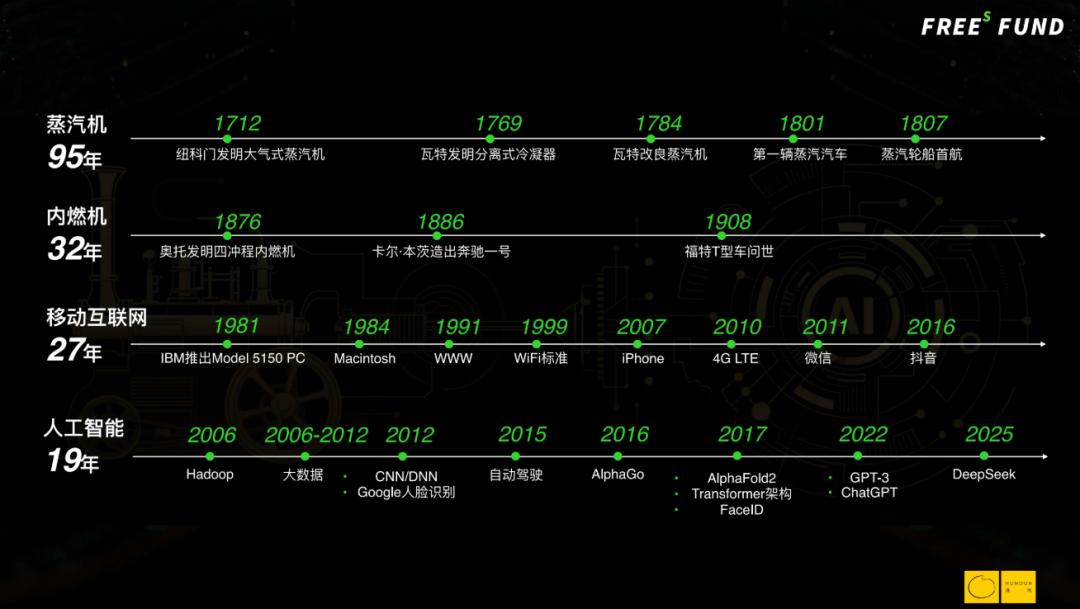
Group 1 - The core viewpoint is that the technological explosion of recent years is just the prologue, with significant societal applications and industrial reshuffling beginning now, particularly in AI and hardware integration in China [1][2] - The second half of the AI technology cycle is expected to see China gaining an advantage, as historically, China tends to catch up and surpass the US in the latter stages of technological waves [1][2] - AI combined with hardware presents a strategic opportunity for China, leveraging its manufacturing supply chain advantages for industrial transformation and upgrades [1][2] Group 2 - The current AI boom is unprecedented, driven by significant capital influx and competition between the US and China in areas such as chips, computing power, models, and applications [5][21] - Historical patterns show that every AI breakthrough leads to a wave of applications when combined with structural changes in industries, which is evident in the current AI landscape [8][9] - The investment logic in the AI era is shifting from mere technological innovation to practical applications that generate revenue, indicating a transition from the initial hype to sustainable business models [25][28] Group 3 - China's AI opportunities are significant, particularly in the context of hardware capabilities and the integration of AI with traditional industries, as highlighted by government initiatives [35][39] - The evolution of AI applications in China is expected to follow a three-stage process, with the first stage focusing on large models, the second on general agents and embodied intelligent robots, and the third on practical, revenue-generating applications [27][28] - The development of AI hardware in China is seen as a strategic advantage, with the potential for new product forms that leverage existing supply chains and technological advancements [36][39] Group 4 - The international landscape is shifting, with the US potentially reducing its military presence globally, which may provide China with a strategic window to enhance its international influence [47][49] - The Chinese economy is undergoing structural adjustments, which could be positively impacted by a more favorable international environment, facilitating the transition to new economic drivers [51][52] - The long-term competition between the US and China will increasingly focus on data and energy, with the country that secures a competitive edge in these areas likely to emerge victorious [66]
AI无处不在的小应用,与行业发展的大困局
Hu Xiu· 2025-09-22 07:07
Group 1 - The article discusses the initial skepticism towards AI advancements due to many major companies' new versions falling short of expectations, leading to concerns about future developments [1] - However, after participating in discussions about AI implementation, there is a renewed optimism as AI is being widely adopted across various industries, subtly transforming the world [2] - There is a distinction made between high-end AI technologies, such as large language models and autonomous driving, and more mature technologies like voice and image recognition, which are not considered groundbreaking [3][4] Group 2 - AI is portrayed as a tool accessible to everyone, capable of improving efficiency and outcomes in specific scenarios, thus demonstrating the value of technological progress [4][5] - Numerous practical applications of AI are highlighted, such as automatic transcription of meetings and structured processing of customer interactions, which significantly enhance digital capabilities [6][7] - Despite some professionals dismissing these applications, they are recognized as valuable and memorable, showcasing AI's ability to meet user needs and gain acceptance [8] Group 3 - The article notes that while AI is a hot topic in the tech industry, many projects are still struggling to achieve profitability, indicating that the AI industry is not yet stable [23][24] - From a supply-side perspective, AI applications often lack economies of scale, as the backend systems require extensive customization, making it difficult to standardize and productize solutions [25] - Users expect AI applications to be cost-effective, and while many AI solutions are currently subsidized, the sustainability of this model is questioned as companies may eventually need to charge for their services [27] Group 4 - There are differing opinions on the future of AI, with some focusing on continuous investment in generative AI, while others seek to commercialize existing technologies and create tangible value [28][31] - The article suggests that without a consensus in the industry, the fragmented approach to investment may lead to suboptimal outcomes for all parties involved [32] - Despite the challenges, the gradual integration of AI is enhancing the overall digital landscape, benefiting both individuals and organizations [33]