DexNDM

Search documents
融资超3亿美元,估值超30亿美元!“北大系”人形机器人公司银河通用刷新具身智能单轮融资纪录
Hua Er Jie Jian Wen· 2025-12-19 09:17
Core Insights - Galaxy General has completed a new financing round exceeding $300 million, setting a record for single-round financing in the embodied intelligence sector, with a post-financing valuation of $3 billion (approximately 211.3 billion RMB) [1][5] - The investment round was led by China Mobile Chain Long Fund, with participation from various industry capital and investment platforms, indicating strong market confidence in the embodied intelligence field [1][2] Financing Details - The financing attracted both domestic and international investors, including significant players like CICC, the Chinese Academy of Sciences Fund, and others, highlighting a collaborative investment approach [1][2] - Following this round, Galaxy General's total financing has reached approximately $800 million, with the valuation tripling in just six months from $1 billion [1][5] Technological Advancements - Galaxy General employs a unique training paradigm using synthetic action data for pre-training and real data for post-training, claiming to have developed a full-stack self-research model from "hundred billion datasets" to "embodied large models" [3] - The company has launched several models, including GraspVLA, GroceryVLA, and NavFoM, and has achieved significant milestones in autonomous operations, winning competitions with its Galbot robot team [3] Industry Collaborations - In the industrial manufacturing sector, Galaxy General has established partnerships with major companies such as CATL, Bosch, Toyota, and others, accumulating thousands of orders for humanoid robots [3] - The company is also expanding into commercial services and healthcare, with solutions like the "Galaxy Space Capsule" and collaborations with medical institutions for robotic applications in hospitals [4] IPO Plans - Galaxy General is preparing for an IPO in Hong Kong, with plans to submit an application as early as the first quarter of next year, targeting a valuation between $3 billion and $4 billion [1][5][6] - The company’s recent stock reform is seen as a strategic move to attract new primary market investors, reflecting a broader trend of startups in the sector accelerating their path to public markets [6]

人形机器人最大融资背后,还拿下7亿大单
3 6 Ke· 2025-12-19 06:11
Core Insights - The article highlights that Galaxy General has completed a new financing round exceeding $300 million, setting records for both the largest single financing amount and post-money valuation in the humanoid robot sector in China [1] - The investment round was led by China Mobile's Chain Long Fund, with participation from various investment platforms and industry giants, indicating a diversified investor base and a move towards internationalization [1][4] - Galaxy General has secured a significant order for 1,000 G1 robots, valued at approximately $7 million, which may have contributed to the recent financing success [2][3] Financing and Valuation - The total financing amount for Galaxy General has reached around $800 million, a significant increase from 240 million RMB six months ago [1] - The company is now valued at over $3 billion, making it the highest-valued humanoid robot company in China [8] - The involvement of major players like China Mobile and other international investors reflects a growing interest in the humanoid robotics sector [4][7] Market Dynamics - The article notes that the humanoid robot market is increasingly characterized by large-scale orders and significant commercial contracts, with Galaxy General's recent $7 million order being a prime example [2][3] - Other companies in the sector, such as Ubiquity and Zhiyuan, are also securing large contracts, indicating a competitive landscape [2] - The trend suggests that the market is shifting towards recognizing the importance of scale, certainty, and the ability to secure substantial orders [2][10] Technological Advancements - Galaxy General is focusing on key areas such as industrial manufacturing, retail, and healthcare, with products already operating continuously for a year [8] - The company has introduced advanced models for navigation and dexterous manipulation, which are critical for operating in complex environments [9] - The "Sim-to-Real" approach is being utilized to enhance the training and deployment of robots in real-world scenarios [9] Investment Landscape - The article discusses the increasing participation of state-owned enterprises and international investors in the humanoid robotics sector, driven by national strategic goals [4][6] - The involvement of funds from the Middle East reflects a broader trend of international capital seeking opportunities in China's technology sector [7] - The competitive landscape is evolving, with a focus on established players and a growing awareness of risk among investors [10][11]
腾讯研究院AI速递 20251111
腾讯研究院· 2025-11-10 16:30
Group 1: Generative AI Developments - OpenRouter platform has launched the anonymous model Polaris Alpha, believed to be a variant of GPT-5.1, with a knowledge base cutoff in October 2024 and a maximum context capacity of 256K and a single output limit of 128K [1] - Polaris Alpha shows smooth performance in desk work and programming tasks, exhibiting typical GPT characteristics and supporting NSFW mode [1] - The model is currently available for free via API, demonstrating good performance in programming mini-games and web design, with GPT-5.1 expected to be officially released in mid-November [1] Group 2: Multi-Modal Intelligence - A new multi-modal paradigm called Cambrian-S has been proposed by researchers including Yann LeCun, focusing on "spatial super-perception" and marking the first step in exploring video spatial super-perception [2] - The research outlines a development path for multi-modal intelligence across four levels: semantic perception, streaming event cognition, 3D spatial cognition, and predictive world modeling, introducing the VSI-SUPER benchmark for spatial super-perception capabilities [2] - Cambrian-S utilizes latent variable frame prediction to manage memory and event segmentation through a "surprise" signal, outperforming Gemini in spatial cognition tasks with smaller models [2] Group 3: AI Programming Tools - Meituan has launched an AI IDE programming tool named CatPaw, featuring code completion, agent Q&A generation, built-in browser preview debugging, and project-level analysis [3] - The core engine of CatPaw is Meituan's self-developed LongCat model, fully compatible with major programming languages like Python, C++, and Java, and currently available for free [3] - Over 80% of weekly active users among Meituan's internal developers utilize CatPaw, with AI-generated code accounting for about 50% of new code submissions, and a Windows version expected to launch soon [3] Group 4: Domestic AI IDE Launch - YunSi Intelligence has introduced Vinsoo, the world's first AI IDE equipped with a cloud-based security agent, surpassing products like Cursor and Codex that utilize Claude [4] - Vinsoo achieves breakthroughs in long-context engineering algorithms, supporting effective context lengths in the millions and allowing up to eight intelligent agents to operate simultaneously [4] - The new Beta 3.0 version supports cloud-based one-click publishing, mobile usage, and team collaboration, led by a founding team of post-00s graduates from top universities in China and the U.S. [4] Group 5: Open Source Audio Editing Model - Jieyue Xingchen has released the first open-source LLM-level audio editing model, Step-Audio-EditX, which allows precise control over audio emotions, speaking styles, and paralinguistic features through language commands [5] - The model employs a unified LLM framework and a "dual-codebook" audio tokenizer structure, supporting zero-shot text-to-speech, iterative editing, and bilingual capabilities [5] - With approximately 3 billion parameters, the model can run on a single 32GB GPU, achieving higher accuracy in emotion and style control compared to closed-source models like MiniMax and Doubao [5] Group 6: AI Glasses Launch - Baidu has officially launched the Xiaodu AI glasses Pro, priced at 2299 yuan, with a promotional price of 2199 yuan for Double Eleven, weighing 39 grams and featuring a 12-megapixel wide-angle camera [6] - The glasses integrate multi-modal AI models, offering functionalities such as photography, music recognition, AI translation, object recognition, note-taking, and audio recording, with real-time translation capabilities [6] - Similar to Xiaomi's AI glasses, these are not the more advanced AI+AR glasses currently available [6] Group 7: Robotics Innovation - Galaxy General has introduced the DexNDM, a dexterous hand neural dynamics model that achieves stable, multi-axial rotation operations on various objects, capable of using tools like screwdrivers and hammers [8] - The DexNDM model disassembles hand-object interactions to the joint level, utilizing a training process that allows for stable operations across tasks and forms without requiring successful examples [8] - This technology has been applied to remote operation systems, enabling operators to give high-level commands via VR controllers while DexNDM autonomously manages fine control at the finger level [8] Group 8: Insights on AI Entrepreneurship - A YC partner emphasizes that AI tools cannot replace a founder's sales capabilities, suggesting that AI should first target quick-to-implement entry points in traditional industries rather than aiming for full automation [9] - The core competitive advantage in early-stage entrepreneurship is "learning speed" rather than scale, with a focus on quickly validating ideas with small customers [9] - AI sales development representatives (SDRs) are effective only when there are already well-functioning sales processes, and founders must clarify their target audience and attention acquisition strategies for AI tools to be effective [9]


机器人“会用手”了!银河通用首破手掌任意朝向旋转难题,拧螺丝、砸钉子样样精通
量子位· 2025-11-10 00:30
Core Insights - The article discusses the breakthrough of the DexNDM model developed by Galaxy Universal, which enables dexterous hands to perform complex tasks such as in-hand rotation and tool usage, bridging the gap between simulation and real-world applications [2][4][55]. Group 1: DexNDM Model Capabilities - DexNDM allows for stable in-hand rotation of various objects, regardless of their size or shape, achieving cross-object and cross-pose manipulation [5][6]. - The model can operate under challenging wrist postures, enabling continuous rotation of long objects and stable manipulation of small items [6][17]. - It enhances the robot's ability to perform complex tasks like screw tightening and furniture assembly, marking a significant leap from simple grasping to dexterous manipulation [21][64]. Group 2: Technical Innovations - DexNDM employs a joint-wise neural dynamics model, allowing each joint to independently predict its next state, improving data efficiency and generalization across different tasks [8][10]. - The model utilizes an automated data collection strategy to generate rich contact data without manual intervention, enhancing learning efficiency [11][14]. - A residual policy network is trained to bridge the gap between simulation and reality, facilitating the transfer of learned strategies to real-world scenarios [15]. Group 3: Importance of Dexterous Manipulation - Dexterous manipulation is crucial for robots to transition from basic capabilities to productive tasks, as it encompasses both motion and operational abilities [24][28]. - The ability to perform in-hand rotation and tool usage is seen as a pinnacle of dexterous manipulation, representing a significant challenge in robotics research [37][38]. - The advancements in dexterous manipulation are expected to lead to robots that can perform a wide range of tasks, moving beyond simple demonstrations to actual productive capabilities [58][65].
银河通用&清华推出DexNDM,用神经动力学重塑灵巧操作
具身智能之心· 2025-11-07 00:05
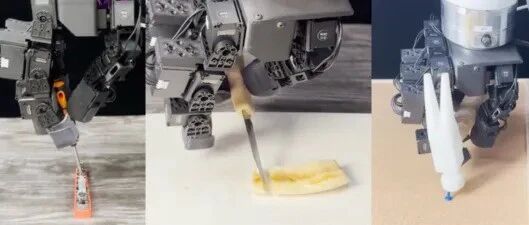
Core Insights - The article discusses the development of DexNDM, a new method aimed at solving the sim-to-real challenge in dexterous robotic manipulation, particularly in achieving stable in-hand rotation of various objects [2][5][31] Group 1: Background and Challenges - High dexterity in remote operation of complex tools, such as using a screwdriver or hammer, has been a long-standing challenge in robotics [4] - Traditional direct mapping remote operation methods are limited to simple tasks and cannot handle complex manipulations requiring fine motor skills [4] Group 2: DexNDM Methodology - DexNDM proposes a semi-autonomous remote operation paradigm that breaks down complex tasks into stable, reliable atomic skills that robots can execute autonomously [5] - The method focuses on learning general, stable atomic skills for in-hand object rotation, covering a wide range of scenarios including challenging elongated and small objects [5][14] Group 3: Key Features and Achievements - DexNDM achieves unprecedented dexterity by enabling continuous rotation of elongated objects and intricate manipulation of small objects under challenging wrist postures [7][14] - The method demonstrates superior performance in manipulating complex geometries compared to previous works, even with more general hardware [14] - It showcases high adaptability to various wrist postures and rotation axes, allowing for precise control regardless of the mechanical hand's orientation [17] Group 4: Robustness and Practical Applications - The DexNDM system exhibits high dexterity and robustness, successfully performing complex tool usage tasks such as tightening screws and assembling furniture [21] - The system's robustness allows it to handle long-horizon assembly tasks without interruption, even in the presence of unforeseen scenarios [21] Group 5: Innovations in Data Collection and Modeling - DexNDM employs a joint-wise neural dynamics model that effectively fits real-world data to bridge the gap between simulation and reality [24] - An automated data collection strategy, termed "chaos box," is utilized to gather diverse interaction data with minimal human intervention [28] - The training of a residual policy network is implemented to compensate for the dynamics gap between simulation and real-world applications [30]
机械手真正「活」了,银河通用&清华推出DexNDM,用神经动力学重塑灵巧操作
机器之心· 2025-11-06 03:28
Core Insights - The article discusses the development of DexNDM, a method aimed at solving the sim-to-real challenge in dexterous robotic manipulation, particularly in achieving stable in-hand rotation of various objects [2][5][24]. Group 1: Background and Challenges - High dexterity in remote operation of complex tools, such as using a screwdriver or hammer, has been a long-standing challenge in robotics [4]. - Traditional direct mapping remote operation methods are limited to simple tasks and cannot handle complex manipulations requiring fine motor skills [4]. - A semi-autonomous remote operation paradigm is proposed, which breaks down complex tasks into stable atomic skills that robots can execute autonomously [4]. Group 2: DexNDM Methodology - DexNDM is designed to learn general and stable atomic skills for in-hand rotation, covering a wide range of scenarios including challenging elongated and small objects [5][19]. - The method utilizes a joint-wise neural dynamics model to bridge the gap between simulation and real-world dynamics, enhancing data efficiency and generalization across different hand-object interactions [19][20]. Group 3: Achievements and Capabilities - DexNDM achieves unprecedented capabilities in continuous rotation of objects under challenging wrist postures, demonstrating superior performance compared to previous methods [9][13]. - The system allows operators to guide dexterous hands in complex tasks such as tightening screws and assembling furniture, showcasing its robustness and adaptability [7][15]. - The method's flexibility enables stable execution of tasks regardless of the wrist orientation or rotation axis required [14][15]. Group 4: Data Collection and Training - An automated data collection system, termed "Chaos Box," is developed to gather diverse real-world interaction data with minimal human intervention [21]. - A residual policy network is trained to compensate for the dynamics gap between simulation and reality, enhancing the system's performance in real-world applications [23]. Group 5: Conclusion and Future Outlook - DexNDM represents a significant advancement in addressing the sim-to-real challenge in robotics, achieving dexterous manipulation skills previously deemed impossible [24]. - The authors believe this is just the beginning, with the potential for dexterous hands to play a crucial role in the future of humanoid robotics [25].