
HDD(机械硬盘)

Search documents
硬盘还得涨!西数CEO:2026年HDD产能已售罄,消费级业务仅占5%
Sou Hu Cai Jing· 2026-02-15 14:25
Core Insights - Western Digital's HDD production capacity has been sold out for 2026, as confirmed by CEO Irving Tan, indicating strong demand in the current market where memory and storage prices are rising significantly [1][3] - The company has secured new formal purchase orders with its top seven customers, including long-term agreements extending to 2028, which are likely from major tech companies investing in data centers [3] - Western Digital is focusing on developing products that meet enterprise customer needs, capitalizing on the rapid construction of large-scale data centers [3][4] Financial Performance - Cloud business revenue constitutes 89% of total revenue, while consumer business revenue is only 5%, highlighting a significant disparity in focus and profitability between the two segments [4] - The shift in focus towards B2B operations has led to a neglect of consumer-level products, as the company prioritizes the more lucrative data center market [4] Market Dynamics - The demand for high-capacity HDDs has surged due to the needs of data centers, reversing the trend where HDDs were losing ground to SSDs before the AI boom [6] - This shift in demand dynamics has resulted in a challenging environment for ordinary consumers, who may face higher prices and limited availability of HDDs [6]



AI推理刚需,NAND“周期更长更稳”!摩根大通:本轮主角是eSSD,铠侠成为首选
Hua Er Jie Jian Wen· 2026-01-26 03:34
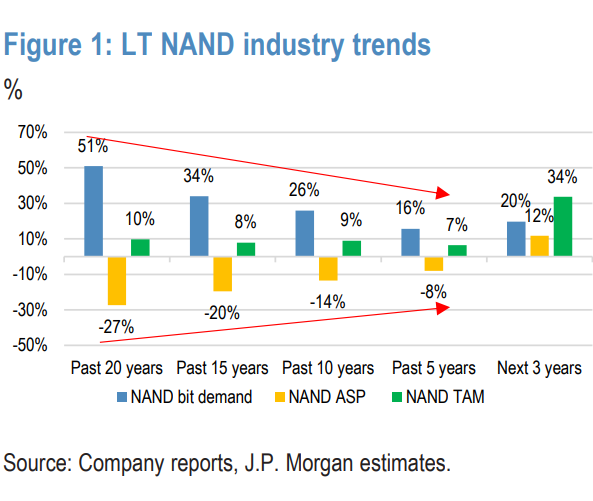
Core Insights - The NAND flash memory industry is entering a new super cycle driven by AI inference, moving away from its previous reliance on smartphone and PC shipments as the main growth driver [1][3] - The market is expected to see a significant increase in the Total Addressable Market (TAM) growth rate, projected to rise to 34% from the historical range of 7%-12% [3][6] - The average selling price (ASP) of NAND is predicted to increase by 40% in 2026, marking a shift where ASP becomes a positive growth driver rather than a negative one [3][24] Industry Dynamics - The NAND market is experiencing structural growth due to the transition of AI workloads from training to inference, alongside supply bottlenecks in HDDs [1][15] - The demand for enterprise SSDs (eSSD) is expected to surge, with eSSD projected to account for 48% of global NAND bit demand by 2027, surpassing smartphones and PCs [11][14] - The supply chain crisis in HDDs, exacerbated by reduced capital expenditures from manufacturers, is forcing data centers to shift towards NAND solutions [15][19] Technological Advancements - The introduction of KV Cache Offloading technology is enhancing the role of eSSD in AI inference, allowing for faster data retrieval and processing [8][9] - The report highlights the limitations faced by NAND manufacturers in scaling production due to technical challenges, leading to a predicted 3% growth in wafer output by 2026 [24][23] Market Valuation - The valuation of storage stocks is shifting from a purely cyclical perspective to one that incorporates AI growth attributes, with a 242% increase in market capitalization since January 2025 [6][35] - Companies like Kioxia are positioned as top picks due to their focus on NAND technology, while SK Hynix and Samsung are also highlighted for their competitive advantages in the market [26][27][28] Competitive Landscape - Kioxia is identified as a leading player in the NAND cycle, while SK Hynix is recognized for its long-term potential due to its successful subsidiary, Solidigm [26][27] - Samsung is expected to experience short-term gains, while Micron is adopting a differentiated strategy to compete in the eSSD market [28][29]

存储“涨飞”!“美股最强”闪迪涨超10%,美光、西部数据、希捷科技等全线大涨
Hua Er Jie Jian Wen· 2026-01-22 00:34
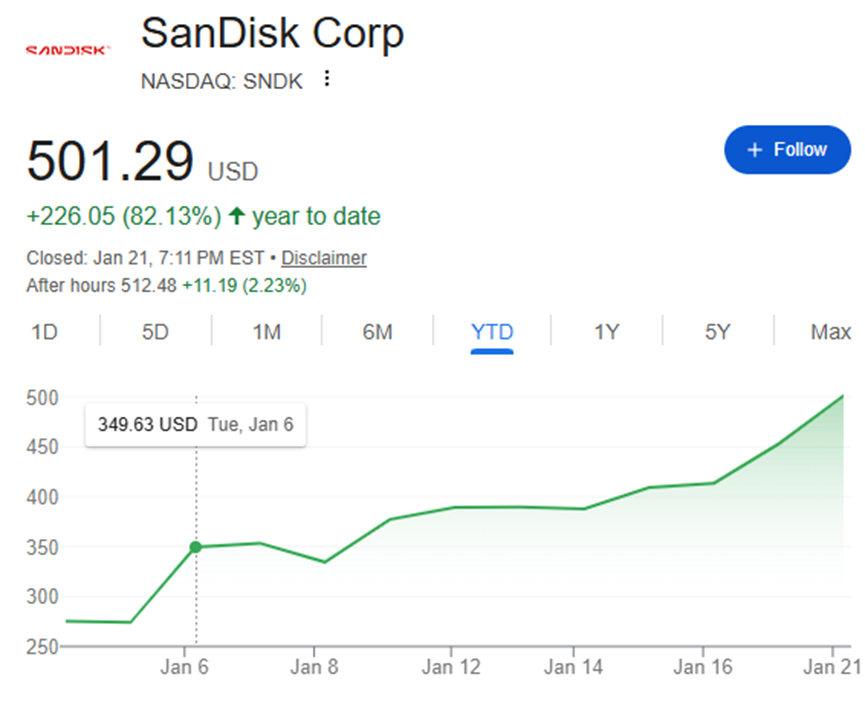
Core Viewpoint - The U.S. storage sector is experiencing a significant surge, with major companies' stock prices reaching historical highs due to a spike in demand for storage chips driven by the AI boom and supply shortages, indicating a new "super cycle" in the global storage market [1] Group 1: Market Performance - The storage chip sector saw a remarkable performance on Wednesday, with SanDisk surging 10.63%, Micron Technology rising 6.6%, Western Digital increasing over 8.5%, and Seagate Technology up over 5.6%, reflecting strong market expectations for the industry's pricing power and profitability [1] - SanDisk's stock has increased over 80% year-to-date, and since its spin-off from Western Digital in February 2025, its stock price has risen more than tenfold [2] - Micron's stock also reached a historical high, with a 20% revenue growth in Q1 of fiscal 2026 and a 167% increase in adjusted earnings per share, indicating strong pricing power [7] Group 2: Analyst Upgrades and Predictions - Analysts have significantly raised their target prices for SanDisk, with Citigroup increasing it from $280 to $490 and Bernstein from $300 to $580, citing strong enterprise SSD demand and tightening NAND supply [5] - Zacks predicts that SanDisk's fiscal 2026 sales will grow by 42% to $10.45 billion, with earnings per share expected to soar 350% to $13.46, supporting the optimistic sentiment [6] Group 3: Supply and Demand Dynamics - The current market dynamics are characterized by a fundamental shift in supply and demand, with major manufacturers reducing production to maximize profits, leading to a severe supply shortage [1][8] - Despite the high valuation concerns, the industry is transitioning from traditional cyclical fluctuations to a "high profit, stable price" model, with expectations that storage chip prices will continue to rise until 2026 due to significant supply gaps [1][9] Group 4: Broader Industry Implications - The semiconductor industry is undergoing a profound transformation, with a shift towards a "super cycle" characterized by reduced cyclicality and increased profit margins, as indicated by strong performance from upstream manufacturers like TSMC [9] - The automotive industry is facing new cost pressures and supply risks due to chip manufacturers prioritizing higher-margin data center and AI clients, as noted by industry leaders [8]
存储芯片,持续“疯涨”
财联社· 2025-12-07 14:21
Core Viewpoint - The storage chip industry is experiencing an unprecedented "super price increase cycle," with DRAM prices rising over four times and Flash prices nearly tripling within the year, driven by AI demand and supply chain constraints [2][11][20]. Group 1: Price Increases and Market Dynamics - The price of 4GB DDR4x chips has surged from $7 at the beginning of the year to over $30 by mid-November, marking a 4 to 5 times increase [2]. - Flash products, such as 64GB eMMC, have seen prices rise from $3.2 to over $8 [2]. - Major companies like Micron Technology are exiting the consumer-grade memory and SSD business to focus on high-growth areas driven by AI [2][11]. Group 2: Supply Chain and Inventory Issues - Downstream manufacturers, particularly in the smartphone sector, are facing historically low inventory levels, with typical healthy stock levels being 8 to 10 weeks, but currently averaging below 4 weeks [8][9]. - Despite rumors of manufacturers pausing purchases due to high prices, the reality is that they are compelled to accept high prices to maintain production, as low-priced inventory will only last until the first quarter of the following year [9][10]. - The supply chain is characterized by a "gambling" mentality among distributors, while manufacturers are forced to engage in passive replenishment due to tight supply [3][4][5]. Group 3: Impact of AI on Production Capacity - The explosive growth in AI server demand is significantly impacting the production capacity for consumer-grade storage, leading to a supply crunch [11][12]. - Manufacturers are prioritizing high-margin products like HBM and DDR5 for AI applications, which is squeezing the supply of DDR4 and LPDDR4 used in mid-range devices [12][13]. - The shift in production focus is expected to lead to severe impacts on low-end smartphones, with potential shifts in consumer demand towards second-hand devices [14]. Group 4: Adjustments by Manufacturers - To cope with rising storage costs, manufacturers are adjusting product configurations, potentially moving from 12GB+512GB to 8GB+256GB models, reversing the trend of increasing storage capacities [16]. - Price increases are anticipated as a necessary response to the rising costs, with industry leaders indicating that future product prices will likely rise significantly [18][20]. - The overall market is expected to remain tight until at least 2026, with large cloud service providers dominating the demand landscape, further weakening the bargaining power of consumer electronics manufacturers [19][20]. Group 5: Domestic Manufacturers' Role - As international giants exit the consumer-grade market, domestic storage manufacturers are stepping in to fill the supply gap, although the overall supply-demand imbalance remains significant [22][24]. - ODM manufacturers are focusing on securing supply and exploring partnerships with domestic storage chip producers to mitigate the impact of shortages [23].

OCP大会焦点:制造和封装已大幅扩产,AI芯片瓶颈转向下游,包括内存、机架、电力等
美股研究社· 2025-10-22 10:09
Core Insights - The AI semiconductor industry is expected to experience significant growth in 2026, with a shift in investment logic from upstream to downstream infrastructure [2][10] - The bottleneck in AI development has transitioned from chip manufacturing and packaging to downstream components such as data center space, power supply, and cooling systems [2][5] Upstream Capacity No Longer the Sole Bottleneck - Chip manufacturing and packaging have significantly expanded, alleviating previous supply concerns [4] - TSMC reported stronger-than-expected AI demand and a quick ramp-up in CoWoS capacity, indicating flexibility in the supply chain [4] - Despite ongoing tightness in advanced node wafer front-end capacity, AI semiconductors are prioritized over other applications like cryptocurrency ASICs [4] Bottleneck Shift - The current constraints are now focused on data center space, power availability, and supporting infrastructure, which have longer construction cycles than chip manufacturing [6] - The deployment of large-scale GPU clusters presents challenges in power consumption and heat dissipation, leading to a shift towards liquid cooling and high-voltage direct current (HVDC) solutions [6] Storage and Memory - AI workloads demand high-speed data storage and access, with companies like Meta opting for QLC NAND flash for cost efficiency [8] - The global demand for HBM (High Bandwidth Memory) is projected to surge, with NVIDIA expected to consume 54% of the total HBM by 2026 [8] Racks and Networking - OCP has introduced standardized blueprints for "AI Open Data Centers" and "AI Open Cluster Designs" to facilitate large-scale deployments [9] - Companies like Alibaba are focusing on pluggable optics for their cost-effectiveness and flexibility, while new technologies like CPO/NPO are gaining attention [9] Demand Forecast Indicates Explosive Growth for Downstream Components - Global cloud service capital expenditure is expected to grow by 31% in 2026, reaching $582 billion, significantly exceeding market expectations [11] - AI server capital expenditure could see approximately 70% year-over-year growth if its share in overall capital spending increases [11] AI Chip Demand Breakdown - NVIDIA is projected to dominate the CoWoS capacity consumption with a 59% share, followed by Broadcom, AMD, and AWS [12] - In AI computing wafer consumption, NVIDIA leads with a 55% share, followed by Google, AMD, and AWS [12] Investment Focus Shift - The signals from the OCP conference and industry data indicate a new direction for AI hardware investment, emphasizing the importance of downstream infrastructure [13] - Investors are encouraged to broaden their focus from individual chip companies to the entire data center ecosystem, identifying key players in power, cooling, storage, memory, and networking [13]



研究所日报-20250918
Yintai Securities· 2025-09-18 04:02
Fiscal Data - From January to August 2025, the national general public budget revenue reached 14.8 trillion yuan, a year-on-year increase of 0.3%[2] - National general public budget expenditure was 17.9 trillion yuan, up 3.1% year-on-year[2] - In August, public fiscal revenue increased by 2.6% year-on-year, while fund revenue turned negative at -6.0%[2] Economic Policies - The government plans to select around 50 pilot cities for new consumption models and scenarios, aiming to enhance domestic demand[3] - Over 25,000 cultural and tourism consumption activities will be held, with more than 330 million yuan in consumption subsidies distributed[3] Monetary Policy - The Federal Reserve lowered interest rates by 25 basis points, bringing the federal funds rate to a range of 4.00%-4.25%[3] - Future rate cuts are projected to total 50 basis points this year and 25 basis points in the following two years, which is less than market expectations[3] Market Trends - A-share total market capitalization is 105.50 trillion yuan, with a year-to-date increase of 19.64 trillion yuan[15] - The average daily trading volume is 16,115.77 billion yuan, reflecting a recent increase of 3,272.13 billion yuan from the previous month[15] Sector Performance - The top three performing sectors are electric power equipment, automobiles, and home appliances[23] - The net inflow of funds is highest in the automotive, public utilities, and electric power equipment sectors[27]
9月18日早餐 | 美联储降息25基点;中概股大涨近3%
Xuan Gu Bao· 2025-09-18 00:06
Group 1: Federal Reserve Actions - The Federal Reserve lowered interest rates by 25 basis points, acknowledging a weakening labor market and mentioning rising inflation [1] - The dot plot indicates two more rate cuts expected this year and one in the next year, with Powell stating that calls for a 50 basis point cut were not strong [1] Group 2: Market Reactions - The S&P 500 closed down 0.10%, while the Dow Jones increased by 0.57%, and the Nasdaq fell by 0.33% [2] - Nvidia dropped over 2.6%, while Tesla rose by 1.01%, with small-cap stocks initially rising before turning to slight declines [3] Group 3: Chinese Stocks Performance - The Chinese concept stock index surged by 2.85%, with notable gains from companies like Baidu and Pinduoduo, which rose over 10% [4] Group 4: Economic Indicators - U.S. Treasury yields fluctuated post-Fed announcement, with the 10-year yield rising by 6.3 basis points and the 2-year yield increasing by 5.62 basis points [4] - The dollar initially fell by 0.4% but later rebounded, gaining over 0.8% from its daily low [4] Group 5: AI and Technology Developments - Figure AI's founder announced significant announcements aimed at achieving human-level intelligence within three days [5] - Musk indicated that the Grok 5 model will begin training in a few weeks, expressing optimism about achieving AGI through Grok 5 [5] Group 6: Sector Insights - According to securities firms, the market has upward potential due to the easing of U.S. monetary policy, which may lead to further domestic rate cuts [7] - The economic outlook shows signs of a "weak recovery," with ongoing efforts to boost consumption and the stock market [7] Group 7: Industry Trends - The demand for HDDs is expected to rise significantly, with Western Digital announcing price increases due to unprecedented demand levels [8] - The AI-driven demand for data center storage has notably increased, with HDDs being preferred for their capacity and cost advantages [9] Group 8: Semiconductor Developments - Alibaba's Pingtouge has developed an AI-focused PPU chip that surpasses Nvidia's A800 in key performance metrics [11] - The domestic AI chip market is expected to grow significantly, with projections indicating that Pingtouge's RISC-V chip shipments could exceed 10 billion units by 2027 [11]

除了内存和SSD,机械硬盘行业供需也偏紧,景气度有望持续到明年下半年
Xuan Gu Bao· 2025-09-17 23:18
Group 1 - Western Digital has announced a gradual price increase for all HDD products, citing unprecedented demand across its storage product lineup and investments in advanced innovative technologies [1] - The stock price of Western Digital rose by 0.68% to $103.09 per share, marking a new historical high and over a twofold increase since its low point earlier this year [1] - According to CITIC Securities, AI has significantly driven up global data center storage demand since 2023, with HDDs offering advantages in capacity and cost over SSDs, making them the preferred choice for near-line storage among cloud providers in Europe and the U.S. [1] Group 2 - Major companies like Seagate Technology and Western Digital account for 80% of global HDD production capacity, and after a downturn in 2021, there is currently a lack of short-term expansion willingness and motivation among enterprises [1] - The current upcycle for data center HDDs is expected to begin in 2024, with major companies having product lead times and order visibility extending over one year, indicating a tight supply-demand situation that may last until at least the second half of 2026 [1] - Deep Technology has core manufacturing technologies for hard disk heads and disk substrates, with products including hard disk heads, disk substrates, and HDDs [2]
刚刚,外围重磅消息突然刷屏!芯片板块集体爆发!
天天基金网· 2025-09-17 03:27
Core Viewpoint - The semiconductor sector is experiencing a significant surge, driven by advancements in AI technology and favorable market conditions, leading to substantial stock price increases for key players in the industry [3][4][5]. Group 1: Market Performance - Semiconductor stocks in A-shares saw a notable rise, with companies like SMIC increasing over 10% and reaching historical highs [4]. - The semiconductor ETF also experienced a rise of over 2%, indicating strong investor interest in the sector [3]. Group 2: Key Drivers - The surge in semiconductor stocks is attributed to several factors, including positive news regarding lithography machines, which are crucial for chip manufacturing [5]. - The 2025 Tencent Global Digital Ecosystem Conference announced the company's commitment to fully open its AI capabilities, which will enhance the application of domestic chips across various industries [5]. - TrendForce reported that Western Digital plans to increase prices for all HDD products due to unprecedented demand levels, indicating a robust market for storage solutions [5]. Group 3: Industry Trends - The global semiconductor manufacturing industry is projected to grow at a compound annual growth rate (CAGR) of 7% from the end of 2024 to 2028, reaching a monthly capacity of 11.1 million wafers [7]. - Advanced process capacity is expected to grow from 850,000 wafers per month in 2024 to 1.4 million in 2028, with a CAGR of approximately 14% [7]. - The demand for advanced semiconductor technology is further driven by AI applications in personal assistants, VR/AR devices, and humanoid robots [7]. Group 4: Technological Advancements - Lithography technology remains a cornerstone for mass production in advanced processes, with ongoing improvements in resolution and efficiency through software optimization [7]. - The production of chips below 14nm relies heavily on DUV and EUV lithography machines, with increasing complexity and costs associated with multi-patterning techniques [7]. Group 5: Domestic Industry Developments - The domestic lithography machine industry is making progress due to policy support and continuous investment from national funds, with the global lithography equipment market expected to grow from $29.57 billion in 2024 to $37.81 billion by 2029, at a CAGR of 5% [8]. - By the end of 2026, China's 12-inch wafer fab capacity is projected to increase from 2.17 million wafers per month in 2023 to over 4.14 million [8]. - The ongoing development of AI is significantly boosting the demand for advanced process capacity domestically, with lithography machine costs constituting 21%-23% of total equipment investment [8].


刚刚,集体爆发!外围重磅,突然刷屏!
Zheng Quan Shi Bao Wang· 2025-09-17 03:26
Core Viewpoint - The semiconductor sector is experiencing a significant surge, driven by positive news regarding lithography machines and advancements in AI technology, leading to substantial stock price increases for key companies in the industry [1][3][4]. Group 1: Market Performance - Semiconductor stocks in A-shares saw a collective rise, with SMIC's stock price increasing over 10%, reaching a historical high [1][2]. - The semiconductor ETF also experienced a rise of over 2% during the trading session [1]. - The photolithography index saw a significant increase, with constituent stocks like Wavelength Optoelectronics and Fuzhicheng Technology achieving notable gains [2]. Group 2: Driving Factors - A sudden influx of news related to photolithography machines is identified as a primary catalyst for the surge in stock prices [3]. - The Tencent Global Digital Ecosystem Conference announced a comprehensive opening of AI capabilities, which is expected to accelerate the application of AI across various industries, further boosting demand for domestic chips [3]. - TrendForce reported that Western Digital plans to increase prices for all HDD products due to unprecedented demand levels, indicating a robust market for storage solutions [3]. - The Philadelphia Semiconductor Index in the U.S. has seen a continuous rise for nine consecutive days, marking the longest streak since 2017, with significant contributions from companies like NVIDIA and TSMC [3]. Group 3: Industry Trends - The development of AI is driving the expansion of advanced process capacities (7nm and below), with increasing demand for ArFi and EUV lithography machines [4]. - The global semiconductor manufacturing industry is projected to grow at a compound annual growth rate (CAGR) of 7% from the end of 2024 to 2028, reaching a monthly capacity of 11.1 million wafers [4]. - The demand for advanced semiconductor technology is further propelled by AI applications in personal assistants, VR/AR devices, and humanoid robots [4]. Group 4: Technological Advancements - Lithography technology remains a cornerstone for mass production of advanced processes, with resolution influenced by factors such as light source wavelength and numerical aperture [4]. - The production of chips below 14nm relies on DUV (ArFi) and EUV lithography machines, with multi-patterning techniques increasing complexity and costs [4]. Group 5: Domestic Industry Developments - The domestic photolithography machine industry is making progress due to policy support and continuous investment from national funds, with the global photolithography equipment market expected to grow from $29.57 billion in 2024 to $37.81 billion by 2029, at a CAGR of 5% [5]. - By the end of 2026, China's 12-inch wafer fab capacity is projected to increase from 2.17 million wafers per month in 2023 to over 4.14 million wafers [5][6]. - The demand for domestic photolithography machines is expected to rise due to the construction of wafer fabs and the rapid development of AI technology [6].