HJT

Search documents
被誉下一代光伏路线的技术再获突破,行业关注“技术驱动的新一轮扩产窗口”
Xuan Gu Bao· 2026-02-26 23:29
Industry Insights - The photovoltaic industry is undergoing a critical technological iteration phase, with TOPCon prices declining, compressing profit margins and necessitating the introduction of new technologies [1] - By 2026, the photovoltaic equipment industry is expected to enter a new structural expansion window driven by technological upgrades, supported by favorable policies for high efficiency and low energy consumption routes [1] - The global share of China's photovoltaic main industry chain has increased to approximately 90%, showcasing its core competitiveness in equipment technology and mass production capabilities [2] Company Developments - Jincheng Co. has successfully entered the semiconductor field with its PERTOP + HJT + perovskite + component equipment, alongside successful shipments of horizontal PVD equipment [3] - Jiejia Weichuang is focusing on the development and process optimization of equipment suitable for space environments, leveraging its self-developed PECVD and PVD core equipment [3]
光伏设备商基本面筑底,看好太空算力应用场景打开&海外地面需求增长
Zhong Guo Neng Yuan Wang· 2026-02-25 02:31
Group 1 - The core viewpoint of the report indicates that the photovoltaic equipment industry is expected to enter a recovery phase in 2026, following a thorough adjustment in 2025, with leading equipment manufacturers managing cash flow effectively through various collection models [2] - The report highlights that the demand for photovoltaic equipment will be driven by overseas markets, particularly in the U.S. and the Middle East, where local manufacturing policies and resource advantages are expected to enhance production capacity [3] - The transition from high-cost gallium arsenide to more cost-effective silicon-based technologies, particularly HJT, is anticipated to play a crucial role in the industry's growth, especially in the context of space computing applications [2][3] Group 2 - The report emphasizes that the photovoltaic industry is experiencing a supply-demand imbalance, which is prompting a new round of technological iterations as a key variable for capacity reset [3] - HJT technology is noted for its advantages in low labor, electricity, and water consumption, making it well-suited for the U.S. manufacturing environment, while also avoiding patent risks associated with TOPCon technology [3] - The investment recommendation includes focusing on leading companies in HJT technology, low-oxygen single crystal furnaces, automation in components, and ultra-thin silicon wafer cutting equipment [4]


东吴证券:光伏设备商基本面筑底 看好太空算力应用场景打开&海外地面需求增长
智通财经网· 2026-02-24 06:24
Core Viewpoint - The solar photovoltaic (PV) industry is expected to undergo a significant adjustment in 2025, with a recovery in equipment orders anticipated in 2026 as supply-side improvements and demand from overseas markets emerge [1]. Group 1: Industry Outlook - The fundamental aspects of the solar PV market are expected to be fully cleared by 2025, leading to a phase of deep adjustment characterized by increased losses among main chain companies and a slowdown in capacity expansion [1]. - Leading equipment manufacturers are enhancing cash flow management through collection models like "3421/3601," focusing on receivables from top clients, which mitigates operational risks [1]. - The acceleration of the elimination of outdated capacity and the gradual optimization of industry standards and pricing mechanisms signal clear improvements on the supply side [1]. Group 2: Technological Advancements - The application of space computing is accelerating, transitioning solar energy from ground-based systems to orbital energy systems, which opens up long-term growth potential for the industry [1]. - The shift from high-cost gallium arsenide to more cost-effective and scalable silicon-based technologies is expected during the scaling phase, with HJT technology showing advantages in weight reduction and adaptability [1]. Group 3: Demand Drivers - The overseas ground demand is projected to be a significant source of incremental growth in 2026, driven by the U.S. and Middle East markets [2]. - The U.S. is maintaining high installation levels, with domestic manufacturing policies enhancing supply chain security and cost control, particularly benefiting HJT technology due to its lower operational costs [2]. - Middle Eastern countries are increasing their installation plans, with Chinese main chain companies accelerating local factory setups, leading to a clear trend of rising overseas revenue [2]. Group 4: Technological Iteration - The ongoing price decline of TOPCon technology is compressing profit margins, necessitating the introduction of new technologies [3]. - The Ministry of Industry and Information Technology is promoting advanced capacity to replace outdated capacity, favoring high-efficiency and low-energy consumption routes [3]. - HJT technology is achieving breakthroughs in production efficiency and silver consumption, further enhancing cost advantages amid rising silver prices [3]. Group 5: Investment Recommendations - The company recommends focusing on leading firms in HJT technology, low-oxygen monocrystalline furnaces, automated components, and ultra-thin silicon wafer cutting equipment as key investment opportunities [4].



再聊光伏
债券笔记· 2026-02-05 10:09
Core Viewpoint - The article discusses Elon Musk's recent visit to China to explore the photovoltaic (PV) industry, focusing on the potential of HJT (Heterojunction Technology) and perovskite technologies, highlighting the strategic importance of Chinese solar energy in Musk's vision for a global energy empire [4][5]. Group 1: Investment Logic - Logic One: Musk views Chinese solar energy as the "heart" of his global energy system, as China produces over 70% of the world's solar products, offering superior cost-effectiveness and technology [5]. - Logic Two: Musk is bypassing traditional solar technologies in favor of HJT and perovskite, which are seen as the next-generation solutions with efficiencies exceeding 24% and potential for 33% when combined, positioning him to secure future market dominance [6]. - Logic Three: Musk aims to create a sustainable energy cycle that includes solar power, energy storage, and electric vehicle charging, with Chinese solar technology providing the necessary support to complete this cycle [7]. - Logic Four: The collaboration between Musk and Chinese solar companies is framed as a win-win situation, where both parties can benefit from technological advancements and market expansion, rather than a one-sided exploitation [8].


博威合金:研发团队持续在研发包括HJT、钙钛矿技术在内的新产品新技术,目前尚无实质性突破
Mei Ri Jing Ji Xin Wen· 2026-01-29 07:52
Group 1 - The company is actively engaged in research and development of new products and technologies, including HJT and perovskite technology, within its new energy business [2] - There has been no substantial breakthrough reported in the research progress of perovskite technology, and the company encourages stakeholders to monitor official announcements for updates [2]

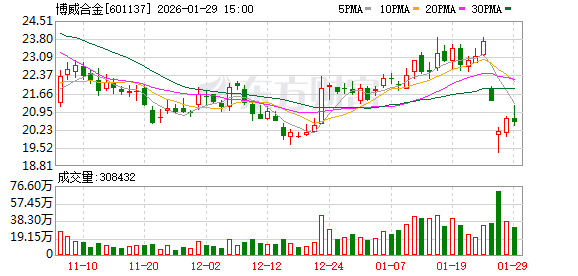
博威合金:目前公司尚无太空光伏技术储备
Mei Ri Jing Ji Xin Wen· 2026-01-29 07:52
Group 1 - The company is currently researching new products and technologies, including HJT and perovskite technology, within its renewable energy business [2] - As of now, the company does not have any reserves in space photovoltaic technology [2]
博威合金(601137.SH):尚无太空光伏技术储备
Ge Long Hui· 2026-01-29 07:42
Core Viewpoint - The company is actively developing new products and technologies in its renewable energy business, including HJT and perovskite technologies, but currently has no reserves in space photovoltaic technology [1] Group 1 - The company's research and development team is focused on new products and technologies in the renewable energy sector [1] - Specific technologies being researched include HJT and perovskite [1] - The company has indicated that it does not have any current reserves in space photovoltaic technology [1]
研报掘金丨东吴证券:维持明阳智能“买入”评级,风机历史质量事故风险释放
Ge Long Hui· 2026-01-29 06:46
Core Viewpoint - Mingyang Smart Energy is expected to achieve a net profit attributable to shareholders of 800 to 1,000 million yuan in 2025, representing a year-on-year growth of 131% to 189% [1] Financial Performance - The net profit for Q4 2025 is projected to be between 34.24 million and 234.24 million yuan, marking a turnaround from a loss of 460 million yuan in Q4 2025, with a quarter-on-quarter change of -78% to +50% [1] - The gross profit margin for wind turbines in Q4 2025 is expected to perform well, leading to an upward revision of the profit forecast for 2025 [1] Strategic Developments - The company has released historical quality accident risks related to wind turbines and is advancing into the domestic satellite power Tier 1 market through the acquisition of Dehua Chip [1] - Zhongshan Dehua Chip Technology Co., Ltd. has passed the AS9100D quality system certification and was selected as a national-level specialized and innovative "little giant" enterprise in 2023, receiving 15 million yuan in project support for key R&D plans in Guangdong Province for 2024 [1] - Following the acquisition, the company will leverage GaAs, perovskite, and HJT technologies simultaneously, and both parties will collaborate on energy management systems and other areas to enhance application validation and commercialization, thereby improving the company's overall competitiveness in the photovoltaic sector [1]

【风口研报】拟收购卫星能源系统龙头,分析师强call公司有望实现太空光伏砷化镓/钙钛矿/HJT三大技术并驾齐驱,更有望迎价值重估
财联社· 2026-01-28 13:23
Group 1 - The article highlights a potential acquisition of a leading satellite energy system company, with analysts strongly suggesting that the company is expected to achieve advancements in three key technologies: space photovoltaic gallium arsenide, perovskite, and HJT, leading to performance improvements and potential value reassessment [1] - A leading player in the chemical sector is benefiting from the recovery of product price differentials and is expanding into new material varieties, alongside numerous expansion projects, prompting analysts to raise the company's profit forecasts [1]

2025年光伏上市公司业绩持续承压
中国能源报· 2026-01-26 13:28
Core Viewpoint - The photovoltaic industry is currently experiencing a cyclical downturn, with companies facing significant operational pressures, but there are signs of improvement such as narrowing losses and recovering gross margins [3][4][12]. Group 1: Industry Performance - As of the latest disclosures, the photovoltaic sector remains at the bottom of the cycle, with most companies reporting losses, including major players like TCL Zhonghuan, Trina Solar, and LONGi Green Energy, with expected losses ranging from tens to hundreds of billions [3][5]. - The China Photovoltaic Industry Association reported a 16.9% year-on-year decline in revenue for the main industry chain in the first three quarters of 2025, while gross margin improved to 3.64%, reaching 5.61% in Q3 [3][4]. Group 2: Losses and Variability - Despite widespread losses, there is a notable divergence in the extent of losses among companies. For instance, LONGi Green Energy's expected loss of 60 to 65 billion is a significant reduction from the previous year's loss of 85.92 billion [6]. - Some companies, like Daqo New Energy, are also showing signs of resilience with losses narrowing by 52.17% to 63.21% year-on-year [6]. Group 3: Market Dynamics - The industry is facing a severe imbalance between supply and demand, exacerbated by concentrated capacity release, leading to aggressive price competition and declining product prices [8]. - Key raw material costs, such as silicon and silver paste, have risen sharply in the second half of 2025, but this cost increase has not been effectively passed down to downstream products, further squeezing profit margins [8]. Group 4: Strategic Responses - Companies are adopting various strategies to navigate the downturn, focusing on technological innovation, global expansion, and business collaboration [10]. - R&D and innovation are seen as critical for overcoming challenges, with companies like LONGi Green Energy and Trina Solar investing in advanced technologies and exploring new market applications [10]. - The integration of energy storage solutions alongside photovoltaic manufacturing is emerging as a new competitive focus, with companies like JinkoSolar and Trina Solar emphasizing the growth of their storage businesses [10]. Group 5: Future Outlook - Industry leaders believe that the current downturn does not signify a decline but rather a necessary adjustment towards high-quality development in anticipation of future demand surges [12].