Januvia

Search documents
Medicare Beneficiaries on These 10 Medications Could Save a Ton in 2026
The Motley Fool· 2026-02-28 22:30
Core Insights - The government has negotiated prices for 10 popular prescription drugs under Medicare Part D for 2026, which will significantly reduce costs for seniors on fixed incomes [1][5]. Group 1: Negotiated Drugs and Pricing - The negotiated prices for a 30-day supply of the drugs include: - Januvia at $113.00 with a 79% discount - Fiasp and related products at $119.00 with a 76% discount - Farxiga at $178.50 with a 68% discount - Enbrel at $2,355.00 with a 67% discount - Jardiance at $197.00 with a 66% discount - Stelara at $4,695.00 with a 66% discount - Xarelto at $197.00 with a 62% discount - Eliquis at $231.00 with a 56% discount - Entresto at $295.00 with a 53% discount - Imbruvica at $9,319.00 with a 38% discount [3][4]. Group 2: Financial Implications - There is a $2,100 out-of-pocket maximum for all Part D beneficiaries, ensuring that seniors will not pay more than this amount for their prescription medications [4]. - Seniors should consider these negotiated prices when planning their healthcare budgets for 2026, as prices may increase slightly in future years due to inflation [5].
Merck & Co to create a separate cancer unit as patent cliff looms
The Economic Times· 2026-02-24 18:31
Core Insights - Merck is facing a critical period as it prepares for the patent expiration of its best-selling cancer drug Keytruda, which has accounted for nearly half of the company's total sales last year [1][8] - The company is diversifying its pipeline with promising new treatments, including a pneumonia vaccine Capvaxive and a novel lung disease treatment Winrevair [1] - Merck plans to create a new division for non-cancer drugs, which will include treatments for infectious diseases and diabetes, to better highlight its growing product lines [2][8] Financial Performance - Merck shares increased by approximately 1% at 11:08 am in New York, with the stock rising over 16% this year [3][8] - Analysts view the decision to split the pharmaceutical unit as a positive strategic move, making the growth story easier to analyze [3][8] Strategic Moves - The company is expected to face lower-cost competition as Keytruda's patents are set to expire in 2028, but it may extend exclusivity until 2033 through additional patents [5][9] - Merck has received US regulatory approval for a new formulation of Keytruda, called Keytruda Qlex, which is designed to be administered more easily [6][9] - The company is actively seeking acquisitions worth tens of billions of dollars to bolster its pipeline and offset the anticipated decline in Keytruda sales [7][9] Organizational Changes - Merck is splitting its main pharmaceutical unit into two, with one unit focusing on cancer drugs, including Keytruda, and the other on non-cancer medications [8] - Jannie Oosthuizen will lead the new cancer business, while Brian Foard will head the non-cancer medicines unit, both reporting to CEO Robert Davis [8][9] - The company is currently conducting around 80 late-stage trials to support its product pipeline [9]



Merck creates separate oncology arm ahead of Keytruda patent loss
Invezz· 2026-02-23 14:11
Core Insights - Merck is restructuring its human-health operations into two divisions: oncology and specialty, to better prepare for the impending patent loss of Keytruda in 2028, which currently accounts for nearly half of the company's sales [1][1][1] Group 1: Business Reorganization - The oncology division will focus on Keytruda and other cancer therapies, while the specialty division will manage non-cancer products, including established drugs like Gardasil and Januvia, as well as newer therapies like Winrevair [1][1] - Leadership changes include Brian Foard as president of the specialty division and Jannie Oosthuizen as head of the oncology division, both reporting to CEO Robert Davis [1][1][1] Group 2: Strategic Focus and Growth - Merck aims to launch over 20 new drugs or expanded uses for existing products in the coming years, including a new cholesterol pill expected to contribute significantly to revenue [1][1] - The company has estimated that its current pipeline could generate over $70 billion in potential commercial opportunities by the mid-2030s, more than double previous peak sales estimates for Keytruda [1][1][1] Group 3: Financial Performance and Market Position - Merck reported better-than-expected fourth-quarter 2025 results, surpassing analysts' forecasts for both revenue and earnings, which has bolstered investor confidence despite the challenges posed by Keytruda's patent expiration [1][1] - The company's phase III pipeline has nearly tripled since 2021, supported by internal research and acquisitions, including the notable purchase of Verona, which introduced a new therapy for chronic obstructive pulmonary disease [1][1][1]

Deutsche Bank Upgrades Merck (MRK) to Buy, Sees “Clear Path” Beyond Keytruda Patent Cliff
Yahoo Finance· 2026-02-20 23:31
Core Viewpoint - Merck & Co., Inc. is seen as undervalued by the market due to concerns over the upcoming patent expiration of Keytruda, but analysts believe there is a clear path for the company to manage this transition and continue to grow [2][3]. Group 1: Analyst Upgrades and Price Target - Deutsche Bank analyst James Shin upgraded Merck from Hold to Buy and raised the price target from $115 to $150, indicating confidence in the company's future despite patent concerns [2]. - The analyst's note suggests that the market is not fully recognizing Merck's potential growth drivers beyond Keytruda [2]. Group 2: Financial Forecasts and Challenges - Merck expects 2026 revenue to be between $65.5 billion and $67.0 billion, which is below the average analyst estimate of $67.6 billion [3]. - The company anticipates a $2.5 billion headwind in 2023 due to generic competition, Medicare price negotiations, and reduced sales of its COVID-19 treatment, Lagevrio [3]. - CEO Rob Davis highlighted that legacy products, particularly Januvia and related treatments, may underperform compared to analyst expectations due to their impending patent expirations [3]. Group 3: Company Overview - Merck operates as a global healthcare company, focusing on prescription medicines, biologic therapies, vaccines, and animal health products, with a significant emphasis on human health treatments [4].
Scotiabank Lifts Merck (MRK) Target as Execution Continues to Impress
Yahoo Finance· 2026-02-05 19:38
Core Viewpoint - Merck & Co., Inc. (NYSE:MRK) has received a price target increase from Scotiabank, reflecting strong execution despite a cautious outlook for 2026 due to potential revenue pressures from product exclusivity losses [2][3]. Group 1: Financial Performance - Merck reported a strong fourth quarter, exceeding revenue and earnings expectations, primarily driven by demand for its cancer immunotherapy Keytruda [4]. - The company anticipates 2026 revenue to be between $65.5 billion and $67.0 billion, which is below the consensus estimate of $67.6 billion [4]. - Merck expects approximately $2.5 billion in revenue pressure this year due to factors such as increased generic competition, Medicare price negotiations, and declining sales of its COVID-19 treatment, Lagevrio [4]. Group 2: Product Outlook - Management indicated that several drugs, including Januvia and related therapies, may underperform expectations, impacting near-term results [5]. - The company is focusing on longer-term growth drivers across its broader portfolio, despite short-term challenges [5]. Group 3: Company Overview - Merck & Co., Inc. is a global healthcare company that specializes in prescription medicines, including biologic therapies, vaccines, and animal health products, with a strong emphasis on human health drugs and vaccines [6].
X @BSCN
BSCN· 2026-02-05 16:03
🚨NEW: TRUMP ADMINISTRATION TO LAUNCH TRUMPRX DRUG PRICING PORTAL TONIGHT?TrumpRx is expected to launch Tonight, according @Axios.The direct-to-consumer platform will connect cash-paying patients with manufacturer drug programs.Sixteen drugmakers have signed agreements, with advertised prices including GLP-1s Zepbound and Wegovy at $149/month, Repatha at $239/month, and Januvia at $100. ...
默沙东2025全年营收650亿美元,同增1%,26年营收指引655亿至670亿美元,低于预期|财报见闻
Hua Er Jie Jian Wen· 2026-02-03 17:47
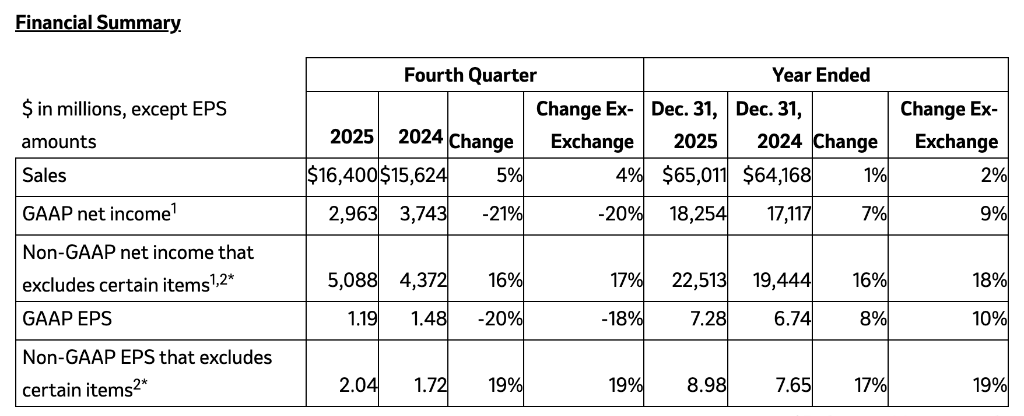
Core Insights - Merck's financial performance for 2025 shows steady growth driven by Keytruda, new products like Winrevair and Capvaxive, and stable animal health business, with total sales reaching $65 billion, a 1% year-over-year increase [1] - The company projects 2026 sales between $65.5 billion and $67 billion, with adjusted EPS expected to be between $5.00 and $5.15, both below Wall Street expectations [1][6] - A significant one-time expense from the acquisition of Cidara Therapeutics is expected to impact 2026 adjusted EPS, which includes approximately $3.65 per share related to this acquisition [1][6] Financial Performance - For Q4 2025, sales were $16.4 billion, a 4% increase from Q4 2024, while total sales for the year were $65.011 billion, up 1% [2] - Non-GAAP EPS for 2025 was $8.98, reflecting a 17% increase year-over-year, while GAAP EPS was $7.28, an 8% increase [2] Product Performance - Gardasil sales faced significant challenges, with Q4 sales at $1.031 billion, a 35% decline year-over-year, and annual sales down 39% to $5.233 billion [3] - Keytruda sales reached $8.4 billion in Q4, a 7% increase, with annual sales surpassing $30 billion for the first time, totaling $31.68 billion [4] - New products like Winrevair and Capvaxive showed strong performance, with Winrevair achieving $1.443 billion in annual sales, and Capvaxive reaching $759 million [5] Strategic Outlook - Merck is focusing on product portfolio transformation to mitigate the impact of patent expirations and competition, with strategic acquisitions being a key part of this strategy [5] - The company has identified potential acquisition opportunities valued in the billions to drive future growth [4] 2026 Guidance - The 2026 guidance includes significant one-time costs from the Cidara acquisition, with adjusted EPS expected to be impacted by these costs [6][7] - The company anticipates a gross margin of approximately 82% for 2026, with adjusted operating expenses projected between $35.9 billion and $36.9 billion [7]
Merck forecasts 2026 sales below estimates on patent losses
Reuters· 2026-02-03 11:34
Core Viewpoint - Merck & Co has projected 2026 sales and profits to be below Wall Street estimates due to the anticipated impact of losing patent exclusivity on its diabetes drug Januvia and other medications, which is expected to be more significant than analysts had previously estimated [1] Group 1 - The loss of patent exclusivity on Januvia is a major factor contributing to the forecasted decline in sales and profits [1] - Analysts had previously underestimated the impact of patent expirations on Merck's financial performance [1] - The company is facing challenges from increased competition in the diabetes medication market following the expiration of patents [1]
Merck tops quarterly estimates, posts modest 2026 guidance as generic competition looms
CNBC· 2026-02-03 11:31
Core Viewpoint - Merck reported strong fourth-quarter earnings driven by demand for its cancer immunotherapy Keytruda, but provided a modest 2026 outlook that fell short of Wall Street expectations due to upcoming patent expirations and generic competition [1][2]. Financial Performance - For the fourth quarter, Merck posted net income of $2.96 billion, or $1.19 per share, compared to $3.74 billion, or $1.48 per share, in the same period last year [4]. - Adjusted earnings for the fourth quarter were $2.04 per share, slightly above the expected $2.01 per share [6]. - Revenue for the quarter was $16.4 billion, a 5% increase from the previous year, and exceeded expectations of $16.19 billion [5][6]. 2026 Outlook - Merck anticipates 2026 revenue between $65.5 billion and $67 billion, lower than analysts' expectations of $67.6 billion [2]. - The company expects adjusted earnings per share to be between $5 and $5.15, compared to the analyst estimate of $5.36 [2]. Acquisition and Charges - The 2026 guidance includes a one-time charge of approximately $9 billion, or around $3.65 per share, related to the acquisition of Cidara, which is developing a flu prevention drug [3]. Cost Management - Merck is implementing a cost-cutting plan aimed at reducing expenses by $3 billion by the end of 2027 to offset revenue losses from the upcoming patent expiration of Keytruda in 2028 [5]. Drug Pricing Deal - Under a "most favored nation" deal, Merck will sell existing treatments to Medicaid patients at the lowest price offered in other developed nations and will receive a three-year reprieve from tariffs [4].
全球制药业洞察 | 2026年展望:美国疫苗承压;商保开辟药企进入中国新路径
彭博Bloomberg· 2026-01-07 06:05
Core Insights - The pharmaceutical industry is expected to face increased pressure in the U.S. vaccine sector by 2026, while commercial insurance opens new pathways for drug companies entering the Chinese market [3][9]. Group 1: U.S. Pharmaceutical Pricing and Investment - Concerns regarding U.S. drug pricing reforms have diminished as many pharmaceutical companies commit to significant investments in the U.S. and sign pricing agreements with the government [4]. - Major companies have pledged substantial investments, including Pfizer and Merck at $70 billion each, and Roche at $50 billion, among others, to enhance manufacturing capacity in the U.S. [5]. - The U.S. government has implemented a maximum fair price for certain drugs, with notable price reductions observed in negotiations, such as Merck's Januvia priced at $113 and similar drugs at $80 and $78 [6]. Group 2: Chinese Pharmaceutical Market Dynamics - The 2025 National Medical Insurance Drug List will add 114 new drugs, with expected price reductions of 40%-50% for those included, reflecting a more mature negotiation mechanism [9][11]. - The introduction of a commercial insurance innovation drug list provides an alternative route for international pharmaceutical companies to launch innovative drugs in China, with 19 drugs included, such as CAR-T therapies [11][13]. - The commercial insurance pathway may allow companies to introduce higher-priced drugs if they are unable to meet the 60% price reduction typically required for inclusion in the national insurance list [11].