
LABUBU文创产品

Search documents
适应产业变革 打造类型化产业金融服务新模式
Shang Hai Zheng Quan Bao· 2025-11-30 18:29
Core Insights - The article emphasizes the need for financial institutions in China to develop new financial service models that align with the evolving demands of new economic industries, particularly focusing on five categories: new consumption, new technology, new digital, new terminals, and future industries [1][4]. Group 1: New Economic Industries - New economic industries are becoming a significant driving force for economic development, with the added value of the new economy projected to reach 24.3 trillion yuan in 2024, accounting for 18.01% of GDP, an increase of 0.43 percentage points from the previous year [2]. - As of June 2025, there are 25.36 million registered new economy enterprises in China, representing a year-on-year growth of 6.6% and exceeding 40% of the total number of enterprises [2]. Group 2: Characteristics of New Economic Industries - New economic industries exhibit distinct characteristics compared to traditional industries, including different driving forces, tighter interdependencies within the industrial chain, higher operational risks, and the creation of diverse social values alongside economic benefits [3]. Group 3: Financial Service Requirements - The traditional financial service model, which relies on collateral and cash flow, is incompatible with the high intangible assets and risks associated with new economic industries, leading to a structural contradiction of "asset scarcity" in financial investment and "capital scarcity" in real investment [4]. Group 4: New Consumption Financial Service Model - The new consumption industry is crucial for expanding domestic demand, with a shift towards service, value, cultural, and green consumption. Financial institutions face challenges in providing services due to the intangible nature of core assets and the lack of market comparables for valuation [5][6]. - Financial institutions must understand the multi-dimensional value of new consumption, focusing on emotional, cultural, and social values, and establish a reasonable valuation system [6][7]. Group 5: New Technology Financial Service Model - The new technology industry is vital for innovation-driven growth, with over 500,000 high-tech enterprises in China as of 2024, an increase of 83% since 2020. However, challenges remain in securing long-term funding and converting technological achievements into marketable products [8][9]. - Financial institutions need to address challenges such as limited understanding of technological innovations, information asymmetry, and differing valuation logic across various new technology sectors [9][10]. Group 6: New Digital Financial Service Model - The digital economy is rapidly growing, with its value added expected to exceed 43% of GDP by 2024. However, financial services for new digital industries are currently insufficient, with a low representation of digital enterprises in the A-share market [11][12]. - Financial institutions must enhance their valuation capabilities for new digital industries and develop a diverse range of investment products to support the growth of digital enterprises [12][13]. Group 7: New Terminal Financial Service Model - The new terminal industry, characterized by deep integration of manufacturing, digital, and technology, requires financial services that can adapt to the evolving relationships within the industrial chain [14][15]. - Financial institutions should provide integrated financial solutions that consider the interdependencies among new terminal enterprises and their supply chains, focusing on value assessment and collaborative development [15][16]. Group 8: Future Industry Financial Service Model - Future industries are marked by breakthroughs in common technologies and face significant risks, including the feasibility of technological paths and the challenges of market demand realization [18][19]. - Financial institutions are encouraged to innovate comprehensive financial service models that address the uncertainties of future industries, leveraging government funds and private equity investments to support long-term development [19][20].
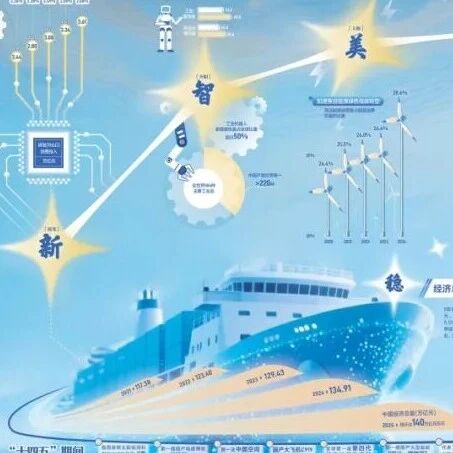
奔赴星辰大海,见证“十四五”中国经济跨越与蝶变
21世纪经济报道· 2025-10-18 13:08
Core Viewpoint - The article highlights the achievements and progress made during China's "14th Five-Year Plan" period, emphasizing economic resilience, innovation, and sustainable development as key drivers for future growth [1][2]. Economic Growth - China's economic increment over the past five years is expected to exceed 35 trillion yuan, with an average growth rate of 5.5%, surpassing the global average and contributing approximately 30% to global economic growth [5]. Innovation - Innovation has become the primary driving force for development, with national R&D investment increasing by nearly 50% compared to the end of the "13th Five-Year Plan." R&D intensity is approaching the OECD average, and China ranks 10th in the global innovation index [7]. Industrial Transformation - The transition from old to new economic drivers is progressing smoothly, with manufacturing value added expected to increase by 8 trillion yuan during the "14th Five-Year Plan," contributing over 30% to global manufacturing growth [9]. Green Development - China has established the world's largest renewable energy system, with installed capacities for hydropower, wind, and solar energy leading globally. By mid-2025, the number of electric vehicles reached 36.89 million, with charging infrastructure also ranking first worldwide [11]. Trade and Global Cooperation - During the "14th Five-Year Plan," China's goods trade volume remained the largest globally, with service trade expected to surpass 1 trillion USD for the first time in 2024. High-tech products accounted for nearly 20% of exports [13][14]. Infrastructure Development - China has built the largest highway, high-speed rail, and port networks globally, with significant growth in new infrastructure sectors such as computing networks and smart cities, achieving a 30% annual growth rate in computing capacity over the past five years [16]. Agricultural Strength - China's grain production has achieved 21 consecutive years of growth, reaching a new milestone of 1.4 trillion jin in 2024, ensuring food security and advancing agricultural technology [18]. Social Welfare - The income gap between urban and rural areas has narrowed, with per capita disposable income reaching 21,840 yuan in the first half of 2025, reflecting ongoing improvements in social welfare systems [20].

文创产品亮点多 文化出海动能足
Zhong Guo Chan Ye Jing Ji Xin Xi Wang· 2025-09-10 23:47
Group 1: Intellectual Property Protection - Intellectual property protection is crucial for innovation and development, with customs focusing on high-infringement areas through various actions like "Dragon Action" and "Blue Network Action" [1] - During the "14th Five-Year Plan" period, customs seized 260,000 batches and nearly 400 million items of suspected infringing goods, effectively curbing infringement trends in import and export [1] - Customs has improved the convenience of rights protection through measures like "policy delivery" and the use of information technology, allowing rights holders to handle registrations and claims from home [1] Group 2: Cultural and Creative Products Export - Guangdong Yinghao Craft Products Co., Ltd. has become a major exporter of cultural and creative home products, with products sold in over 80 countries, focusing on design and development to capture new overseas markets [2][3] - The company exported approximately 190 million yuan worth of cultural products in the first eight months of the year, with orders extending into the next spring [3] - Dongguan Weishi Culture Co., Ltd. has a 95% market share in the global metal assembly model market, creating products that incorporate traditional Chinese cultural elements [6][7] Group 3: Support from Customs - Customs has implemented tailored support measures for companies exporting cultural products, including one-on-one guidance and compliance with different countries' regulations [3][4] - The establishment of the National Technical Trade Evaluation Workstation has provided targeted solutions for companies to navigate technical trade measures and avoid export risks [8][9] - Suzhou Customs has organized training and provided personalized services to enhance companies' intellectual property protection levels and facilitate their international expansion [9]
海关总署:今年拦截涉嫌侵权LABUBU产品183万件
Nan Fang Du Shi Bao· 2025-08-25 07:26
Group 1 - The core viewpoint of the articles highlights the increasing importance of intellectual property protection by customs in response to the rise of counterfeit products in the gaming and cultural product sectors, particularly with the popularity of LABUBU [1][2] - In 2023, customs intercepted 1.83 million suspected infringing products, demonstrating a commitment to maintaining a fair international trade environment [1] - The customs authority has implemented several targeted actions, including "Dragon Action," "Blue Net Action," and "Clean Net Action," resulting in the seizure of nearly 400 million suspected infringing items across 260,000 batches [1] Group 2 - During the "14th Five-Year Plan" period, nearly 20,000 new rights holders have registered, and the number of intellectual property records has approached 100,000, indicating a growing reliance on customs protection for intellectual property [2] - Customs has enhanced its services through initiatives like "Customs Officials Deliver Policies" and the use of digital tools, allowing rights holders to handle registrations and applications conveniently from home [2] - The customs authority encourages businesses to utilize its online services for efficient intellectual property protection, emphasizing its commitment to providing high-quality services [2]
千年商都全球“圈粉”
Guang Zhou Ri Bao· 2025-06-08 18:59
Core Insights - Guangzhou's inbound tourism is experiencing rapid growth, driven by policy benefits, cultural appeal, and service innovations, positioning the city as a premier destination for international visitors [1][8] Group 1: Inbound Tourism Growth - The implementation of the "240-hour transit visa exemption" policy has significantly boosted international transit tourism, with nearly 50 countries represented among visitors since its launch [2] - In Q1 2025, Guangzhou welcomed 1.187 million overnight international tourists, marking an 11.7% year-on-year increase, with foreign overnight visitors increasing by 31.0% [3] - The expansion of international flight routes from Baiyun Airport, including the addition of six new routes and two international airlines, has enhanced connectivity and facilitated inbound tourism [3] Group 2: Enhanced Visitor Experience - Guangzhou is improving the inbound tourism environment with convenient services such as electronic transportation codes and foreign currency exchange points, ensuring a smooth experience for international travelers [3] - The city is leveraging cultural events and celebrity endorsements to enhance the tourism experience, with international artists promoting local attractions through social media [4][6] - A diverse range of tourism products, including medical tourism and educational travel, is being developed to attract various international visitor segments [5][6] Group 3: Marketing and Promotion Strategies - Guangzhou has established 20 overseas tourism promotion centers across five continents to enhance global marketing efforts, focusing on key source markets [7] - The "International Tourism Influencers' Happy Journey in Flower City Guangzhou" event has become a signature initiative to attract inbound tourists, showcasing the city's cultural richness [7] - Positive word-of-mouth marketing is driving further growth in inbound tourism, with notable increases in visitors from countries like Argentina, which saw a 344.7% year-on-year growth [8]