MI300X芯片

Search documents
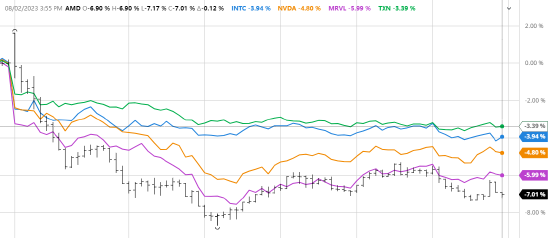
美国芯片股普跌:受AMD疲软预期、惠誉下调美国评级拖累
Xin Lang Ke Ji· 2025-11-26 08:21
Group 1 - The core concern is the decline in U.S. chip stocks, particularly due to AMD's disappointing revenue forecast, raising worries about the fragility of the PC market and slowing corporate spending [1][2] - AMD's projected Q3 revenue is $5.7 billion, below analysts' expectations of $5.81 billion, with a 54% decline in its client segment revenue attributed to a weak PC market [3][4] - Semiconductor companies are leading the decline in tech stocks, influenced by Fitch Ratings downgrading the U.S. long-term foreign currency issuer default rating from AAA to AA+, citing expected deterioration in fiscal conditions over the next three years [3] Group 2 - The Nasdaq index fell by 2.1%, marking its second-largest drop of the year, following AMD's earnings report [4] - AMD's CEO Lisa Su indicated that the company is emerging from a "turbulent period" in the PC industry, with expectations for growth in the second half of the year [4] - AMD is one of the few companies producing high-end GPUs necessary for artificial intelligence, and analysts are monitoring its server chips for potential market share gains against Intel [4] - AMD is collaborating closely with partners like Microsoft to leverage AI, enhancing productivity through computing [4] - In Q2, AMD launched a new chip aimed at building and running AI models similar to OpenAI's ChatGPT, with MI300X chips currently being sampled to customers and production expected to ramp up in Q4 [4][5]


英伟达成全球首家市值突破5万亿美元上市公司,AI狂潮再掀资本神话
Sou Hu Cai Jing· 2025-10-30 06:30
Core Insights - NVIDIA has achieved a market capitalization of over $5 trillion, becoming the first publicly traded company to reach this milestone, with a stock price increase of over 56% year-to-date and a market value increment of $2.9 trillion in 2023 [1][3] Group 1: Market Performance - NVIDIA's stock price surged to $207.04 per share, with an intraday increase exceeding 5%, contributing significantly to the S&P 500 index's annual growth of 17% [1] - The company's market value growth from $4 trillion to $5 trillion occurred in just over three months, a record pace compared to Microsoft and Apple [1] Group 2: AI Demand and Product Development - The explosive growth in AI computing demand is driving NVIDIA's success, with CEO Jensen Huang announcing that the flagship Blackwell chip has entered full-scale production, projecting over $500 billion in revenue over the next five quarters [2] - NVIDIA's next-generation Rubin chip is set for early production in October 2026, with a rolling innovation model in place for future architectures [2] Group 3: Strategic Partnerships and Ecosystem - NVIDIA has formed strategic partnerships, including a $100 billion investment in OpenAI for a 10 GW AI data center and collaboration with Uber to expand a global fleet of autonomous vehicles [2] - The company has also invested $1 billion in Nokia to explore the integration of 5G and AI technologies [2] Group 4: Market Position and Competition - NVIDIA's market capitalization surpasses the combined total of major semiconductor companies and is comparable to the total market value of several major economies [3] - Despite strong analyst support, there are concerns regarding the sustainability of NVIDIA's valuation amid competition from AMD and Broadcom [3][4] Group 5: Geopolitical Risks - NVIDIA's market share in China has dropped from 95% to 0%, raising concerns about geopolitical risks affecting its global supply chain [4] - CEO Huang emphasized that the strength of AI models will continue to drive customer willingness to pay, highlighting the synergy of software, hardware, and ecosystem as NVIDIA's competitive advantage [4] Group 6: Future Technologies - NVIDIA is developing the NVQLink quantum interconnect system to integrate GPU computing with quantum processors, aiming to create a global quantum supercomputer network [5] - The AI-native 6G technology stack, NVIDIA Arc, is designed to provide ultra-low latency for future communication infrastructure [5] Group 7: Market Sentiment - Analysts express high expectations for the transformative impact of AI, with NVIDIA redefining the technology industry's potential at an unprecedented pace [6]

整理:每日科技要闻速递(6月13日)
news flash· 2025-06-12 23:43
Artificial Intelligence - Trump will attend the AI Energy Summit in Pittsburgh [1] - Apple plans to delay the long-awaited upgrade of Siri to Spring 2026 [1] - OpenAI's Altman announced the use of AMD's MI300X and MI450 AI chips [1] - Shanghai Municipal Cyberspace Administration guides platforms like Xiaohongshu and Bilibili to clean up illegal AI product marketing information [1] - TPG Capital and Sequoia Capital invested $250 million in Musk's xAI company [1] - AMD claims the latest version of its MI350 series chips outperforms similar products from Nvidia and announced the next generation AI chip, MI400 series [1] Other Developments - Cathie Wood has been purchasing Tesla stock throughout the week [2] - Trump terminated California's electric vehicle mandate, expressing support for Tesla and other electric vehicle companies [3] - Google Cloud experienced an outage, causing service interruptions for OpenAI, Shopify, and others [3] - Micron plans to invest $200 billion in the U.S., with $150 billion allocated to chip manufacturing [3]



AMD Lisa Su,是如何力挽狂澜的
半导体行业观察· 2025-03-04 00:53
Core Viewpoint - Lisa Su, CEO of AMD, emphasizes the importance of long-term decision-making in the semiconductor industry, reflecting on her career and the pivotal choices made during her leadership at AMD [1][2]. Group 1: Company Background and Leadership - AMD's market capitalization is currently $162 billion, and it has undergone significant transformation under Lisa Su's leadership since she became CEO in 2014 [1]. - When Su took over, AMD was facing severe challenges, with stock prices around $3 per share and rumors of impending bankruptcy due to fierce competition from Intel and Nvidia [3]. - Su's leadership has been marked by a strategic shift from personal computing to high-performance computing and gaming, leading to a substantial recovery in AMD's business [3][6]. Group 2: Strategic Decisions and Market Position - In 2014, AMD evaluated entering the smartphone chip market but ultimately decided to focus on high-performance computing, which aligned better with the company's strengths [2]. - Under Su's guidance, AMD transitioned its manufacturing partnership to Taiwan Semiconductor Manufacturing Company (TSMC) in 2018, enhancing its production capabilities [3]. - AMD's stock price has increased over 60 times since Su became CEO, reflecting the company's successful turnaround [6]. Group 3: Future Prospects and AI Market - AMD is positioning itself to compete in the AI sector, launching the MI300X chip as a competitor to Nvidia's top products, with expected sales of $1 billion by mid-2024 [8]. - The company anticipates significant growth in the AI industry, projecting a market valuation of $400 billion by 2027 [8]. - Despite being overshadowed by Nvidia, AMD's advancements in AI technology indicate a promising future for the company under Su's leadership [8].