
MLC NAND

Search documents
存储周期持续-模组先行-利基跟进
2026-03-30 05:15
Summary of Conference Call Records Industry Overview - The records focus on the **memory storage industry**, particularly related to **AI server memory** and **niche storage** markets [1][2][3]. Key Points and Arguments 1. **AI Server Memory Shortage**: There is an extreme shortage of memory for AI servers, with channel vendors dismantling servers to sell memory separately. CSP order fulfillment is below 100%, making it difficult for consumer electronics clients to obtain supplies [1][2]. 2. **Jevons Paradox**: Algorithm optimizations may reduce memory demand per GPU, but they will accelerate AI application deployment and token release, leading to an exponential increase in overall memory demand [1][2]. 3. **Extended Storage Cycle**: The storage upcycle is expected to last longer than previously anticipated, with major manufacturers like Hynix pushing peak expectations from 2027 to 2028-2030 due to demand uncertainty and cautious supply expansion [1][3]. 4. **DRAM Price Increase**: The expected increase in DRAM contract prices for Q2 2026 is projected to be between 40% and 50%, with module manufacturers experiencing a 50% increase in ASP in Q1 2026, leading to a net profit margin of around 40% [1][5]. 5. **Niche Storage Market Growth**: The niche storage market, particularly SLC and MLC NAND, is expected to see significant price increases due to supply constraints, with major players like Kioxia exiting certain product lines [1][7][9]. 6. **Investment Opportunities**: Companies such as Zhaoyi Innovation, Puran, and Dongxin are expected to benefit from the supply gap in niche NAND, with their PE ratios adjusted to the 20-30 range, indicating good investment potential [1][10]. 7. **Market Sentiment**: The storage module sector is viewed as a "safe asset" within the tech sector, driven by low valuations and high earnings certainty, despite macroeconomic disturbances [6][8]. Additional Important Insights - **Supply and Demand Characteristics**: The demand side is characterized by significant but unclear needs from AI servers, while the supply side remains cautious due to past experiences of overproduction leading to negative margins [4]. - **Performance of Storage Module Sector**: The strong performance of the storage module sector in Q1 2026 is attributed to strategic inventory management rather than rapid stock depletion, indicating potential for sustained growth in subsequent quarters [5][8]. - **Valuation Levels**: The storage module sector's PE ratios have fallen to around 10, suggesting limited downside potential as earnings expectations are revised upwards [8][10]. This summary encapsulates the critical insights from the conference call records, highlighting the dynamics of the memory storage industry and the implications for investment strategies.


半导体:资深内存投资者对我们下调评级的反馈-Greater China Semiconductors-Old Memory Investor Feedback on Our Downgrade
2026-03-26 13:20
Summary of Conference Call Notes on Greater China Semiconductors Industry Overview - The focus is on the semiconductor industry, specifically memory products such as DDR4 and legacy NAND - The report addresses investor feedback regarding a downgrade of DDR4 memory products Key Points and Arguments 1. Implications for the Mainstream Memory Market - The company has adopted a cautious stance on DDR4 while remaining optimistic about legacy NAND - Legacy memory operates on different supply-demand dynamics compared to mainstream memory, which is benefiting from AI computing demands - Mainstream DRAM supply is tightening due to increased data processing needs from AI workloads, indicating a durable strength in mainstream memory as long as AI spending remains high [2][3] 2. Reasons for Downgrading DDR4 - **Supply Side**: Major suppliers are increasing DDR4 capacity, with Winbond planning to double DRAM bit shipments in 2026 and CXMT intending to more than double its DDR4 capacity by 2027 - **Demand Side**: High DDR4 prices have negatively impacted consumer demand in sectors like smartphones and PCs, and DDR4 lacks direct exposure to AI, limiting its benefits from increased memory consumption tied to AI workloads [4][5] 3. Timing of the Downgrade - As of February 2026, DDR4 8Gb contract prices increased by 752% year-over-year, leading to pushback from smaller customers - Suppliers are now more willing to sell inventory, indicating limited upside potential for DDR4 prices moving forward [10] 4. Legacy NAND Market Dynamics - The downgrade of DDR4 coincides with a shift in focus to Macronix, which is expected to capitalize on MLC NAND opportunities - A projected undersupply of MLC NAND could reach approximately 40% in the second half of 2026, with prices expected to rise over 200% from Q1 to Q4 2026 - Legacy NAND is experiencing a structural supply shortage, contrasting with the current situation of DDR4, as major suppliers are reducing supply [12][13] Additional Important Insights - The report highlights the potential for a divergence in trading between legacy NAND and DDR4 due to differing supply-demand dynamics - The analysts express confidence in the resilience of MLC NAND demand despite price increases, particularly in industrial and enterprise applications [12][13] Conclusion - The semiconductor industry, particularly in memory products, is facing significant shifts influenced by AI demands and supply chain dynamics - The cautious outlook on DDR4 reflects broader market trends and the need for investors to consider the unique characteristics of different memory segments when making investment decisions
半导体 - 传统存储器定价能力再度提升-Greater China Semiconductors-Old Memory Upping Pricing Power Again
2026-02-05 02:22
Summary of Conference Call on Greater China Semiconductors Industry Overview - The focus is on the semiconductor memory market, particularly old memory types such as NOR, MLC NAND, and DDR4 - The analysis indicates a significant shift in supply-demand dynamics, with expectations of reduced support from mainstream memory vendors for older memory types [1][3] Key Points Memory Supply-Demand Dynamics - The memory supercycle is expected to further squeeze support for old memory types, with expectations that commodity memory supply will be fully sold by 2026 [3] - Forecasts indicate a 26% undersupply for DDR4 in 2026, up from a previous estimate of 20%, driven by reduced support from Korean vendors [4] - MLC NAND is projected to face a 30%+ undersupply in 2026, with Samsung, Kioxia, and Micron potentially reducing supply [5] - NOR memory is expected to see an 8% undersupply in 2026, an increase from 5%, due to declining supply from US vendors [6] Pricing Power and Market Sentiment - There is a bullish sentiment on old memory, with analysts recommending buying on dips [1][3] - Pricing for DDR4 and MLC NAND is expected to rise, with significant price hikes noted for smartphone products (60-70% QoQ) and server DDR5 pricing increasing by 100% QoQ [59] - The pricing for consumer NAND is anticipated to increase by 30-40% QoQ, while eSSD pricing may rise by 50-70% QoQ [59] Company-Specific Insights - Price targets for several companies have been raised, including: - Nanya Technology Corp: NT$298.00 to NT$348.00 - Winbond Electronics Corp: NT$130.00 to NT$155.00 - Powerchip Semiconductor: NT$77.00 to NT$88.00 - Macronix International: NT$93.00 to NT$121.00 - GigaDevice Semiconductor: Rmb355.00 to Rmb414.00 [7] AI and Memory Demand - The shift towards AI, particularly Agentic AI, is driving massive demand for DRAM and NAND memory, necessitating higher memory capacity and performance [34][35] - The memory requirements for AI inference are increasing, with projections indicating that AI inference demand will account for significant portions of global memory supply in 2026 [49] Market Risks and Considerations - The potential for supply shortages poses risks, particularly for automotive applications [5] - The overall DRAM industry demand is expected to grow by 20% YoY in 2026, driven by strong order demand from cloud service providers [59] Additional Insights - The analysis highlights the importance of memory in AI development, noting that memory is becoming a critical bottleneck as AI systems evolve [29][33] - The report emphasizes the need for architectural and software-level memory efficiency to address the increasing memory demands of AI applications [29][33] This summary encapsulates the key insights and projections regarding the semiconductor memory market, highlighting the implications for pricing, supply-demand dynamics, and the impact of AI on memory requirements.

中国半导体-昔日存储板块落后者迎头赶上-Greater China Semiconductors-Old Memory Laggards Catching Up
2026-01-28 03:03
Summary of Conference Call Notes on Greater China Semiconductors Industry Overview - The focus is on the semiconductor industry in Greater China, particularly memory stocks and companies involved in integrated device manufacturing (IDM), foundry services, and IC design. Key Companies Discussed 1. **Winbond** - Remains the top pick for investment in the sector [1] 2. **Macronix** - Plans to raise fab utilization and execute pricing power, delaying 3D NOR development [4] - Will invest NT$22 billion (~US$700 million) to increase 12-inch fab production capacity from 20k to 30k wafers per month, addressing an "extreme shortage" in eMMC [4][10] - Expected to catch up on NOR pricing hikes and respond to MLC market undersupply from 1Q26 [10] 3. **Powerchip** - Anticipated re-rating due to a partnership with Micron, with potential long-term benefits from advanced DRAM production [5] - Valuation methodology changed to book value, with a price target set at NT$77, based on 1.7x book value per share (BVPS) [5][34] - Expected earnings upside and pricing power from 2Q26 [10] 4. **GigaDevice** - More disciplined in pricing adjustments, focusing on new business areas [6] - Expected to show meaningful margin expansion in 1H26 [10] Market Dynamics - IDMs are leading the cycle outperformance, with laggards expected to catch up in share price performance [3] - The under-guidance from Nanya Tech presents a good entry point for investors [3] - The memory up-cycle is anticipated to continue, with 1Q26 marking the third quarter of this cycle [3] Financial Projections - Earnings estimates and price targets have been raised for Macronix, GigaDevice, and Powerchip [10] - Macronix's price target increased from NT$72.50 to NT$93.00 [7] - GigaDevice's price target raised from RMB288.00 to RMB355.00 [7] - Powerchip's price target increased from NT$56.00 to NT$77.00 [7] Additional Insights - The semiconductor industry is experiencing a shift with increased demand for specialty DRAM and NAND products, driven by consumer electronics [41] - The pricing power in the industry is expected to remain strong into 2026, with potential risks from competition and inventory levels [51] - The overall sentiment remains positive, with a focus on the long-term benefits of partnerships and technological advancements in production processes [39][41] Conclusion - The semiconductor sector in Greater China is poised for growth, with specific companies like Winbond, Macronix, Powerchip, and GigaDevice expected to perform well. The anticipated pricing power and market dynamics suggest a favorable investment environment, despite potential risks from competition and market fluctuations.
大摩闭门会-存储-AI新瓶颈
2026-01-26 02:49
Summary of Conference Call on Memory Market Dynamics Industry Overview - The conference call focuses on the memory market, specifically DRAM and NAND sectors, in the context of increasing AI demands and evolving architectures [1][2][3]. Key Insights and Arguments - **Increased Demand from AI**: The reliance on memory in AI systems is growing, with AGI systems requiring enhanced memory capabilities for context understanding and long-term learning. This is expected to significantly increase the demand for DRAM and SSDs [2][4]. - **Projected Memory Consumption**: It is estimated that by 2026, text reasoning alone will consume approximately 35% of global DRAM supply and 90% of NAND supply, indicating a structural increase in overall memory demand [3][4]. - **Price Forecasts**: - DRAM prices are expected to rise by 50%-60% in Q1 2026, with some manufacturers anticipating even higher increases. NAND prices are projected to increase by 50%-80% during the same period [5][6]. - A consensus for Q2 indicates a price increase of 15%-20%, with significant pricing power still expected [5][6]. - **Supply Shortages**: The MLC NAND market is facing severe supply shortages, with global production capacity dropping by 60% due to reductions by major players like Samsung and Micron. This is expected to lead to a price increase of around 400% [10]. Additional Important Points - **Deepseek Ingress Architecture**: The introduction of the Ingress architecture by Deepseek optimizes memory and reasoning separation, enhancing performance without increasing memory usage. This shift indicates a competitive advantage for Chinese AI development in system design [4]. - **CSP Long-term Contracts**: U.S. Cloud Service Providers (CSPs) are signing long-term contracts to ensure CPU supply, which is driving strong demand for server DRAM and impacting older memory markets like DDR4 and low-tier NAND [6][7]. - **Market Dynamics**: The overall memory market has seen a significant shift in supply and demand dynamics over the past year, with supply decreasing faster than demand, particularly in the DDR4 segment [8][9]. - **Impact on End Products**: Rising memory costs are expected to affect end products such as PCs and smartphones, with anticipated declines in shipments for PCs and Chinese Android phones by approximately 10% and 8-10%, respectively [13]. Conclusion - The memory market is entering a phase of significant price increases and supply constraints driven by the growing demands of AI applications and evolving architectures. The strategic moves by major players and the introduction of innovative technologies will shape the future landscape of the memory industry.
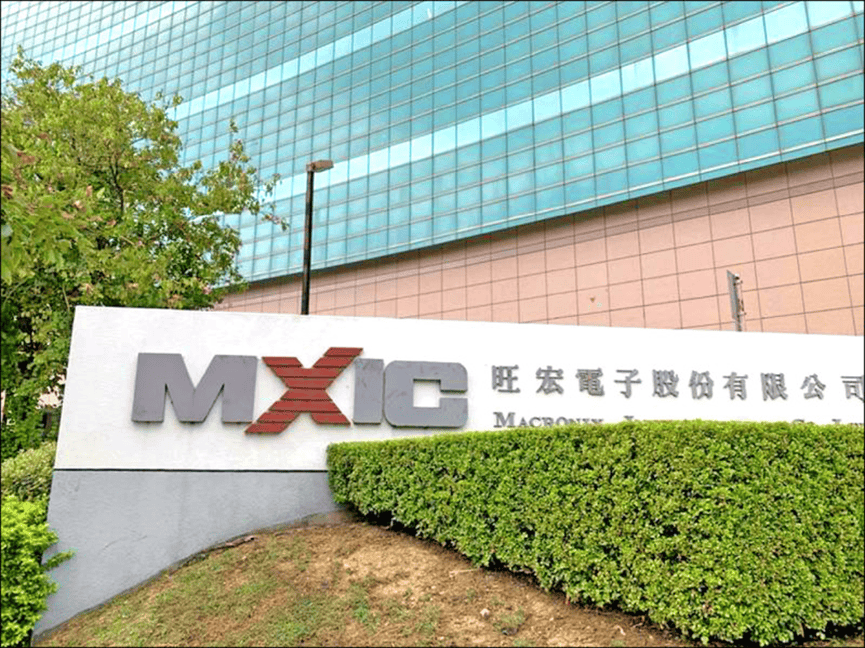
旺宏电子公布最新业绩
Sou Hu Cai Jing· 2026-01-08 08:45
Group 1 - The core viewpoint of the articles indicates that Winbond Electronics has shown a positive trend in its financial performance, with significant revenue growth in December 2025 compared to previous months and the same period last year [1][3] - The consolidated revenue for December 2025 reached NT$26.32 billion, marking a 7.7% increase from NT$24.44 billion in November and a substantial 44.9% increase year-over-year [1] - The total consolidated revenue for the fourth quarter was NT$77.33 billion, reflecting a decline of over 5% from the third quarter and a slight decrease compared to the same period in 2024 [1] Group 2 - For the full year of 2025, the consolidated revenue amounted to NT$288.8 billion, representing an 11.6% year-on-year growth [1] - Inventory levels decreased to approximately NT$101 billion in the third quarter, down from NT$121 billion in the second quarter, indicating ongoing inventory reduction which may support future gross margin recovery [1] - The operational outlook for Winbond is optimistic due to the exit of major international competitors from the market and a rebound in demand from the automotive and industrial control sectors [3] Group 3 - NOR Flash prices are expected to continue rising in the first half of the year, providing Winbond with an opportunity to achieve profitability [3] - The transition of SLC NAND production from 36nm to 19nm is anticipated to lower unit costs [3] - The exit of international manufacturers from the MLC NAND market is expected to enhance Winbond's shipping opportunities in eMMC and related applications [3]

“最近买存储芯片,遇到两次假标了。”
Xin Lang Cai Jing· 2025-12-31 04:30
Group 1 - The storage chip market is experiencing a significant surge in prices, leading to increased instances of counterfeit products and labels [1][7][10] - Two recent cases highlighted by a distributor, Amy, involved abnormal labeling on storage chips, raising concerns about authenticity [2][3] - The price of a common 8G DDR4 chip has skyrocketed from $1.7 in March to over $20, reflecting a more than tenfold increase since the beginning of the year [8][10] Group 2 - The influx of new participants in the storage market has complicated the trading chain, resulting in longer transaction paths and increased risk of counterfeit products [7][10][12] - Distributors are advised to prioritize purchasing from established channels and to verify labels and products before payment to mitigate risks [12][13] - The current market dynamics have created a divide among distributors, with some successfully navigating the market while others struggle due to lack of channels or customers [14]
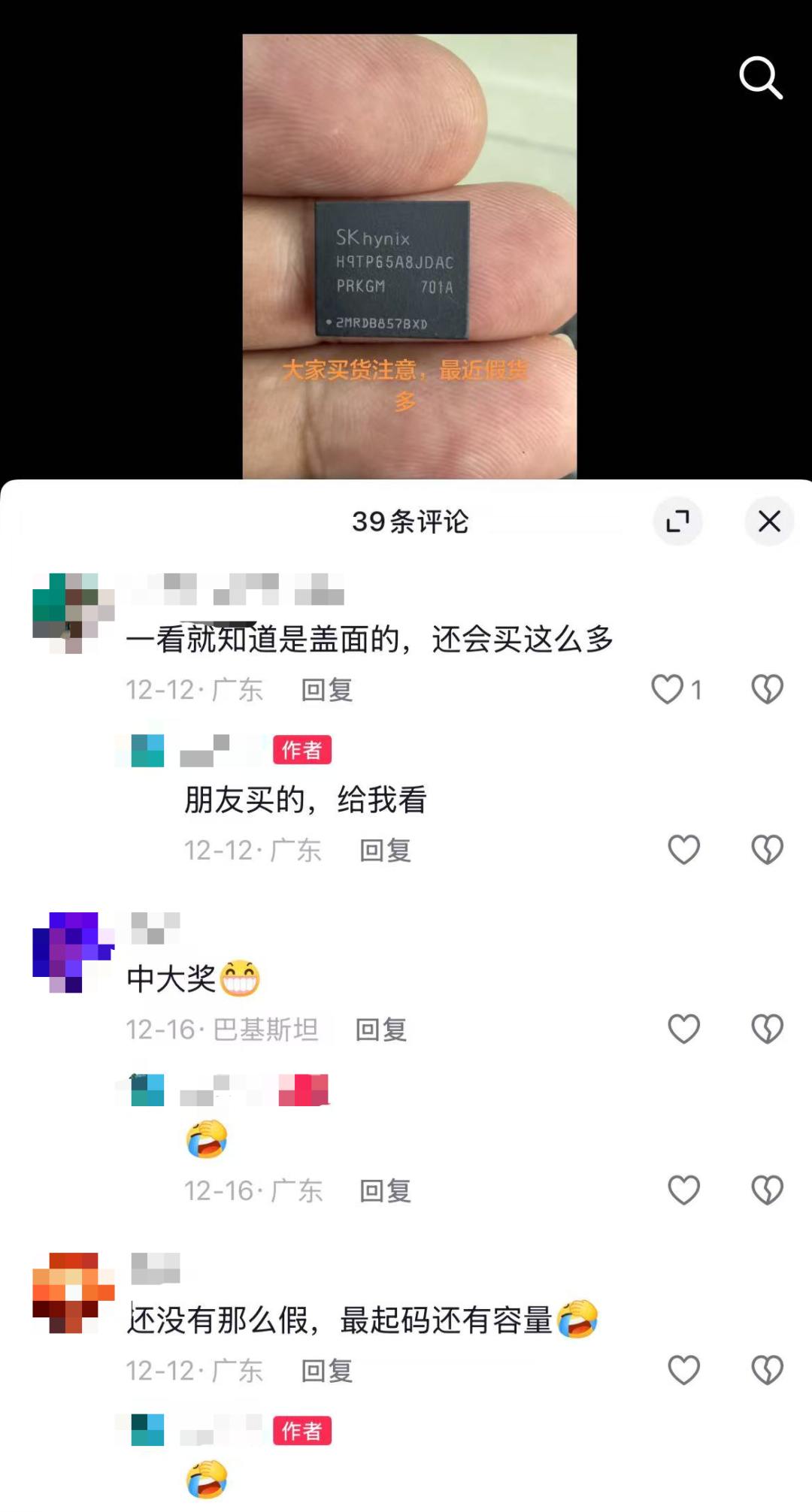
“最近买存储芯片,遇到两次假标了。”
芯世相· 2025-12-31 04:08
Core Viewpoint - The storage chip market is experiencing significant price increases and heightened activity, but this has also led to a rise in counterfeit products and labeling issues, indicating growing risks in the market [3][9][10]. Group 1: Market Activity and Trends - The storage chip market has become the most active segment in the current year, with prices continuously rising and market sentiment remaining strong [3]. - Since early this year, storage chip prices have been on an upward trend, particularly after major manufacturers announced production halts for DDR4 chips, which further fueled price increases [9][10]. - For instance, the price of a common 8G DDR4 chip from Samsung surged from $1.7 in March to over $20 by the end of October, representing an increase of more than 10 times [10]. Group 2: Counterfeit and Labeling Issues - Recent cases have highlighted the emergence of counterfeit labels in the storage chip market, with distributors encountering issues where labels did not match standard formats [5][6]. - Social media reports have also surfaced, showing instances of counterfeit products, such as chips being misrepresented with incorrect specifications [6]. - The increase in market participants has led to longer transaction chains and more opportunities for counterfeit products to enter the market, raising the risk of encountering fake goods [13][14]. Group 3: Changes in Distribution Dynamics - The influx of new participants in the storage market has resulted in a more complex trading environment, with many transactions occurring between traders and stockpilers rather than directly with end-users [11][13]. - Distributors have noted that the current market dynamics have led to increased turnover and a higher likelihood of encountering counterfeit products, especially as the market heats up [13][15]. - The competitive landscape has shifted, with some distributors successfully navigating the market while others struggle due to lack of established channels or customer bases [15]. Group 4: Recommendations for Distributors - Distributors are advised to prioritize sourcing from established and reputable channels to mitigate risks associated with counterfeit products [14][16]. - It is crucial for distributors to verify labels and inspect products before making payments to avoid purchasing counterfeit goods [14][16]. - The current market conditions necessitate a cautious approach, emphasizing the importance of risk management over speculation [16].

存储芯片概念强势,德明利涨停,香农芯创等大涨
Zheng Quan Shi Bao Wang· 2025-12-08 07:00
Group 1 - The storage chip sector has seen a significant surge, with companies like Maiwei Co., Ltd. (300751) rising over 18%, and others like Shannon Semiconductor (300475) and Jiangbolong (301308) increasing by approximately 15% [1] - Reports indicate that the spot prices of storage chips have skyrocketed recently, with DDR4x particles experiencing a price increase of over 400% this year, leading to a "hoarding" phenomenon in the supply chain [1] - End manufacturers, such as mobile phone producers, are facing historically low inventory levels, generally below 4 weeks, which is below the healthy range of 8-10 weeks, resulting in a "passive replenishment" situation under supply chain constraints [1] Group 2 - CITIC Securities notes that since September, the storage market has shifted to a seller's market, with price increases spreading across all categories and accelerating [2] - Looking ahead, enterprise SSD contract prices for NAND are expected to rise by over 50% in Q4 2025 and Q1 2026, while DDR4 8Gb products have seen a price increase of approximately 350% from March to September [2] - The overall storage sector is in the early stages of a super cycle, with high visibility of shortages expected to continue at least until the end of 2026, indicating a positive outlook for the sustainability of this structural cycle [2]

大中华区半导体:传统存储持续超预期向好-Greater China Semiconductors-Old memory keeps surprising to the upside
2025-12-05 06:35
Summary of Conference Call on Greater China Semiconductors Industry Overview - The focus is on the **semiconductor industry** in Greater China, particularly on **old memory stocks** such as DDR4, MLC NAND, and NOR Flash [2][3][6]. Key Insights 1. **Pricing Power and Market Dynamics**: - The pricing power for DDR4, MLC NAND, and NOR is expected to strengthen into 2026, indicating a bullish outlook for old memory stocks [2][3]. - Old memory contract pricing began to rise in late Q3 2025, suggesting a potential super-cycle driven by undersupply [3][4]. 2. **Earnings Projections**: - Consensus earnings for 2026 are anticipated to increase significantly, with a typical old memory up-cycle lasting 3-4 quarters [3][6]. 3. **DDR4 Market Conditions**: - Preliminary pricing negotiations for Q1 2026 are favorable, with potential contract pricing increases exceeding 100% due to strong enterprise demand [4][10]. - DDR4 16Gb is experiencing a significant shortage, with spot prices reaching **US$100**, up from **US$45.5** [4]. 4. **Flash Product Supply Cuts**: - Supply cuts in MLC NAND and expected cuts in NOR are driving up prices, with NOR pricing projected to increase by over 20% in Q1 2026 [5][10]. - NOR undersupply is expected to widen to high single digits percentage-wise in 2026 [5]. 5. **Investment Recommendations**: - The top pick remains **Winbond**, with expectations of further upside in NOR and DRAM pricing and bit shipment output into 2026 [6]. - Other recommended stocks include **Nanya Tech**, which reported a **29% month-over-month sales increase** in November, and **GigaDevice**, **Macronix**, **APMemory**, and **PowerChip** [6]. Additional Insights - The semiconductor industry is characterized by cyclical trends, and the current up-cycle is expected to last longer than typical cycles [6]. - The report emphasizes the importance of monitoring pricing trends and supply dynamics in the semiconductor market to identify investment opportunities [3][5][6]. Conclusion - The semiconductor industry in Greater China is poised for growth, particularly in the old memory segment, with strong pricing power and favorable market conditions expected to drive earnings higher in 2026. Investors are encouraged to consider the highlighted stocks for potential investment opportunities.