DDR3

Search documents
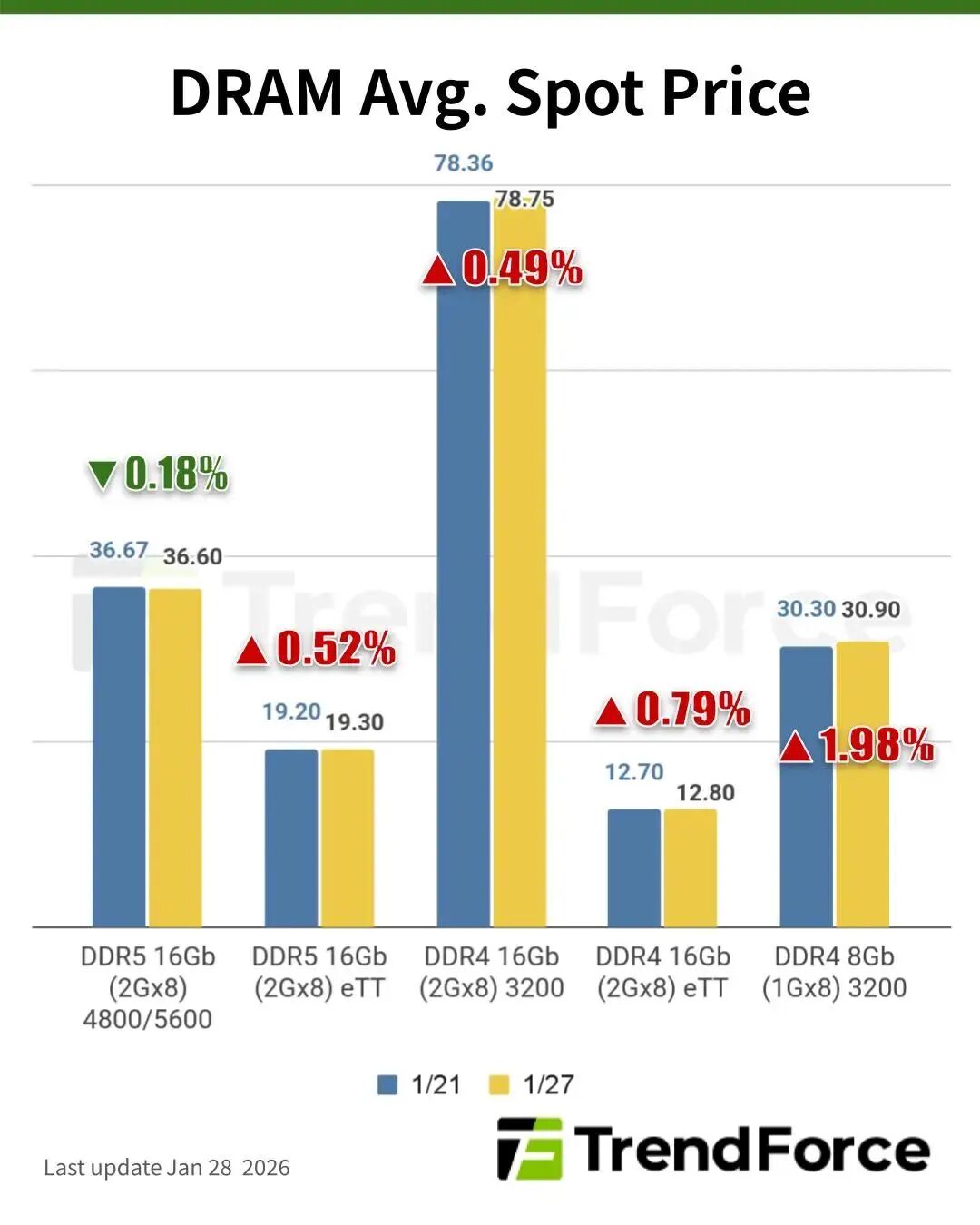
光通信后,美股存储公司也集体大涨,英伟达称“产多少用多少”
Xuan Gu Bao· 2026-03-10 23:16
Group 1 - The core viewpoint of the articles highlights a significant surge in the storage chip market driven by the AI boom, with major companies like SanDisk, Micron, and Western Digital seeing stock increases of over 5% following NVIDIA CEO Jensen Huang's statement on storage capacity demand [1] - Samsung Electronics plans to raise NAND Flash prices significantly, with a reported increase of over 100% in Q1 2023, leading to an expected cumulative price rise of over 200% in the first half of the year [1] - Other NAND manufacturers, including SK Hynix and Kioxia, are expected to follow suit with price increases, indicating a broader trend in the industry [1] Group 2 - According to Rongzhong Consulting, the price increase trend for storage chips is expected to continue at least until the second half of 2026, with projections of a 40%-50% rise in Q1 2026 and an additional 20% increase in Q2 [2] - The DRAM supply shortage is anticipated to last until Q1 2027, while NAND shortages are expected to persist until Q3 2026, indicating prolonged demand pressures in the market [2] - TrendForce data suggests that the growth rate for DRAM and NAND will accelerate in 2026, with DRAM growth projected at 26% and NAND growth at 21%, both higher than in 2025 [2]

深圳市大为创新科技股份有限公司2025年年度报告摘要
Shang Hai Zheng Quan Bao· 2026-03-05 21:07
Core Viewpoint - The company, Dawi Co., Ltd., reported a revenue of 1.222 billion yuan for the year 2025, marking a year-on-year growth of 16.74%. The semiconductor storage business showed significant growth, achieving a revenue of 1.098 billion yuan, a 25.20% increase, solidifying its core position in the company's strategy. Despite a net loss of 15.62 million yuan, the company has made substantial progress in its semiconductor storage and new energy sectors, indicating strong potential for future growth [4][24][54]. Group 1: Business Overview - The company focuses on semiconductor storage and new energy sectors, with its semiconductor storage business primarily conducted through its wholly-owned subsidiary, Dawi Chuangxin. The product range includes various DRAM and NAND Flash products, which are widely used in consumer electronics and industrial applications [3][4]. - The new energy business includes investments in lithium battery projects and trade in new energy materials, aiming to expand the industrial chain [11]. Group 2: Financial Performance - The company achieved a total revenue of 1.222 billion yuan, with the semiconductor storage business contributing 1.098 billion yuan, accounting for 90% of total revenue. The overall gross margin improved to 6.5% [4][24]. - The net loss for the year was significantly reduced by 67.73% compared to the previous year, indicating improved profitability despite ongoing investments in R&D and new projects [4][24]. Group 3: Market and Product Development - The semiconductor storage sector is experiencing a structural recovery and a "super price increase cycle," which the company is leveraging to enhance its revenue and profitability [4][6]. - The company has made significant advancements in product innovation, including the development of LPDDR5 and UFS storage products, and has successfully integrated its products with domestic CPU platforms [6][7]. Group 4: New Energy Initiatives - The company has invested approximately 155 million yuan in its lithium battery project, achieving important milestones in resource exploration and technology development [12][14]. - The exploration report for the Guizhou Daqiongli mining area has been approved, confirming substantial mineral resources, including lithium, which will support the company's new energy business [14][13]. Group 5: Corporate Governance and Future Plans - The company plans not to distribute dividends for the year 2025 due to its net loss, focusing instead on reinvesting in its core business and future growth strategies [25][54]. - The board of directors has approved various measures to enhance operational efficiency and market competitiveness, including the appointment of new management personnel [60].

三力驱动旺到2027年 产值将逼近1万亿美元
Jing Ji Ri Bao· 2026-02-21 23:30
Group 1 - The global semiconductor market value is forecasted to reach $772 billion in 2026, a 7% increase, with a year-on-year growth of 22%, marking a record high [1] - The growth is primarily driven by the IC design, wafer foundry, and packaging/testing industries, with expectations for continued growth into 2027, projected to exceed $975 billion [1] - TSMC has revised its global AI market growth outlook positively, and major memory manufacturers are optimistic about their performance for this year and next [1] Group 2 - MediaTek is confident that its data center ASIC revenue will exceed $1 billion this year, with expectations to reach several billion dollars by 2027 [1] - Creative Technology anticipates continued growth in revenue and profits this year, despite potential pressure on gross margins from two major cloud service provider chip productions [2] - The DRAM market remains tight due to limited new capacity, with demand driven by AI and general server needs, and this situation is expected to persist until mid-next year [2] Group 3 - Advanced packaging and testing leader ASE Technology is optimistic about revenue growth this year, with momentum expected to continue into next year due to the expansion of advanced processes and AI trends [2]
巨头业绩指引远超市场预期,行业供给紧缺短期难解
Xuan Gu Bao· 2026-02-12 23:30
Group 1 - Kioxia's annual performance forecast significantly exceeds market expectations, with revenue and net profit targets higher than analyst predictions by approximately 35% to 60% [1] - Demand for storage driven by AI computing power is becoming dominant, leading to a sustained shortage in storage [1] - In the DRAM sector, major cloud service providers (CSPs) in North America and China are actively negotiating long-term agreements for server DRAM supply, resulting in a projected price increase of about 90% in Q1, marking the highest increase on record [1] Group 2 - The market demand for high-performance storage devices is expected to exceed forecasts due to the expansion of AI inference applications, with major CSPs in North America starting to ramp up orders for Enterprise SSDs from the end of 2025 [2] - The supply gap is prompting buyers to aggressively stock up, leading to a projected price increase of 53-58% for Enterprise SSDs in Q1 2026, the highest quarterly increase on record [1][2] - Financial Street Securities anticipates that the trend of tight storage capacity will continue into 2026, with domestic manufacturers like "Two Storage" having sufficient motivation to expand production, benefiting the domestic storage industry chain [2] Group 3 - Zhaoyi Innovation, a global leader in NOR Flash, is expanding into niche DRAM and MCU markets, accelerating its growth in automotive electronics and AI terminal markets [3] - Daway Co., Ltd. has a subsidiary, Daway Chuangxin, whose main products include various DRAM products (DDR3, DDR4, LPDDR4X, DDR5) and NAND Flash products (eMMC, BGA NAND Flash) [3]
存储芯片,何以至此?
Xin Lang Cai Jing· 2026-02-08 18:26
Group 1 - The price of RAM, particularly DDR5, has skyrocketed, with 64GB desktop memory kits becoming more expensive than a Sony PlayStation 5 and some larger kits exceeding high-end desktop GPUs [1] - The surge in RAM prices is primarily driven by overwhelming demand from AI computing giants, which are consuming a significant portion of available memory manufacturing capacity [2][3] - TrendForce predicts that AI-centric memory will account for 70% of global memory hardware output this year, leaving little capacity for consumer products [2] Group 2 - Major memory chip manufacturers are reallocating production capacity towards high-bandwidth memory (HBM) and server-grade DDR5, further reducing supply for consumer-grade chips [3] - Micron has exited the consumer memory market entirely, closing its long-standing sub-brand Crucial, which will impact supply for PC manufacturers as well [3] - The price increases are expected to persist for a year or longer, as AI software and hardware companies secure supply contracts for unproduced wafers and chips [3] Group 3 - The price increases are not limited to DDR5 memory modules; DDR4 and DDR3 prices are also rising, affecting older memory standards that still meet basic needs [4] - The supply shortage is impacting other components that rely on memory, such as graphics cards, which use dedicated memory for rendering and AI workflows [4] - Prices for GDDR6 and GDDR7 memory have more than tripled in the past six months, leading to higher costs for both desktop and laptop graphics cards [4] Group 4 - As PC users face memory shortages, they may turn to high-speed solid-state drives (SSDs) and software solutions, but the companies producing DRAM also manufacture the NAND chips used in SSDs [5] - The demand for DRAM is diverting production capacity away from NAND chips, causing NAND wafer prices to rise, with a month-over-month increase of 60% reported last November [5]
存储芯片,何以至此?
半导体行业观察· 2026-02-07 03:31
Core Insights - The price of RAM, particularly DDR5, has skyrocketed, with 64GB desktop memory kits becoming more expensive than a Sony PlayStation 5 and some larger kits exceeding high-end desktop GPUs [2] - The overwhelming demand from AI computing giants is driving the price increases, as AI data centers consume a significant portion of available memory manufacturing capacity [3] - Major memory manufacturers like Micron, Samsung, and SK Hynix are reallocating production capacity towards high-bandwidth memory (HBM) and server-grade DDR5, further constraining supply for consumer products [4] Summary by Sections RAM Price Surge - DDR5 RAM prices have doubled or more in recent months, affecting not only new PCs but also older memory types like DDR4 and DDR3 [2] - The demand for AI applications is a primary driver of this price surge, with AI data centers projected to consume 70% of global memory hardware output this year [3] Impact on Other Components - The price increases are not limited to RAM; graphics cards and SSDs are also experiencing pressure due to the same supply constraints [5] - GDDR6 and GDDR7 memory prices have more than tripled in the past six months, directly impacting the cost of desktop and laptop graphics cards [6] SSD Price Dynamics - The production capacity for NAND chips used in SSDs is also being affected by the demand for DRAM, leading to a 60% month-over-month increase in NAND wafer prices since last November [7]


这些芯片,继续涨价
半导体行业观察· 2026-02-04 01:38
Group 1: Memory Market Insights - The general manager of Winbond, Chen Peiming, announced that prices are expected to continue rising, with contract prices for this and next season maintaining similar increases as Q4 of last year [2] - Despite rising prices, demand remains strong, with customers eager to secure production capacity, leading to full bookings for both existing and new capacities through 2027 [2] - The memory market is described as "very good," with Winbond planning to increase prices quarterly while customers are willing to accept these increases [2] Group 2: DRAM and Flash Memory Production - Winbond is expanding production capacity at its Kaohsiung facility, with DRAM installations expected to begin in mid-June, while Flash memory installations will start even earlier [2] - There is a significant supply shortage in DDR4, prompting some customers to downgrade to DDR3, but Winbond aims to maximize output, particularly focusing on the growth potential of LPDDR4 [2] Group 3: Passive Components Price Trends - Passive components, including MLCCs, are experiencing price increases, with recent adjustments in the Chinese market showing price hikes of up to 20% [3] - Major Taiwanese manufacturers like Yageo and Walsin are expected to follow suit with price increases in their contract prices due to the overall upward trend in passive component pricing [3][4] Group 4: Market Dynamics for Passive Components - The demand for tantalum capacitors has surged due to their adoption in high-end AI servers, leading to significant price increases of 20-30% for large-sized polymer tantalum capacitors [4][5] - The increasing use of MLCCs is attributed to their small size and reliability, making them essential in high-density AI server applications [4] Group 5: Financial Outlook for Key Players - Yageo's revenue from tantalum capacitors is approximately 18-22%, with MLCCs contributing 18-20% to its revenue, indicating a diversified product line benefiting from current market trends [5] - Japanese companies Murata and TDK have also reported positive financial forecasts, with Murata's order-to-shipment ratio exceeding 1 for five consecutive quarters, indicating strong demand [5][6]
长鑫IPO:万亿估值的狂欢与隐忧
Xin Lang Cai Jing· 2026-02-03 10:08
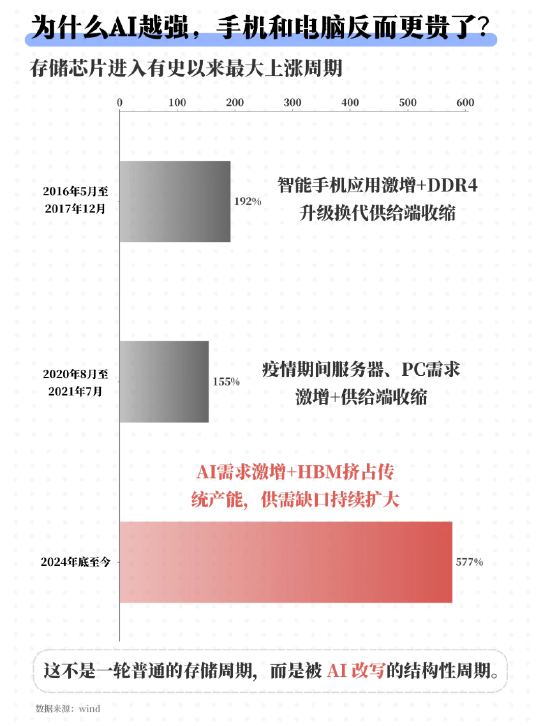
Group 1: Market Dynamics - The storage chip market is experiencing its largest price increase cycle in history, driven by AI demand and supply constraints [1][19] - Traditional DRAM products have seen a cumulative price increase of nearly 600%, significantly exceeding historical trends [19][20] - Major companies like Samsung, SK Hynix, and Micron are increasing HBM capacity, which is squeezing traditional DRAM supply [19][20] Group 2: Company Performance - Changxin Technology, the largest DRAM IDM company in China, is projected to raise approximately 29.5 billion yuan through its IPO, making it the second-largest IPO in the Sci-Tech Innovation Board's history [19] - The company is expected to achieve a compound annual revenue growth rate of over 70% from 2022 to 2024, with a revenue forecast of 55-58 billion yuan for 2025 [19][21] - Despite rapid growth, Changxin's revenue is currently about one-eighth that of industry leaders, indicating a significant capacity gap [20][21] Group 3: Technological Advancements - Changxin has achieved advanced product performance with LPDDR5X and DDR5, but still lags behind international competitors in process technology by 1.5 to 2 generations [17][20] - The company has not yet mass-produced HBM products, while international firms are advancing towards HBM4 [17][20] Group 4: Market Valuation - The market is pricing in the scarcity of Changxin Technology, with expectations that its valuation could approach 1 trillion yuan post-IPO [21] - Based on a revenue estimate of 55 billion yuan for 2025, the company's valuation could center around 600 billion yuan, with a potential upper limit of 900 billion yuan when considering strategic premiums [21] - The high valuation expectations reflect the market's focus on Changxin as "China's first storage stock," but also imply higher performance expectations [21]
还在涨!存储、TDK、ST等热门芯片料号鉴定
芯世相· 2026-01-30 04:23
Core Viewpoint - The article discusses the rising prices and demand for various semiconductor components in January, highlighting specific products that have seen significant price increases and market interest [3][4][9][12][16][18][21][25]. Group 1: NOR Flash - The prices of NOR Flash products W25Q128JV and W25Q64JV have increased, with W25Q128JV rising from approximately 6 RMB to 8-10 RMB, and W25Q64JV from around 3 RMB to 5-8 RMB [4][6]. - The global second-ranked NOR Flash, GD25Q128ESIGR, has also seen a price increase from nearly 4 RMB to 4-6 RMB, with its applications in industrial control and consumer electronics [21]. Group 2: Motion Sensors - The ICM-42688-P motion tracker has experienced a price surge from about 30 RMB to 50-60 RMB, with some quotes exceeding 70 RMB, while ICM-42670-P has risen from 5-6 RMB to 15-16 RMB [9][11]. - Both sensors are designed for low-power applications in AR/VR, wearables, and IoT devices [11]. Group 3: DDR Memory - The DDR3 memory chip MT41K256M16TW-107:P has seen its price rise from just over 20 RMB to around 30 RMB [12][13]. - The DDR5 chip H5CG48AGBDX018N has experienced a dramatic price increase, reaching approximately 390 RMB, up from around 46 RMB [16]. Group 4: eMMC - The eMMC chip KLM8G1GETF-B041 has increased in price from 70-80 RMB to about 120 RMB, with a significant rise from 28 RMB a year ago [18][19]. Group 5: MEMS Accelerometers - The LIS3DHTR MEMS accelerometer has seen its price fluctuate between 1.7-2.5 RMB, with a notable increase from 2 RMB at the end of last year [25].

集邦咨询发布存储现货价格趋势报告:DDR4/DDR5交易停滞 NAND持续看涨但成交平淡
智通财经网· 2026-01-29 09:24
Group 1 - The core viewpoint of the article indicates that the DRAM market is experiencing stagnant procurement due to rising prices of DDR4 and DDR5, while NAND prices are also increasing but facing weak consumer demand [1][2][4] Group 2 - In the DRAM spot market, factories have halted purchases due to significant price increases and challenges in cost transfer, leading to stagnant trading; however, ongoing supply shortages keep prices high [2] - The average price of mainstream DDR4 1Gx8 3200MT/s increased by 1.98% this week, rising from US$30.30 to US$30.90 [2] - In the NAND Flash spot market, prices have continued to rise, with a 5.58% increase in the average price of 512Gb TLC Wafer, reaching US$16.310; however, weak consumer demand and uncertainty around production capacity during the upcoming Spring Festival have led some buyers to adopt a wait-and-see approach [4]