Meshy

Search documents
原神LOL齐聚的Unity开发者大会,我看到了AI游戏的未来
量子位· 2025-11-01 03:59
Core Insights - The article emphasizes the transformative impact of AI on the gaming industry, highlighting its role in enhancing creativity and efficiency in game development [1][7][15]. Group 1: AI Integration in Game Development - The integration of AI in game development is becoming essential, with only 4% of developers currently not using AI tools [6]. - Unity's latest engine version focuses on AI capabilities, allowing developers to create 3D models in hours instead of days or months, improving 2D design efficiency by 30% and 3D asset production efficiency by 70% while reducing costs to 90% of previous levels [10][13]. - The AI Graph platform introduced by Unity and Tencent simplifies the AI development process, making it accessible even for beginners [11][14]. Group 2: AI's Role in Game Lifecycle - AWS outlines AI's role across the entire game lifecycle, focusing on building, running, and growing games [19][22]. - In the building phase, AI enhances development efficiency, content richness, and cost reduction, while in the running phase, it improves performance and operational efficiency [23][24]. - For growth, AI aids in player engagement and monetization strategies through data analysis and personalized recommendations [25][26]. Group 3: 3D GenAI and Cost Efficiency - Meshy, a 3D GenAI tool, is revolutionizing the creation of 3D assets, significantly reducing costs and development time for AAA games, which typically require substantial resources [32][39]. - The tool allows for rapid generation of 3D models, enabling smaller studios to validate concepts quickly and efficiently [41][43]. - The integration of 3D GenAI is seen as a critical factor in reducing the high costs associated with AAA game development, which can reach up to $200 million [39][40]. Group 4: Market Trends and Player Acceptance - The trend of AI in gaming is gaining momentum, with 60% of Chinese studios already utilizing generative AI in their development processes [48]. - Despite the growing acceptance of AI tools among developers, there remains a cautious sentiment among players regarding AI-generated content, necessitating transparency and trust-building measures from game companies [62][65]. - The article suggests that as AI capabilities improve, player acceptance will likely increase, leading to a new form of game creation [66].



Teable 宣布完成数百万美元天使轮融资,让数据库「长出耳朵和手」
Sou Hu Cai Jing· 2025-09-19 14:14
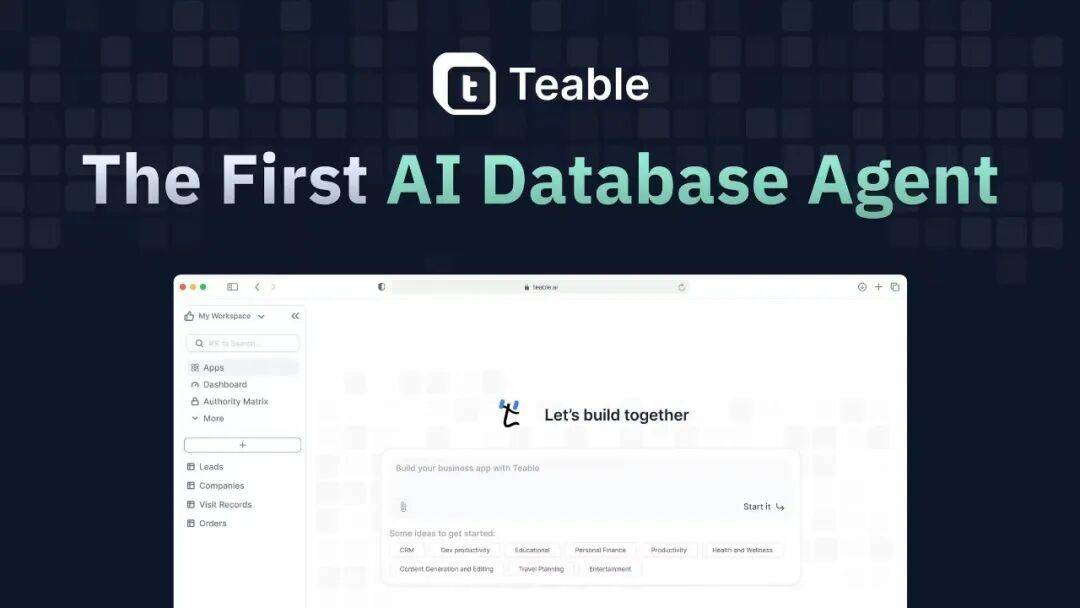
Core Insights - Teable has launched the world's first AI Database Agent, Teable 2.0, which integrates capabilities such as conversational database creation, application generation, automation, data analysis, and bulk content generation, allowing users to perform complex data tasks using natural language [2][4][10] - The company has completed a multi-million dollar angel round of financing, with investors including Zhen Fund, Baidu Ventures, and Vertex Ventures [2] - Teable aims to solve the "three-way paradox" of big data volume, real-time collaboration, and ease of use, which has troubled the industry for years [4][15] Company Overview - Teable's founder, Chen Jiabei, has a strong background in the multi-dimensional table field, having been a founding member of Feishu's multi-dimensional table and co-founder of Vika [4][15] - The company has restructured its data layer to ensure that applications are built directly on the database, facilitating seamless integration of reading, writing, permissions, auditing, and automation [5][10] - Teable's approach allows non-technical users to easily create operational business scenarios using natural language, thus democratizing access to industrial-grade AI capabilities [6][8] Product Features - Teable 2.0 offers six core functionalities, including conversational data table application building and bulk file organization, which significantly simplify data-related tasks [11][18] - The product has gained significant traction, with over 1.1 million views on social media and high engagement on platforms like Hacker News and GitHub [4][11] - Teable's architecture supports high concurrency, complex permissions, and full-link auditing, making it suitable for industries with stringent data sovereignty and compliance requirements [21] Market Position - Teable positions itself as a world-class AI Database Agent, differentiating itself from competitors like Airtable by offering a more integrated and user-friendly experience [10][11] - The company has achieved recognition in the developer community, with its open-source version accumulating 20,000 stars on GitHub within a year [13] - Teable's focus on ease of use and data autonomy is expected to appeal to a wide range of enterprise clients, from small teams to large corporations [21]
这是最新AI产品百强 | 量子位智库AI 100
量子位· 2025-07-30 23:56
Core Viewpoint - The article discusses the evolution of AI products in China, highlighting a shift from rapid growth to a phase of refinement and competition based on user experience and retention [2][3][4]. Group 1: Current Landscape of AI Products - The AI product market is showing a "stronger stronger" trend, with the top five AI products capturing over half of the market share [9]. - Leading products such as Doubao, Quark, and DeepSeek dominate both web and app platforms, establishing themselves as national-level AI products [9]. - AI smart assistants remain the most popular category, accounting for approximately 40% of monthly active users on web platforms and daily active users on mobile apps [9]. Group 2: Evaluation Methodology - The "AI 100" dual list employs a combination of quantitative and qualitative assessment methods to ensure objectivity and accuracy [7][10]. - Quantitative metrics include user scale, growth, activity, and retention, with over 20 specific indicators such as total downloads and active user numbers [10]. - Qualitative assessments focus on long-term development potential, considering factors like underlying technology, market space, and monetization potential [10]. Group 3: Emerging Opportunities and Challenges - New opportunities are emerging in the low-code platform and AI programming tool sectors, with products like Vibe Coding gaining traction [11]. - Traditional popular sectors like AI creation and companionship face intense competition and challenges of homogenization, particularly in areas like AI writing and image generation [11]. - Smaller products are under pressure from larger competitors and may face marginalization unless they innovate in user interaction or product design [11]. Group 4: Insights from the Flagship and Innovation Lists - The flagship list indicates that large companies maintain dominance, with a focus on systematic capabilities and new market opportunities for breakthroughs [13]. - The innovation list highlights products that are rapidly growing and show potential for technical breakthroughs, often targeting niche markets [14][15]. - The trend towards vertical AI applications is increasing, with many small, specialized applications emerging in fields like healthcare and mental wellness [19]. Group 5: Future Implications - The dual structure of flagship and innovation products illustrates a comprehensive map of the AI product landscape, with established products evolving from tools to assistants [22]. - As user expectations shift from mere functionality to long-term value, AI products must demonstrate sustainability and market resilience [23][24]. - The outcomes of these evaluations will shape the AI industry landscape for the coming year and beyond [24].