PF'3944

Search documents
辉瑞2025年财报:非新冠业务增长6%,减重新药数据亮眼
Jing Ji Guan Cha Wang· 2026-02-12 15:10
Core Insights - Pfizer's total revenue for 2025 was $62.6 billion, a 2% year-over-year decline, but core business revenue grew by 6% when excluding COVID-19 products, indicating robust growth in non-COVID segments [1] - Adjusted EPS for 2025 was $3.22, a 4% increase, driven by cost-cutting measures and improved operational efficiency [1] - The management reaffirmed its 2026 guidance, expecting revenue between $59.5 billion and $62.5 billion, with adjusted EPS projected at $2.80 to $3.00 [1] Financial Performance - In Q4 2025, Pfizer's revenue reached $17.6 billion, with a 9% year-over-year increase when excluding COVID-19 products, highlighting accelerated business transformation [1] - Non-COVID products like the anticoagulant Eliquis generated $8 billion in revenue (up 8%), and the pneumonia vaccine Prevnar contributed $6.5 billion, providing stable growth to offset declines in COVID-related sales [3] Market Analysis - According to a report by CMB International, Pfizer's Q4 performance exceeded expectations, with promising data from the weight-loss pipeline PF'3944 showing a 12.3% weight reduction in the mid-dose group, indicating competitive potential against Eli Lilly's tirzepatide [2] - Analyst ratings for Pfizer range from $26 to $30, with Scotiabank maintaining a "Buy" rating and a target price of $30, emphasizing improvements in cash flow and pipeline catalysts [2] Stock Performance - Over the past week (February 5 to 11, 2026), Pfizer's stock price fluctuated by 3.55%, with a range of $26.46 to $27.94, closing at $27.73 on February 11, reflecting a daily increase of 0.43% and a trading volume of $1.157 billion [4] - Year-to-date, Pfizer's stock has risen by 13.23%, outperforming the pharmaceutical sector, which saw a slight decline of 0.02% during the same period [4]
Can Pfizer Crash the Lilly and Novo Nordisk Weight-Loss Party?
The Motley Fool· 2026-02-05 08:45
Core Insights - Eli Lilly and Novo Nordisk currently dominate the obesity drug market, with Eli Lilly's Zepbound generating $13.5 billion in sales in 2025 and Mounjaro bringing in nearly $23 billion, while Novo Nordisk's obesity franchise earned approximately $13 billion [1] - Pfizer, despite not generating revenue in the obesity drug market last year, is positioning itself to compete with Lilly and Novo Nordisk through strategic acquisitions and innovative product development [2][4] Pfizer's Strategy - Pfizer's acquisition of Metsera for $7 billion, potentially rising to $10 billion, aims to re-enter the GLP-1 market after previous setbacks with danuglipron [4] - The company is optimistic about its PF'3944 drug, with encouraging Phase 2b clinical study results, and plans to initiate a Phase 3 study later this year [5] - Pfizer's Chief U.S. Commercial Officer highlighted that PF'3944's efficacy, combined with a monthly injection regimen, could appeal to patients and healthcare providers, differentiating it from competitors' weekly injections [6] Market Potential - Pfizer plans to conduct over 20 clinical trials for obesity drugs in 2026, including 10 late-stage studies for PF'3944, indicating a strong commitment to capturing market share [7] - The collaboration with YaoPharma for the oral GLP-1 agonist YP05002 demonstrates Pfizer's intention to compete in both injectable and oral therapy markets [8] - The obesity drug market is projected to reach $150 billion, presenting significant growth opportunities for Pfizer as it develops its pipeline [9] Investment Outlook - Pfizer is considered an attractive high-yield dividend stock with a forward dividend yield of 6.4%, providing investors with returns while waiting for product approvals [10] - The competitive landscape may shift as Pfizer prepares to enter the market, suggesting that Lilly and Novo Nordisk should capitalize on their current advantages while they last [10]



招银国际每日投资策略-20260205
Zhao Yin Guo Ji· 2026-02-05 05:29
Core Insights - Pfizer reported strong Q4 2025 earnings with revenue of $17.6 billion, aligning closely with previous expectations of $18.1 billion, and adjusted net income of $3.8 billion, exceeding the prior forecast of $3.3 billion [2] - Total revenue for 2025 is projected at $62.6 billion, a 2% year-over-year decline, but operational revenue excluding COVID-19 products grew by 6%, indicating robust underlying business momentum [2] - The management reaffirmed guidance for 2026, expecting revenue between $59.5 billion and $62.5 billion, with adjusted EPS ranging from $2.80 to $3.00, highlighting a year rich in catalysts [2] Company Analysis - Pfizer's pipeline includes significant catalysts such as long-acting GLP-1 and Amylin projects, with key data readouts expected in 2026 [2] - The VESPER-3 study demonstrated a 12.3% weight loss effect at the 28-week mark for the mid-dose group of PF'3944, with predictions suggesting a 15.8% weight loss for the high-dose group [6] - The company plans to initiate a Phase 3 study for PF'3944 later this year, with further updates on its obesity product portfolio expected [6][7] Market Performance - The Hang Seng Index closed at 26,847, reflecting a slight increase of 0.05% for the day and a year-to-date gain of 4.75% [2] - The U.S. stock market saw declines, particularly in technology and consumer discretionary sectors, while energy and materials sectors showed strength [4] - Notable movements included a 17% drop in AMD shares following weak guidance, impacting the semiconductor sector [4]
辉瑞:肥胖领域风险降低推动重估潜力-20260205
Zhao Yin Guo Ji· 2026-02-05 03:24
Investment Rating - The report maintains a "Buy" rating for Pfizer Inc. (PFE US) with a target price of $35.46, down from the previous target of $36.16, reflecting a potential upside of 32.4% from the current price of $26.78 [5][7]. Core Insights - Pfizer reported strong Q4 2025 results with revenues of $17.6 billion, aligning closely with the forecast of $18 billion. Adjusted net income was $3.8 billion, exceeding the estimate of $3.3 billion. Excluding COVID-19 products, operational revenue grew by 6% year-over-year, indicating a robust business foundation [3]. - The management reiterated revenue guidance for 2026 at $59.5 billion to $62.5 billion, with adjusted EPS projected between $2.80 and $3.00. Anticipated catalysts for 2026 include key data releases for long-acting GLP-1 and insulin projects, as well as positive clinical progress for obesity products and PF'4404 [3][5]. - The VESPER-3 study results for PF'3944 showed a 12.3% weight reduction at the medium dose, with expectations for the high dose to achieve a 15.8% reduction, positioning it competitively against alternatives [4]. - Pfizer is rapidly advancing the integration of PF'4404 (PD-1/VEGF) with its leading ADC product portfolio, aiming to establish a dominant position in the oncology market [5]. Financial Summary - For FY2026, revenue is projected at $60.7 billion, with a year-over-year decline of 2.9%. Adjusted net income is expected to be $16.34 billion, reflecting an 8.8% decrease from the previous year [6][16]. - The report outlines a decrease in P/E ratios, with FY2026 expected at 14.1x, down from 19.6x in FY2024, indicating a shift in valuation metrics [6][17]. - The DCF valuation estimates a share value of $35.46, based on a WACC of 9.95% and a terminal growth rate of 2.0% [13][14].
招财日报:每日投资策略-20260205
Zhao Yin Guo Ji· 2026-02-05 03:07
Market Performance - The Hang Seng Index closed at 26,847, with a slight increase of 0.05% for the day and a year-to-date increase of 4.75% [1] - The Hang Seng Technology Index decreased by 1.84% for the day and is down 2.71% year-to-date [1] - The US stock market saw the Dow Jones increase by 0.53%, while the S&P 500 and Nasdaq fell by 0.51% and 1.51%, respectively [1] Sector Performance - In the Hong Kong market, the financial sector increased by 0.66% and is up 8.51% year-to-date, while the industrial sector decreased by 0.48% [2] - The real estate sector in Hong Kong saw a significant increase of 1.99% for the day and is up 17.13% year-to-date [2] Capital Flows - Southbound funds recorded a net inflow of 13.373 billion HKD, with Tencent, Alibaba, and Xiaomi being the top net buyers [3] - In contrast, SMIC, Hua Hong Semiconductor, and Jun Da Co. were the most sold stocks [3] US Market Trends - The US stock market experienced a sell-off in technology stocks, particularly in software and semiconductor sectors, with AMD's weak guidance leading to a 17% drop [3] - The S&P 500 software sector has seen an average decline of 25% since reaching a historical high last October [3] Company Analysis: Pfizer (PFE US) - Pfizer reported strong Q4 2025 earnings with revenue of 17.6 billion USD, slightly below the expected 18.1 billion USD, but adjusted net income exceeded expectations at 3.8 billion USD [4] - The company anticipates 2026 revenue between 59.5 billion to 62.5 billion USD, with adjusted EPS guidance of 2.80 to 3.00 USD [4] - Key upcoming milestones include data readouts for long-acting GLP-1 and Amylin projects, which are expected to drive significant valuation re-evaluation [4] Clinical Developments - Pfizer's VESPER-3 study showed a 12.3% weight loss effect at the 28-week mark for its long-acting GLP-1 candidate, with a potential 15.8% weight loss projected for a higher dose [5] - The company plans to initiate a Phase 3 study for the higher dose later this year, with detailed data expected at the ADA conference in June [5] Oncology Pipeline - Pfizer is advancing its PD-1/VEGF and ADC combination therapies, with ongoing Phase 3 trials for PF'4404 in colorectal cancer and additional trials planned for 2026 [6] - The market narrative is shifting towards pipeline execution strength, with obesity products and PF'4404 clinical progress expected to drive stock price increases [6]
辉瑞(PFE.US)超长效减重疗法取得积极顶线结果 将启动3期试验
智通财经网· 2026-02-03 23:59
Core Insights - Pfizer (PFE.US) announced positive topline results for its long-acting injectable GLP-1 receptor agonist PF'3944 (MET-097i) in the phase 2 VESPER-3 study, targeting adults with obesity or overweight without type 2 diabetes [1][2] Group 1: Study Results - In the VESPER-3 study, patients in the first and third groups experienced weight reductions of 10% and 12.3% respectively compared to the placebo group by week 28, indicating sustained weight loss without reaching a plateau [1] - The treatment demonstrated a favorable safety profile consistent with GLP-1RA class drugs, with mostly mild to moderate gastrointestinal adverse events observed [2] Group 2: Drug Development Pipeline - Following the recent acquisition of Metsera and a global exclusive collaboration with YaoPharma, Pfizer has established a diversified pipeline of obesity candidates, including injectable and oral GLP-1 receptor-targeting drugs, GIPR agonists and antagonists, and insulin analogs [3] - Pfizer plans to advance a large-scale obesity development program, expecting to initiate over 20 clinical trials by 2026, including 10 phase 3 studies for PF'3944 [3]
速递|28周减重12.3%,辉瑞100亿美元月度GLP-1药物展现强劲减重效果
GLP1减重宝典· 2026-02-03 15:21
Core Viewpoint - Pfizer's PF'3944, a monthly injectable GLP-1 receptor agonist, shows promising weight loss results in its Phase IIb clinical trial, validating the company's $10 billion investment in the Metsera drug [4]. Group 1: Clinical Trial Results - In the Vesper-3 trial, approximately 250 overweight or obese adults without type 2 diabetes were randomly assigned to receive one of four dosing regimens of PF'3944 or a placebo [4]. - At week 28, the placebo-adjusted weight loss for the low and medium dose monthly maintenance regimens of PF'3944 was reported at 10% and 12.3%, respectively [4]. - Patients maintained stable weight loss after switching to monthly dosing, with no plateau observed at week 28, indicating potential for continued weight loss in the following weeks [4]. Group 2: Analyst Insights - BMO Capital Markets analysts expressed cautious optimism regarding the data, noting that a 12.3% weight loss at week 28 appears competitive, especially in combination studies with Pfizer's other projects [6]. - The monthly dosing data aligns with competitor performance, suggesting PF'3944 can provide competitive weight loss effects while avoiding the inconvenience of weekly injections [6]. - Pfizer plans to explore higher doses in its Phase III trials, with expectations that placebo-adjusted weight loss could reach around 16% based on high-dose predictions [6]. Group 3: Safety and Future Plans - Pfizer has not yet released complete safety data for week 28, but existing gastrointestinal adverse event data indicates that most side effects were mild to moderate, with few severe cases of nausea or vomiting [8]. - In the low and medium dose groups, 10 patients discontinued treatment due to adverse events, while no patients in the placebo group stopped treatment for this reason [8]. - Pfizer is initiating Phase III trials for PF'3944 with weekly dosing and plans to start an additional nine Phase III studies this year, focusing on both diabetic and non-diabetic patients, as well as evaluating monthly dosing regimens [8].

Pfizer's Newly Acquired Drug Shows Weight Loss Of Just Around 13%, Stock Drops
Benzinga· 2026-02-03 13:50
Core Insights - Pfizer Inc. reported positive topline data from a mid-stage study for its weight loss drug PF'3944 and exceeded fourth-quarter earnings expectations [1][6] Weight Loss Data - The Phase 2b VESPER-3 study showed a mean placebo-adjusted weight loss of up to 12.3% at week 28 for adults with obesity or overweight [2] - At week 28, Arms 1 and 3 achieved 10% and 12.3% placebo-adjusted weight loss, respectively, indicating robust weight loss without a plateau [3] - PF'3944 maintained a favorable safety profile, with mostly mild or moderate gastrointestinal adverse events reported [4] Clinical Development - Pfizer plans to initiate ten Phase 3 trials for PF'3944 in 2026, as part of a broader clinical development program with over 20 studies planned or ongoing [5] Fourth Quarter Earnings Snapshot - Adjusted earnings for Q4 2025 were 66 cents, up from 63 cents year-over-year, surpassing the consensus estimate of 57 cents [6] - Q4 sales decreased by 1% year-over-year to $17.56 billion, exceeding the consensus of $16.96 billion, reflecting a 3% operational decline [6] Revenue Drivers - The operational decline was mainly due to reduced COVID-19 product revenues, partially offset by increases in sales of Abrysvo, oncology biosimilars, and other products [7] - Comirnaty sales fell 35% to $2.27 billion, while Paxlovid sales dropped 70% to $218 million due to lower COVID-19 infections [8] Core Drugs Performance - Sales of the heart drug Vyndaqel family increased by 7% to $1.69 billion, while cancer drug Ibrance sales decreased by 5% to $1.04 billion [9] - Blood thinner Eliquis revenues rose by 8% to approximately $2.02 billion, and Prevnar sales also increased by 8% to $1.71 billion [10] Outlook - Pfizer reaffirmed its fiscal 2026 adjusted earnings guidance of $2.80-$3.00 per share, compared to the consensus of $2.97 [11] - The company expects approximately $5 billion in revenues from COVID-19 products and anticipates a negative revenue impact of about $1.5 billion due to loss of exclusivity for certain products [12] Stock Performance - Pfizer's stock was down 5.10% at $25.30 during the premarket session [13]
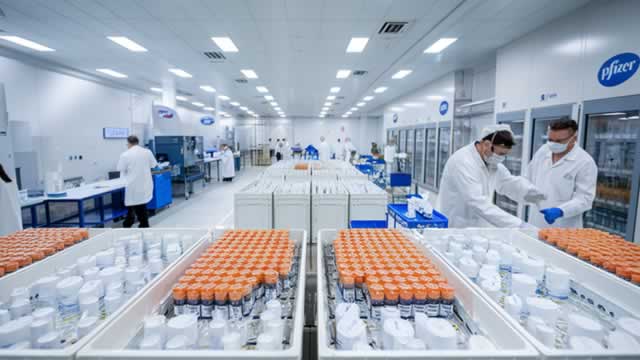
Pfizer says obesity injection shows promise as monthly treatment in mid-stage trial
CNBC· 2026-02-03 12:18
Core Insights - Pfizer's experimental obesity drug, acquired through Metsera, demonstrated significant weight loss in a mid-stage trial, with patients losing up to 12.3% of their weight compared to placebo at week 28 [1] - The injection's weight loss efficacy was noted to be 10.5% when considering all patients, regardless of discontinuations [1] Group 1 - The data suggests that the injection can be administered less frequently than existing treatments without losing efficacy, positioning Pfizer favorably in a market currently led by Eli Lilly and Novo Nordisk [2] - Pfizer plans to initiate 10 phase three trials for the injection, named PF'3944, within the year [2] Group 2 - Dr. Jim List, Pfizer's chief internal medicine officer, stated that the topline results support the potential of PF'3944 as a monthly treatment with competitive efficacy [3] - The trial involved patients transitioning from weekly to monthly injections, with no plateau in weight loss observed after the switch [3]