
Polivy

Search documents
全球药王易主
21世纪经济报道· 2026-03-10 11:24
Core Viewpoint - The global pharmaceutical industry is experiencing a new competitive landscape as multinational companies release their 2025 performance reports, with Johnson & Johnson leading in total revenue at $94.193 billion, followed by Eli Lilly with a remarkable growth rate of 44% [1][2]. Group 1: Financial Performance of Major Pharmaceutical Companies - Johnson & Johnson achieved total revenue of $94.193 billion, with its innovative pharmaceuticals and medical technology segments generating $60.401 billion (+6%) and $33.792 billion (+6.1%) respectively [2]. - Eli Lilly reported a total revenue of $65.179 billion, marking a significant growth of 44% [2]. - Roche, Merck, Pfizer, AbbVie, AstraZeneca, and Novartis also showed upward revenue trends, contributing to the steady growth of the global pharmaceutical industry [1][2]. Group 2: Strategic Adjustments and Leadership Changes - Sanofi appointed Belén Garijo as the new CEO, focusing on enhancing the productivity and innovation capabilities of the R&D department [3]. - Merck announced a reorganization of its pharmaceutical business into two segments: oncology and specialty, aiming to maintain its leadership in cancer treatment [3]. - The global pharmaceutical industry is expected to see continued growth differentiation, with only Eli Lilly providing a double-digit revenue growth forecast for 2026 [3]. Group 3: Competition for the "King of Drugs" Title - In 2025, Eli Lilly's Tirzepatide secured the title of "King of Drugs" with a revenue contribution of $36.5 billion, while Merck's Keytruda generated $31.68 billion, marking a 7% increase [6][7]. - Novo Nordisk's Semaglutide followed closely with $36.1 billion in sales, reflecting over 10% growth [7]. - The GLP-1 drug market is becoming increasingly competitive, with both Eli Lilly and Novo Nordisk dominating the landscape [8]. Group 4: Performance in the Chinese Market - AstraZeneca maintained its leading position in the Chinese market with a revenue of $6.654 billion, representing a 4% increase [12]. - Roche and Novartis were among the top three companies in terms of revenue growth in China, with Roche achieving a 10% increase [13]. - Companies are increasingly focusing on local partnerships and innovations to enhance their market presence in China [14]. Group 5: Patent Expiration and New Growth Opportunities - Many multinational pharmaceutical companies are facing significant risks due to impending patent expirations, with some companies exposed to risks as high as 70% [16]. - The industry is witnessing a surge in business development activities, with 142 innovative drug transactions reported in 2025, marking a new high [17]. - Companies are increasingly seeking new growth avenues through mergers, acquisitions, and collaborations to mitigate the impact of patent cliffs [19].






1700亿“专利悬崖”,罗氏走出来了
3 6 Ke· 2026-02-02 12:21
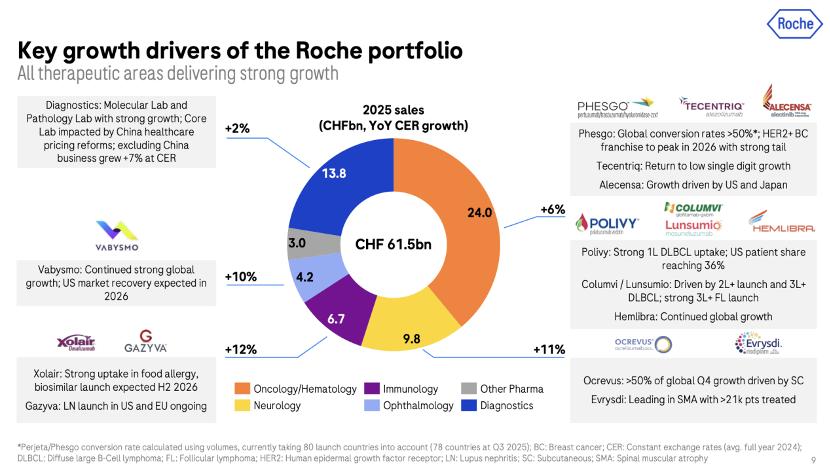
Core Insights - Roche, once a dominant player in oncology, has shown a revenue growth of 7% and a 9% increase in its pharmaceutical business, indicating a strategic recovery and diversification in its product portfolio [1][3] - The company is focusing on six key products, including Phesgo and Polivy, which are driving growth and compensating for declines in older drugs due to patent expirations [1][5] - Roche plans to launch 19 new drugs by 2030, with 16 having blockbuster potential, aiming to avoid the so-called "patent cliff" [1][3] Oncology Business - Roche's oncology segment has seen continuous growth for eight consecutive quarters, contributing 239.38 billion Swiss Francs (approximately 289.5 billion USD) in 2025, a 6% year-over-year increase [3] - Phesgo has emerged as a standout product with a 48% sales increase, leveraging its innovative dual-target subcutaneous formulation [5][6] - The HER2-targeted therapies are expected to peak at around 9 billion Swiss Francs by 2026, with a stable revenue stream projected thereafter [6] New Drug Developments - Roche is optimistic about Giredestrant, a new oral SERD for ER-positive breast cancer, which is anticipated to become a first-line treatment option, with peak sales expectations exceeding 3 billion USD [7][8] - The company has achieved significant milestones in clinical trials, particularly with the lidERA study, which shows promise in reducing recurrence risk in early-stage breast cancer patients [7] Hematology Sector - Roche's hematology products generated 86 billion Swiss Francs in 2025, marking a 15% increase, with Polivy being a key driver of this growth [9][10] - Polivy has become a leading first-line treatment for diffuse large B-cell lymphoma (DLBCL), achieving sales of 14.7 billion Swiss Francs in 2025, a 38% increase [10] Strategic Expansion into Chronic Diseases - Roche is diversifying its portfolio by investing over 20 billion USD in chronic disease areas such as obesity and Alzheimer's, aiming to become a top player in the obesity market [11][12] - The company has made significant acquisitions and partnerships to build a robust pipeline in obesity treatments, including GLP-1 receptor agonists and long-acting insulin analogs [11][15] Future Outlook - Roche's strategy emphasizes maintaining a diverse product portfolio to mitigate risks associated with patent expirations, with a focus on innovative therapies in various therapeutic areas [12][16] - The next few years will be critical for validating Roche's ambitious plans and determining the sustainability of its new growth trajectory [18]
明慧医药拟港交所上市,抗体偶联药领域会二次爆发吗?
Xin Lang Cai Jing· 2025-11-27 10:14
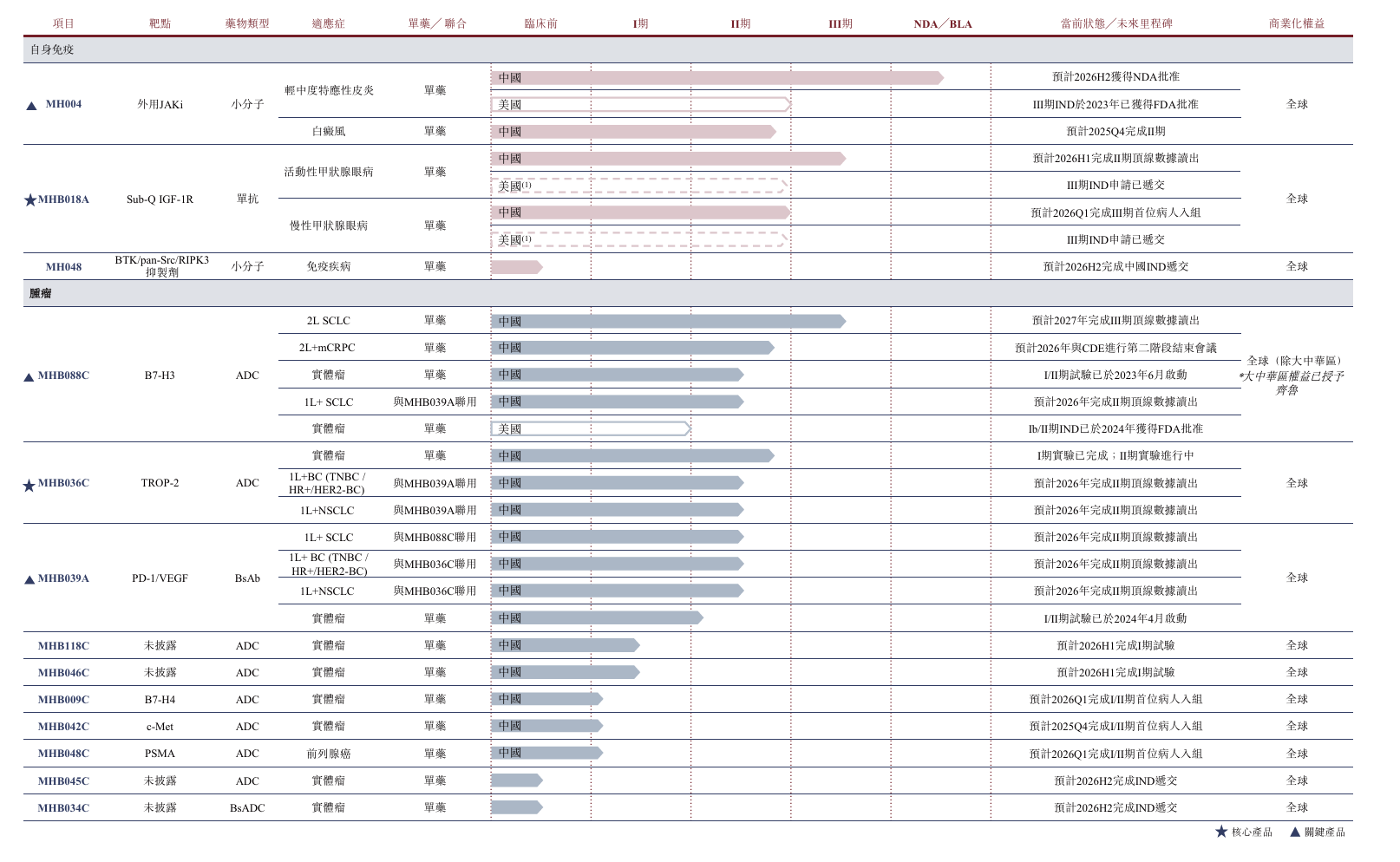
Core Viewpoint - Minghui Pharmaceutical has submitted its IPO application, focusing on its pipeline of nearly 10 antibody-drug conjugates (ADCs) in early development stages, including targets like TROP-2, B7-H3, B7-H4, c-Met, and PSMA, as well as a PD-1/VEGF bispecific antibody [1][4]. Group 1: Company Overview - Minghui Pharmaceutical was established in 2018 and is currently developing a range of ADCs, with a notable focus on innovative drug development [1]. - The company has no marketed products yet and is facing significant competition in the ADC space, particularly from companies like Hansoh Pharmaceutical [5][9]. - The founder and chairman, Cao Guoqing, previously held a senior position at Heng Rui Pharmaceutical, which adds credibility to the company [8]. Group 2: Financial Performance - The company reported losses of 137 million yuan in 2023 and 283 million yuan in 2024, with no revenue expected in these years [5][7]. - In the first half of 2025, the company generated revenue of 264 million yuan but incurred a loss of 167 million yuan [7]. - The company’s cash and cash equivalents were reported at 1.3 billion yuan in 2023 and 290 million yuan in 2024, indicating a potential liquidity issue [7]. Group 3: Product Pipeline and Market Potential - The ADC market is experiencing significant growth, with products like Enhertu generating sales of 1.976 billion USD in the first three quarters of the year, reflecting a 37% year-on-year increase [1]. - Minghui's B7-H3 ADC (MHB088C) has been licensed to Qilu Pharmaceutical for development in Greater China, with an initial payment of 280 million yuan and potential milestone payments exceeding 1 billion yuan [4]. - The company is also developing a topical JAK inhibitor for atopic dermatitis, which is closest to commercialization, with its application already accepted [5]. Group 4: Industry Trends - The ADC sector is evolving, with innovations in antibody, payload, linker, and conjugation technologies expected to enhance clinical differentiation and market potential [8]. - Chinese companies are moving from a fast-follow approach to becoming global leaders in ADC development, with a focus on innovative targets and combination therapies [8].
抗体偶联药物ADC产业投资框架:“精准化疗”引爆千亿市场,中国创新引领全球浪潮
Shanghai Aijian Securities· 2025-11-21 06:59
Investment Rating - The report rates the industry as "Outperform" [2] Core Insights - The global market for Antibody-Drug Conjugates (ADC) is projected to exceed $100 billion, driven by the dual advantages of targeted therapy and potent cytotoxic effects [2][3] - ADCs are recognized as a promising new therapy in oncology, with the potential to redefine standard treatments for major cancers like lung and breast cancer [2][3] - China has emerged as a key player in ADC innovation, with over 50% of global ADC pipelines originating from Chinese companies, showcasing significant cost and efficiency advantages [2][3][5] Summary by Sections Section 1: ADC as a Targeted Prodrug - ADCs utilize a "Trojan horse" strategy for targeted delivery of cytotoxic agents to tumor cells, minimizing damage to normal tissues [11][13] - The mechanism involves several steps, including circulation, target binding, internalization, and release of the active drug within the tumor cell [11][13] Section 2: Market Growth and Trends - The ADC market is expected to enter a product explosion phase, with rapid growth anticipated in the coming years [2][3] - The global ADC market size is forecasted to reach $115.1 billion by 2032 [2] Section 3: Investment Opportunities - Investment in ADCs should focus on companies with innovative technology platforms and promising product candidates [2][3] - Key players to watch include those with leading ADC technology platforms and robust pipelines, such as Kelun-Biotech, Innovent Biologics, and WuXi AppTec [2][3] Section 4: Technological Advancements - ADC technology is characterized by modular upgrades and innovative combinations, with a variety of ADC types currently in development [2][3] - The report highlights the potential for ADC technology to extend into broader categories of conjugated drugs (XDC) [2][3] Section 5: Competitive Landscape - The report emphasizes the competitive nature of the ADC industry, with numerous players vying for market share and innovation [2][3] - Chinese ADC companies are recognized for their ability to lead in innovation and capture significant market opportunities [2][3][5]


RHHBY's Sales Up 7% in First 9 Months of 2025, '25 Earnings View Raised
ZACKS· 2025-10-23 14:06
Core Insights - Roche Holding AG reported third-quarter sales of CHF 14.9 billion for 2025, reflecting a 6% year-over-year increase at constant exchange rates, driven by strong demand for its drugs [1] - For the first nine months of 2025, total sales reached CHF 45.9 billion, up 7% at constant exchange rates, with the Pharmaceuticals Division growing 9% to CHF 35.5 billion [2][8] - The Diagnostics Division's sales totaled CHF 10.3 billion, up 1%, as demand for pathology solutions and molecular diagnostics offset the impact of healthcare pricing reforms in China [3] Pharmaceuticals Division Performance - Key drugs such as Phesgo, Xolair, Hemlibra, Vabysmo, and Ocrevus generated total sales of CHF 15.8 billion, an increase of CHF 2.4 billion at constant exchange rates compared to the first nine months of 2024 [4] - Ocrevus sales reached CHF 5.2 billion, up 7%, while Hemlibra surged 12% to CHF 3.5 billion, and Vabysmo grew 13% to CHF 3 billion [5] - Xolair sales increased by 34% to CHF 2.2 billion, and Phesgo's sales skyrocketed 54% to CHF 1.8 billion [9] Diagnostics Division Performance - The Diagnostics Division's sales were CHF 10.3 billion, with growth driven by pathology solutions and molecular diagnostics [3] Financial Outlook - Roche expects total sales to grow in the mid-single-digit range at constant exchange rates for 2025, with core earnings per share projected to grow in the high single-digit to low double-digit range [12] Pipeline Developments - The FDA approved label expansions for Gazyva/Gazyvaro and Tecentriq, enhancing Roche's treatment options [13] - Positive results from the phase III evERA study on giredestrant for breast cancer were announced, showing significant reductions in disease progression risk [14] - Roche plans to acquire 89bio, Inc. for $3.5 billion to enhance its portfolio in cardiovascular, renal, and metabolic diseases [15] Competitive Landscape - Roche's drugs, particularly Vabysmo and Hemlibra, have shown strong performance, competing effectively against other market players [17][18]
三生制药(1530.HK):BD出海金额创纪录 ASCO数据表现亮眼
Ge Long Hui· 2025-06-07 18:08
Core Viewpoint - Sanofi has achieved breakthroughs in international collaboration and clinical progress for its innovative drug SSGJ-707, a PD-1/VEGF dual antibody, with a total deal value of up to $61.5 billion with Pfizer, setting a record for domestic dual antibodies going abroad [1][2][3] Event Summary - On May 20, Sanofi announced the global (excluding mainland China) development, production, and commercialization rights of SSGJ-707 to Pfizer, with a total transaction value of up to $60.5 billion, including a $12.5 billion upfront payment and potential payments of up to $48 billion, along with a two-digit percentage tiered sales share based on product sales in authorized regions [1][2] - On June 1, Sanofi presented Phase II data for SSGJ-707 at the ASCO conference, showing an objective response rate (ORR) of 75% for squamous cell carcinoma and 64% for non-squamous cell carcinoma in advanced NSCLC patients, with a disease control rate of 97% and a grade 3 or higher treatment-related adverse event (TRAE) rate of 24.1% [2][3] Product Development - SSGJ-707 is developed based on the proprietary CLF2 patent platform and is the second PD-1/VEGF dual antibody globally, currently advancing to Phase III clinical trials [3] - In previous trials, SSGJ-707 demonstrated an ORR of 58.3% in non-squamous and 81.3% in squamous patients when combined with chemotherapy, with a grade 3 or higher TRAE rate of 8.9% [4] Future Prospects - Pfizer's acquisition of Seagen for $43 billion enhances its ADC platform, which may lead to the exploration of ADC and dual antibody combination therapies in solid tumors [5][6] - Clinical studies suggest that VEGF inhibition can improve tumor microenvironment and enhance ADC penetration, while PD-1 blockade may overcome immune evasion post-ADC treatment [6] Financial Forecast - Sanofi is expected to generate revenues of 10.421 billion, 11.817 billion, and 13.277 billion yuan from 2025 to 2027, with net profits of 2.404 billion, 2.788 billion, and 3.271 billion yuan, corresponding to PE ratios of 20, 17, and 15, maintaining a "buy" rating [7]
Seagen(SGEN) - 2020 Q3 - Earnings Call Transcript
2025-04-29 20:13
Financial Data and Key Metrics Changes - Total revenues for Q3 2020 were $1.1 billion, with year-to-date revenues of $1.6 billion [21] - Product sales reached $267 million in Q3, with year-to-date product sales of $706 million [21] - Collaboration revenues significantly increased to $758 million in Q3, compared to $18 million in the same period of 2019 [22] - The company ended Q3 with $1.7 billion in cash and investments, bolstered by $725 million in upfront payments from Merck [25][26] Business Line Data and Key Metrics Changes - ADCETRIS sales were $163 million in Q3, a 3% decrease from Q3 2019, attributed to the pandemic's impact on new diagnoses [16][18] - PADCEV sales were $62 million in Q3, an 8% increase over Q2 2020, indicating strong adoption in both academic and community settings [19] - TUKYSA generated $42 million in net product revenues in its first full quarter since launch, with strong adoption and reimbursement coverage exceeding expectations [20] Market Data and Key Metrics Changes - The pandemic has led to a 15% decrease in new Hodgkin lymphoma diagnoses, impacting ADCETRIS sales [16][18] - The company is seeing a shift in site of care that negatively affected gross to net pricing for ADCETRIS [17] - The collaboration with Merck is expected to enhance global reach and patient access for TUKYSA and LV [10] Company Strategy and Development Direction - The company aims to invest in clinical development for ADCETRIS, PADCEV, and TUKYSA, while advancing late-stage pipeline products [12] - Strategic collaborations with Merck are focused on co-developing LV and TUKYSA, enhancing the company's market position [10][12] - The company plans to continue expanding its international infrastructure to support TUKYSA's launch in Europe [9] Management's Comments on Operating Environment and Future Outlook - Management expressed concern over the long-term impact of COVID-19 on cancer patient diagnoses and treatment [48][49] - The company remains optimistic about maintaining market share despite the pandemic's challenges [49] - Future guidance for ADCETRIS has been adjusted to $650 million to $660 million due to fewer new patient diagnoses [26] Other Important Information - The company is pursuing legal action against Daichi Sankyo for patent infringement related to a breast cancer drug [13] - Upcoming R&D Day is scheduled for November 16, where the company will discuss its pipeline and development activities [12] Q&A Session Summary Question: Can you comment on ADCETRIS market dynamics and diagnosis rates? - Management noted that product sales have increased year-over-year, but the pandemic has led to fewer patients starting treatment, which is concerning for future diagnoses [48][49] Question: What is the outlook for PADCEV's growth? - Management indicated that the launch has been strong, and while there may be a slight slowdown in growth, they are maintaining guidance and expect significant developments ahead [54][56] Question: Can you provide details on TUKYSA's launch and adoption hurdles? - The company reported strong uptake in both community and academic settings, with ongoing efforts to enhance awareness and access despite COVID-19 challenges [72][73] Question: How does the cash influx from Merck affect capital allocation? - Management emphasized that the priority is to drive existing products into blockbuster status while exploring new drug opportunities and maintaining innovation [89][92]
