
RoboOS

Search documents
具身智能商业化大单“含金量”几何?从业者也看不明白
Nan Fang Du Shi Bao· 2025-11-23 05:50
Core Insights - The embodied intelligence robotics industry has seen significant commercial orders in the second half of this year, creating an optimistic outlook, but there are concerns about the authenticity of these orders and whether they address real problems [1][2] - Industry experts emphasize the need for companies to focus on genuine user demands and to refine specific scenarios to ensure sustainable demand and avoid potential market bubbles [1][2] Group 1: Industry Concerns - Questions have been raised about whether the current orders in the robotics sector are driven by real needs or merely by superficial demands, which could lead to a downturn if expectations are not met [1][2] - Experts suggest that government support should focus on policy guidance rather than directly creating demand, as true demand originates from businesses and users [1] Group 2: Technological Challenges - Despite the push for commercialization, the technology behind embodied intelligence remains immature, with companies facing challenges in both hardware and software development [3][4] - Hardware issues include overheating joints, low torque density, and limited computational power, which hinder the transition of robots into real industrial and domestic applications [4] - Software development is seen as a non-linear challenge, with uncertainties about when significant breakthroughs will occur, potentially taking years [4][5] Group 3: Data and Model Training - There is an ongoing debate in the industry regarding the importance of data quality versus quantity, with some companies advocating for high-quality real-world data while others emphasize the role of simulation data [5] - The high costs associated with training embodied intelligence models pose a significant barrier for many startups, leading them to seek partnerships with research institutions for support [5][6] Group 4: Future Outlook - Experts recommend that companies focus on developing specialized models for specific scenarios to achieve high accuracy and reliability before attempting broader applications [6] - The emphasis is on surviving potential market downturns to eventually reach a more advanced stage of embodied intelligence [6]

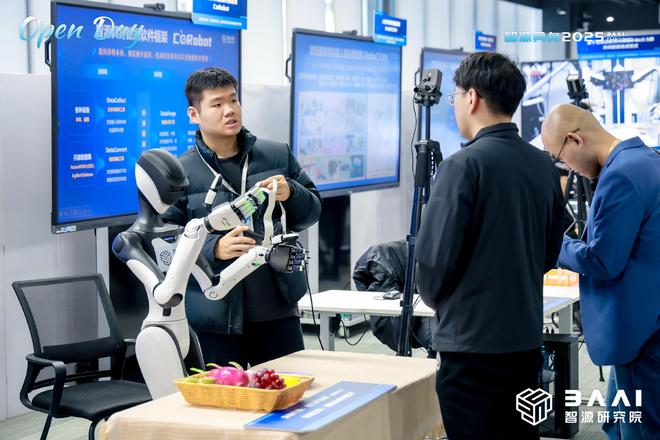
100亿都不够烧!机器人公司CEO们给出新判断:具身智能不能再照搬LLM
Sou Hu Cai Jing· 2025-11-22 02:41
Core Insights - The event highlighted the latest advancements in embodied intelligence by the Zhiyuan Research Institute, focusing on the importance of world models and the development of a comprehensive embodied brain system [2][3] Group 1: Zhiyuan's Full-Stack Layout - Zhiyuan introduced the native multimodal world model Emu3.5, which expanded training data from 15 years of video to 790 years and increased parameter size from 8 billion to 34 billion, enhancing video and image generation speed [5] - The institute is constructing a cross-heterogeneous ontology embodied intelligence system, including RoboBrain, RoboOS, and RoboBrain-0, deployed across various robotic forms for tasks ranging from navigation to complex interactions [5] Group 2: Key Elements of Embodied Intelligence - The role of world models in embodied intelligence was debated, with experts emphasizing the need for models that predict the next state based on the robot's form and goals, rather than merely generating videos [7][10] - There is a consensus that embodied intelligence should not follow the current language-first paradigm but rather adopt a structure centered on action and perception [10][12] - The importance of real data was highlighted, with discussions on the necessity of combining real, simulated, and video data for effective learning in robots [15][17] Group 3: Investment Priorities - When asked how to allocate 10 billion, experts prioritized talent acquisition, computational power, and data engines as key investment areas [19][21] - There were differing views on the importance of infrastructure versus model development, with some advocating for a focus on creating a comprehensive data engine for continuous digitalization [21][22] Group 4: Human-like Robots and Hardware Limitations - The debate on whether human-like robots represent the ultimate form of embodied intelligence concluded that neither models nor hardware define each other; rather, the specific application scenarios dictate the requirements [22][24] - Experts suggested that a layered structure for embodied intelligence should be adopted, where higher-level models can be reused across different robotic forms, but lower-level models must be tailored to specific hardware [23][24] Conclusion - The discussions at the event signaled a proactive search for solutions to achieve a closed-loop system in embodied intelligence, emphasizing the need for models, hardware, and scaling to evolve together [24]

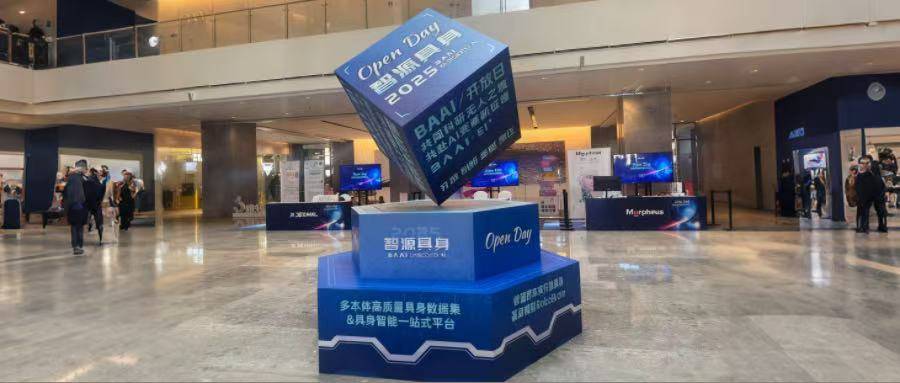
智源研究院院长王仲远:多模态大模型会给具身智能带来新变量
Xin Jing Bao· 2025-03-30 10:00
Core Insights - The topic of embodied intelligence is a major focus at the 2025 Zhongguancun Forum, with the introduction of the RoboOS framework and the open-source RoboBrain model [1][3] - Multi-modal large model technology is expected to enhance the intelligence of robots, allowing them to better understand and interact with the physical world [2][3] Group 1: Multi-modal Large Models - Multi-modal large models enable AI to perceive and understand the world through various data types, such as medical imaging and sensor data, facilitating the transition from digital to physical environments [2] - The performance improvement of large language models has slowed due to the exhaustion of available internet text data, necessitating the integration of multi-modal capabilities [2] Group 2: RoboBrain and RoboOS - RoboBrain and RoboOS are designed to support cross-scenario, multi-task deployment and collaboration among different types of robots, enhancing their general intelligence [3] - RoboBrain can interpret human commands and visual inputs to generate actionable plans based on real-time feedback, supporting various robotic configurations [3] Group 3: Industry Development and Challenges - The open-source approach is seen as a key driver for rapid development in the AI industry, allowing for collaboration among hardware, model, and application vendors [4] - Despite the potential of humanoid robots, there are significant challenges in their industrial application, with many still in the early stages of development [5] - The realization of Artificial General Intelligence (AGI) is projected to take an additional 5-10 years, influenced by advancements in embodiment capabilities and data accumulation [5]