
RoboBrain

Search documents
2025,中国大模型不信“大力出奇迹”?
3 6 Ke· 2025-12-19 11:06
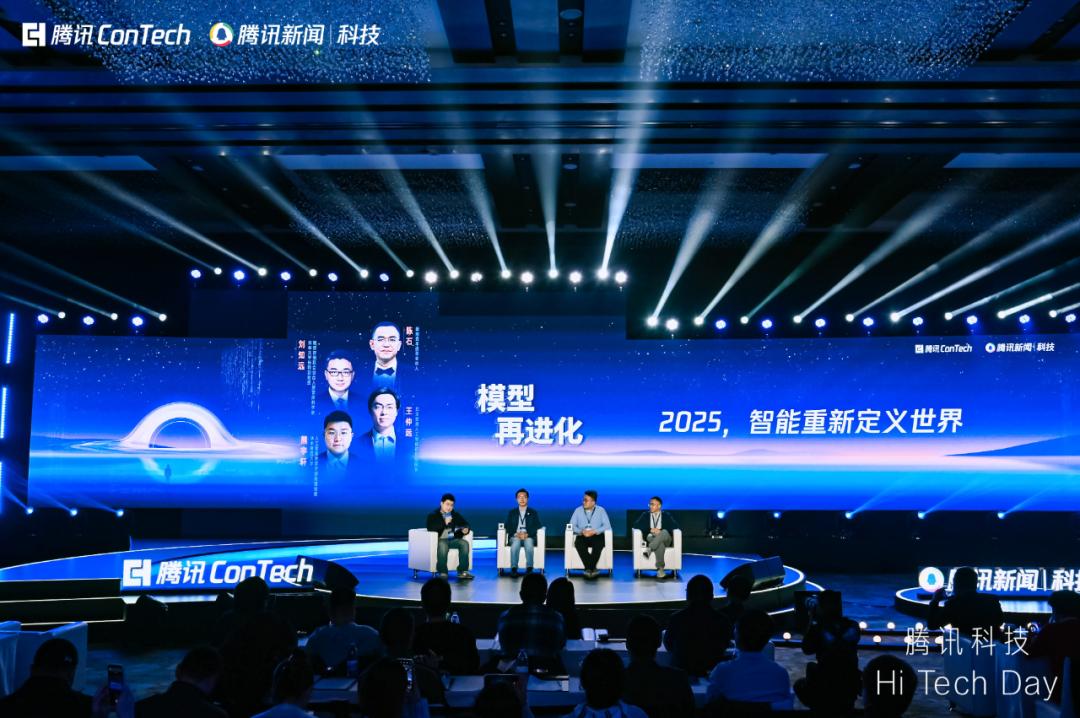
Core Insights - The article discusses the evolution of generative AI leading up to 2025, highlighting three main trajectories: cognitive deepening, dimensional breakthroughs, and efficiency reconstruction [1][2][3] Group 1: Evolution of AI Models - The first trajectory is cognitive deepening, transitioning from "intuition" to "logic," where models evolve from quick pattern matching to multi-step reasoning through reinforcement learning [1] - The second trajectory involves dimensional breakthroughs, moving from "language" to "physical space," emphasizing the importance of spatial intelligence in understanding the physical world [1][2] - The third trajectory focuses on efficiency reconstruction, shifting from "brute force aesthetics" to "cost-effectiveness," necessitating lighter model architectures to support deep reasoning and spatial understanding [1] Group 2: Key Discussions from the Forum - At the Tencent HiTechDay forum, experts discussed the evolution of large models, emphasizing the transition from learning from text to learning from video, which provides rich spatiotemporal information [2][3] - The "Densing Law" proposed by Liu Zhiyuan suggests that the future of AI lies in increasing the "intelligence density" within model parameters, predicting that by 2030, devices could support capabilities equivalent to GPT-5 [3][8] - The commercial landscape is characterized by a "dual-core drive" between open-source and closed-source models, with a focus on building a sustainable business structure that can withstand model iteration cycles [3][10] Group 3: Challenges and Opportunities - The article identifies three main challenges in the commercialization of AI agents: insufficient core reasoning capabilities, the need for domain-specific training, and issues with memory and forgetting mechanisms [11][12] - The discussion highlights the importance of end-side intelligence, which must balance quick responses with deep thinking, particularly in applications like robotics [13][18] - The potential for AI to penetrate various industries is noted, with a focus on the "ToP" (To Professional) market segment as a lucrative opportunity for AI applications [15][21] Group 4: Future Directions and Recommendations - The article emphasizes the need for a collaborative ecosystem that combines open-source initiatives with efficient model technologies to drive AI advancements in China [20][22] - Entrepreneurs are advised to seek opportunities in niche industries that are less accessible to large models and to establish business structures that can adapt to ongoing model iterations [21][22] - The integration of hardware and software is seen as crucial for the future of AI, with a call for investments in both areas to achieve a balanced development [19][20]

具身智能商业化大单“含金量”几何?从业者也看不明白
Nan Fang Du Shi Bao· 2025-11-23 05:50
Core Insights - The embodied intelligence robotics industry has seen significant commercial orders in the second half of this year, creating an optimistic outlook, but there are concerns about the authenticity of these orders and whether they address real problems [1][2] - Industry experts emphasize the need for companies to focus on genuine user demands and to refine specific scenarios to ensure sustainable demand and avoid potential market bubbles [1][2] Group 1: Industry Concerns - Questions have been raised about whether the current orders in the robotics sector are driven by real needs or merely by superficial demands, which could lead to a downturn if expectations are not met [1][2] - Experts suggest that government support should focus on policy guidance rather than directly creating demand, as true demand originates from businesses and users [1] Group 2: Technological Challenges - Despite the push for commercialization, the technology behind embodied intelligence remains immature, with companies facing challenges in both hardware and software development [3][4] - Hardware issues include overheating joints, low torque density, and limited computational power, which hinder the transition of robots into real industrial and domestic applications [4] - Software development is seen as a non-linear challenge, with uncertainties about when significant breakthroughs will occur, potentially taking years [4][5] Group 3: Data and Model Training - There is an ongoing debate in the industry regarding the importance of data quality versus quantity, with some companies advocating for high-quality real-world data while others emphasize the role of simulation data [5] - The high costs associated with training embodied intelligence models pose a significant barrier for many startups, leading them to seek partnerships with research institutions for support [5][6] Group 4: Future Outlook - Experts recommend that companies focus on developing specialized models for specific scenarios to achieve high accuracy and reliability before attempting broader applications [6] - The emphasis is on surviving potential market downturns to eventually reach a more advanced stage of embodied intelligence [6]
100亿都不够烧!机器人公司CEO们给出新判断:具身智能不能再照搬LLM
Sou Hu Cai Jing· 2025-11-22 02:41
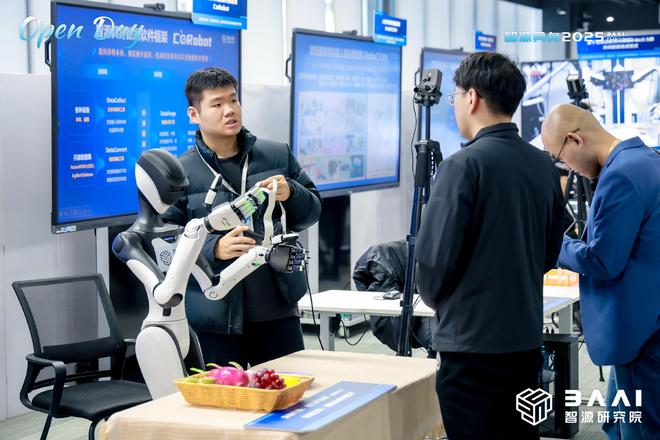
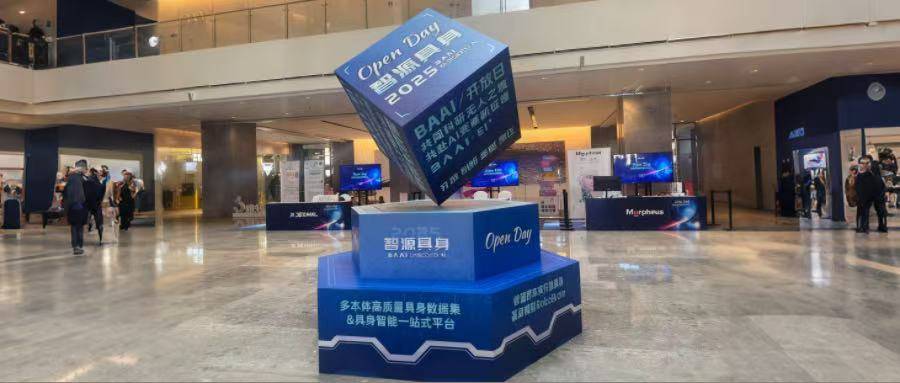
Core Insights - The event highlighted the latest advancements in embodied intelligence by the Zhiyuan Research Institute, focusing on the importance of world models and the development of a comprehensive embodied brain system [2][3] Group 1: Zhiyuan's Full-Stack Layout - Zhiyuan introduced the native multimodal world model Emu3.5, which expanded training data from 15 years of video to 790 years and increased parameter size from 8 billion to 34 billion, enhancing video and image generation speed [5] - The institute is constructing a cross-heterogeneous ontology embodied intelligence system, including RoboBrain, RoboOS, and RoboBrain-0, deployed across various robotic forms for tasks ranging from navigation to complex interactions [5] Group 2: Key Elements of Embodied Intelligence - The role of world models in embodied intelligence was debated, with experts emphasizing the need for models that predict the next state based on the robot's form and goals, rather than merely generating videos [7][10] - There is a consensus that embodied intelligence should not follow the current language-first paradigm but rather adopt a structure centered on action and perception [10][12] - The importance of real data was highlighted, with discussions on the necessity of combining real, simulated, and video data for effective learning in robots [15][17] Group 3: Investment Priorities - When asked how to allocate 10 billion, experts prioritized talent acquisition, computational power, and data engines as key investment areas [19][21] - There were differing views on the importance of infrastructure versus model development, with some advocating for a focus on creating a comprehensive data engine for continuous digitalization [21][22] Group 4: Human-like Robots and Hardware Limitations - The debate on whether human-like robots represent the ultimate form of embodied intelligence concluded that neither models nor hardware define each other; rather, the specific application scenarios dictate the requirements [22][24] - Experts suggested that a layered structure for embodied intelligence should be adopted, where higher-level models can be reused across different robotic forms, but lower-level models must be tailored to specific hardware [23][24] Conclusion - The discussions at the event signaled a proactive search for solutions to achieve a closed-loop system in embodied intelligence, emphasizing the need for models, hardware, and scaling to evolve together [24]

VLA的基础模型与大规模训练任务汇总
具身智能之心· 2025-10-08 02:49
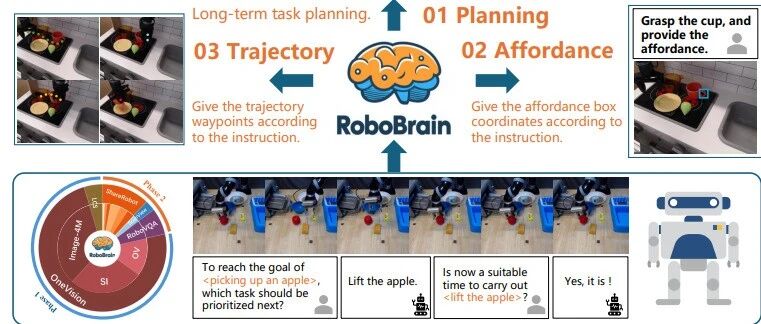
Core Insights - The article summarizes several research papers related to Vision-Language-Action (VLA) models and their training strategies, highlighting advancements in embodied intelligence and robotics [2][3][5][7][9][11][13][15][17][19]. Group 1: Training Strategies and Model Improvements - The paper "Training strategies for efficient embodied reasoning" discusses the use of Chain of Thought (CoT) reasoning to enhance the performance and generalization of VLA models, achieving a threefold increase in reasoning speed compared to standard methods [3]. - "CAST: Counterfactual labels improve instruction following in vision-language-action models" introduces a method to generate counterfactual labels, which significantly improves the instruction-following capabilities of VLA models, with a 27% increase in navigation task success rates [5]. - "RoboBrain: A unified brain model for robotic manipulation" presents a new dataset, ShareRobot, which enhances the planning and trajectory prediction capabilities of robots, leading to state-of-the-art performance in various tasks [7]. Group 2: Dataset Development and Evaluation - The "DROID" dataset is introduced as a large-scale, diverse dataset for robot manipulation, containing 76,000 demonstration trajectories collected over 350 hours, which improves performance and generalization of trained strategies [9]. - "ViSA-Flow" proposes a framework for learning from large-scale video data, achieving state-of-the-art performance in robot skill learning, particularly in low-data scenarios [11]. - The "CORTEXBENCH" benchmark evaluates pre-trained visual representations for embodied AI, revealing that no single representation excels across all tasks, but task-specific adaptations can lead to significant performance improvements [13]. Group 3: Generalist Robot Policies and Learning Frameworks - "Effective tuning strategies for generalist robot manipulation policies" identifies key factors influencing the performance of Generalist Manipulation Policies (GMPs) during fine-tuning, establishing a new benchmark for future research [15]. - The "CACTI" framework focuses on scalable multi-task learning in robotic systems, demonstrating effective training across various kitchen tasks in both real and simulated environments [17]. - "R3m: A universal visual representation for robot manipulation" shows that pre-trained visual representations can enhance data-efficient learning in real-world environments, improving task success rates by over 20% compared to training from scratch [19].
对话智源王仲远:具身智能“小组赛”才刚刚开打,机器人需要“安卓”而非 iOS
AI科技大本营· 2025-06-07 09:42
悟道 1.0 发布时,学术界对" 大模型是通往 AGI 的技术路线 "尚未得出统一结论。 现在的具身智能,也处于这个阶段。 作者 | 王启隆 出品丨AI 科技大本营(ID:rgznai100) 大模型的热潮之下,一种微妙的瓶颈感,正成为行业共识。 "过往所说的 '百模大战',更多是大语言模型的竞争," 智源大会前夕, 智源研究院院长王仲远 在 与 CSDN 的对话中,开门见山地指出了问题的核 心,"而大语言模型受限于互联网数据的使用,性能虽然还在提升,但速度已大不如前。" 出路何在?在王仲远看来,AI 要突破天花板,就必须在"读万卷书"(互联网数据)后,去"行万里路"(物理世界)。 这并非孤立的判断。今年三月, 英伟达 CEO 黄仁勋就在 GTC 大会上为 AI 的下半场指明了方向 :打造"AI 工厂",迎接"物理 AI"时代,让 AI 走出屏 幕,与现实世 界交互。 思考趋于一致,行动便接踵而至。6 月 6 日,CSDN 在北京智源大会现场,见证了王仲远在他的主题演讲中给出的答案。如果说 2021 年的"悟道"系列 代表着对技术路径的探索(" 道 "),那么他所揭晓的全新"悟界"系列,则亮明了新的野心——用 ...

智源研究院院长王仲远:多模态大模型会给具身智能带来新变量
Xin Jing Bao· 2025-03-30 10:00
Core Insights - The topic of embodied intelligence is a major focus at the 2025 Zhongguancun Forum, with the introduction of the RoboOS framework and the open-source RoboBrain model [1][3] - Multi-modal large model technology is expected to enhance the intelligence of robots, allowing them to better understand and interact with the physical world [2][3] Group 1: Multi-modal Large Models - Multi-modal large models enable AI to perceive and understand the world through various data types, such as medical imaging and sensor data, facilitating the transition from digital to physical environments [2] - The performance improvement of large language models has slowed due to the exhaustion of available internet text data, necessitating the integration of multi-modal capabilities [2] Group 2: RoboBrain and RoboOS - RoboBrain and RoboOS are designed to support cross-scenario, multi-task deployment and collaboration among different types of robots, enhancing their general intelligence [3] - RoboBrain can interpret human commands and visual inputs to generate actionable plans based on real-time feedback, supporting various robotic configurations [3] Group 3: Industry Development and Challenges - The open-source approach is seen as a key driver for rapid development in the AI industry, allowing for collaboration among hardware, model, and application vendors [4] - Despite the potential of humanoid robots, there are significant challenges in their industrial application, with many still in the early stages of development [5] - The realization of Artificial General Intelligence (AGI) is projected to take an additional 5-10 years, influenced by advancements in embodiment capabilities and data accumulation [5]