Sierra Forest

Search documents
半导体行业深度报告:AgenticAI时代的算力重构:CPU,从“旁观者”到“总指挥”的价值回归
Soochow Securities· 2026-01-28 03:29
证券研究报告·行业深度报告·半导体 2026 年 01 月 28 日 证券分析师 陈海进 执业证书:S0600525020001 chenhj@dwzq.com.cn 证券分析师 李雅文 执业证书:S0600526010002 liyw@dwzq.com.cn 半导体行业深度报告 Agentic AI 时代的算力重构:CPU,从"旁观 者"到"总指挥"的价值回归 增持(维持) [Table_Tag] [Table_Summary] 投资要点 产业端推进方面,AWS 和 Google Cloud 等头部 CSP 正在加速建设面向 Agent的沙盒环境软硬件基础设施,率先在软件层面强化 Agent Sandbox 的隔离与编排能力,通过运行时与调度体系的完善,为后续 CPU 侧基 础设施规模化部署奠定基础。与此同时,CPU 龙头也在 Agent 驱动下向 超多核架构演进:AMD 推出的 Turin 最高可达 192 核;Intel 的 Sierra Forest 采用纯能效核设计,核心数可达 144 甚至 288 核。我们认为, 随着 Agent 商业化推进,厂商必须持续压低每次任务执行成本。在这一 目标下,超多 ...
3 Reasons to Buy Intel Stock Right Now
The Motley Fool· 2026-01-18 12:30
Core Viewpoint - Intel is positioned as a strong buy due to the booming demand for server CPUs, the introduction of the Panther Lake CPU family, and opportunities in the foundry business [1][2]. Group 1: Panther Lake and CPU Comeback - The Panther Lake family of PC CPUs, unveiled at CES 2026, represents a significant leap in performance and efficiency, being the first high-volume chip to utilize the Intel 18A process [3]. - Early reviews suggest that Panther Lake laptops are well-received, highlighting improvements in battery life, performance, and graphics capabilities, indicating a potential resurgence for Intel in the PC market [4]. - Following Panther Lake, the Nova Lake CPU line is expected to launch, also utilizing the Intel 18A process, while the Serpent Lake CPU, developed in collaboration with Nvidia, remains a future prospect [5][6]. Group 2: Server CPU Demand - There is a soaring demand for server CPUs as major tech companies build AI data centers, leading to a scarcity of these chips, with Intel unable to fully meet demand in early 2026 despite shifting manufacturing capacity [7]. - Intel's Granite Rapids and Sierra Forest server CPU families are manufactured using the Intel 3 process, with next-gen CPUs expected to leverage the Intel 18A process, which is anticipated to enhance performance and efficiency [8][9]. Group 3: Foundry Opportunities - The Intel 18A process has significantly closed the performance gap with TSMC, positioning Intel to attract external customers seeking advanced semiconductor manufacturing amid a supply shortage [10]. - The current demand for advanced semiconductor manufacturing exceeds supply, and Intel's improving yields could allow it to capture business from chip designers needing additional capacity [11][12]. - Although it may take time for Intel's foundry business to generate substantial revenue, the company is well-positioned to secure orders due to the ongoing shortage of advanced chip manufacturing capacity [13]. Group 4: Market Position and Stock Performance - Intel's market capitalization stands at $234 billion, with shares having increased by 27% in early 2026, following an 84% gain in 2025, indicating a strong investor interest in the company's turnaround story [1][14]. - Despite the recent surge in stock price, Intel's market cap remains below its all-time high, suggesting potential for further growth as the total addressable market expands due to the foundry business and rising demand for AI-related chips [14][15].



英特尔的先进封装,太强了
Xin Lang Cai Jing· 2026-01-17 09:33
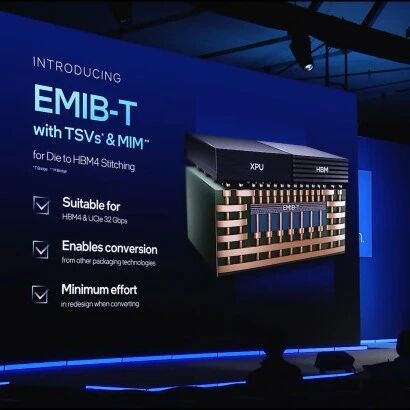
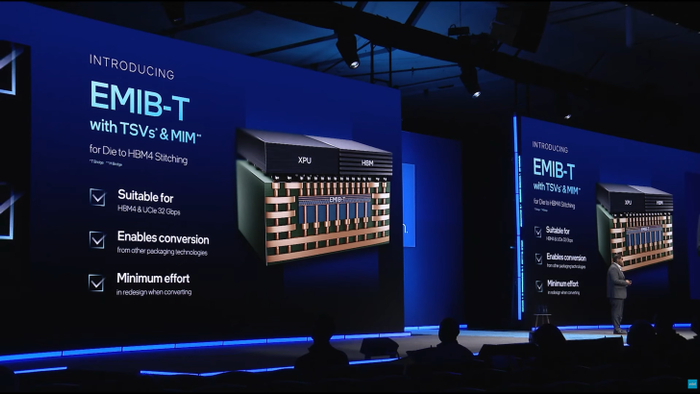
Core Viewpoint - Intel's EMIB interconnect solution demonstrates advantages over traditional 2.5D technology in advanced chip packaging design, showcasing its application in various products and its potential for next-generation chips [1][14]. Group 1: EMIB Technology and Applications - Intel's EMIB technology has been implemented in several of its products, including Ponte Vecchio, Sapphire Rapids, Granite Rapids, Sierra Forest, and the upcoming Clearwater Forest series [1]. - The company emphasizes its advanced packaging capabilities, which include large-scale packaging using EMIB and other proprietary technologies, specifically designed for data center solutions [1][12]. - EMIB technology allows for efficient and cost-effective connections between multiple complex chips, supporting both 2D and 3D expansions, which traditional 2.5D methods cannot achieve [12][14]. Group 2: Comparison with Competitors - Competitors like TSMC utilize 2.5D and 3D packaging technologies that rely on silicon interposers and TSV (Through-Silicon Vias) for interconnections, which can increase design complexity and costs [3][7]. - Intel points out the drawbacks of 2.5D packaging, such as additional costs for silicon used solely for interconnections and limitations in chip size and flexibility [7]. Group 3: Future Prospects and Industry Position - Intel's advancements in EMIB, including the "T" type packaging and Foveros packaging, have attracted attention from industry giants, intensifying competition in the chip manufacturing sector previously dominated by TSMC [14][15]. - The company aims to leverage its advanced packaging solutions to establish a foothold in the foundry business, particularly with the 14A process node designed for third-party customers [28]. - Intel's upcoming products, such as the Jaguar Shores and Crescent Island GPU, are critical for regaining market share, with a focus on securing orders from third parties [30].
英特尔的先进封装,太强了
半导体行业观察· 2026-01-16 01:48
Core Viewpoint - Intel's EMIB interconnect solution demonstrates advantages over traditional 2.5D technology in advanced chip packaging design, showcasing its application in various products and its potential for next-generation chip production [1][17]. Group 1: EMIB Technology and Comparison - Intel's EMIB technology has been applied in several products, including Ponte Vecchio, Sapphire Rapids, Granite Rapids, Sierra Forest, and the upcoming Clearwater Forest series [1]. - Competitors like TSMC utilize 2.5D and 3D packaging technologies, which involve silicon interposers and TSV (Through-Silicon Vias) for interconnections, contrasting with Intel's smaller interconnect bridges [3]. - 2.5D packaging has drawbacks, such as additional costs for silicon interposers and increased complexity and reduced yield with larger chip sizes [8]. Group 2: Advantages of EMIB - EMIB technology eliminates the need for silicon interposers between chips and packages, allowing for flexible chip placement and integration [11]. - The key advantages of EMIB include improved layout flexibility, support for 2D and 3D scaling, cost-saving opportunities, and simplified design processes [14][16]. - Intel's EMIB-T technology enhances bandwidth and chip integration by incorporating TSVs, making it suitable for high-performance applications [13][20]. Group 3: Future Developments and Market Position - Intel is increasing investments in wafer fabrication and aims to establish a new era of advanced chip production in the U.S. with its 14A technology [17][31]. - The company showcased its scalable packaging capabilities with multi-chip products using 18A/14A nodes, Foveros 3D, and EMIB-T technology, setting standards for high-performance computing and AI [18][20]. - Intel's advanced packaging solutions are expected to intensify competition with TSMC's CoWoS solutions, which also integrate multiple HBM chips [18]. Group 4: Industry Collaboration and Customer Focus - Intel is developing a diverse ecosystem participation plan to accelerate product launch and enhance supply chain resilience [29]. - The recent advanced packaging chip demonstration targets external customers, particularly highlighting the advantages of the 14A process node designed for third-party clients [31]. - The success of Intel's advanced packaging technology will depend on securing orders from third parties, which is crucial for the adoption of its 14A technology [33].