
Snapmaker U1

Search documents
未知机构:消费级3D打印40页行业深度AI时代个性化物理实现核心入口26年有望迎来i-20260228
未知机构· 2026-02-28 02:55
Summary of the Conference Call on Consumer 3D Printing Industry Industry Overview - The consumer 3D printing industry is positioned as a key entry point for AI and physical world integration, with a significant market expansion driven by the transition from industrial to consumer products. The global market size is projected to achieve a CAGR of 28.6% from 2020 to 2024, reaching $4.1 billion by 2024 [1][1]. Key Insights - The industry is experiencing an acceleration phase, comparable to the iPhone's evolution, with the launch of products like the拓竹X1 in 2022 marking a pivotal moment. The introduction of multi-color printing models such as the拓竹H2C/H2D and Snapmaker U1 is expected to lead to a second acceleration phase by 2026 [1][1]. - Current challenges in adapting industrial-grade products for consumer use are being addressed through: 1. **Technological Accessibility**: Utilizing AI modeling and closed-loop control to overcome process challenges, with breakthroughs in efficiency through multi-color printing and modular systems [2][2]. 2. **Cost Reduction**: Bringing prices down to household appliance levels [2][2]. 3. **Ecosystem Growth**: Implementing a DTC (Direct-to-Consumer) model combined with community-driven operations to enhance market reach [2][2]. Notable Companies - **创想三维 (Chuangxiang Sanwei)**: Recognized as a global leader in the ecosystem, with plans to complete its Hong Kong listing by February 14, 2026, and expected to go public in Q2 2026 [3][3]. - **拓竹科技 (Tuozhu Technology)**: Identified as a benchmark enterprise in the industry, with potential for secondary market entry. The demand for consumables is expected to grow due to accelerated equipment usage, with PLA being the preferred material. However, the limitations of pure PLA highlight the importance of modification technology as a core competitive barrier [4][4]. - **家联科技 (Jialian Technology)**: Engaged in the拓竹 supply chain for consumables, with a production base in Thailand expected to reach full capacity by the end of 2025. The company holds over 220 patents in PLA modification, addressing traditional PLA limitations and meeting quality requirements of key clients [6][6]. - **汇纳科技 (Huinat Technology)**: Partnering with拓竹科技 to establish the largest 3D printing factory globally, with plans to deploy 15,000拓竹 3D printers by Q1 2026 [6][6]. Additional Insights - The leading equipment brands are accelerating industry consolidation, indicating a trend towards focusing on suppliers of consumables that integrate with top-tier equipment brands [5][5]. - The service aspect of the industry encompasses a full range of support from scanning, modeling, equipment operation, parameter adjustment, to ODM/OEM production, catering to both B2B and C2C markets [6][6].
消费级3D打印的iPhone时刻来了,A股概念股大涨,52家企业新获投资
21世纪经济报道· 2026-01-23 08:10
Core Viewpoint - The consumer-grade 3D printing industry is approaching a pivotal moment, often referred to as the "iPhone moment," characterized by rapid growth and increased consumer engagement [1][11]. Market Performance - The A-share 3D printing index has seen a nearly 90% increase year-to-date as of January 23, 2025, with almost all stocks in the sector rising and about 70% of companies reporting positive net profit growth [3][4]. Competitive Landscape - The market is witnessing intense competition, with major players like DJI, Meituan, and Hillhouse Capital entering the space, while established companies like Creality are pursuing IPOs [5][10]. - Bambu Lab, a pioneer in consumer-grade printers, faces significant competition from both established and new entrants, indicating a shift from a single-player dominance to a multi-competitor environment [5][11]. Investment Trends - Since 2025, there have been 72 investment events in the 3D printing sector, with 52 companies receiving funding, primarily concentrated in the domestic market [7][8]. - Notable investments include DJI's multi-million dollar investment in Elegoo, highlighting the potential for growth in consumer-grade 3D printing technology [7][8]. Financial Performance of Key Players - Creality's revenue is projected to grow from 13.46 billion to 22.88 billion from 2022 to 2024, but its net profit is expected to decline by 31% in 2024, indicating a challenging competitive environment [10]. - Bambu Lab's revenue is estimated to be between 55 billion and 60 billion in 2024, with a net profit close to 20 billion, maintaining a leading market share [13]. Ecosystem Development - Bambu Lab's Maker World community has become a central part of its ecosystem strategy, boasting nearly 10 million active users and over one million 3D models, which enhances user engagement and lowers operational barriers [14][16]. - The industry is experiencing a shift towards ecosystem competition, with companies like Elegoo and Snapmaker also focusing on building robust content ecosystems to attract users [16][18]. Future Outlook - The global consumer-grade 3D printing market is expected to grow from $1.5 billion in 2020 to $4.1 billion in 2024, with a compound annual growth rate of approximately 28% [13]. - The entry of AI technologies is anticipated to lower barriers for content creation, facilitating a transition to a "everyone can create" era in 3D printing [18].


拓竹“战群狼” 百亿3D打印赛道大战
2 1 Shi Ji Jing Ji Bao Dao· 2026-01-23 08:07
Core Viewpoint - The consumer-grade 3D printing industry is approaching a pivotal moment, often referred to as the "iPhone moment," indicating significant growth and transformation in the market [1]. Market Performance - The A-share 3D printing index has seen an impressive year-to-date increase of 82.11%, with nearly 70% of companies reporting positive net profit growth in the first three quarters [2]. - The global consumer-grade 3D printing market is projected to grow from $1.5 billion in 2020 to $4.1 billion by 2024, with an annual compound growth rate of approximately 28% [11]. Competitive Landscape - The competitive environment is intensifying, with major players like DJI, Meituan, and Hillhouse Capital entering the market, while established companies like Creality are pursuing IPOs [3][6]. - Bambu Lab, once a dominant player, is now facing significant competition, with multiple companies vying for market share and investment [3][4]. Investment Trends - Since 2025, there have been 72 investment events in the 3D printing sector, with 52 companies receiving funding, primarily concentrated in the domestic market [6]. - Notable investments include DJI's multi-million dollar investment in Elegoo, highlighting the potential for growth in consumer-grade 3D printing technology [6]. Company Developments - Elegoo, a key player in the market, has achieved a compound annual growth rate of over 40% in the past three years, with projected revenues of 1.6 billion yuan in 2024 and 2.5 billion yuan in 2025 [7]. - Snapmaker has also gained attention, raising over $20 million on Kickstarter for its innovative 3D printer, which boasts significant efficiency improvements [7][8]. Ecosystem and Community - Bambu Lab's success is attributed not only to hardware performance but also to its robust community and content ecosystem, exemplified by its Maker World platform, which has nearly 10 million active users [12][13]. - The shift towards a closed ecosystem has sparked debates within the industry regarding the balance between open-source and proprietary models [15]. Future Outlook - The entry of large players like DJI is expected to accelerate industry consolidation and competition, making the landscape more complex and dynamic [17]. - The ongoing development of AI technologies is anticipated to lower barriers to entry in 3D modeling, facilitating a broader participation in the 3D printing ecosystem [16].
从3D打印到桌面CNC,中国创客硬件集体破圈丨36氪直击CES
36氪· 2026-01-06 13:36
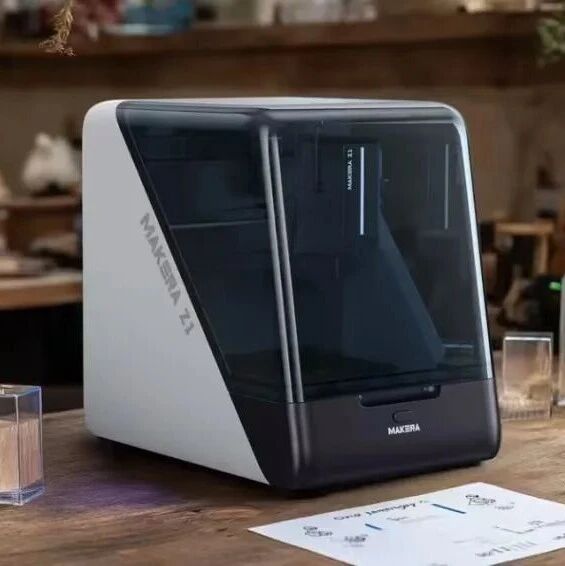
Core Viewpoint - The hardware industry is experiencing intense competition, particularly in the Maker segment, where companies are rapidly innovating and launching new products to capture market share [5][7][9]. Group 1: Industry Trends - The CES event showcases a variety of ambitious products from Chinese companies, including humanoid robots and innovative mobile devices, indicating a vibrant and competitive hardware landscape [4]. - The Maker tools segment has transformed from niche, high-cost products to widely accessible tools, with significant crowdfunding successes reported [8][28]. - Companies like xTool and Snapmaker are leading the charge in the Maker space, with xTool's UV printer and Snapmaker's 3D printer achieving impressive crowdfunding results [11][16]. Group 2: Product Innovations - xTool's new desktop UV printer utilizes UV-LED curing technology, allowing for high-precision printing on various materials, and is positioned to capitalize on market opportunities following the success of competitors [11][13]. - Snapmaker's U1 3D printer has set a record on Kickstarter, emphasizing speed and efficiency in multi-color printing, which is becoming a standard in the consumer market [16][19]. - The introduction of user-friendly features in CNC devices, such as the Makera Z1, is lowering barriers to entry and expanding the audience for these tools [27][28]. Group 3: Market Dynamics - The competition in the Maker tools market is intensifying, with companies needing to differentiate their products through innovation and user engagement [15][21]. - The shift towards multi-color printing in 3D printers is gaining traction, with significant market demand for such capabilities, reflecting a broader trend in consumer preferences [32][34]. - The Maker community is evolving, with tools transitioning from being seen as niche products to essential resources for small businesses and individual entrepreneurs [35].
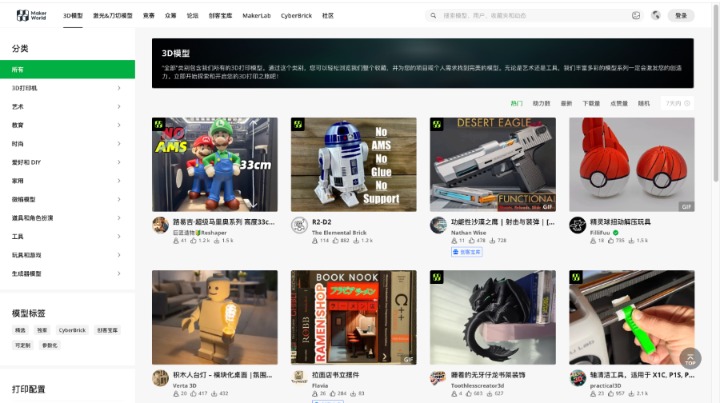
从3D打印到桌面CNC,中国创客硬件集体破圈|硬氪直击CES
3 6 Ke· 2026-01-06 02:51
Core Insights - The CES event showcases a significant presence of Chinese companies, highlighting the competitive landscape in the hardware industry, particularly in the Maker sector [1] - The Maker tools market has rapidly evolved from niche products to mainstream offerings, with companies achieving impressive crowdfunding results [2][3] - The introduction of innovative products, such as xTool's desktop UV printer and Snapmaker's 3D printer, reflects a shift towards user-friendly designs and enhanced functionalities [6][10] Group 1: Product Innovations - xTool's new desktop UV printer utilizes UV-LED curing technology, allowing for high-precision color printing on various materials [6] - Snapmaker U1, a 3D printer, achieved over $20 million in crowdfunding, emphasizing its rapid development and market acceptance [10][13] - The introduction of features like multi-color printing and waste reduction technologies is becoming standard among new products, enhancing their appeal [14][20] Group 2: Market Dynamics - The Maker tools market is experiencing increased competition, with companies like xTool and Snapmaker pushing the boundaries of product capabilities [5][6] - Crowdfunding successes indicate a growing consumer interest and market potential for Maker tools, with some products achieving over $10 million in funding [2][17] - The shift from industrial-grade CNC machines to more accessible desktop versions is expanding the user base and redefining productivity in creative fields [4][15] Group 3: User Engagement and Community - Companies are adopting co-creation strategies, inviting community input in product development to enhance user engagement and meet market demands [8][9] - The social aspect of Maker tools is becoming more pronounced, with features that allow users to share their creative processes on social media [18][19] - The demographic of users is shifting from niche enthusiasts to small business owners, indicating a broader acceptance and utilization of Maker technologies [21][22]
快造科技发布Snapmaker U1,京东预售2小时成交破2000台
Xin Lang Cai Jing· 2025-12-18 04:47
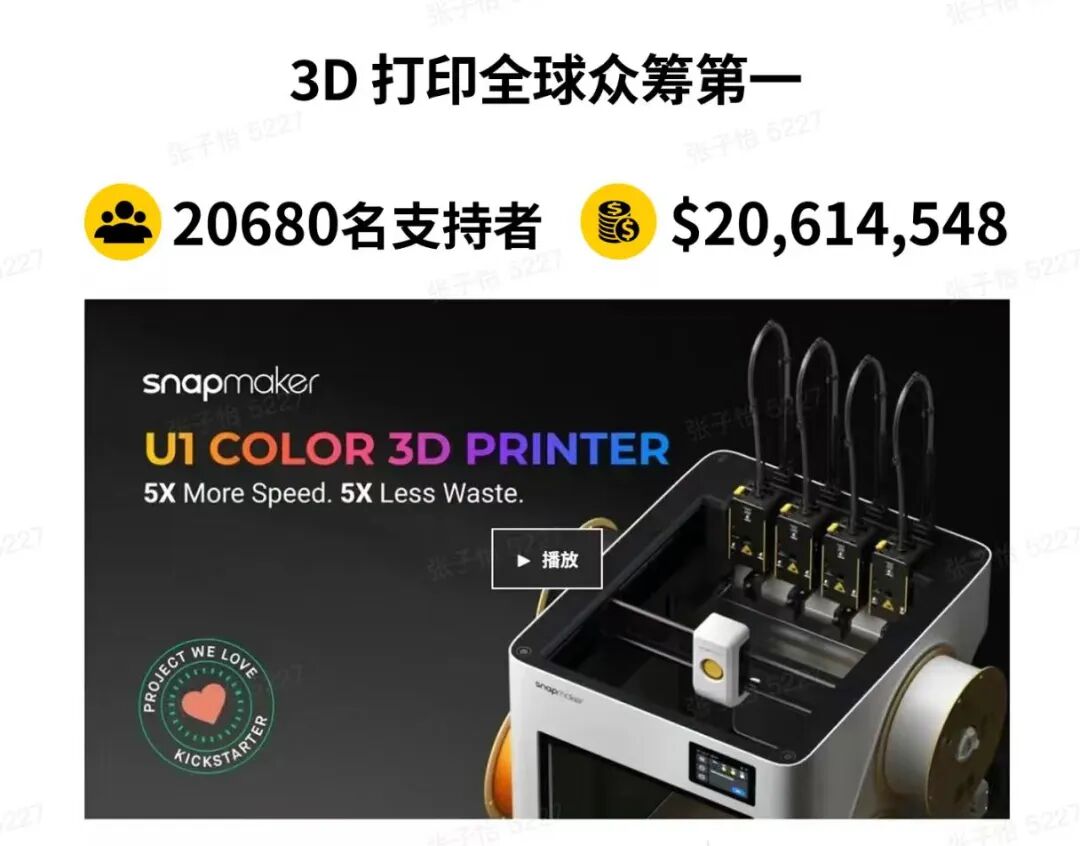
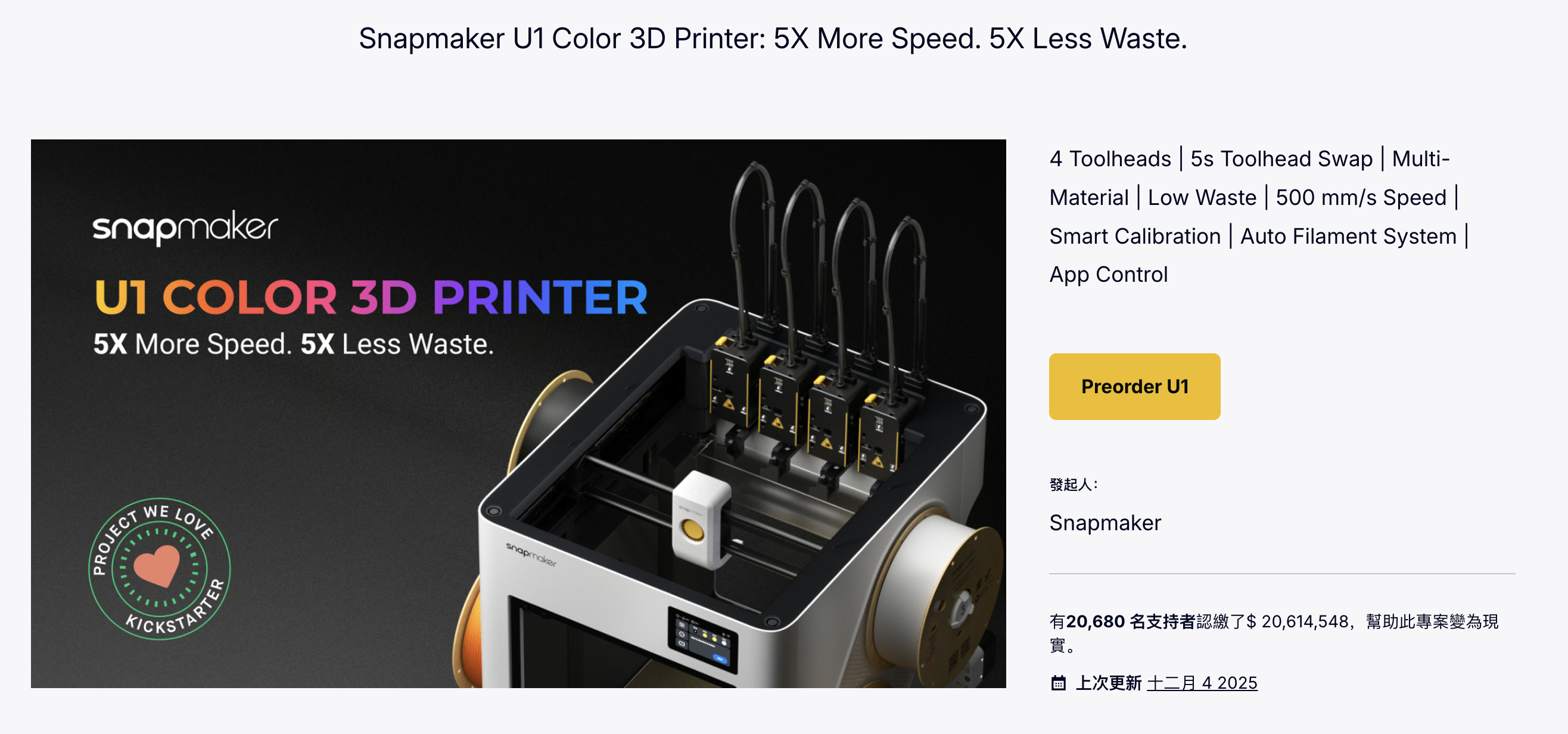
Core Insights - Snapmaker U1 3D printer achieved a record crowdfunding amount of $20.61 million on Kickstarter, the highest in its category [1][5] - The product was pre-sold exclusively on JD.com, selling over 2,000 units within 2 hours and becoming the top-selling item in the 3D printing category [1][5] - Snapmaker U1 features the innovative SnapSwap™ independent four-head system, which addresses the efficiency bottlenecks of traditional single-head 3D printers, claiming "5 times speed, 5 times material savings" [1][5] Product Features - The SnapSwap™ system allows for rapid switching between four print heads, completing head changes in under 5 seconds, thus minimizing material waste during color changes [6] - The printer can complete similar four-color printing tasks in just 5-6 hours, achieving up to a 5-fold increase in printing efficiency and saving approximately 80% in material usage compared to traditional single-head printers [2][6] Market Launch - Snapmaker U1 is set to officially launch on JD.com on December 25 [3][6]
刷新众筹记录后,这家3D打印公司拿到美团、高瓴和顺为的投资
Xin Lang Cai Jing· 2025-12-12 05:24
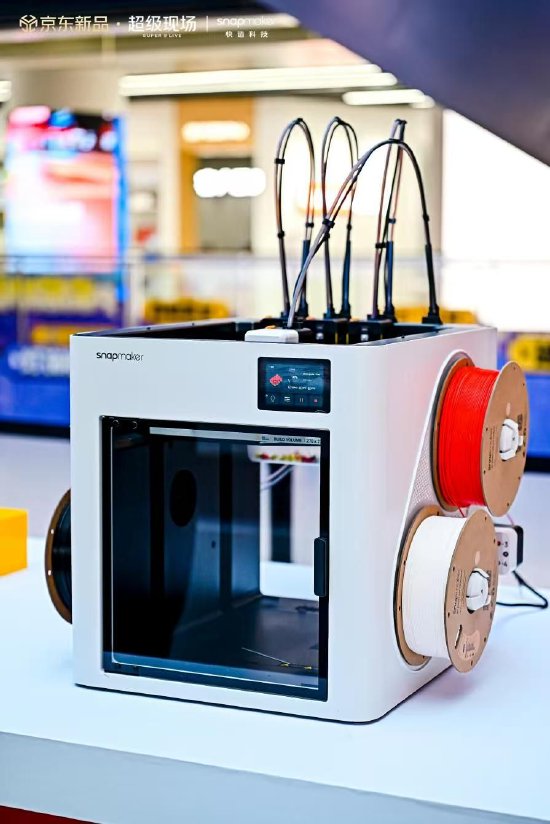
Core Insights - Snapmaker, a 3D printing company, has completed a multi-hundred million yuan Series B financing round led by Hillhouse Capital and Meituan, with participation from other investors including Shunwei Capital and Nanshan Zhanxin [1][12] - The company’s Snapmaker U1 3D printer achieved over $20 million (approximately 150 million yuan) in crowdfunding on Kickstarter, setting a record for the highest crowdfunding amount in the 3D printer category [1][4] - The U1 printer features innovative technology that allows for a five-second color change without interrupting the printing process, significantly improving printing efficiency by up to five times and reducing material waste by approximately 80% [5][6] Company Overview - Snapmaker is recognized as a leading player in the 3D printing industry, particularly after the successful launch of the U1 printer, which represents a shift from their previous "three-in-one" devices to a more focused product line [6][12] - The company plans to launch the U1 globally in the first quarter of 2026, with expectations of substantial revenue growth in the coming year [6][7] Market Context - The 3D printing industry has seen increased investment interest, with notable companies like DJI and other startups also securing funding, indicating a growing trend in the sector [12] - Competitors are beginning to introduce similar multi-color printing solutions, highlighting the competitive landscape in the 3D printing market [6][12] Future Plans - The recent funding will be allocated towards core technology development, talent acquisition in hardware and AI software, and building an open ecosystem to lower the barriers to 3D printing [12] - Snapmaker aims to address key challenges in multi-color printing and high-speed manufacturing as part of its strategic focus for the upcoming year [12]

人均 “第一”,深圳 3D 打印 “四大天王” 有多卷?
Nan Fang Du Shi Bao· 2025-11-29 12:02
Core Insights - Shenzhen 3D printing companies are intensifying competition, with Chuangxiang Sanwei and Tuozhu Technology leading the charge as they aim for market dominance and public listing [2][5][10] Company Developments - Chuangxiang Sanwei submitted its main board listing application to the Hong Kong Stock Exchange in August 2025, aiming to become the first consumer-grade 3D printing stock in Hong Kong [2] - Tuozhu Technology opened its first flagship store in Shenzhen, featuring a wall made of 28 3D printers, attracting significant industry attention [2] - DJI invested several hundred million yuan in another competitor, Smart派, which holds the title for the highest shipment volume in the global consumer-grade light-curing 3D printer market [5][10] Investment Landscape - Tencent has invested in both Chuangxiang Sanwei and Tuozhu Technology, indicating a strong interest in the sector [5] - Tuozhu Technology's valuation may reach 10 billion USD, although its founder denied any ongoing financing [5] - Snapmaker, another Shenzhen 3D printing company, completed a B round of financing in 2025, attracting new investors like Meituan and Hillhouse Capital [6] Market Positioning - Each of the "Four Kings" in Shenzhen's 3D printing market claims a leading position in specific segments, creating a differentiated competitive landscape [7] - Tuozhu Technology achieved sales of 5.5 to 6 billion CNY in 2024, maintaining its status as the global leader in desktop 3D printer sales [7][8] - Chuangxiang Sanwei, established in 2014, is recognized for its cumulative shipment volume, although its annual shipments decreased to 700,000 units in 2024, capturing 16.9% of the market [8] Competitive Dynamics - The competition is characterized by a struggle for technological talent and market resources, with Tuozhu's team originating from DJI's core development group [10][11] - The rivalry has intensified with DJI's investment in Smart派, which is seen as a strategic move to bolster its ecosystem [5][10] - The ongoing competition is not just about product offerings but also involves talent retention and the establishment of technological barriers [11]


申万宏源:AI赋能+技术突破+资金加码 持续看好消费级3D打印
智通财经网· 2025-11-26 06:52
Core Viewpoint - The report from Shenwan Hongyuan highlights the maturation of 2D to 3D model conversion technology, which is expected to enhance the "playability" of consumer-grade 3D printing and stimulate demand in this sector [1] Group 1: AI Empowerment - The NanoBanana Pro version has improved image quality and resolution, significantly enhancing text rendering capabilities and supporting the fusion of 14 images to create new visuals, providing flexible and efficient tools for 3D printing creators [1] - Meta is leading the commercialization of multi-modal models with the release of SAM 3D, which can convert segmented image slices directly into 3D models, allowing for individual reconstruction of objects even in the presence of occlusions [1] Group 2: Technological Breakthroughs - Traditional 3D printers face inefficiencies with color/material switching, leading to waste and low success rates; several companies are innovating in smart multi-color printing technology [2] - Snapmaker's U1 model reduces the waiting time for switching tools from about two minutes to just five seconds, significantly saving material costs, having raised $2.022 million on Kickstarter [2] - TuoZhu Technology's system can accommodate up to six replaceable hot ends and supports the use of up to 24 materials in a single print, showcasing industry-leading heating technology [2] Group 3: Investment and Industry Ecosystem - DJI has invested in Shenzhen Intelligent Technology Co., holding a 5% stake, which specializes in SLA and FDM 3D printing technologies [3] - Meituan has become a shareholder in Shenzhen Fast Technology Co., indicating a trend of major companies investing in the consumer-grade 3D printing sector to enhance the industry ecosystem [3] Group 4: Demand Outlook - In the first three quarters of 2025, China exported 3.491 million 3D printers, nearing the total of 3.778 million units expected for the entire year of 2024 [4] - The export value of 3D printers from January to September 2025 reached 7.514 billion yuan, close to the projected 8.163 billion yuan for the full year of 2024, with expectations of reaching 10.7 billion yuan in 2025 [4] Group 5: Key Industry Players - Key components include Jiepu Te and Ruike Laser (lasers), Jinchengzi (control cards + galvanometers) [5] - 3D scanners include Sikan Technology and Obsidian Light [5] - Material suppliers include Haizheng Shengcai (raw materials) and Jialian Technology (filaments) [5] - Notable machine manufacturers include TuoZhu Technology (unlisted), Chuangxiang Sanwei (in IPO process), Anker Innovation, and Huina Technology [5]

高瓴美团联手,疯抢3D打印
3 6 Ke· 2025-11-09 07:31
Core Insights - The 3D printing industry is experiencing a resurgence, particularly in the consumer segment, driven by advancements in AI technology that lower the barriers to entry for users [1][7][10] - Investment activity in the 3D printing sector has reached a five-year high, with significant funding rounds for companies like Snapmaker and Chuangxiang Sanwei [2][4][9] Company Highlights - Shenzhen Snapmaker Technology Co., Ltd. recently completed a Series B funding round led by Meituan and Hillhouse Capital, marking a significant milestone since its last funding announcement in 2021 [1][2] - Snapmaker's product, Snapmaker U1, raised $22,020 in crowdfunding on Kickstarter, setting a record for 3D printer crowdfunding and attracting over 20,000 supporters [3][4] - Chuangxiang Sanwei, another Shenzhen-based company, is aiming to become the first publicly listed consumer 3D printing company in China, having achieved annual revenue of 1 billion yuan in 2020 [5][6] Market Trends - The consumer 3D printing market is seeing a compound annual growth rate (CAGR) exceeding 30% over the past three years, with major brands in Shenzhen reporting annual revenues surpassing 1 billion yuan [4][6] - The price of consumer-grade 3D printers has decreased by 60% over the past three years, making them more accessible to a broader audience [8] Technological Advancements - The integration of generative AI modeling tools has significantly reduced the complexity of 3D modeling, allowing users to create 3D models with minimal technical knowledge [7][8] - Snapmaker's U1 addresses key industry pain points, such as low efficiency in color switching and material waste, enabling faster and more efficient multi-color printing [4][10] Investment Landscape - The 3D printing sector is attracting increased attention from investors, with over 40 financing events reported this year, indicating a strong interest in consumer hardware [2][4] - Companies like拓竹科技 (Tuozhu Technology) have achieved unicorn status, with valuations exceeding 30 billion yuan, prompting investors to seek similar opportunities in the market [9][10]