
个性化教育

Search documents
华福商社:2026年春秋假和入境游政策加码带动文旅需求
Huafu Securities· 2026-03-30 07:28
Investment Rating - The industry rating is "Strongly Outperform the Market," indicating that the overall return of the industry is expected to exceed the market benchmark index by more than 5% in the next 6 months [29]. Core Insights - The report highlights that the demand for education, particularly in high school training, is expected to increase due to a rise in the eligible population and the expansion of school capacity. The government plans to build or renovate 1,000 high schools, adding over 2 million new student places [3][10]. - In the tourism sector, the introduction of spring and autumn holidays, along with enhanced inbound travel policies, is anticipated to boost local tourism demand significantly. The report notes that travel demand surged during the spring holiday and Qingming Festival, with a notable increase in travel bookings compared to the previous year [4][12][15]. Summary by Sections Education - The eligible population for high school education is increasing, leading to a rise in school capacity. The peak enrollment for ordinary high schools is expected around 2031. The government aims to expand high school supply and enhance higher education quality by increasing undergraduate enrollment by over 100,000 [10][11]. - The report suggests focusing on personalized education leaders like Xueda Education (000526.SZ), as the peak training demand is expected in Q1 and Q2, while the company is strengthening its network and teacher capacity for sustained competitive advantage [10]. Tourism - The implementation of spring and autumn holidays is part of a broader strategy to enhance service consumption and promote travel. Various provinces are already trialing these policies, creating extended holiday periods that encourage family travel [12][13]. - By 2025, inbound travel is projected to exceed pre-pandemic levels, with 697 million entries and exits recorded, marking a 14.2% increase from 2019. The report emphasizes the growth in foreign visitors, particularly those benefiting from visa exemptions [17]. - The report anticipates that the 2026 inbound tourism policies will further expand, enhancing the benefits of visa-free travel, which has already seen significant growth in visitor numbers and spending [17].
初中老师手写“文言文”奖状,有点厉害
Huan Qiu Wang· 2026-02-14 07:46
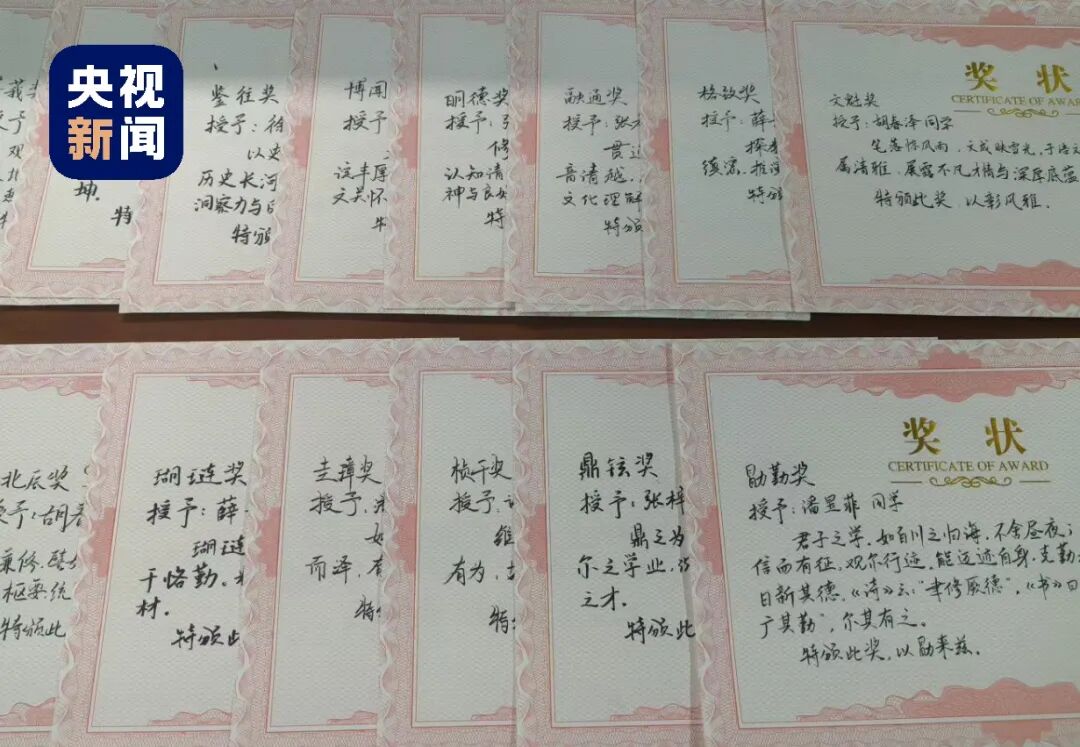
Core Viewpoint - A middle school teacher in Nanjing, named Lü Jiaheng, has created customized "classical Chinese" report cards for his students, reflecting their individual characteristics and achievements, aiming to make them feel valued and understood [1][8]. Group 1: Customized Awards - The awards include unique names and comments tailored to each student, such as "Dingxuan Award" for Zhang Ziyang, which praises his steady character using classical references [3]. - The "Beichen Award" was given to Hu Chunzhe, highlighting his leadership qualities as recognized by his peers, drawing from a quote in "The Analects" [5]. - The "Xuqin Award" was awarded to Xue Jing and others, recognizing their diligence and personal progress, with a quote from "Book of Documents" emphasizing self-improvement [6]. Group 2: Educational Philosophy - Lü Jiaheng believes that every child is unique and aims for them to feel warmth and recognition through these awards, balancing praise without overwhelming expectations [8]. - He emphasizes that education is about seeing and illuminating differences, and the use of classical Chinese is intended to convey the importance of each student's unique qualities [12]. - Lü Jiaheng's approach includes making learning enjoyable and engaging, as reflected in the positive feedback from students about his teaching style [9]. Group 3: Cultural Integration - The awards not only serve as recognition but also aim to instill traditional cultural values in students, as parents express appreciation for the thoughtful approach [8]. - Lü Jiaheng prepared a presentation to explain the significance of the award names and the cultural references, enhancing the educational experience [12]. - He also provided stamps with classical poetry for students to use, promoting interaction and deeper understanding of the literature [14].

智慧赋能 探索教育新征程
Xin Lang Cai Jing· 2026-02-07 20:47
Core Viewpoint - Donghai County Zhu Ziqing Middle School is actively integrating artificial intelligence and personalized education, aiming to enhance student development through innovative teaching methods and research initiatives [1][3]. Group 1: Educational Philosophy and Goals - The school adheres to the core philosophy of "leveraging intelligent platform resources to support personalized education and promote comprehensive student development" [1]. - The institution recognizes the uniqueness of each student and utilizes the National Primary and Secondary School Smart Platform's resources and data analysis capabilities to facilitate personalized education [1]. Group 2: Research and Development Initiatives - The school is undertaking a provincial research project titled "Artificial Intelligence-Driven Evaluation Model for Cross-Disciplinary Learning in Junior High School English," aiming to construct a precise evaluation model that enhances cross-disciplinary teaching [1]. - The project focuses on a three-dimensional evaluation system encompassing "language ability, subject integration, and thinking quality," which supports the precise implementation and quality enhancement of cross-disciplinary teaching [1]. Group 3: Implementation of Smart Education - A series of diverse activities have been organized to promote the deep integration of smart education, including workshops on cross-disciplinary teaching design and the establishment of a digital teaching leadership team [2]. - Teachers are utilizing platform resources and AI technology to enhance teaching practices, optimizing lesson designs and collecting data to support the evaluation model [3]. Group 4: Outcomes and Future Directions - The research outcomes are beginning to show effectiveness, with specific applications in mathematics and English, where AI tools are used for dynamic evaluation and personalized feedback [3]. - The school emphasizes a humanistic approach alongside technological integration, aiming to cultivate students with both scientific thinking and cultural literacy [3]. - Future plans include expanding the application of research outcomes to ensure that technology serves the essence of education [3].
千问回应“AI新寒门”论:不存在
Feng Huang Wang· 2026-01-23 05:02
Core Viewpoint - The discussion surrounding the impact of artificial intelligence (AI) on education has sparked widespread concern, with fears that prolonged use of AI may hinder children's cognitive development and create a new divide in access to technology [1] Group 1: AI's Impact on Education - The rapid proliferation of AI technology is outpacing previous technologies like personal computers, leading to a reduction in the access gap between urban and rural areas [1] - The development of open-source ecosystems has lowered the barriers to using AI, making educational applications more accessible to the general public [1] Group 2: Changes in Learning Approaches - AI is expected to transform learning methods from knowledge transmission to a more inquiry-based approach, emphasizing questioning and exploration [1] - Knowledge is no longer scarce; the ability to ask good questions and develop judgment skills becomes more critical in the AI era [1] - Personalized education and continuous inquiry may lead to more efficient learning, potentially shortening the duration of formal education [1] Group 3: Limitations and Human Element - AI cannot solve all educational challenges; its effectiveness depends on how it is utilized [1] - While AI may help level the "starting line" for learning, the "timeline" for lifelong learning may be extended [1] - AI can assist in learning but cannot replace the fundamental need for human thought and comprehensive personal development [1]
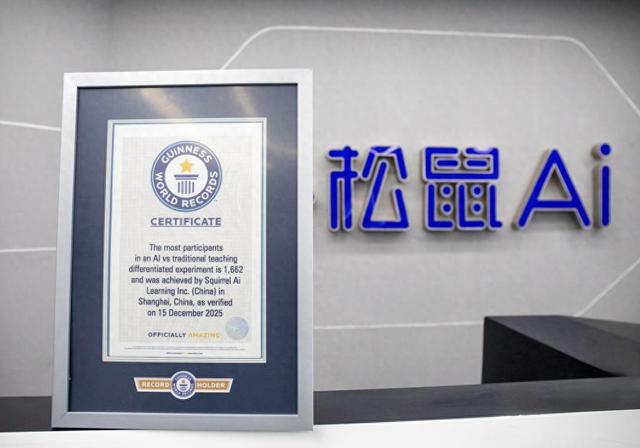
松鼠Ai成功挑战“最多人参与的AI与传统教学差异化实验”吉尼斯世界纪录™称号
Xin Lang Cai Jing· 2025-12-29 08:55
Group 1 - The core achievement of Squirrel AI is the successful challenge of the Guinness World Record for the "Most Participants in an AI vs. Traditional Teaching Differentiation Experiment," which was certified on December 15, 2025 [1][3] - The experiment involved 1,662 students from five schools in grades six and seven, demonstrating that the Squirrel AI adaptive system outperformed traditional teaching methods in various metrics [1][3] - The experiment's design and execution adhered to rigorous standards set by Guinness, ensuring the validity and reliability of the data collected [3] Group 2 - Data from the independent report by iResearch showed that the Squirrel AI group had higher average scores and better performance metrics compared to the traditional teaching group [4][5] - In sixth grade, the Squirrel AI group achieved an average score of 87.58, with an excellent rate of 67.61% and a pass rate of 96.48%, significantly outperforming the traditional group [4] - In seventh grade, the Squirrel AI group scored an average of 92.91, with an excellent rate of 49.95% and a pass rate of 81.22%, again surpassing the traditional group [5] Group 3 - The Squirrel AI adaptive education model utilizes a multi-modal approach, integrating text, images, and voice to understand learners' knowledge states and emotional conditions [8] - The system provides personalized learning paths and content recommendations based on extensive analysis of learning behavior data, enhancing individual learning experiences [8][9] - The experiment highlighted the potential of AI technology to improve educational efficiency and promote equitable education through tailored instruction for diverse student groups [9] Group 4 - The successful Guinness World Record challenge and the empirical research validate the effectiveness of the Squirrel AI adaptive education system, marking a significant step in the integration of AI in education [9] - The initiative reflects a comprehensive framework that encompasses technology development, application scenarios, and effect verification, contributing to the future of personalized and high-quality education [9]
东西问|马来西亚学者刘慧敏:人工智能如何让教育更普惠?
Zhong Guo Xin Wen Wang· 2025-12-14 05:29
Core Insights - The interview with Liu Huimin emphasizes the role of artificial intelligence (AI) in promoting equitable and personalized education, highlighting China's advantages in AI implementation and data resources for collaboration with ASEAN countries [1][10]. Group 1: AI in Education - AI technology is facilitating a more inclusive and equitable future in education through precise assessments and personalized support [1][6]. - AI can objectively and systematically identify children's learning disabilities or developmental delays, which were previously reliant on subjective observations by teachers or parents [2][6]. - The "Lemon" system, developed by Liu's company, is a digital assessment tool that helps monitor children's development across eight learning indicators, providing timely feedback for improvement [7][10]. Group 2: Impact of AI on Educational Resources - AI democratizes access to high-quality educational content and assessment tools, making them available at more affordable prices and reducing educational inequality caused by geographic and economic factors [6][10]. - The integration of AI allows educators to focus more on emotional development and critical thinking skills rather than rote memorization and repetitive tasks [6][10]. Group 3: Future of AI in Education - The future of education should emphasize interdisciplinary and blended learning models, such as STEAM, to foster creativity and problem-solving skills in children [6][10]. - AI is seen as a supportive tool that enhances the efficiency of education rather than replacing the essential human interaction between teachers and students [12][10]. - There is a call for more collaboration between Chinese scholars and technology professionals to develop additional educational products that leverage AI for special education and early childhood development [10][12].

学大教育(000526):师资储备影响短期利润 合同负债高增提升业绩潜力
Xin Lang Cai Jing· 2025-11-02 12:38
Core Viewpoint - The company experienced steady revenue growth in Q3, but faced a significant decline in net profit, indicating challenges in profitability despite increased contract liabilities and expansion efforts [1][2][3] Financial Performance - In Q3, the company reported revenue of 697 million, a year-on-year increase of 11.19%, while net profit attributable to shareholders was 1.43 million, down 89.90% year-on-year, with a non-recurring loss of 2.30 million [1] - For the first three quarters, revenue reached 2.613 billion, up 16.30% year-on-year, and net profit attributable to shareholders was 231 million, an increase of 31.52% year-on-year [1] - The company's contract liabilities at the end of the period were 1.204 billion, reflecting a year-on-year growth of 22.45% [1] Business Strategy and Operations - Q3 is characterized as a low season for course consumption but a peak season for enrollment, with a focus on network expansion and customer acquisition [2] - The company’s gross margin in Q3 was 27.17%, a decrease of 5.07 percentage points year-on-year, attributed to increased costs from teacher reserves and business expansion [2] - Sales expense ratio increased by 3.10 percentage points due to upfront marketing investments during the enrollment season, while management expenses decreased significantly, indicating operational efficiency [2] Growth Outlook - The company is positioned as a leader in personalized education, with a clear strategy for business expansion and expectations for sustained revenue growth [3] - Long-term profitability is anticipated to improve towards 10% as front-end business revenue increases and operational costs are diluted through scale effects [3] - Profit forecasts for 2025-2027 project net profits of 245 million, 304 million, and 369 million respectively, with corresponding price-to-earnings ratios of 22, 18, and 15 [3]

学大教育(000526):2025年三季报点评:师资储备影响短期利润,合同负债高增提升业绩潜力
Changjiang Securities· 2025-11-02 12:12
Investment Rating - The investment rating for the company is "Buy" and is maintained [8]. Core Insights - In Q3, the company reported revenue of 697 million, a year-on-year increase of 11.19%, while the net profit attributable to the parent company was 1.43 million, a year-on-year decrease of 89.90%. The adjusted net loss was 2.30 million, compared to a loss of 9.12 million in the same period last year. For the first three quarters, revenue reached 2.613 billion, up 16.30% year-on-year, with a net profit of 231 million, an increase of 31.52% year-on-year, and an adjusted net profit of 209 million, up 29.75% year-on-year. The contract liabilities at the end of the period were 1.204 billion, a year-on-year increase of 22.45% [2][6]. Summary by Sections Financial Performance - In Q3, the company achieved a revenue of 697 million, reflecting an 11.19% year-on-year growth. The net profit attributable to the parent company was 1.43 million, down 89.90% year-on-year, with an adjusted net loss of 2.30 million, compared to a loss of 9.12 million in the previous year. For the first three quarters, total revenue was 2.613 billion, up 16.30% year-on-year, with a net profit of 231 million, a 31.52% increase year-on-year, and an adjusted net profit of 209 million, up 29.75% year-on-year. The contract liabilities at the end of the period were 1.204 billion, representing a 22.45% year-on-year increase [2][6]. Business Strategy - The company is focusing on expanding its network and customer acquisition during the third quarter, which is typically a peak season for enrollment. The revenue growth of 11.19% in Q3 and the 22.45% increase in contract liabilities align with the company's expansion plans, laying a foundation for future performance growth [12]. Profitability Outlook - The gross margin in Q3 was 27.17%, down 5.07 percentage points year-on-year, primarily due to increased costs associated with teacher reserves and business expansion. The sales expense ratio increased, reflecting the effectiveness of the company's customer acquisition strategy during the enrollment season. The management expense ratio decreased significantly, indicating operational efficiency. The company aims to improve profitability towards 10% in the medium to long term as revenue increases and cost structures improve [12]. Earnings Forecast - The company is projected to achieve net profits attributable to the parent company of 245 million, 304 million, and 369 million for the years 2025, 2026, and 2027, respectively, corresponding to price-to-earnings ratios of 22, 18, and 15 times [2][12].
学大教育(000526):网点扩张致利润承压,收款端明显提速
GOLDEN SUN SECURITIES· 2025-10-28 13:08
Investment Rating - The report maintains a "Buy" rating for the company [7] Core Views - The company has experienced revenue growth of 16.30% year-on-year, reaching 2.613 billion yuan in the first three quarters of 2025, while net profit increased by 31.52% to 231 million yuan [1] - The expansion of outlets has put pressure on profit margins, with a notable decline in net profit in Q3 2025, attributed to increased teacher labor costs due to expansion [1][3] - The education business is expected to maintain steady growth, with cash collections showing a significant increase, indicating strong revenue growth potential [2] Summary by Sections Financial Performance - For Q3 2025, the company reported revenue of 697 million yuan, a year-on-year increase of 11.19%, but net profit fell to 1.43 million yuan, down 89.90% year-on-year [1] - The gross margin for Q3 2025 was 27.17%, a decrease of 5.07 percentage points year-on-year, primarily due to increased labor costs from outlet expansion [3] - The company expects to achieve net profits of 250 million, 310 million, and 380 million yuan for 2025, 2026, and 2027, respectively, with growth rates of 40.6%, 23.9%, and 22.7% [4] Business Outlook - The core high school personalized education business is expected to perform well, especially leading up to the college entrance examination, with full-time programs supporting off-peak operations [2] - The company has expanded its personalized learning centers to over 300 and opened 5 full-time schools, with a total student enrollment of nearly 7,500 [3] - The vocational education segment is also deepening its layout, with over 15 vocational schools and partnerships for industry-education integration [4] Market Position - The company is well-positioned in the education sector, benefiting from a favorable competitive landscape post-"double reduction" policy, which has cleared out excess supply [3] - The report highlights the company's strong brand, network scale, and teaching resources as key advantages for future growth [3]
学大教育(000526):2025 年三季报点评:合同负债快速增长,个性化龙头动力十足
Minsheng Securities· 2025-10-28 06:43
Investment Rating - The report maintains a "Recommended" rating for the company [4][7]. Core Insights - The company achieved a revenue of 2.613 billion yuan in the first nine months of 2025, representing a year-on-year growth of 16.30%. The net profit attributable to shareholders was 231 million yuan, up 31.52% year-on-year, with an EPS of 1.95 yuan, reflecting a growth of 30.53% [1]. - The company is a leader in personalized education, with over 300 learning centers across more than 100 cities and more than 5,200 dedicated teachers, utilizing a hybrid online and offline teaching model [1]. - The company's profitability has significantly improved, with a net profit margin of 8.67%, an increase of 0.97 percentage points year-on-year, while the gross margin was 33.86%, a slight decrease of 1.12 percentage points year-on-year [2]. - The company has successfully reduced its debt ratio, with a total asset-liability ratio of 77.09%, down 2.35 percentage points year-on-year. The cash flow remains relatively strong, with a cash collection ratio of 112.24% [3]. - The company has increased its market expansion efforts, with sales expenses rising by 37.5% year-on-year, leading to a record high in contract liabilities of 1.204 billion yuan, a year-on-year increase of 22.48% [4]. Financial Forecasts - The projected revenues for 2025-2027 are 3.223 billion yuan, 3.717 billion yuan, and 4.088 billion yuan, respectively, with corresponding EPS of 2.02 yuan, 2.50 yuan, and 2.89 yuan [6]. - The dynamic PE ratios for the same period are expected to be 22 times, 18 times, and 15 times, indicating a favorable valuation trend [4][6].