Starship(星舰)

Search documents
马斯克最新访谈:哲学、AI科技、经济与政治
Sou Hu Cai Jing· 2026-01-10 14:16
Group 1 - The core viewpoint of the article is that AI is rapidly advancing and will significantly impact the workforce and society, leading to a future where human roles may change dramatically as AI capabilities grow [4][6][20]. - AI is now capable of performing over half of white-collar jobs, and this trend is accelerating, making it essential for companies to adapt or risk falling behind [7][8][10]. - The future will see unprecedented production efficiency and a decrease in costs due to AI and robotics, potentially leading to a scenario of material abundance and high income for all [11]. Group 2 - The ability to control and utilize energy will be the true measure of a civilization's progress, with future currency being based on power (watts) [13][14]. - Solar energy is highlighted as the most significant resource, with the potential to capture a fraction of its output vastly exceeding current global energy production [15][18]. - The U.S. must significantly increase its solar energy capacity, with ambitious plans involving AI satellite clusters to achieve this goal [18][19]. Group 3 - The emergence of Artificial General Intelligence (AGI) is anticipated by 2026, with AI intelligence expected to surpass human intelligence by 2030 [21][22]. - AI will begin to design its own chips, leading to a self-improvement cycle that could revolutionize technology [23]. - A significant leap in computational power is expected through a shift to lower precision calculations, which could enhance performance dramatically [23]. Group 4 - Humanity's role is viewed as a "biological guide program" for digital superintelligence, with the potential for human intelligence to become negligible in the face of advanced AI [25][27]. - To ensure the development of beneficial AI, three principles are proposed: the pursuit of truth, maintaining curiosity, and having an aesthetic sense [28][29][30]. - The future may consist of multiple AI entities rather than a single dominant superintelligence, leading to a decentralized landscape [31]. Group 5 - The article concludes with a vision of a future where material abundance and intelligent governance by AI allow humans to pursue their dreams freely [34][36]. - It raises critical questions about the meaning of work and human value in a world where machines handle most production and services [37][38].

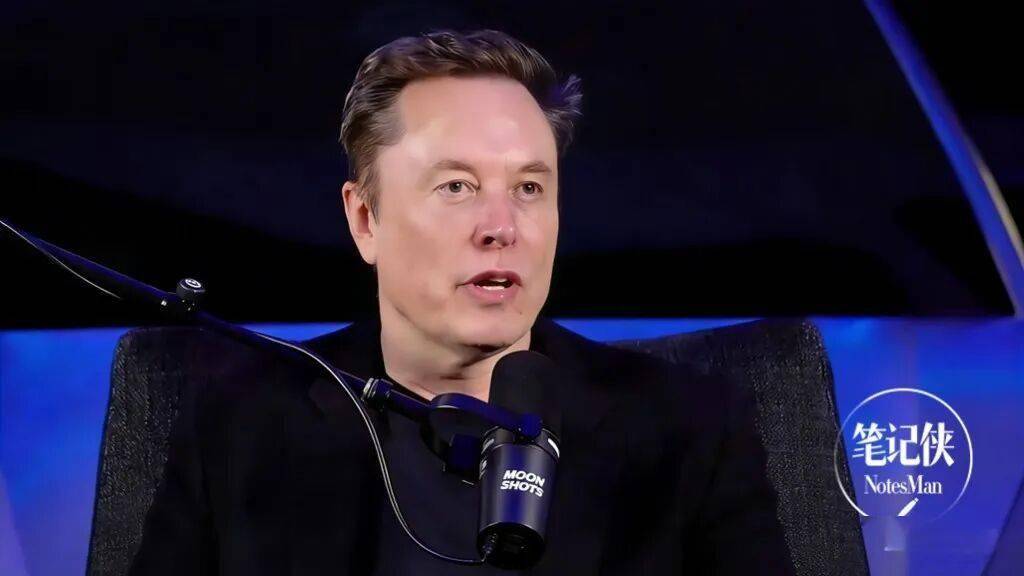
马斯克最新访谈:2026,必须面对的关键时刻!
Sou Hu Cai Jing· 2026-01-09 15:22
Group 1 - AI is capable of performing over half of white-collar jobs, accelerating the process and making it irreversible [4][7][8] - The future will see unprecedented production efficiency and a significant drop in costs, leading to material abundance and high income for all [11] - The future challenges will shift from survival to creating new challenges in a world of abundance [11] Group 2 - The true measure of a civilization's progress is its ability to control and utilize energy, with future currency being based on power (watts) [13][14] - Solar energy is emphasized as the most efficient and abundant energy source, with current production at 1,500 gigawatts annually [18] - A significant increase in solar energy capacity is proposed, utilizing AI satellite clusters for efficient energy capture [18][19] Group 3 - The emergence of Artificial General Intelligence (AGI) is expected by 2026, with AI intelligence surpassing human intelligence by 2030 [21][22] - AI will begin designing its own chips, leading to a self-improvement cycle and significant advancements in computational efficiency [23] - The potential for a 4-bit revolution in computing could lead to performance leaps by simplifying calculations [23] Group 4 - Humanity's role is seen as a "biological guide program" for digital superintelligence, with humans acting as a catalyst for silicon-based intelligence [25][26] - Ensuring the development of "good" AI involves three principles: pursuing truth, maintaining curiosity, and having an aesthetic sense [28][29][30] - The future may consist of multiple AI entities rather than a single superintelligence, due to physical limitations in real-time synchronization [31] Group 5 - The ideal future envisioned includes a world of material abundance governed by intelligent AI, allowing humans to pursue their dreams freely [34][36] - The discussion highlights the need for reflection on the meaning of work and human value in a future dominated by machines [37] - The future is shaped by four key areas: philosophy, AI technology, economy, and politics, which are interconnected and drive progress [39][40]
马斯克的2026愿景:我们已处于“技术奇点”,AI和机器人不可阻挡,短期是动荡和挑战,长期是丰盛时代
美股研究社· 2026-01-08 11:27
Core Insights - Humanity is currently in the "biological bootloader" phase of digital superintelligence, with a transformative wave of change that cannot be halted [4] - Elon Musk predicts that Artificial General Intelligence (AGI) will be achieved by 2026, with AI's total intelligence surpassing that of all humanity by 2030 [5][6] - The transition period leading to AGI will be tumultuous, particularly affecting white-collar jobs, as AI is capable of performing over half of these roles [9] AGI and Technological Singularity - Musk asserts that we are already experiencing the "technological singularity," characterized by rapid and irreversible changes [6] - The impact of AI will lead to a significant reshaping of the workforce, with white-collar jobs being the first to disappear [9] Economic Predictions - Musk introduces the concept of Universal High Income (UHI), suggesting that a future of abundance will allow people to have whatever they desire, as production costs will drop significantly [11] - He warns that this abundance will coincide with social unrest, as society grapples with the implications of a world where work is no longer a measure of value [11] Energy Competition - Musk praises China's efficiency in solar energy deployment, stating that by 2026, China's electricity output will be three times that of the U.S. [12] - He emphasizes the need for the U.S. to catch up in energy production to remain competitive in AI [12] Space and Computing Infrastructure - Musk plans to establish "orbital data centers" using Starship, which will reduce launch costs to below $100 per kilogram, enabling large-scale computing in space [13] - This shift aims to create a self-evolving "Dyson Swarm" and address energy challenges for AI infrastructure [13] AI Safety Principles - Musk outlines three core principles for AI safety: Truth, Curiosity, and Beauty, to prevent AI from becoming a threat to humanity [15] - He emphasizes the importance of ensuring AI remains curious about humanity and does not resort to deception [15]

“图钉型”社会降临:马斯克预言下的中产崩塌与算力霸权
Tai Mei Ti A P P· 2025-12-24 09:48
Core Insights - Elon Musk predicts that in the future, work will become optional due to advancements in humanoid robots and AGI technology, leading to a potential collapse of the traditional labor-for-pay economic model [1][2] - The rise of AI and robotics will redefine poverty and wealth distribution, making survival resources more accessible while potentially increasing wealth inequality [2][3] Group 1: Economic Implications - The marginal cost of productivity is approaching zero, which could lead to a deflationary environment where the value of human labor diminishes significantly [1][2] - The traditional economic model, which has relied on labor as a core production factor since the Industrial Revolution, is being disrupted by technological advancements [1][3] Group 2: Social Structure Changes - The middle class's economic security is eroding as AI reduces the value of high-skill jobs, leading to a polarized "tack-shaped" society where wealth is concentrated among those who control computational power and algorithms [3][5] - In this new economic landscape, computational power and energy may become the new forms of currency, overshadowing traditional monetary wealth [3][5] Group 3: Human Capital and Innovation - Musk emphasizes that human creativity and intuition remain irreplaceable, as demonstrated by the development of the Starship, which was not reliant on AI [4][6] - The future economy will prioritize cognitive abilities and knowledge over traditional financial assets, as the ability to leverage AI for complex problem-solving will become crucial [7]
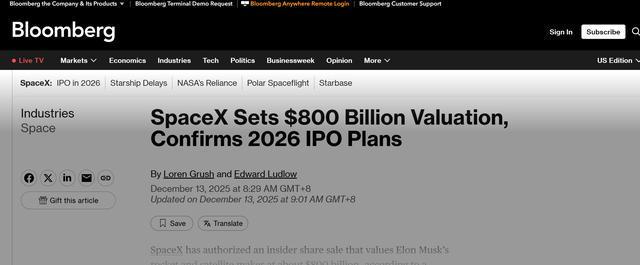
SpaceX 敲定内部股票交易,估值达 8000 亿美元
Huan Qiu Wang Zi Xun· 2025-12-13 03:37
Core Insights - SpaceX has increased its internal valuation to approximately $800 billion, with internal share prices set at $421, nearly double the $212 price from July when the company was valued at around $400 billion [1][3] - The company is preparing for a potential IPO as early as 2026, which has garnered significant industry attention [1][3] Group 1: IPO Plans - SpaceX has indicated that the timing, final valuation, and whether the IPO will proceed remain uncertain [3] - The company aims to raise over $30 billion through the IPO, which could become one of the largest public offerings globally [3] - The overall target valuation for SpaceX is approximately $1.5 trillion, close to the record set by Saudi Aramco in 2019 [3] Group 2: Business Development - SpaceX is currently the leading commercial space company in terms of launch frequency, with its Falcon 9 rocket dominating satellite launches and crewed space missions [4] - The company provides high-quality satellite internet services to millions globally through its Starlink system, addressing coverage gaps in various regions [4] - SpaceX is actively developing the next-generation heavy-lift rocket, Starship, which is intended for large-scale Starlink deployments and critical missions to the Moon and Mars [4]