
Vera Rubin机架

Search documents
黄仁勋深度访谈:“Token经济”爆发,AI计算占GDP比重将翻百倍,英伟达10万亿是必然
硬AI· 2026-03-25 15:18
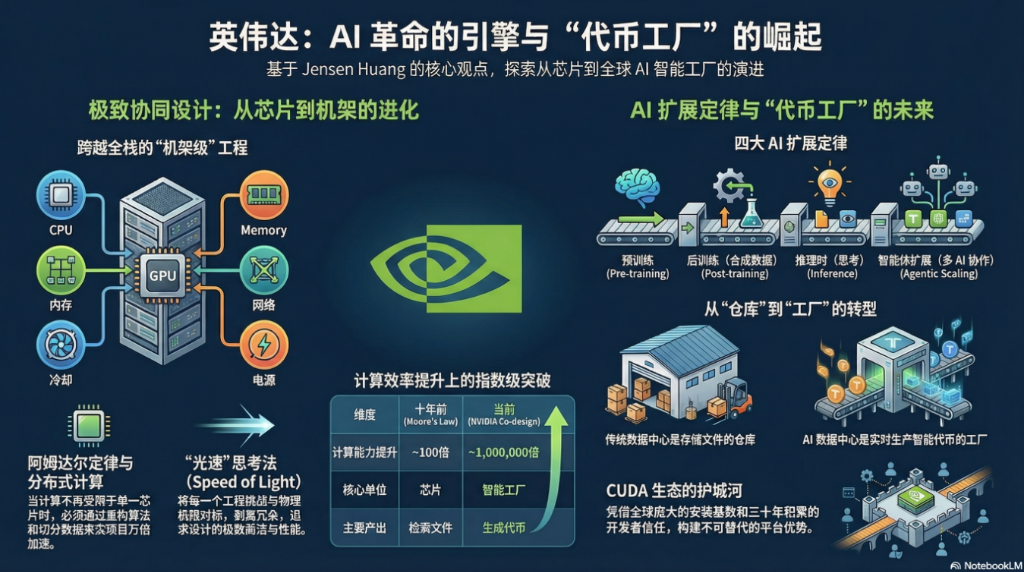
Group 1 - The core viewpoint of Huang Renxun is that computing has transitioned from a "storage system" to a "generation system," significantly impacting its role in the economy and potentially increasing its contribution to global GDP by 100 times [6][9]. - Huang predicts that the production of "Token" goods by AI factories will create a new economic model, linking computing directly to revenue generation, thus transforming computing devices from cost centers to profit centers [7][8]. - The potential for NVIDIA to reach a market valuation of $10 trillion is seen as highly probable, with future revenue targets of $3 trillion being feasible [10]. Group 2 - Huang identifies electricity as a significant bottleneck for AI expansion, proposing the use of underutilized energy from the grid and advocating for "graceful degradation" in data centers to manage power consumption during peak times [12][14]. - The company is focusing on enhancing energy efficiency, with a target of reducing token generation costs by an order of magnitude each year [13]. - Huang emphasizes the need for a shift in contracts between cloud providers and power companies to allow for more flexible energy usage [14]. Group 3 - NVIDIA is proactively addressing supply chain concerns by collaborating with around 200 suppliers to ensure the availability of high-bandwidth memory (HBM) and other critical components for AI production [16][17]. - Huang has successfully convinced memory manufacturers to invest in HBM production, anticipating its future dominance in data centers [16]. Group 4 - Huang outlines four scaling laws for AI expansion: pre-training, post-training, testing time, and agentic scaling, emphasizing that the future of AI will be driven by computational power rather than data limitations [19][70]. - The company is focused on creating a flexible architecture that can adapt to evolving AI models, ensuring that it remains at the forefront of technological advancements [78]. Group 5 - Huang asserts that the number of programmers will increase dramatically from 30 million to potentially 1 billion, as AI tools become more accessible and integrated into various professions [25][26]. - The company believes that the advent of AGI (Artificial General Intelligence) has already been achieved, enabling AI to autonomously create applications and generate revenue [26].



黄仁勋深度访谈:“Token经济”爆发,AI计算占GDP比重将翻百倍,英伟达10万亿是必然
Hua Er Jie Jian Wen· 2026-03-24 03:22
Core Insights - The essence of computing has fundamentally shifted from a "storage system" to a "generative system" with context-awareness capabilities, transforming computers from profit centers to factories directly linked to revenue generation [3][4]. - The concept of "Token" as a new commodity produced by AI factories is emerging, with significant value across various audiences, indicating a potential market where people are willing to pay substantial amounts for these tokens [3][4]. - The global GDP share attributed to computing is expected to increase by a factor of 100 in the future, driven by productivity enhancements [4]. - The company is confident in its growth trajectory, with a potential to reach a market valuation of $10 trillion, viewing this as an inevitable outcome [4]. Energy and Efficiency - Energy is a significant concern for AI expansion, but it is not the only issue; improving energy efficiency and acquiring more power are both critical paths forward [6]. - The efficiency metric emphasized is "tokens per watt per second," with a focus on extreme collaborative design to enhance energy efficiency [6]. - The current power grid is designed for peak demand, leaving much idle capacity that can be utilized by changing contracts between cloud providers and power companies to allow for "graceful degradation" of data centers during power shortages [6]. Supply Chain and Memory - The company is not worried about potential bottlenecks in AI production due to supply chain constraints, having established relationships with around 200 suppliers and advanced planning for high bandwidth memory (HBM) usage [7][8]. - The traditional assembly model for data centers has been replaced by a pre-assembly approach in the supply chain, requiring significant power reserves for testing before shipment [7]. AI Scaling Laws - The CEO outlines four scaling laws for AI expansion: pre-training, post-training, testing time expansion, and agentic scaling [9][10]. - The concern over "data exhaustion" is addressed by emphasizing the continued growth of training data, much of which will be synthetic, indicating that training is now limited by computational power rather than data availability [9][10]. Competitive Advantage and Future Outlook - The company's greatest competitive advantage lies in the extensive deployment of CUDA and the trust built within its ecosystem, supported by a large developer community [11]. - The exploration of deploying data centers in space is acknowledged, but significant physical challenges remain, with a current focus on optimizing energy use on Earth [11]. - The potential for AI to disrupt employment is discussed, with a prediction that the number of programmers could grow from 30 million to 1 billion, as AI becomes integrated into various professions [12][13].
黄仁勋三万字采访:展望10万亿市值,3万亿营收
半导体行业观察· 2026-03-24 03:20
Core Viewpoint - NVIDIA is recognized as one of the most influential companies in human history and a driving force behind the AI revolution, largely due to the leadership and innovative decisions of Jensen Huang [2]. Group 1: Extreme Collaborative Design - NVIDIA's success is attributed to its extreme collaborative design approach, which integrates various components such as GPU, CPU, memory, and networking to solve complex computational problems [3][4]. - The challenges of collaborative design include distributing workloads across multiple computers while ensuring efficient communication and data management [3][4]. - A key aspect of NVIDIA's design philosophy is optimizing the entire software stack, from architecture to applications, to achieve better performance than simply increasing the number of computers [4][5]. Group 2: Evolution of Business Focus - Initially, NVIDIA started as a specialized accelerator company but recognized the need to broaden its scope to enhance its impact in the computing field [6][7]. - The introduction of programmable pixel shaders and the development of CUDA were pivotal steps in transitioning from a narrow focus to a broader computing company [7][8]. - CUDA became a foundational technology for AI infrastructure, significantly expanding the range of applications for NVIDIA's GPUs [8][10]. Group 3: Scaling Laws and Future Challenges - NVIDIA believes in the importance of scaling laws, which dictate that the amount of data and computational power directly influences AI capabilities [15][16]. - Future challenges include ensuring sufficient computational power and addressing the complexities of data generation and processing, particularly in the context of AI agents [19][20]. - The company is focused on improving energy efficiency and reducing token costs to overcome potential bottlenecks in AI scaling [28][29]. Group 4: Supply Chain and Energy Management - NVIDIA emphasizes the importance of a robust supply chain to support its growth, engaging with CEOs across the industry to align on future needs and investments [29][30]. - The company is exploring innovative energy solutions, such as modular nuclear power plants, to address the increasing power demands of AI computing [28][34]. - Effective energy management strategies are being developed to utilize excess power from the grid, ensuring that data centers can operate efficiently without compromising reliability [34][35].
英伟达一年大赚超1200亿美元,3月有望发布新一代产品!全球算力产业链迎机遇
Jin Rong Jie· 2026-02-27 01:00
Core Insights - Nvidia's Q4 2026 financial report exceeded expectations, with revenue reaching $68.1 billion and net profit at $42.96 billion, marking a significant year-on-year increase of 73% and 94% respectively [2][3] - The company anticipates Q1 2027 revenue to be around $78 billion, driven by a substantial increase in demand for computing power due to generative AI [3] Financial Performance - For the fiscal year 2026, Nvidia's revenue grew by 65% to $215.94 billion, with net profit also increasing by 65% to $120.07 billion, translating to a net profit exceeding 800 billion RMB [2] - The data center business accounted for over 90% of Q4 revenue, reaching $62.3 billion with a year-on-year growth rate of 75% [2] - Gaming revenue was $3.7 billion, up 47% year-on-year, while professional visualization revenue was $1.3 billion, showing a growth of nearly 160% [2] Future Outlook - Nvidia's CEO Jensen Huang highlighted a paradigm shift in AI, predicting a thousandfold increase in computing power demand, with "computing power equals revenue" becoming a consensus among industry leaders [3] - The company is confident in its performance for Q1 2027, providing a revenue guidance that has shocked the market [2] Product Development - Nvidia showcased the Vera Rubin rack, which includes 1.3 million components from over 80 suppliers, as part of its new product line [4][6] - The company plans to launch the Rubin Ultra in the second half of 2027, following the Vera Rubin product line [5] - Nvidia has restructured its AI computing platform, releasing six new chips that significantly reduce the computing power required for training large models by 75% [5] Market Position - Nvidia's core market remains in China, although it faces challenges due to U.S. export policies and the rapid development of domestic GPU manufacturers [3] - The upcoming GTC 2026 event is expected to unveil groundbreaking new chips, including the anticipated Richard Feynman architecture [7]