Visa信用卡

Search documents
当“网红股”跌落神坛,什么才是穿越周期的投资真谛?丨CV荐书
投中网· 2026-01-18 07:04
Core Viewpoint - The article emphasizes the importance of identifying companies with a strong economic moat that can withstand economic cycles and competition, providing reliable long-term returns for investors [3][4]. Group 1: Economic Moat Concept - The concept of an economic moat is crucial for understanding which companies can deliver sustainable competitive advantages and superior capital returns over time [3][4]. - Morningstar has developed a rigorous and globally applicable analysis and rating system based on the economic moat concept, demonstrating its effectiveness through decades of performance [5][8]. Group 2: Morningstar's Investment Philosophy - Morningstar's investment philosophy is built on three core principles: decoding economic moats, identifying great companies, and determining the best time to invest in them [10][14]. - The analysis framework includes five identifiable sources of economic moats: intangible assets, cost advantages, switching costs, network effects, and efficient scale [11][12][13]. Group 3: Investment Timing and Valuation - Identifying great companies is only part of the investment success; buying them at fair or undervalued prices is essential for generating excess returns [14]. - Morningstar employs a discounted cash flow model to estimate intrinsic value, requiring deep analysis of future cash flows and competitive advantage periods [15]. Group 4: Safety Margin and Uncertainty - Acknowledging the inherent limitations of human predictions is vital for rational investors, leading to the principle of safety margin to protect against unforeseen risks [18]. - Morningstar's unique uncertainty rating system helps assess the difficulty and risk of future cash flow predictions, guiding the required safety margin for investments [18]. Group 5: Consumer Sector Analysis - The consumer sector serves as an excellent platform for applying the economic moat theory, with strong brands and difficult-to-replicate scale advantages being key factors [21]. - Specific industries, such as beverages and packaged goods, demonstrate how brand loyalty and distribution networks create robust economic moats [26][23]. Group 6: Case Studies and Practical Insights - The book "Investing with Moats" provides a systematic approach to identifying valuable companies, offering practical insights and case studies across various consumer sub-industries [30][31]. - It emphasizes the importance of focusing on intrinsic value rather than market price fluctuations, fostering a mindset that resists market panic and greed [31].


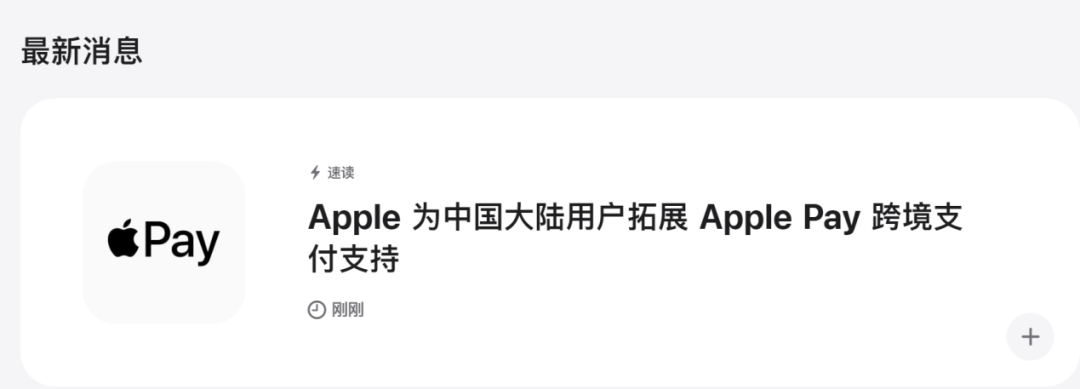
苹果宣布为中国大陆用户支持Apple Pay跨境支付:可添加Visa信用卡
Feng Huang Wang· 2026-01-15 02:43
Core Viewpoint - Apple Inc. expands the cross-border payment support for Apple Pay in mainland China, allowing users to add local bank-issued Visa credit and debit cards to Apple Wallet for use during international travel [1] Group 1: Announcement Details - Starting immediately, users in mainland China can add Visa credit and debit cards issued by local banks to Apple Wallet for cross-border payments [1] - The initial banks supporting this feature include Industrial and Commercial Bank of China, Bank of China, Agricultural Bank of China, Bank of Communications, China Merchants Bank, Citic Bank, Ping An Bank, and Industrial Bank, with additional support from Shanghai Pudong Development Bank, China Construction Bank, China Minsheng Bank, and China Everbright Bank expected in the coming months [1] - Mastercard has also announced plans to provide this functionality to cardholders of certain issuing institutions in the upcoming months [1] Group 2: Security Features - Users can add cards through the latest bank app or the Wallet app on iPhone, requiring Face ID, Touch ID, or device password along with a one-time dynamic security code for authentication [1] - Apple emphasizes that security and privacy are core design principles, stating that actual card numbers will not be stored on the device or Apple servers [1] Group 3: Historical Context - Apple Pay was officially launched in mainland China in February 2016, primarily supporting UnionPay cards prior to this expansion [2]

Apple Pay+Visa,今起支持中国持卡用户跨境支付
Shang Hai Zheng Quan Bao· 2026-01-15 02:26
Core Insights - Apple expands Apple Pay's cross-border payment support for users holding Visa credit and debit cards issued by several Chinese banks, enhancing the payment experience for travelers [1][3] Group 1: Apple Pay Expansion - Apple Pay now supports cross-border payments for users with Visa cards from major Chinese banks, including ICBC, Bank of China, and others [1][3] - Additional banks, such as SPDB, China Construction Bank, and China Minsheng Bank, will support this feature in the coming months [3] - Mastercard is also preparing to launch this functionality for certain cardholders in the upcoming months [3] Group 2: User Experience and Security - Users can add their Visa cards to the Apple Wallet app via their bank's app or directly through the Wallet app on their iPhone [3] - Each Apple Pay transaction requires authentication through Face ID, Touch ID, or a device password, along with a one-time dynamic security code for enhanced security [4] Group 3: Historical Context - Apple Pay was launched in China in December 2015 in partnership with China UnionPay, making China the first Asian country to support Apple Pay [4] - Visa has been a long-standing partner of Apple Pay since its initial release in the U.S. in September 2014 [6]
国内Apple Pay支持绑定Visa信用卡 为出境游和留学生带来更多便利
Xin Lang Cai Jing· 2026-01-15 01:47
Core Viewpoint - Apple has officially announced that users in mainland China can now link Visa credit cards to Apple Pay, enabling overseas payments through the service [1]. Group 1: Apple Pay Expansion - The new feature allows for a more convenient and secure global payment experience for tourists and overseas students [4]. - Previously, Apple Pay in China only supported dual-currency cards with UnionPay, limiting international payment options [4]. - The integration of Visa credit cards will simplify cross-border transactions for users traveling abroad [8]. Group 2: Supported Banks and Cards - Users can add Visa credit cards issued by several banks, including Industrial and Commercial Bank of China, Bank of China, Agricultural Bank of China, and others, to their Apple Wallet [4]. - Additional banks, such as Shanghai Pudong Development Bank and China Construction Bank, will gradually support this feature in the coming months [4]. Group 3: User Experience and Security - Apple Pay maintains its user-friendly setup, allowing users to add Visa cards via their bank's app, with a requirement for device updates to iOS 17 or higher [7]. - The service emphasizes security, using encrypted device account numbers instead of real card numbers, and requires dual authentication for transactions [8]. - Apple aims to enhance the travel experience by providing a reliable payment method for users globally [7].

信用卡境外盗刷频发!多家银行发布公告
证券时报· 2026-01-14 09:14
Core Viewpoint - The increase in overseas card fraud incidents since 2025 has raised significant concerns, prompting various banks to take measures to enhance user security and optimize risk control systems [1][3]. Group 1: Fraud Incidents - Reports of credit and debit card fraud have surged, particularly around the New Year holiday, affecting major state-owned banks, joint-stock banks, and local small and medium-sized banks [1]. - Many cardholders have experienced unauthorized transactions, with losses ranging from hundreds to over ten thousand yuan, highlighting the vulnerability of users [2]. Group 2: Bank Responses - In response to the rising fraud cases, several small and medium-sized banks in regions like Hunan, Guangdong, Jilin, Hebei, and Hubei have proactively disabled cross-border transaction capabilities for their debit cards [4][5]. - The closures primarily involve village and township banks, which have limited exposure to overseas transactions, thus minimizing the impact while enhancing customer security [5]. Group 3: Underlying Causes - The rise in fraud is attributed to several factors, including inconsistent information security measures among overseas merchants and acquiring institutions, as well as insufficient cross-border risk monitoring capabilities of smaller banks [3]. - Additionally, a lack of awareness among cardholders regarding safe card usage abroad exacerbates the risk of fraud [3]. Group 4: Future Outlook - Despite the temporary suspension of cross-border transaction capabilities, industry experts suggest that small and medium-sized banks are unlikely to permanently exit the overseas financial sector, as this could lead to a loss of retail customers and associated revenue [6]. - There is potential for these banks to gradually reintroduce cross-border services for verified scenarios, such as study abroad and cross-border e-commerce, while leveraging partnerships with larger banks for improved risk management [6][7].

Visa Stock Offers Rare Chance To Buy
Forbes· 2025-12-02 15:55
Core Insights - Visa stock (V) is currently viewed as a good buying opportunity due to its high margins and efficient cash generation, which are indicative of strong pricing power [2][3] - The stock has increased by 4.3% year-to-date but is priced at a 38% discount based on its Price-to-Sales (P/S) ratio compared to the previous year [3][9] - Visa's fiscal year 2025 net revenue rose by 11% to $40 billion, driven by a 9% increase in payment volumes and an 11% rise in higher-margin cross-border transactions [3][4] Financial Performance - Visa's operating cash flow margin is approximately 57.6% and the operating margin is 66.4% for the last twelve months [9] - Long-term profitability metrics show an operating cash flow margin of around 58.9% and an operating margin of 66.8% over the last three years [9] - Revenue growth for Visa is reported at 11.3% for the last twelve months and 10.9% over the last three-year average [9] Strategic Developments - Recent partnerships, such as advancing stablecoin settlement in CEMEA, are expected to enhance operations with an annualized run rate of $2.5 billion [4] - Management has increased dividends by 14%, reflecting confidence in ongoing cash generation and supported by strategic fee modifications [4] Investment Criteria - Visa meets several investment criteria, including a market capitalization exceeding $10 billion, high cash flow from operations, and a significant reduction in value over the prior year [10] - The stock has shown an average 12-month forward return of nearly 19% and a win rate of about 72% for positive returns [10]


Where Will Chime Financial Stock Be in 5 Years?
The Motley Fool· 2025-11-05 08:57
Core Viewpoint - Chime Financial, a fintech company, has shown growth potential despite a recent stock price decline since its IPO, which may present a buying opportunity for long-term investors [1][2]. Business Model - Chime offers no-fee checking and savings accounts, overdraft protection, early-pay features, and a Visa debit card with access to over 50,000 ATMs [3][4]. - The company primarily targets lower-income users who may not qualify for traditional banking services, helping them build credit scores through its credit card offerings [4]. Financial Performance - Chime's market capitalization is $7 billion, with a current stock price around $17.80, down from its IPO price of $27 [5][6]. - Key financial metrics for 2023 and 2024 show growth in active members, purchase volume, and revenue, although there was a sequential decline in purchase volume and average revenue per active member (ARPAM) in Q2 2025 [8]. - Revenue for 2024 is projected to rise by 28% to 29%, with an adjusted EBITDA margin expected to expand to 4% [10]. Growth Projections - Analysts forecast a compound annual growth rate (CAGR) of 23% for Chime's revenue from 2024 to 2027, reaching $3.1 billion, with adjusted EBITDA turning positive in 2025 [11]. - If Chime meets these projections and achieves a CAGR of 20% through 2031, its stock could potentially increase nearly sixfold, raising its enterprise value to $32.2 billion [13]. Competitive Landscape - Chime faces competition from other fintech applications like PayPal and Block's Cash App, but there remains significant market potential for these platforms to coexist and attract lower-income customers from traditional banks [12].

传统金融和数字金融加速融合 HashKey联手上海商业银行推信用卡
Zheng Quan Shi Bao Wang· 2025-11-05 08:31
Core Insights - HashKey Group launched a one-stop service platform called HashKey Crypto-as-a-Service (CaaS) to lower the entry barriers for Web3 and connect traditional finance with digital finance [1] - The collaboration with Shanghai Commercial Bank aims to create a Visa credit card that integrates traditional regulated financial systems with compliant digital asset exchanges [2] Group 1 - The HashKey CaaS platform will leverage HashKey Chain and its core capabilities, including asset tokenization and institutional-grade custody, to help financial institutions efficiently enter the digital asset space [1] - The platform addresses challenges faced by traditional institutions, such as regulatory complexity and high technical barriers, by providing a systematic solution for seamless integration [1] Group 2 - The partnership with Shanghai Commercial Bank is not limited to the credit card; it aims to facilitate new paradigms in wealth management and settlement through digital assets [2] - A dual rewards program will be implemented for credit card holders, integrating digital asset services into everyday consumer spending [2] - The collaboration signifies a significant step towards the integration of traditional banking with the digital asset ecosystem within a regulatory framework [2]
Should You Buy Chime Stock While It's Below $43?
The Motley Fool· 2025-07-18 08:15
Core Viewpoint - Chime, a fintech company, has significant growth potential despite its stock trading below its initial public offering price, warranting a closer examination of its business model, growth rates, and valuations [1] Business Model - Chime operates as a mobile-first banking service provider, partnering with FDIC-insured banks to manage customer deposits, offering features like free checking and savings accounts, overdraft protection, and early pay access [3][4] - The company primarily targets lower-income users who may not have access to traditional banking services, providing tools that cater to those living paycheck to paycheck [4] - Chime generates revenue mainly through interchange fees from Visa debit and credit card transactions, retaining up to 1% of the fees charged to merchants [6] Growth Rates - In 2023, Chime's revenue increased by 27% to $1.28 billion, with a gross margin of 83% and a narrowed net loss from $406 million to $189 million [9] - The number of active members grew by 25% to 6.6 million, with an average revenue per active member (ARPAM) improving slightly from $210 to $212 [10] - For 2024, revenue rose by 31% to $1.67 billion, gross margin increased to 88%, and net loss further narrowed to $25 million, with active members reaching 8 million and ARPAM jumping 16% to $245 [11][12] Valuations - In Q1 2025, Chime's revenue grew by 32% year over year to $519 million, with an adjusted EBITDA margin of positive 5% and active members increasing to 8.6 million [13] - Analysts project Chime's revenue to rise by 26% to $2.1 billion for the full year, with a positive adjusted EBITDA of $53 million, and expect a CAGR of 19% for revenue and 175% for adjusted EBITDA from 2025 to 2027 [14] - With an enterprise value of $10.1 billion, Chime's valuation stands at 4 times next year's sales and 43 times its adjusted EBITDA, indicating it may be a long-term investment opportunity in the growing market for banking services aimed at unbanked and underbanked individuals [15]