
eDRAM

Search documents
英特尔,“重返”DRAM?
3 6 Ke· 2026-01-27 03:35
Core Insights - Sandia National Laboratories and Intel have made significant advancements in memory technology through their collaboration on the Advanced Memory Technology (AMT) project, which aims to address memory bandwidth and latency issues in critical tasks for the U.S. National Nuclear Security Administration (NNSA) [1] - The news has sparked speculation about whether Intel will return to the DRAM market, especially given the current upswing in the DRAM industry driven by the AI supercycle [1] - Intel's historical dominance in the DRAM market and the current market dynamics make its potential re-entry a topic of interest [1][2] Intel's Historical Context - Intel launched the first commercially successful DRAM product, the 1103 chip, in 1970, which quickly established its dominance in the storage industry [2][5] - At its peak, Intel held a 90% market share in the global DRAM market [5] - The company's exit from the DRAM business in 1985 was a significant strategic shift, leading it to focus on CPUs instead [6] Current Market Dynamics - The DRAM industry is experiencing a new structural opportunity due to the explosive demand for memory bandwidth and capacity driven by AI workloads [9] - TrendForce predicts that DRAM contract prices will increase significantly in the coming years, with general DRAM prices expected to rise by 55-60% and server DRAM prices by over 60% in Q1 2026 [9] - The DRAM market is projected to recover to a revenue level of $100 billion by 2025 and reach $150 billion by 2029, with data centers and automotive applications as key growth drivers [9] AMT Project and Technological Innovations - The AMT project, part of the exascale computing initiative, has entered the productization phase, showcasing Intel's next-generation DRAM bonding (NGDB) plan, which aims to enhance DRAM performance while reducing power consumption and costs [10] - The NGDB technology addresses the performance trade-offs between high bandwidth memory (HBM) and DDR DRAM, allowing for broader application of high-bandwidth memory advantages [10][11] - Intel's strategic focus on redefining DRAM architecture indicates a long-term commitment to the memory sector [11] Saimemory Joint Venture - Intel's partnership with SoftBank to establish Saimemory aims to develop low-power stacked DRAM solutions to address the challenges posed by HBM technology [12] - The Saimemory project has a total investment of approximately 10 billion yen (about $70 million), with SoftBank committing initial funding and prioritizing procurement [13] - This collaboration represents a significant step for Intel in the DRAM market, focusing on architectural optimization and energy efficiency [13][14] eDRAM Technology - Intel's existing expertise in embedded DRAM (eDRAM) technology provides additional support for its potential return to the memory market [15][19] - eDRAM offers advantages such as low latency and high bandwidth, making it a viable solution for bridging the gap between GPUs and memory [15][19] - The resurgence of interest in eDRAM aligns with the increasing demand for high-performance computing and AI applications [19] Conclusion - Intel's recent activities in the memory sector, including collaborations and technological advancements, suggest a strategic repositioning in the DRAM market [20] - The company is exploring multiple avenues for re-entering the memory space, including partnerships and innovative technologies, while facing challenges from established competitors [21] - The evolving landscape of memory technology driven by AI presents both opportunities and challenges for Intel as it seeks to redefine its role in the storage industry [21]


英特尔,“重返”DRAM?
半导体行业观察· 2026-01-27 01:26
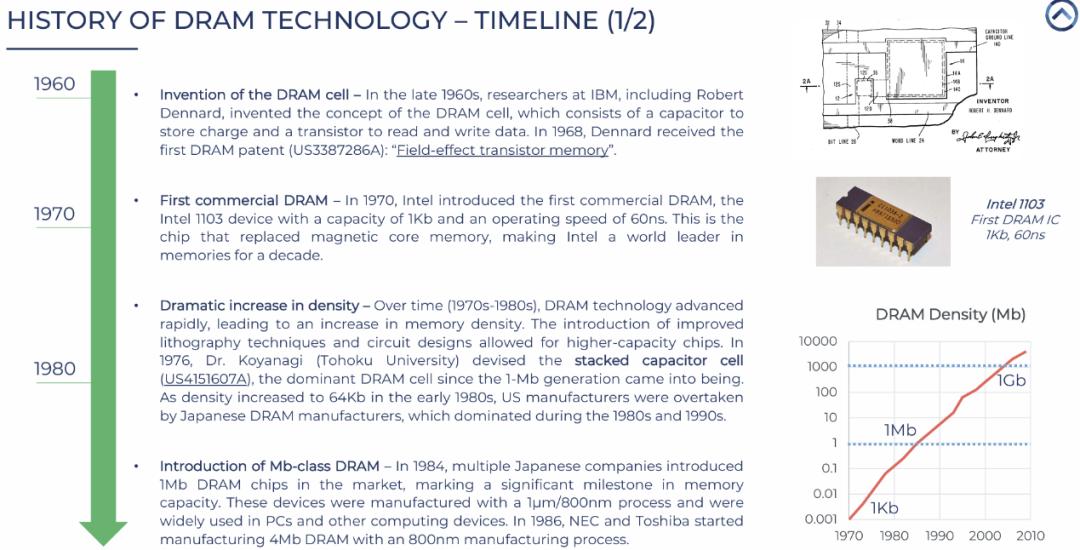
Core Viewpoint - The collaboration between Sandia National Laboratories and Intel on advanced memory technology (AMT) indicates a potential return of Intel to the DRAM market, amidst a booming demand driven by AI applications [1][10][11]. Group 1: Intel's Historical Context in DRAM - Intel's involvement in the DRAM market began in 1970 with the launch of the 1103 chip, which became the first commercially successful DRAM product, capturing 90% of the global market share in the 1970s [3][6]. - The company's dominance was challenged in the 1980s by Japanese manufacturers, leading to Intel's exit from the DRAM business in 1985, a decision described as a significant strategic shift in semiconductor history [6][7]. Group 2: Current Market Dynamics - The DRAM industry is experiencing a structural opportunity due to the explosive growth in demand for memory bandwidth and capacity driven by AI workloads, with predictions of a recovery to $100 billion in revenue by 2025 and $150 billion by 2029 [9][10]. - The market is expected to see a significant increase in DRAM contract prices, with general DRAM prices projected to rise by 55-60% and server DRAM prices by over 60% in Q1 2026 [9]. Group 3: AMT Project and Technological Innovations - The AMT project aims to address memory bandwidth and latency issues for critical tasks of the U.S. National Nuclear Security Administration, showcasing Intel's innovative approach to DRAM technology [1][11]. - Intel's Next Generation DRAM Bonding (NGDB) plan introduces a new memory organization and stacking method that enhances performance while reducing power consumption and costs, potentially allowing for broader application of high-bandwidth memory [11][13]. Group 4: Strategic Partnerships and New Ventures - Intel's joint venture with SoftBank, Saimemory, aims to develop low-power stacked DRAM solutions to address the limitations of HBM, with a target of achieving 512GB per chip and reducing power consumption by 40-50% [15][16]. - The project has a total investment of approximately 7 million USD, with significant backing from SoftBank and the Japanese government, highlighting Japan's strategic interest in revitalizing its semiconductor industry [16][17]. Group 5: eDRAM Technology and Future Prospects - Intel's existing expertise in embedded DRAM (eDRAM) positions it well for a return to the storage market, as eDRAM offers low latency and high bandwidth, making it suitable for AI and high-performance computing applications [19][20]. - Despite challenges in eDRAM development, advancements in semiconductor technology are expected to overcome existing limitations, further enhancing Intel's competitive edge in the storage sector [21][22]. Group 6: Conclusion and Future Outlook - Intel's recent activities suggest a multi-faceted approach to re-entering the DRAM market, balancing technological innovation with strategic partnerships [24][25]. - The evolving landscape of memory technology, driven by AI demands, presents Intel with a unique opportunity to redefine its role in the storage industry, potentially leading to a new chapter in its storied history [25].
赛道Hyper | SK海力士首超三星登顶DRAM市场
Hua Er Jie Jian Wen· 2025-06-05 11:46
Core Insights - The global DRAM market has experienced a significant shift in Q1 2025, with SK Hynix surpassing Samsung Electronics to become the largest DRAM supplier for the first time since Samsung established its market leadership in 1992 [1] - SK Hynix achieved a market share of 36.9%, while Samsung's market share fell to 34.4%, marking the end of Samsung's 33-year market monopoly [1] - Despite a 9% quarter-over-quarter decline in global DRAM sales to $26.33 billion due to falling contract prices and decreased HBM shipments, SK Hynix's revenue rose to $9.72 billion, while Samsung's revenue dropped 19% year-over-year to $9.1 billion [1] Market Dynamics - High Bandwidth Memory (HBM) has been a core variable in this market shift, with SK Hynix establishing a significant advantage in the HBM3E sector through long-term technological investments [2] - The fifth-generation HBM3E products utilize a 12-layer stacking technology, achieving a bandwidth of 1.2TB/s and a maximum single-chip capacity of 36GB, primarily supplying AI accelerator cards from Nvidia [2] - SK Hynix's HBM products now dominate the global market, holding over 90% of the HBM3 segment, while Samsung's HBM3E technology has struggled to pass Nvidia's testing, leading to a sharp decline in high-priced product shipments [3] Technological Advancements - The exponential growth of generative AI model parameters has created stringent demands for storage bandwidth and capacity, with Nvidia's H100 GPU requiring 640GB of HBM3E and 2TB of DDR5 memory [4] - SK Hynix has secured over 70% of the AI server market through deep partnerships with Nvidia, with its HBM3E products being adopted by major AI projects from Microsoft and Google [4] - SK Hynix's self-developed MR-MUF technology has improved the stacking layers of HBM3E from 8 to 12, while maintaining good yield rates [5] Future Outlook - Both SK Hynix and Samsung have initiated HBM4 development, with SK Hynix planning to release samples in the second half of 2025, featuring 16-layer stacking and a bandwidth of 2.56TB/s [6] - Samsung is focusing on hybrid bonding technology for HBM4E but faces uncertainties in mass production due to compatibility issues with NAND and DRAM processes [6] - The DRAM industry is shifting from scale competition to deep technological competition, with SK Hynix, Samsung, and Micron collectively holding over 95% market share in DRAM [7] Market Trends - The price cycle is showing structural differentiation, with standard DRAM prices dropping over 10%, while HBM3E prices have only slightly decreased by 3% [7] - As demand for AI servers continues to grow, DRAM prices are expected to stabilize and potentially rise, with HBM3E prices projected to increase by 5%-10% [7] - This transition signifies a broader storage revolution driven by AI, with technological innovation and ecosystem restructuring shaping the industry's landscape for the next decade [7]