iX

Search documents
Germany Revives EV Subsidies: Industry Impact & Key Beneficiaries
ZACKS· 2026-01-26 16:00
Core Insights - Germany has reintroduced a significant electric vehicle (EV) subsidy program with a budget of €3.5 billion until 2029, aiming to support up to 800,000 EV purchases and revive demand in a price-sensitive market [1][9] Subsidy Framework - The updated incentive framework includes battery electric vehicles (BEVs), plug-in hybrids (PHEVs), and extended-range electric vehicles (EREVs), providing a more flexible approach to consumer needs [2] - BEVs are eligible for a base subsidy of approximately €3,000, which can increase to €6,000 for lower-income households, while PHEVs and EREVs qualify for around €1,500 [3][2] - The subsidy applies to both purchases and leases, provided the vehicle is owned or leased for at least 36 months, and includes imported vehicles from brands like those in China [3] Social Tier System - The program features a social tier system with eligibility capped at €80,000 in taxable household income, which can rise to €90,000 with children, aligning with the median income of new-car buyers [4][5] Impact on Automakers - BYD Co. is expanding its European presence, planning to double its sales network to around 2,000 outlets by 2026, with European sales tripling in 2025 to over 80,000 vehicles [6] - The inclusion of Chinese brands in the subsidy scheme reduces competitive barriers for BYD, potentially increasing consumer adoption [7] - Volkswagen AG continues to be a major player in the EV market, reporting significant growth in all-electric deliveries, particularly in Germany [8][10] - BMW AG is expected to benefit from the renewed subsidies, which could accelerate sales of its electric models and enhance production utilization [11] - Tesla, Inc. is committed to the European market despite slowing sales, with plans to increase battery production, making its models more competitive due to the new subsidies [12] Semiconductor Industry - Infineon Technologies AG stands to benefit indirectly from the revived EV subsidy program, as rising EV demand will likely lead to increased semiconductor orders from automakers [13][14] Conclusion - Germany's renewed EV subsidy program is a strategic move to enhance demand while allowing foreign competition, potentially reshaping consumer behavior in electric vehicle purchases and attracting investor interest in the automotive sector [15]

起动机继电器存在安全隐患 宝马汽车或召回超过33万辆汽车
Zhong Guo Zheng Quan Bao· 2025-09-29 20:57
Group 1 - BMW is recalling over 330,000 vehicles globally due to corrosion risks in the starter relay, which may lead to short circuits and fire hazards [1][2] - The recall affects multiple models produced between September 2015 and September 2021, with over 130,000 vehicles in Germany and nearly 200,000 in the United States [1][2] - This is BMW's sixth major recall since 2025, following a significant recall of over 230,000 electric vehicles in August due to issues with the starter generator [2][3] Group 2 - BMW's sales in China have shown a declining trend, with a 6.4% drop in 2022, a slight recovery in 2023, and a projected 13.4% decline in 2024 [4] - The company's financial performance reflects this sales decline, with a 8.2% decrease in revenue to €33.93 billion and a 31.4% drop in EBIT to €2.66 billion in Q2 2025 [4] - The decline in sales is attributed to the rapid rise of domestic brands in the electric and intelligent vehicle sectors, which has impacted traditional luxury brands [4] Group 3 - In response to market challenges, BMW has made significant personnel changes, appointing its first female CEO for Brilliance BMW and committing to invest more in the Chinese market [5] - The company plans to launch over 20 new models, including the first new-generation model in Shenyang in 2026, as part of its strategy to regain confidence in the Chinese market [5] - The automotive industry is facing increasing consumer demands for product quality and safety, necessitating a new quality control system that extends beyond hardware to software and electronic control units [5]

业绩承压!宝马2025年上半年净利润同比暴跌29%
Xi Niu Cai Jing· 2025-08-05 14:07
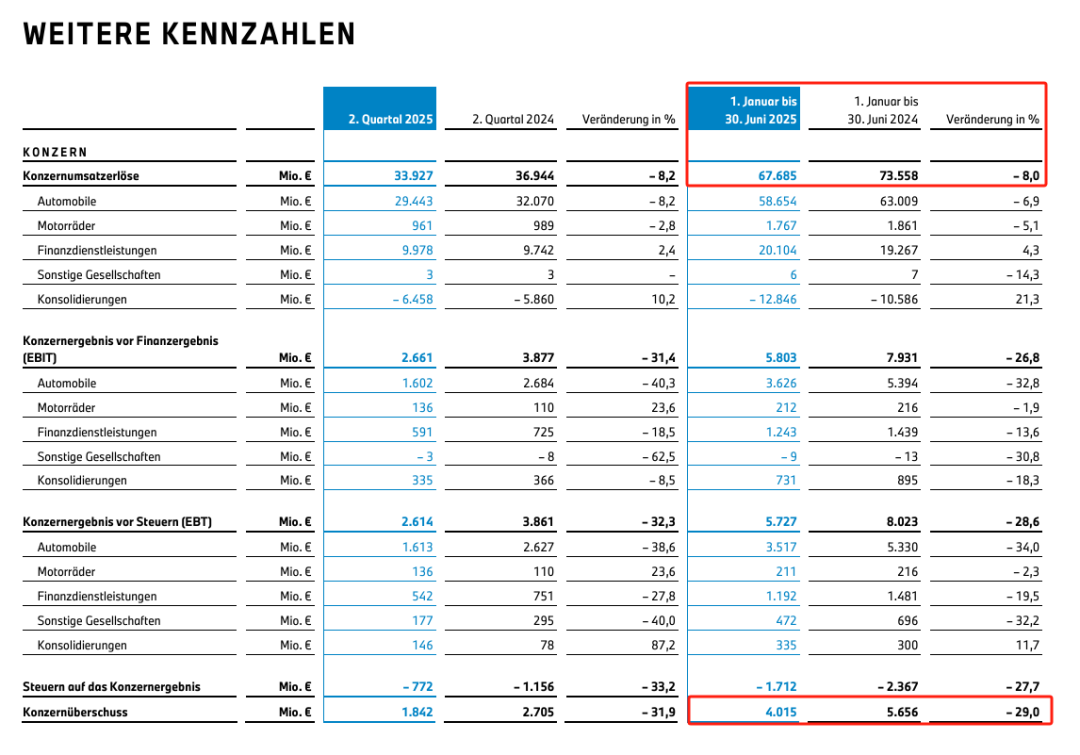
Core Insights - BMW Group reported a significant decline in financial performance for the first half of 2025, with sales revenue dropping by 8% to €67.7 billion and net profit falling by 29% to €4 billion, marking a recent low [1][2] - The second quarter of 2025 saw a sales revenue of €33.9 billion, down 8.2% year-on-year, and an EBIT of €2.66 billion, which represents a 31.4% decrease compared to the previous year [1][2] - Global deliveries in the second quarter increased slightly by 0.4% to 621,500 units, but profitability faced significant pressure [1] Financial Performance - Total sales revenue for the automotive segment in Q2 2025 was €29.4 billion, down 8.2% from €32.1 billion in Q2 2024 [2] - EBIT for the automotive segment fell by 40.3% to €1.6 billion in Q2 2025, compared to €2.7 billion in Q2 2024 [2] - The overall net profit for the group in Q2 2025 was €1.84 billion, a decrease of 31.9% from €2.7 billion in Q2 2024 [2] Market Performance - Europe remains BMW's largest market, with a cumulative sales volume of 497,800 units in the first half of 2025, reflecting an 8.2% year-on-year increase [2] - North American sales reached 237,200 units, up 3.4% year-on-year, while Asian market sales declined by 11.1% to 438,300 units, with China experiencing a 15.5% drop [2] - The decline in the Chinese market is attributed to the rise of local brands in the fields of new energy and smart technology, which are increasingly capturing BMW's market share [2] Electric Vehicle Performance - BMW delivered 318,900 electrified vehicles in the first half of 2025, marking an 18.5% increase and accounting for 26.4% of total deliveries [3] - The European market showed strong growth in electric and plug-in hybrid vehicles, with a 34.8% increase, driven by models like the i4, iX1, and iX [3] - However, BMW's electric vehicle offerings in China are lagging behind local competitors, impacting their market performance [3] Strategic Outlook - BMW's transformation is deemed urgent due to declining profits and sales, with plans to launch over 40 new and updated models by 2027, starting with the BMW iX3 [3] - The NEUE KLASSE platform's first model is set to debut at the IAA Mobility in September, representing a new beginning for the company [3]
宝马,突发!
Zhong Guo Ji Jin Bao· 2025-07-31 13:13
Core Insights - BMW Group reported a decline in sales revenue and net profit for the first half of 2025, with sales revenue at €67.7 billion, down 8% year-on-year, and net profit at €4 billion, down 29% [1][2]. Financial Performance - In Q2 2025, BMW's sales revenue was €33.9 billion, a decrease of 8.2% compared to Q2 2024 [2]. - The EBIT for Q2 2025 was €2.66 billion, reflecting a significant decline of 31.4% year-on-year [2]. - The automotive segment's EBIT margin fell to 5.4% from 8.4% in the previous year [2]. - Total vehicle deliveries for the first half of 2025 were over 1.2 million, remaining stable compared to the previous year [3]. Regional Performance - Sales in the Chinese market dropped by 15.5% due to weak demand for high-end models, indicating a decline in BMW's competitiveness in China [3]. - The European market saw double-digit growth in Q2, with BMW's market share continuing to expand [3]. - The Americas market experienced a cumulative growth of 3.4% in the first half of 2025 [3]. Electric Vehicle Strategy - BMW delivered 318,900 electrified vehicles in the first half of 2025, marking an 18.5% increase year-on-year, with over a quarter of total deliveries being electric models [3]. - The growth in electric models was primarily driven by the i4, iX1, and iX models, with strong performance in plug-in hybrid vehicles in Europe [4]. Strategic Outlook - BMW's Chairman, Oliver Zipse, emphasized the resilience of the company's business model, which is based on globalization, innovation, and attractive products [4]. - The company plans to launch over 40 new and updated models by 2027, covering all market segments and drive types [4]. Market Reaction - Following the disappointing Q2 performance, BMW's stock price has declined, with shares trading at €84, resulting in a total market capitalization of €47.6 billion [5].
宝马,突发!
中国基金报· 2025-07-31 13:10
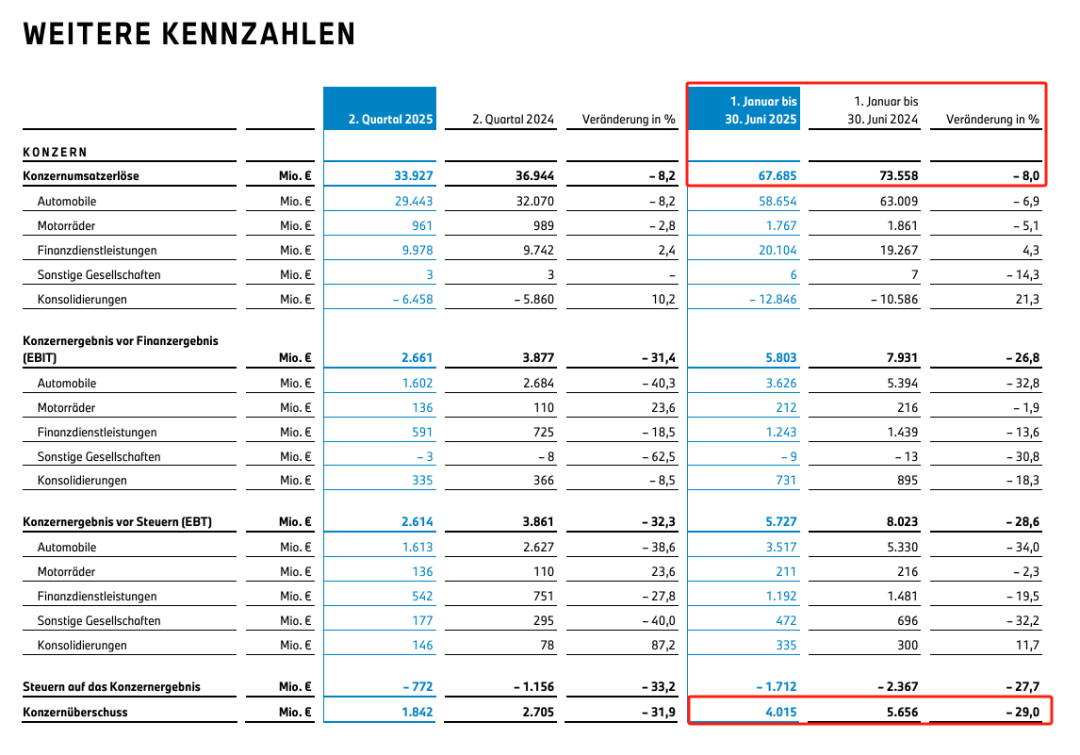
Core Viewpoint - BMW Group reported a decline in sales revenue and net profit for the first half of 2025, with sales revenue down 8% year-on-year to €67.7 billion and net profit down 29% to €4 billion [2]. Financial Performance - In Q2 2025, BMW Group's sales revenue was €33.9 billion, a decrease of 8.2% compared to Q2 2024 [3]. - The EBIT for Q2 2025 was €2.66 billion, reflecting a significant decline of 31.4% year-on-year [3]. - The automotive segment's EBIT margin fell to 5.4% from 8.4% in the previous year [3]. Sales and Market Performance - BMW Group delivered 621,500 vehicles in the first half of 2025, a slight increase of 0.4% year-on-year [4]. - Sales in the Chinese market dropped by 15.5%, attributed to weak demand for high-end models, while the European market saw double-digit growth in Q2 [4]. - The Americas market experienced a cumulative growth of 3.4% in the first half of the year [4]. Electric Vehicle Transition - BMW Group delivered 318,900 electrified vehicles in the first half of 2025, marking an 18.5% increase year-on-year, with over a quarter of total deliveries being electric models [4]. - The growth in electric models was primarily driven by the i4, iX1, and iX, with strong performance in plug-in hybrid vehicles in the European market [4]. Strategic Outlook - BMW Group's Chairman, Oliver Zipse, emphasized the resilience of the business model, which is based on globalization, innovation, and attractive products [4]. - The company plans to launch over 40 new and updated models by 2027, covering all market segments and drive types, integrating innovative technologies and new design language [4]. Stock Market Reaction - Following the disappointing Q2 performance, BMW Group's stock price has seen a decline, trading at €84 per share with a total market capitalization of €47.6 billion [5].