
Zhong Guo Fa Zhan Wang

Search documents
实现3个100%!大连统筹推进“三水”治理
Zhong Guo Fa Zhan Wang· 2025-11-13 10:08
Core Viewpoint - Dalian City has achieved significant improvements in water quality and ecological protection through comprehensive management strategies focusing on water environment, resources, and ecology, resulting in 100% compliance rates for various water quality metrics [1][2][3][4][5][6] Group 1: Water Quality Achievements - Dalian City has reached a 100% excellent rate for 13 national monitoring river sections and maintained a 100% excellent rate for 14 drinking water sources [1] - The city has implemented targeted pollution control measures, including the establishment of pollution source databases and management plans for major rivers [1][2] Group 2: Pollution Control Initiatives - The city has developed a specific management plan for total nitrogen reduction in the Revzhou River, which has been successfully implemented and is set to be replicated across other national monitoring rivers [2] - A comprehensive management scheme for river pollution sources has been initiated, including the establishment of a database for 1,983 pollution outlets [3] Group 3: Infrastructure and Treatment Capacity - Dalian's wastewater treatment capacity has doubled from 124.3 million tons per day in 2016 to 248.7 million tons per day, with a centralized treatment rate exceeding 98% [3] - The city has constructed and upgraded wastewater treatment facilities and networks to enhance urban water quality [3][4] Group 4: Ecological Restoration and Resource Management - Dalian has prioritized ecological flow management and the optimization of water resource allocation, achieving a 100% compliance rate for ecological flow discharge in key reservoirs [4] - The city has initiated ecological restoration projects in several rivers, improving their self-purification capabilities and overall ecological health [5][6] Group 5: Biodiversity and Monitoring - A biodiversity assessment has been conducted in major rivers, providing a scientific basis for ecological protection and restoration efforts [6] - Continuous monitoring and management of water quality and ecological health are being emphasized to ensure sustainable water resource management [6]
天津大学携手行业协会与企业捐赠农机,助力甘肃宕昌县大寨村产业增收
Zhong Guo Fa Zhan Wang· 2025-11-13 08:03
Core Points - The donation of agricultural machinery by Tianjin University significantly enhances farming efficiency in Dazhai Village, Gansu Province, addressing the challenges of traditional farming methods [1][2] - The initiative reflects Tianjin University's commitment to rural revitalization and its practical application of the principle of "seeking truth from facts" [2] Group 1 - The donation includes 10 new micro tillers and 2 generators, which have been delivered and put into use, greatly improving agricultural productivity in the mountainous region [1] - Traditional farming methods in Dazhai Village were inefficient and costly, limiting agricultural production and income for villagers [1] - The micro tillers are well-suited for the village's scattered and steep terrain, allowing for deep plowing and soil breaking, which previously required extensive manual labor [1] Group 2 - The micro tillers have increased sowing efficiency several times compared to manual labor, ensuring timely planting of winter wheat and laying a solid foundation for next year's summer grain harvest [1] - The initiative not only alleviates the physical labor burden on villagers but also frees up labor for other income-generating activities, such as specialized animal husbandry [1] - Tianjin University aims to continue exploring diversified and precise support paths to contribute to the effective connection between poverty alleviation and rural revitalization [2]
陕西商州区构建“三维蓄能+十网覆盖”金融生态 激发民营经济活力
Zhong Guo Fa Zhan Wang· 2025-11-13 07:20
Core Viewpoint - Shaanxi Province's Shanzhou District has established a "financial ecological circulation system" through a three-dimensional linkage mechanism involving government guidance, proactive bank engagement, and active enterprise participation, effectively addressing the financing challenges faced by small and micro enterprises. Group 1: Enterprise Self-Reliance - The establishment of a "self-blood-making system" focuses on creating a financialized mutual assistance network among industries, with a "mutual guarantee fund pool" facilitating inter-enterprise financial support. In the first three quarters, the output value of the metal and non-metal materials industry reached 6.429 billion yuan, while the intelligent manufacturing industry achieved 2.525 billion yuan, resulting in over 120 financing batches totaling 65 million yuan within the industry clusters [2] - A focus on core technologies and brand value is driving enterprises towards digital transformation and project development, with 353 technology innovation projects reserved, totaling an investment of 80.278 billion yuan, providing a source of financing [2] - A financial management health monitoring mechanism has been established to promote standardized financial management, leading to the signing of 47 projects with a total investment of 5.27 billion yuan, facilitating positive capital flow [2] Group 2: Bank Empowerment - The expansion of credit loan offerings aims to reduce costs and increase access for small and innovative enterprises, with banks visiting over 34,000 enterprises and providing concentrated credit of 520 million yuan, resulting in loan disbursements of 360 million yuan [3] - Financial products are being optimized to ensure precise resource allocation towards green and specialized industries, with 42 financial product project libraries established and 20 VEP projects planned [3] - Digital inclusive finance is being promoted through products like "Qin e-loan" and "Qin V-loan," achieving a loan balance of 1.767 billion yuan across over 48,000 signed loans [3] Group 3: Policy Regulation - A targeted approach to fiscal funding has been adopted, with 108 policy funding projects submitted and 61 approved, injecting 571 million yuan into 48 projects and leveraging over 30 billion yuan in major project investments [4] - The planning of bond funds aims to balance financing returns and activate "future funds" for current development, with 114 million yuan in national special bonds and 269 million yuan in provincial special funds allocated [4] - Collaborative funding management is enhancing regional development, with 22 million yuan allocated for village collective industry funds and 19.4 million yuan for edible fungus subsidies [4] Group 4: Risk Mitigation - A "助保贷" mechanism has been established to support small and micro enterprises, with emergency loan funds assisting 30 struggling enterprises in obtaining 41.7 million yuan [5]
深圳以“硬约束”落实执法监督码 护航法治化营商环境
Zhong Guo Fa Zhan Wang· 2025-11-13 06:31
Core Points - Shenzhen Municipal Government held a press conference to explain the "Shenzhen Administrative Law Enforcement Supervision Code Management Regulations" and address how enterprises can protect their rights and how the judicial bureau will ensure the effective implementation of the regulations [1] Group 1: Enterprise Rights Protection - The Shenzhen Municipal Judicial Bureau has established multiple channels for enterprises to file complaints, including a hotline (12345), written submissions to supervisory agencies, and email submissions to relevant enforcement supervision institutions [1][2] - Enterprises must ensure that their complaints are objective and truthful, taking responsibility for the authenticity of the materials provided [1] Group 2: Implementation of Regulations - The Shenzhen Municipal Judicial Bureau is implementing three key measures to ensure the regulations are enforced: conducting special supervision, dynamic data monitoring, and strict accountability [2] - Special supervision involves creating a work plan to visit enterprises and enforcement units to understand compliance with the "scan code" requirements and identify issues for timely rectification [2] - Data monitoring utilizes the supervision code system to analyze complaints and evaluations, with regular reports on enforcement situations to encourage compliance [2] - Strict accountability measures will be taken against enforcement units that fail to comply with the regulations, including recommendations for rectification and potential reporting to higher authorities [2]
深圳市司法局:进一步推动规范涉企行政执法专项行动走深走实
Zhong Guo Fa Zhan Wang· 2025-11-13 06:31
Core Viewpoint - The Shenzhen Municipal Government has introduced the "Shenzhen Administrative Law Enforcement Supervision Code Management Regulations" to enhance the supervision of administrative law enforcement related to enterprises, aiming to reduce arbitrary inspections and improve the business environment [1][2]. Background of the Regulations - The national government has prioritized the standardization of administrative law enforcement concerning enterprises, launching a special action in March to address prominent issues raised by businesses [2]. - The introduction of the enforcement supervision code aims to utilize information technology to enhance the efficiency of law enforcement supervision and to standardize administrative law enforcement practices [2][3]. - Historically, enterprises have faced issues such as multiple, redundant, and arbitrary inspections, which have diverted their focus and resources [2]. Importance of the Regulations - The enforcement supervision code system connects law enforcement bodies and business entities, allowing for real-time monitoring of the entire enforcement process [4]. - The system enables businesses to track enforcement activities and file complaints against non-compliant behaviors, thus enhancing accountability and transparency [4][5]. - The regulations aim to establish a long-term mechanism for the application of the enforcement supervision code, transitioning successful pilot practices into formal regulations [4]. Next Steps - The Shenzhen Municipal Justice Bureau plans to continue improving the system's functionality and promoting the standardization of administrative law enforcement actions [7]. - There will be an emphasis on legal education and compliance guidance for enterprises to better support their development and enhance the legal business environment in Shenzhen [7].
深圳光明区“扫码入企”改革的三个创新观察
Zhong Guo Fa Zhan Wang· 2025-11-13 06:17
Core Insights - The Shenzhen government is implementing the "Scan to Enter Enterprises" initiative in Guangming District, which has shown significant results in optimizing the business environment and reducing unnecessary administrative visits [1][2][3] Group 1: Implementation and Results - The "Scan to Enter Enterprises" initiative was first launched in Guangming District in August last year, with over 10,000 scans conducted to date, establishing it as a pilot program [1] - The total number of enterprise visits has decreased from 21,301 to 8,741, representing a reduction of 12,560 visits or 59% [1][2] - The initiative has been recognized at a national level, being promoted during a State Council press conference as a contribution to improving the business environment in Shenzhen [1] Group 2: Innovative Approaches - The initiative includes a systematic approach involving district-level coordination, local street leadership, and participation from various departments to create a long-term operational mechanism [1][2] - The government has introduced measures such as "Enterprise Day - Quiet Day" to manage the timing and scale of visits, allowing businesses to have predictable schedules and focus on production during quieter periods [2] - The use of the municipal law enforcement supervision code system platform enhances the ability to trace, evaluate, and supervise government-enterprise interactions, promoting better governance and efficiency [2] Group 3: Future Directions - Guangming District plans to deepen the "Coordinated Entry + Scan Supervision" work under the unified city deployment, aiming to further enhance law enforcement service efficiency and improve the legal business environment [3]
潮州市饶平县:推动传统农业大县向数字农业强县跨越
Zhong Guo Fa Zhan Wang· 2025-11-13 06:04
Core Insights - The article discusses the initiatives taken by Raoping County to enhance rural e-commerce development through government guidance and association leadership [1][2] - A three-year action plan for high-quality rural e-commerce development has been implemented, focusing on resource integration and providing comprehensive services [1] - The county has established a service system consisting of 112 e-commerce service institutions to connect farmers with quality product channels [2] Group 1 - Raoping County has launched a three-year action plan for rural e-commerce, integrating supply chains and providing one-stop services such as training and live-streaming incubation [1] - The county is creating a dual-platform exhibition to showcase local specialties like tea, seafood, and lychee, facilitating partnerships between enterprises and farmers [1] - The county emphasizes deep processing and product development, nurturing leading enterprises in seafood processing and exporting products to over 30 countries [1] Group 2 - A service system with 112 e-commerce service institutions has been established to connect farmers with e-commerce associations, providing a one-stop service for product commercialization [2] - The county has implemented a logistics model to efficiently connect southern e-commerce sales resources with northern high-quality agricultural products, supported by 360 logistics stations [2] - Significant projects like the 175 million yuan cold chain logistics industrial park aim to enhance the commercialization of agricultural products and ensure a continuous cold chain from production to market [2] Group 3 - The county has trained over 200 local e-commerce talents and provided nearly 1,000 training sessions this year, promoting entrepreneurship among new farmers [2] - Policy support includes tax reductions, entrepreneurial loans, and the establishment of legal service teams to assist rural e-commerce businesses [2] - The county has served over 1,000 enterprises through legal service initiatives, including the creation of a legal risk prevention manual for rural e-commerce [2]
江苏姜堰:工业经济“高端智能绿色融合”澎湃强劲动能
Zhong Guo Fa Zhan Wang· 2025-11-13 05:43
Core Insights - Jiangyan District in Taizhou, Jiangsu Province is advancing its industrial economy towards "high-end, intelligent, green, and integrated" development, achieving an industrial sales revenue of 73.8 billion yuan from January to September, a year-on-year increase of 12%, leading the growth in Taizhou [1][3] Group 1: Industrial Growth and Development - The district added 29 new industrial enterprises this year, bringing the total to 704, a net increase of 232 since 2020 [3] - In the first nine months, 137 enterprises reached or exceeded the billion yuan sales target, with the top 60 enterprises generating a combined sales revenue of 30.7 billion yuan [3] - The industrial structure has been optimized, focusing on traditional industries like automotive parts and medical devices, while also nurturing emerging sectors such as new energy and electronic information [3] Group 2: Green Development Initiatives - Since the start of the 14th Five-Year Plan, the energy consumption per unit of industrial added value has decreased by 36%, the largest decline in Taizhou [4] - The district has established a number of green factories, with 8 national-level and 35 provincial-level green factories created by the end of October [4] - Six enterprises are applying for national-level green factory status, and 24 for provincial-level status this year [4] Group 3: Intelligent Manufacturing and Innovation - The district has launched several intelligent manufacturing demonstration projects, including national 5G factories and advanced manufacturing platforms [6] - This year, one new national 5G factory and 21 provincial-level intelligent factories were established, reflecting a growing consensus on digital transformation among local enterprises [6] - A gradient cultivation system for innovative small and medium-sized enterprises has been developed, with notable achievements in creating national manufacturing champions and specialized small giants [8][9] Group 4: Future Development Focus - The district's industrial development strategy emphasizes precision manufacturing, stable growth, specialized innovation, digital empowerment, and a robust green system [11] - The goal is to strengthen the foundation of the real economy and contribute to achieving the annual industrial economic target of 100 billion yuan [11]


引领生物医用材料特色产业发展!中国药谷工信部“揭榜挂帅”企业+1
Zhong Guo Fa Zhan Wang· 2025-11-13 05:27
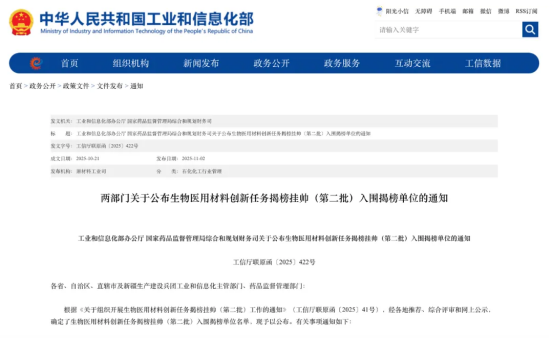
Core Insights - The Ministry of Industry and Information Technology and the National Medical Products Administration have announced the second batch of companies selected for the "Innovative Task of Biomedical Materials" initiative, with 14 companies from Beijing, including AoJing Medical Technology Co., Ltd. recognized for its "degradable semi-hydrated calcium sulfate" medical material [1][7] Company Overview - AoJing Medical is focused on the research, development, production, and sales of implantable medical devices for tissue regeneration and repair. The company pioneered the development of mineralized collagen biomimetic bone materials that closely resemble natural human bone tissue in composition and structure, achieving clinical transformation and industrialization [2][4] - The mineralized collagen biomimetic bone material consists of collagen and mineral components, such as hydroxyapatite, offering excellent biocompatibility and mechanical properties. It has been used in over one million clinical cases, demonstrating significant effectiveness in bone defect repair and regeneration [2][4] Industry Development - The Daxing Biomedical Industry Base is actively promoting the construction of specialized industrial parks, focusing on key technology research and development in high polymer materials, metal materials, and inorganic non-metallic materials [4][11] - The "Innovative Task of Biomedical Materials" initiative aims to address critical challenges in the industry, with selected companies receiving support in financing and regulatory reviews to accelerate technology transfer and application [11] - The Daxing Biomedical Industry Base has been officially named the "Zhongguancun (Daxing) Biomedical Materials Industrial Park," emphasizing its role in integrating medical and engineering sectors and fostering innovation in biomedical materials and medical devices [9][11]
“粮食安全看山东”之济南市济阳区:“链式”服务夏粮收购,全力保障粮食安全
Zhong Guo Fa Zhan Wang· 2025-11-13 05:03
Group 1 - The core viewpoint of the articles highlights the effective measures taken by the Jiyang District Grain and Material Reserve Center to enhance wheat production and post-harvest services, ensuring a good quality harvest and supporting local farmers [1][2][3] Group 2 - In 2023, the wheat planting area in Jiyang District is approximately 578,900 acres, with a total production of about 355,000 tons, showing an improvement in the proportion of high-quality wheat compared to last year [1] - The center has conducted multiple special inspections in collaboration with various departments to maintain order in the grain purchase market and protect the rights of farmers and legitimate operators [1] - The center provides a comprehensive range of post-harvest services, including cleaning, drying, storage, processing, and sales, which have been well-received by local farmers, creating significant economic value [1] - During the summer grain purchase season, the center offered cleaning services for 32,000 tons, storage services for 51,000 tons, and sales services for 100,000 tons, resulting in a reduction of grain loss by 2,300 tons, benefiting approximately 36,000 farming households [1] - The center has ensured sufficient storage capacity by renovating old warehouses and constructing new emergency storage facilities, increasing total storage capacity to about 130,000 tons [2] - The center has organized training sessions to enhance the skills of staff and ensure the proper functioning of equipment necessary for grain purchase, thereby improving efficiency and quality [2] - The center has strengthened communication with financial institutions to facilitate credit services for grain operators, addressing financing challenges and ensuring timely payment to farmers [2] - The center has implemented a plan to enhance post-harvest services, focusing on reducing grain loss and promoting scientific and professional harvesting practices [3] - Investments have been made to upgrade storage facilities, including the installation of high-precision temperature and humidity sensors to ensure optimal storage conditions for grain [3] - The center's staff actively guides grain purchase enterprises on-site, helping to resolve issues and ensuring compliance with quality standards during the purchasing process [3]