CNBC

Search documents
Rio Tinto and Glencore restart talks over mega-merger that would create the world's largest mining firm
CNBC· 2026-01-09 07:15
Core Viewpoint - Rio Tinto and Glencore are in discussions for a potential $260 billion merger that could create the world's largest mining company [1] Group 1: Merger Discussions - Preliminary discussions are ongoing regarding a possible combination of some or all of their businesses, potentially through an all-share merger [1] - The current expectation is that the merger would involve Glencore being acquired by Rio Tinto via a Court-sanctioned scheme of arrangement [2] - Rio Tinto has until 5 p.m. London time on February 5 to announce a firm intention to make an offer for Glencore or state that it does not intend to make an offer [2] Group 2: Historical Context - Previous merger talks in late 2024 collapsed due to valuation issues and concerns regarding Glencore's coal mines [3] - In August, Rio Tinto's CEO announced a reorganization aimed at cutting costs and unlocking up to $10 billion from its asset base, focusing on iron ore, aluminium, lithium, and copper [3] Group 3: Market Context - A merger between Rio Tinto and Glencore would contribute to the recent M&A activity in the mining sector, following Anglo American and Teck Resources' $66 billion merger [4] - The renewed discussions are influenced by rising demand for copper, with prices reaching an all-time high of $13,000 per ton this week [4]



China consumer inflation hits fastest pace since February 2023, in line with expectations
CNBC· 2026-01-09 01:43
Economic Indicators - Core inflation in December was up 1.2% year on year, unchanged from the previous month [1] - Consumer prices rose 0.8% year on year, the highest level since February 2023, following a 0.7% increase in November [2] - Monthly consumer prices grew 0.2%, exceeding the expected 0.1% gain [3] Industrial Performance - Factory-gate prices dipped 1.9% in December, better than the forecasted 2% decline, extending a deflationary streak beyond three years [1] - Industrial production growth is estimated to have edged up to around 4.9%, supported by a pickup in manufacturing activity [5] - The official purchasing managers' index (PMI) rose to 50.1 from 49.2, indicating a return to growth in manufacturing activity after eight months of decline [5] Investment and Consumption - Fixed-asset investment likely contracted by around 11.8% in December, worsening from an 11.1% decline in November [5] - Policymakers are expected to implement measures to boost consumption and stabilize the property market, although past efforts have not yielded significant results [6] - New home sales in floor space are estimated to fall by 7% in 2026 after an 8% decline in 2025 [6] Profitability and Market Dynamics - Industrial firms experienced a profit drop of 13.1% year-on-year in November, marking the steepest decline in over a year [7] - Carmakers have initiated a new round of price cuts and perks due to sluggish demand and the withdrawal of part of a tax incentive for electric vehicles [8]

Jim Cramer says the market rotation is punishing last year's winners and reviving beaten-down stocks
CNBC· 2026-01-08 23:48
Market Rotation - Investors are witnessing a classic market phenomenon characterized by a violent rotation where previous winners become sources of cash and previous losers regain favor [1][2] - Such rotations can appear chaotic but are often driven by valuation extremes correcting towards equilibrium, creating new investment opportunities [2] Constellation Energy and Constellation Brands - Constellation Energy has surged approximately 185% over the past two years due to increased enthusiasm for nuclear energy, leading to a valuation that may be excessively high [3] - In contrast, Constellation Brands has faced challenges from rising costs, tariffs, and changing consumer habits, resulting in a stock that may be undervalued despite its strong global franchise in beer, wine, and spirits [4] Retail Sector Dynamics - Walmart was previously favored for assisting inflation-weary consumers, while Costco lagged due to internal changes and weaker membership data [5] - Recently, funds have shifted from last year's leaders like Walmart to laggards such as Costco, which has seen a rebound following stronger-than-expected sales [5] Technology Sector Trends - Stocks that dominated portfolios in 2025 are being trimmed to finance new positions, with Amazon emerging as the best performer among the Magnificent Seven this year, while Nvidia has struggled despite positive commentary [6]

Trump instructs 'representatives' to buy $200 billion in mortgage bonds, aiming to lower rates
CNBC· 2026-01-08 21:57
Core Viewpoint - President Trump is directing his representatives to purchase $200 billion in mortgage bonds to lower rates and monthly payments, claiming this will restore affordability in the housing market [2][3][4]. Group 1: Government-Sponsored Entities - Fannie Mae and Freddie Mac are currently in a strong financial position with $200 billion in cash, which Trump cites as a reason for the proposed bond purchases [2][4]. - The Federal Housing Finance Agency (FHFA) Director indicated that a decision regarding a potential IPO for Fannie Mae and Freddie Mac may be made in the coming months [2]. Group 2: Market Impact - Trump's directive aims to drive down mortgage rates, although it remains unclear whether the bond purchases will effectively impact these rates [5][6]. - Historically, the Treasury has purchased mortgage bonds during financial crises, such as the 2008 housing crisis, to stabilize the market [6]. Group 3: Political Context - Trump's comments reflect a critique of the previous administration's handling of the housing market, positioning his actions as a corrective measure [3][4]. - The term "affordability" has become a focal point in political discourse, particularly among Democrats, highlighting the competitive nature of housing policy discussions [3].
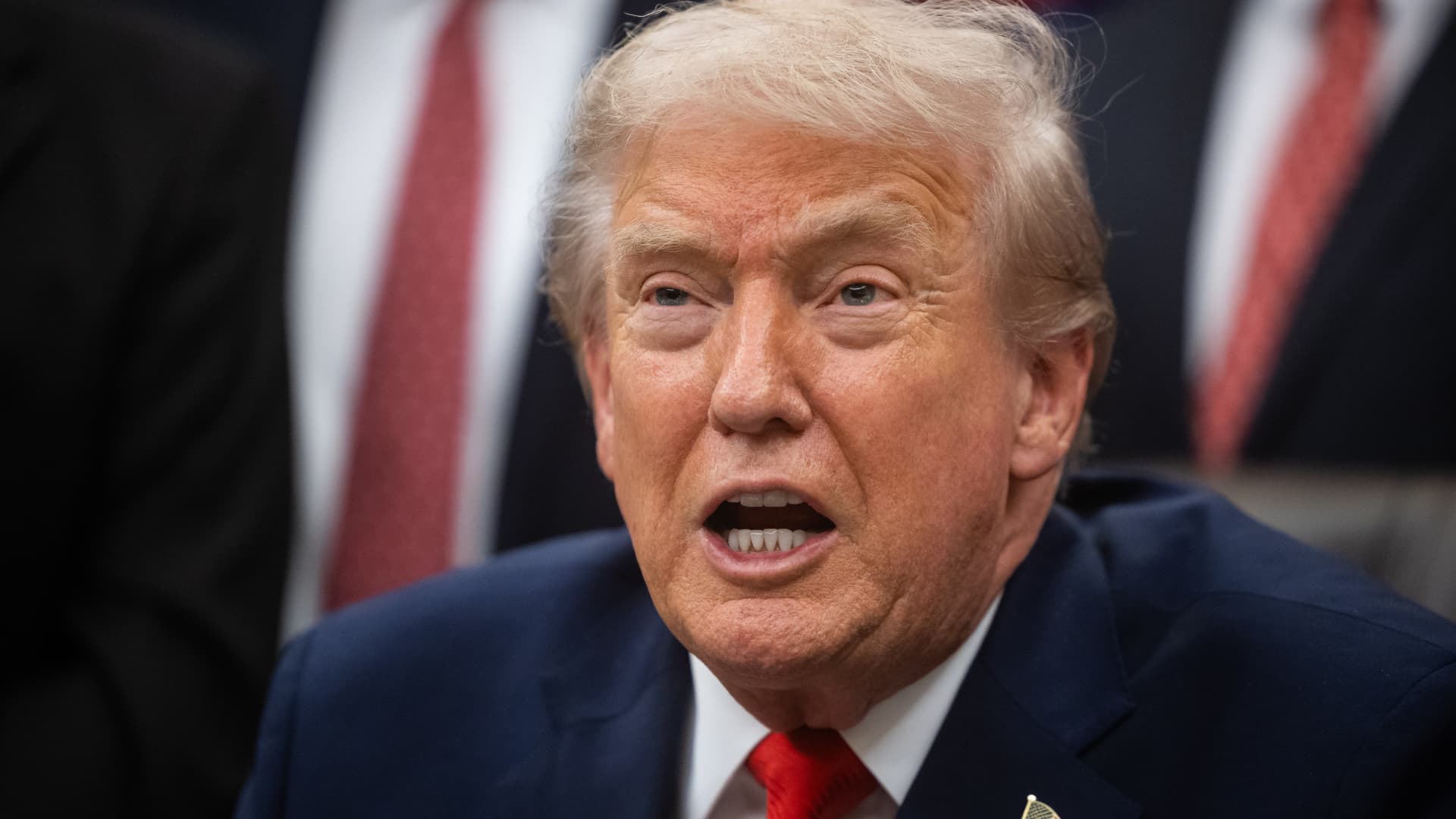
Intel stock rises after Trump touts 'very successful' CEO, applauds government's investment
CNBC· 2026-01-08 21:41
Group 1 - Intel shares increased by 2% following a positive social media post from President Trump regarding the company and its CEO [1] - The U.S. government acquired a 10% stake in Intel through an $8.9 billion investment from CHIP Act grants and semiconductor manufacturing awards [2] - Since the investment announcement, Intel shares have surged by 75%, raising the government's stake to over $18 billion, making it Intel's largest shareholder [3] Group 2 - Lip-Bu Tan became Intel's CEO in March, succeeding Pat Gelsinger, amid challenges from competitors like AMD and Nvidia [4] - Tan faced calls for resignation from Trump due to perceived conflicts of interest related to his investments in Chinese technology companies [5] - Intel has laid off thousands of employees and is reducing chip production in Europe under Tan's leadership [5]


GM to record $7.1 billion in fourth-quarter charges due to EV pullback, China restructuring
CNBC· 2026-01-08 21:04
Core Viewpoint - General Motors (GM) will incur $7.1 billion in special charges for Q4 related to its electric vehicle (EV) strategy and restructuring in China [1][2]. Group 1: Financial Impact - The charges include approximately $6 billion for adjustments to EV plans due to declining demand and $1.1 billion related to a restructuring of a Chinese joint venture, which includes $500 million in cash [1]. - These charges will affect GM's net income but will not impact adjusted results [2]. Group 2: Industry Context - The announcement follows Ford Motor's expectation of $19.5 billion in special charges for similar reasons, indicating a broader trend in the automotive industry regarding EV investments and restructuring [2]. - GM's CFO emphasized the need for structural changes to reduce production costs for EVs while maintaining confidence in the future of electric vehicles [3].


The December jobs report is due out Friday. Here's what it is expected to show
CNBC· 2026-01-08 20:57
Core Viewpoint - The U.S. labor market showed modest improvement in December, with nonfarm payrolls expected to rise by 73,000 and the unemployment rate decreasing to 4.5% [1] Group 1: Labor Market Performance - Nonfarm payrolls likely increased by 73,000 in December, a slight improvement from the average monthly gain of 55,000 over the previous 11 months of 2025 [2] - The unemployment rate is projected to be 4.5%, which is half a percentage point higher than at the beginning of the previous year [2] - The labor market exhibited fluctuations throughout 2025, with a peak gain of 158,000 in April and a loss of 105,000 in October, indicating instability [3] Group 2: Economic Outlook - Economists anticipate a stable labor market heading into 2026, though it is not expected to be exceptional [2] - Positive trends in hiring and a slowdown in layoffs have been noted, suggesting a more optimistic outlook for 2026 [3] - The overall sentiment indicates that the year is ending on a stronger note compared to its beginning, with expectations of stability in the labor market [3]

The Supreme Court may rule Friday on Trump's tariffs. Here's what's at stake for the economy
CNBC· 2026-01-08 19:25
Core Viewpoint - The U.S. Supreme Court is set to rule on the legality of President Trump's tariffs, which could significantly impact trade policy and the U.S. fiscal situation [1]. Group 1: Legal Framework - The ruling will address whether the administration can levy tariffs under the International Emergency Economic Powers Act (IEEPA) and if reimbursement is required for importers who have already paid the duties [2]. - The court may grant limited powers under the IEEPA and require only limited repayment, among other options [3]. Group 2: Implications for Tariffs - Even if the White House loses the case, it retains other tools to implement tariffs without relying on the emergency powers cited under the IEEPA [3]. - Treasury Secretary Scott Bessent indicated that the ability to collect tariffs at current revenue levels remains intact, but the ruling could limit the president's flexibility in using tariffs for national security and negotiation purposes [4].

Retail traders had one of their best years ever in 2025. Here's what they're buying now
CNBC· 2026-01-08 18:09
Core Viewpoint - Retail investors are increasingly focusing on energy stocks, particularly following the U.S. military intervention in Venezuela, which has led to significant inflows into oil-related companies [2][4][5]. Group 1: Retail Investor Behavior - Retail investors have returned to the market with a strong interest in energy stocks, marking the second-highest buying level in nearly eight months at the start of 2026 [2]. - There has been a notable spike in net daily inflows into Halliburton, reaching the highest level since early 2022, while Chevron also saw significant inflows, indicating a strong interest in companies that could benefit from the situation in Venezuela [4]. - The trend of retail investors gravitating towards energy stocks suggests a potential shift from high-growth sectors to those with more stable cash flow generation [7]. Group 2: Market Dynamics and Predictions - The situation in Venezuela, where the country has the largest proven crude oil reserves, has prompted speculation about the return of Venezuelan heavy crude to the U.S., which could benefit companies involved in rebuilding the oil infrastructure [3][5]. - Despite recent stock price fluctuations, retail investors are likely to remain committed to energy stocks, similar to their behavior with artificial intelligence stocks, indicating a potential long-term interest in the sector [6][7]. - The strong performance of retail investors in 2025, with record inflows into various sectors, has shifted perceptions of retail traders from "dumb money" to more mature market participants, prompting institutional investors to reconsider their strategies [9][10].



RFK Jr.'s new food guidelines could boost beaten down fast-casual chains like Chipotle and Sweetgreen
CNBC· 2026-01-08 17:54
Core Viewpoint - New federal dietary recommendations may lead to reduced dining out frequency among Americans, impacting the restaurant industry [1][4]. Group 1: Dietary Guidelines Overview - The Departments of Health and Human Services and Agriculture released updated nutrition guidelines advocating for increased protein and full-fat dairy consumption while reducing processed foods and sugary drinks [2]. - The guidelines serve primarily as a public health tool, with limited direct influence on consumer behavior, although they do suggest choosing nutrient-dense options when dining out [3]. Group 2: Industry Reactions - The restaurant industry has mixed reactions; while some sectors may face challenges, fast-casual chains like Sweetgreen and Chipotle could benefit from the emphasis on natural ingredients [4]. - A lobbying executive indicated that the final outcome of the guidelines was more favorable than earlier proposals, suggesting a less negative impact on the industry [5]. - Concerns remain that the guidelines may encourage home dining over restaurant visits, particularly when affordable options are available [6]. Group 3: Support from Industry Groups - The National Restaurant Association expressed support for the new guidelines, highlighting the industry's adaptability in offering diverse options to meet consumer dietary needs [7]. - The International Franchise Association described the guidelines as "nuanced," suggesting they may help limit price increases for restaurants [8]. - The International Franchise Association emphasized the importance of considering cost implications in future regulations, as small business owners face significant challenges [9].