思宇MedTech

Search documents
路演报名:医疗科技项目融资路演活动
思宇MedTech· 2025-10-15 03:38
Core Viewpoint - The article discusses an upcoming investment roadshow organized by the Zhongguancun Alliance for New Biomedical Industry and Siyu MedTech, focusing on connecting projects in the biomedical and medical device sectors with potential investors [2][5]. Group 1: Event Details - The roadshow will take place on October 30, 2025, at 14:00, both online via Tencent Meeting and in-person at Tsinghua Science Park [5]. - Projects eligible for participation range from angel to Series C funding stages, covering fields such as biomedicine, medical devices, and medical aesthetics [5][6]. - Participation is free for alliance members, but projects must undergo a review process to be accepted [7]. Group 2: Investor Participation - A list of vetted investment institutions will be provided to project teams after confirmation, ensuring that participating investors have relevant investment experience [4][5]. - Project teams are encouraged to leave their contact information during the presentation for investors to reach out directly, with additional support for connecting with CEOs provided by the organizers [4][5]. Group 3: Previous Roadshows - The article references multiple previous roadshows, indicating a history of similar events aimed at facilitating investment in the healthcare sector [10][11].


官方公告!迈瑞医疗正式启动赴港上市
思宇MedTech· 2025-10-15 03:38
Core Viewpoint - The announcement of Mindray Medical's plan to issue H-shares and list on the Hong Kong Stock Exchange marks a significant step in its globalization strategy, transitioning to a new phase of capital platform development [2][4]. Strategic Logic - Mindray's H-share listing is not merely a financing action but an upgrade of its international strategy, indicating a new phase of "business and capital synergy" [4]. - The company has established a solid foundation for international business, with overseas revenue exceeding 50% and significant market presence in key medical device sectors [5][6]. Market Environment and Timing - The decision to initiate the H-share listing is based on a favorable market environment and a critical point in business expansion, as the global medical device industry undergoes significant transformation [8]. - The Hong Kong market offers favorable financing conditions and valuation premiums for high-quality assets, enhancing Mindray's flexibility in global competition [8]. Investor Concerns and Company Responses - Investors are particularly interested in the reasons for the listing, the intended use of raised funds, and potential geopolitical risks [9]. - Mindray aims to enhance its international influence, attract global talent, and optimize its shareholder structure through this listing [11][12][13]. Financial Performance - In the first half of 2025, Mindray achieved revenue of 20.53 billion yuan, a year-on-year increase of 11.12%, with net profit rising by 17.37% [5]. - The company reported a decline in revenue and net profit for the latest reporting period compared to the previous year, indicating challenges in the domestic market [5]. Long-term Impact - The H-share listing is expected to enhance Mindray's international brand influence, broaden financing channels, and accelerate global business expansion [14]. - This move is seen as a reflection of a broader trend in the Chinese medical technology industry, where leading companies leverage international capital markets for simultaneous technological innovation and global competitiveness [23].


融资近2亿!国产神经调控进入“无线化竞赛”
思宇MedTech· 2025-10-14 04:28
无线神经调控,正成为新一代神经治疗方案的技术支点。近日,专注于无线携能与闭环神经调控系统的全链条企业—— 北京领创医谷科技发展有限责任公司(以 下简称"领创医谷"),宣布完成 近2亿元人民币B轮融资。 本轮融资由顺禧基金、亦庄国投共同领投,银河创新资本、广州产投资本和亦庄投资跟投,源壹资本 长期担任企业战略顾问。 本轮融资将进一步加速其在脊髓电刺激(SCS)、周围神经电刺激(PNS)、骶神经刺激(SNS)与脑深部电刺激(DBS)等神经调控核心赛道的产品化与商业化 布局,并同步在产能升级、人才建设等方面实现突破。 # 融资与 发展路 径:种子轮完成 ,冲刺注册 与验证 据团队透露,本轮融资将聚焦以下几 个方向, 推动企业从单一产品平台走向系统化布局: # 市场驱 动逻辑 :产业窗口期已 现,国产技 术亟需突破 根据 Neurotech Reports 数据,全球神经调控设备市场正在快速扩张,2024 年整体规模预计超百亿美元,年复合增长率在 11% 以上。细分来看,SCS(脊髓刺激) 系统仍是最大市场,但其侵入性与高成本限制了部分患者使用。 在这种大环境下,传统的有源植入系统(IPG + 导线)仍占据主流技术路 ...

千万级收购!生命科学上市公司加速全链路布局
思宇MedTech· 2025-10-14 04:28
Core Viewpoint - The acquisition of 51% stake in Shanghai Haowei Technology by Kangwei Century for 12.75 million yuan is a strategic move to enhance its capabilities in the molecular diagnostics and multi-omics service sectors, marking a significant step towards fourth-generation gene sequencing technology and precision medical services [2][4][14] Transaction Details - The acquisition price is set at 12.75 million yuan, funded by the company's own resources, which will not significantly impact daily operations [3] - After the acquisition, Kangwei Century will hold 51% of Haowei Technology, while Tianhao Biotechnology retains 49% [3] Performance Targets and Risks - Haowei Technology is committed to achieving over 20% revenue growth in 2025; failure to meet this target may trigger a compensation mechanism for Kangwei Century [4] - Potential risks include uncertainties in agreement execution, increased management costs during integration, and changes in industry policies [4] Market Environment - The molecular diagnostics market in China has been growing rapidly, with a projected market size of 50 billion yuan in 2024 and expected to exceed 150 billion yuan by 2030, reflecting a compound annual growth rate (CAGR) of over 20% [5] - The multi-omics integration analysis market is expected to grow even faster, with a CAGR of 30% [5] - Domestic companies are gaining market share by offering lower prices and faster service delivery compared to international giants [5] Company Overview: Kangwei Century - Established in 2007, Kangwei Century specializes in molecular detection enzyme raw materials and diagnostic kits, with a strong focus on independent technology development [8] - The company has launched over 700 products, breaking international monopolies in several niche areas [8] - Kangwei Century is advancing towards fourth-generation nanopore sequencing technology, aiming for scalable production and application in both research and clinical settings [8] Company Overview: Haowei Technology - Founded in 2024, Haowei Technology focuses on microbiome detection, multi-omics analysis, and bioinformatics services, targeting research institutions and biopharmaceutical companies [9][10] - The company achieved 8 million yuan in revenue in 2024, with service accuracy exceeding 95% and a 30% reduction in service delivery time [10] Synergistic Effects - The acquisition is part of Kangwei Century's strategy of combining internal research and external acquisitions, aiming to enhance its service capabilities across various disease areas [11] Future Outlook - The acquisition positions Kangwei Century to enter the multi-omics research service market, strengthening its overall presence in the molecular diagnostics industry [14] - The company anticipates a 25% revenue growth and a net profit margin increase to 22% by 2025, driven by the rising demand for precision medicine [14] - The integration of multi-omics and fourth-generation sequencing technologies is expected to create a competitive edge for domestic companies against imported products [14]


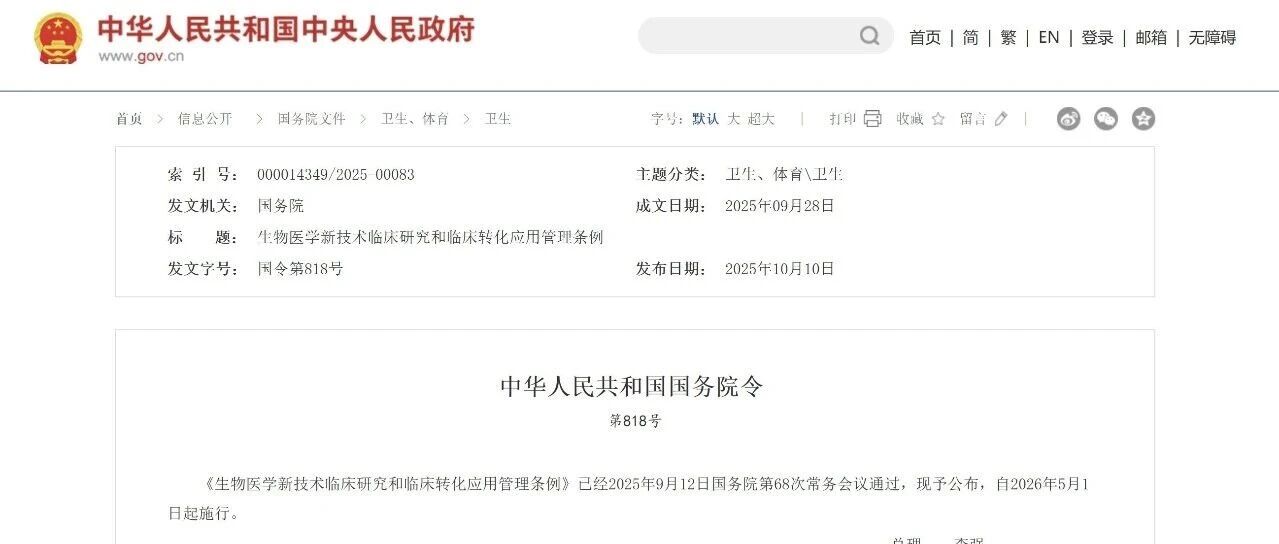
国务院新发布政策,对医疗器械有何影响?
思宇MedTech· 2025-10-13 04:15
Core Viewpoint - The newly announced regulation by the Chinese State Council on the management of clinical research and application of biomedical new technologies establishes a systematic framework for the clinical research and transformation of these technologies, effective from May 1, 2026. This regulation primarily targets new medical technologies that utilize biological principles and act at the cellular or molecular level, which have not yet been applied clinically in China [2][13]. Summary by Sections 1. Regulation Scope and Definition - The regulation defines "biomedical new technologies" as medical methods and measures that utilize biological principles to assess health status, prevent or treat diseases, and promote health, specifically targeting those not yet applied clinically in China [13][14]. - It consolidates various innovative methods from fields like stem cells, gene therapy, and regenerative medicine under a unified regulatory framework, indicating that all new medical technologies affecting the basic units of life will be subject to national regulation [14]. 2. Affected Entities and Roles - The regulation outlines the roles of various entities involved in the research and application of biomedical technologies, including regulatory bodies, research initiators, clinical research institutions, project leaders, and professional evaluation agencies [15][16][18][19]. - The National Health Commission (NHC) will oversee the management and ensure compliance with the regulation, while local health departments will handle supervision and enforcement [15][16]. 3. Research to Application Process - A complete closed-loop system is established from research filing to clinical transformation, requiring approval from the NHC before any new technology can be applied clinically [21][22]. - The NHC will publish the names of approved technologies, the medical institutions allowed to use them, and the conditions and operational standards for their application [22]. 4. Historical Context and Policy Evolution - The regulation is not a standalone initiative but builds upon previous trial management methods and local explorations, marking a transition from pilot policies to comprehensive legislation [23][27]. - It enhances the legal standing of biomedical technology management from departmental regulations to administrative laws, expanding the scope from stem cell therapy to all biomedical technologies affecting cellular and molecular levels [23][28]. 5. Compliance and Legal Responsibilities - The regulation introduces stringent compliance requirements, including high penalties for violations, emphasizing the need for ethical governance and the protection of participants in clinical research [30][31][46]. - It establishes a comprehensive lifecycle governance framework for biomedical technologies, from non-clinical research to ethical review, national filing, process reporting, and post-application evaluation [47]. 6. Implications for Stakeholders - Hospitals must meet stricter entry requirements, including having academic and ethical review committees, and must maintain comprehensive records for 30 years [48]. - Pharmaceutical companies need to navigate dual regulatory pathways for clinical trials and medical technology research, ensuring compliance with both drug administration and new technology regulations [50]. - Medical device companies, especially those involved in bio-device intersections, must enhance collaboration with hospitals and ensure compliance with both medical device regulations and the new biomedical technology framework [56]. - Academic institutions are encouraged to prepare for compliance by establishing clear pathways for technology transfer and collaboration with clinical institutions [57]. 7. Key Timelines and Action Items - The regulation will take effect on May 1, 2026, and existing projects must comply with the new filing requirements within one month of the regulation's implementation [62]. - Stakeholders are advised to prepare comprehensive compliance assets that encompass the entire research and application process to maintain competitiveness under the new regulatory environment [63].
又打起来了!中美贸易战下的医疗器械行业
思宇MedTech· 2025-10-13 04:15
Core Viewpoint - The escalation of the US-China trade war has transitioned from tariff disputes to a more systemic and long-term confrontation, impacting various industries, particularly the medical device sector [2][6]. Group 1: Policy Signals - The US government has initiated a "medical device import safety investigation," which is expected to create new systemic risks for the medical device industry [4][8]. - The focus has shifted from tariffs to national security and supply chain stability, with medical devices now being viewed as tools in economic policy and diplomatic negotiations [9][16]. - The introduction of non-tariff barriers is increasing regulatory pressure on manufacturers, affecting product pricing and procurement processes [9][14]. Group 2: Industry Performance - The US medical health sector, including medical devices, has underperformed the broader market, with a year-on-year decline of approximately 5% as of September 2025 [10]. - The industry's structural anxieties are reflected in stock volatility, driven by long investment cycles and high R&D costs, leading to short-term capital outflows [10][13]. - The expectation of policy-driven valuation fluctuations is becoming a new norm, where companies' competitiveness will depend on their ability to navigate global policy frameworks [10][13]. Group 3: Supply Chain Risks - The medical device industry's core challenge is not just manufacturing capability but the stability of manufacturing processes [11]. - A decline in the US manufacturing PMI to 49.1 in September 2025 indicates a contraction, which will impact upstream suppliers and increase hidden costs for medical device manufacturers [11][12]. - The shift from low-cost manufacturing to a model prioritizing stability and control is reshaping the global supply chain dynamics [11][12]. Group 4: Structural Reassessment - The high regulatory nature of the medical device industry has led to a reassessment of its stability and defensive characteristics [12]. - The trend of "de-risking" is replacing "decoupling," indicating a move towards diversified supply chains to mitigate single risk exposure [12][17]. - The global production model is transitioning from cost optimization to risk minimization, marking a significant structural change driven by the trade war [12][17]. Group 5: Future Outlook - The potential for further US import restrictions on medical devices could disrupt extensive US-China material and OEM collaborations [15]. - The medical device industry is becoming a strategic focal point in the economic and security landscape, with implications for both domestic and international market dynamics [16][17]. - The long-term competition will increasingly hinge on technology and standards, with countries and companies that master certification systems and supply stability redefining competitive boundaries [17].

美敦力“拆分”?创新的游戏,还是权力的游戏?
思宇MedTech· 2025-10-13 04:15
Core Viewpoint - The article discusses the challenges faced by Medtronic, including stagnation in growth, innovation fatigue, and pressure from activist investors, while exploring the potential for restructuring or revitalization [2][4]. Group 1: Activist Investor Involvement - Elliott Investment Management has entered Medtronic's shareholder list, advocating for a reassessment of the business portfolio and a focus on core assets to enhance shareholder returns [6][7]. - The entry of Elliott reflects a broader trend where undervalued large companies are pressured to divest non-core assets and improve capital efficiency [7][8]. - Medtronic's valuation disadvantage compared to peers indicates investor concerns regarding its management structure and innovation efficiency [8][9]. Group 2: Growth and Innovation Challenges - Medtronic's issues are traced back to the 2015 acquisition of Covidien, which has led to integration difficulties and cultural clashes [10][11]. - Financially, Medtronic reported approximately $32.3 billion in revenue for FY2024, with a net profit of about $5.1 billion, but its growth rate of 3% is below industry peers [11][12]. - The company's R&D spending of $2.6 billion represents only 8.1% of revenue, lower than competitors, indicating a slowdown in innovation output [14][15]. Group 3: Investor Perspective - Investors view Medtronic as a "sleeping giant," with stable financials but lacking growth appeal, as evidenced by a total shareholder return of less than 4% over the past five years [15][16]. - There is a demand for not just cost optimization but also significant innovation to change the valuation narrative [16][19]. Group 4: CEO's Response - CEO Geoff Martha asserts that Medtronic is in an "Innovation Super Cycle," with significant new products expected to launch between 2025 and 2027 [16][20]. - Martha emphasizes that the company's focus is on portfolio reshaping to enhance innovation rather than breaking up the company [19][20]. - The management is undergoing a dual reboot of structure and personnel to improve decision-making speed and execution [22][23]. Group 5: Future Directions - Medtronic aims to focus on financial recovery through divesting low-margin businesses and simplifying its organizational structure [23][24]. - The company is also working on bringing high-tech platforms to market, although the timeline for significant sales remains extended [24][25]. - The shift in focus from expansion to innovation reflects a recalibration towards core technological strengths, with the challenge of balancing innovation delivery and capital returns [25].


27亿出售业务!医疗供应链巨头完成战略转型
思宇MedTech· 2025-10-12 00:37
Core Viewpoint - Owens & Minor is transforming into a pure-play company focused on home-based care by selling its Products & Healthcare Services (P&HS) division for $375 million, retaining a 5% stake, marking a strategic shift from supply chain logistics to patient-centric services [2][4][6]. Group 1: Company Transformation - The sale of the P&HS division allows Owens & Minor to redefine its position in the healthcare supply chain, moving from a logistics provider to a direct service provider for patients [2][6]. - The Patient Direct platform, established after acquiring Byram Healthcare in 2020, focuses on home-based care for chronic disease patients, directly connecting to the patient end [7][8]. - The decision to divest the P&HS division is part of a strategy to concentrate on higher-margin, faster-growing segments of the business, enhancing overall financial structure and resource allocation [8][12]. Group 2: Market Context - The U.S. healthcare supply chain has faced declining profit margins, with companies like Owens & Minor experiencing gross margins around 10% and net margins below 2% due to pricing pressures and increased costs [9][10]. - The Patient Direct model offers a more stable and profitable business model, with gross margins 1.5 to 2 times higher than traditional hospital supply chains, appealing to capital markets [9][10]. - The timing of the sale coincides with a resurgence in private equity activity in the healthcare sector, allowing Owens & Minor to achieve favorable pricing while retaining a stake in future growth [14][15]. Group 3: Buyer Perspective - Platinum Equity, the buyer, specializes in operational turnarounds and aims to enhance the value of Owens & Minor's P&HS division through restructuring and resource optimization [16][18]. - The acquisition aligns with Platinum's strategy of integrating and improving underperforming assets in the healthcare supply chain, reflecting a broader trend of private equity involvement in the sector [19][20]. Group 4: Industry Trends - The divestiture by Owens & Minor is part of a larger trend in the medical device industry, where companies are shifting from manufacturing to service-oriented models, emphasizing asset-light operations [22][23]. - The rise of home-based care is driven by policy changes and a growing demand for chronic disease management, positioning companies like Owens & Minor to capitalize on this shift [24][25]. - The transformation reflects a broader industry movement towards decentralization, where patient-centric models are becoming the focal point of healthcare delivery [27][32].


观众报名:医美投融资|第三届八大处整形美容产业论坛
思宇MedTech· 2025-10-12 00:37
Core Viewpoint - The article discusses the upcoming Fourth China Plastic Surgery and Regenerative Medicine Development Conference and the 14th Beijing International Aesthetic Surgery Conference, scheduled for October 31 to November 2, 2025, in Beijing, aimed at promoting the development of plastic surgery in China and enhancing collaboration among related disciplines [3]. Event Details - The event will feature the Third Ba Da Chu Aesthetic Industry Forum, a competition final, and nine sub-forums [3]. - Participation is free, and there will be an exhibition of enterprise products on-site [4]. Organizers - The event is organized by Ba Da Chu Plastic Surgery Medical Concept Verification Center, Si Yu MedTech, Jin Yu Mao Wu, and Zi Niu Fund [5]. Agenda Highlights - The conference will include various presentations, such as: - "Current Status and Opportunities in the Medical Aesthetic Industry from an Investment Perspective" by Sun Hai Shun, Investment Vice General Manager, Jin Yu Mao Wu [6]. - "Development Trends in the Light Medical Aesthetic Industry from an Investment Perspective" by Yu Bo, Partner, Zi Niu Fund [6]. - "Application of Stem Cells and Exosomes in Postoperative Wound Repair" by Zhao Yong, Chairman, Bei Zheng Sai Ou (Beijing) Biotechnology Co., Ltd. [6]. - A roundtable forum is scheduled for discussion among experts [6]. Additional Sessions - Afternoon sessions will cover topics such as: - Non-invasive treatments supported by technology and the application of functional nucleic acid nanotechnology in the light medical aesthetic industry [7]. - New generation needle-free drug delivery technology in the medical aesthetic field [7]. - Development practices of high-end domestic laser medical equipment [7]. Target Audience - The conference aims to attract representatives from medical device and aesthetic enterprises, clinical doctors, researchers, investment institutions, regulatory experts, and industry observers [10].

近千万元种子轮融资!AI超声医美平台
思宇MedTech· 2025-10-11 02:39
Core Insights - Nodinxian Medical Technology Co., Ltd. has completed nearly 10 million RMB in seed round financing, led by Maike Fund, to optimize engineering prototypes, advance clinical validation, expand the team, and prepare for registration pathways [1] - The company aims to leverage non-invasive AI-driven ultrasound technology to create a differentiated competitive advantage in the medical aesthetics sector [1][2] Market Situation - The light medical aesthetics market in China is growing rapidly, with a compound annual growth rate of 19.4%, expected to exceed 237.5 billion RMB by 2026 [2] - There are over 19,000 medical beauty institutions in China, with nearly 90% being private, indicating a vast downstream application landscape [2] - The market is shifting from "energy intensity" to "path precision" and "repeatable efficacy," driven by regulatory tightening on ultrasound treatment devices [3] Company Overview - Nodinxian was established in late 2024, with a team experienced in medical imaging, AI algorithms, and device development [5] - The company is headquartered in Zhangjiang, Shanghai, and aims to create an international, modular ultrasound shaping and repair platform [5] Product Introduction - The product technology roadmap includes key modules and capabilities focused on AI ultrasound applications [6] Differentiated Advantages and Innovations - The company’s technology includes three-dimensional individualized energy planning, AI-assisted guidance systems, non-invasive ultrasound control, and plastic data tracking management [9] - The first engineering prototype has been completed and is currently undergoing internal validation and optimization [9] Current Progress and Roadmap - The company plans to initiate NMPA Class III device registration applications in 2026 and pursue FDA certification for international expansion [9]