具身智能之心

Search documents
具身智能之心招募合作伙伴了!课程开发/培训/论文辅导等
具身智能之心· 2025-10-06 02:35
Core Viewpoint - The article emphasizes the importance of collaboration in the development of a platform that continuously adds value to the industry, inviting influential figures to participate in various initiatives [1]. Group 1: Collaboration Opportunities - The company seeks to develop courses and provide paper guidance to benefit beginners and promote industry advancement, targeting both C-end and enterprise training [2][3]. - There is an initiative to create a cost-effective and user-friendly research platform for embodied intelligence, ensuring accessibility for developers and ease of use for beginners [4][5]. - The company aims to offer consulting and training services for both B-end and C-end clients in areas such as embodied data, ontology, algorithms, and deployment, supporting industry upgrades and talent development [6][7]. Group 2: Recruitment and Compensation - The company is looking for individuals with engineering experience in the field or those holding a PhD or higher, including top-tier professionals, for both full-time and part-time positions [7]. - Competitive compensation is offered, along with access to industry resources for those who join [8].


提供最专业的平台和运营团队!我们正在招募运营的同学~
具身智能之心· 2025-10-06 02:35
Core Viewpoint - The company has evolved from a small workshop to a platform with significant technical depth and breadth, indicating a growing demand in the industry for embodied intelligence and related technologies [1]. Group 1: Team and Operations - The team has spent over two years developing four key IPs: Embodied Intelligence, Autonomous Driving, 3D Vision, and Large Model Tech, with a total online following of nearly 360,000 across various platforms [1]. - The company is currently hiring for full-time and part-time positions in operations and sales to support its expanding business lines [2]. Group 2: Job Responsibilities and Requirements - The operations role includes managing course progress, enhancing platform engagement, planning commercialization projects, and creating content related to the AI industry [4]. - The sales role involves creating promotional materials for online and hardware products and liaising with hardware manufacturers and academic/enterprise clients [5][6]. - Candidates for both roles are expected to have strong execution, communication skills, and a background in computer science, AI, or robotics, with familiarity in social media operations being a plus [12]. Group 3: Growth Opportunities - The company offers exposure to top-tier operational teams, providing opportunities to learn operational techniques and sales strategies, leading to rapid personal growth [7]. - Employees will engage with cutting-edge content in autonomous driving, embodied intelligence, 3D vision, and large models, broadening their technical perspective [8]. - There are opportunities for further academic pursuits, such as research and doctoral studies, which can enhance personal development [9].

强化学习在机械臂、四足、人形的应用有哪些?
具身智能之心· 2025-10-05 16:03
Core Viewpoint - The article discusses the importance of reinforcement learning (RL) in the development of embodied intelligent robots, highlighting its applications in various complex tasks and the challenges faced by newcomers in the field [3][4][10]. Group 1: Reinforcement Learning Applications - Reinforcement learning is crucial for gait control in humanoid and quadruped robots, enabling them to perform tasks such as climbing stairs, running, and dancing [3][9]. - The VLA+RL approach for robotic arms is gaining popularity in academia, enhancing the efficiency and smoothness of robot operations [4][9]. Group 2: Challenges in Learning and Research - The complexity and breadth of reinforcement learning make it difficult for beginners to enter the field, often leading to frustration and abandonment of studies [6][10]. - A lack of a comprehensive learning system can result in repeated mistakes and missed opportunities for aspiring researchers [7][10]. Group 3: Educational Offerings - To address the challenges faced by newcomers, the company has launched a 1v6 paper guidance small class in the field of reinforcement learning, aimed at graduate students and others needing paper guidance [7][8]. - The course includes 14 weeks of concentrated online guidance followed by 8 weeks of maintenance support, focusing on paper idea confirmation, project implementation, experimental guidance, and writing refinement [10][12]. Group 4: Course Structure and Content - The course covers various topics, including paper direction and submission analysis, reinforcement learning basics, simulation environments, and writing guidance [10][18]. - Students will have the opportunity to work on specific ideas related to quadruped robots, humanoid robots, and robotic arms, with a structured approach to developing a paper suitable for submission to top conferences [19][30]. Group 5: Expected Outcomes - Participants are expected to produce a draft of a paper that meets the requirements of specific conferences or journals, with support for writing and submission processes [29][34]. - The course emphasizes a comprehensive research cycle, including methodology, engineering, evaluation, writing, submission, and maintenance [36].

仅需 1 次演示,机器人就能像人手一样抓遍万物?DemoGrasp 刷新灵巧抓取天花板
具身智能之心· 2025-10-04 13:35
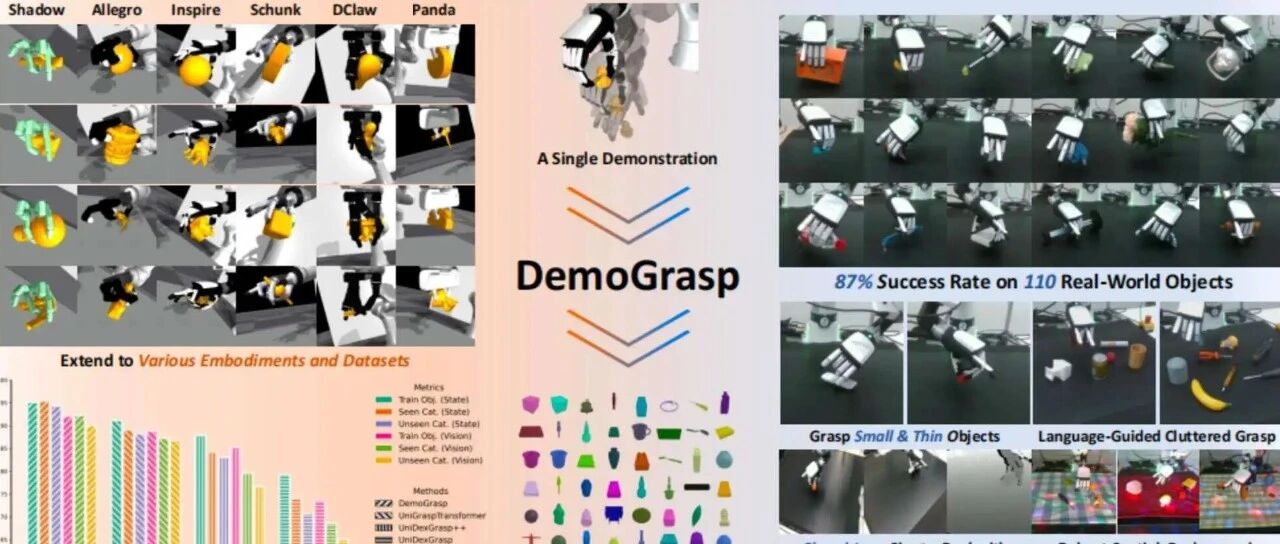
Core Viewpoint - The article discusses the innovative DemoGrasp framework, which enables robots to perform dexterous grasping tasks with a single demonstration, overcoming traditional challenges in robotic manipulation [2][20]. Group 1: Traditional Challenges in Robotic Grasping - Traditional reinforcement learning methods struggle with high-dimensional action spaces, requiring complex reward functions and often leading to poor generalization [1][2]. - Robots trained in simulation often fail in real-world scenarios due to the lack of precise physical parameters and environmental variations [1][2]. Group 2: Introduction of DemoGrasp - DemoGrasp, developed by a collaboration of Beijing University, Renmin University of China, and BeingBeyond, utilizes a single successful demonstration to redefine grasping tasks [2][4]. - The framework significantly improves performance in both simulated and real environments, marking a breakthrough in robotic grasping technology [2][4]. Group 3: Core Design of DemoGrasp - The core innovation of DemoGrasp includes three main components: demonstration trajectory editing, single-step reinforcement learning (RL), and visual-guided virtual-real transfer [4][10]. - The design allows robots to optimize "editing parameters" instead of exploring new actions, greatly reducing the dimensionality of the action space [6][7]. Group 4: Performance Results - DemoGrasp outperforms existing methods in simulation, achieving a success rate of 95.5% in testing with seen categories and 94.4% with unseen categories [10]. - The framework adapts to six different robotic embodiments without hyperparameter adjustments, achieving an average success rate of 84.6% on unseen datasets [11]. Group 5: Real-World Performance - In real-world tests, DemoGrasp achieved an overall success rate of 86.5% across 110 unseen objects, demonstrating its capability to handle various everyday items [14]. - The framework successfully grasps small and thin objects, such as coins and cards, which traditional methods struggle with due to collision issues [14]. Group 6: Limitations and Future Directions - Despite its strengths, DemoGrasp has limitations in handling functional grasping tasks and highly cluttered scenes [17][19]. - Future improvements may include segmenting demonstration trajectories for better decision-making and integrating visual feedback for dynamic scene adjustments [19][20].
突然发现,具身相关的公司已经近200家了......
具身智能之心· 2025-10-03 12:02
Core Viewpoint - The article discusses the growing number of companies in the embodied intelligence sector in China, highlighting the potential for market saturation and competition among nearly 200 companies, which may lead to a "cutthroat" environment [1]. Group 1: Industry Overview - The number of companies involved in embodied intelligence, including robotics and related research, has approached 200, indicating a crowded market with high product and business similarity [1]. - Companies are adopting different strategies, with some focusing on integrating applications with their core technologies while others prioritize foundational research, leaving application validation to developers [1]. - The article emphasizes the importance of having a rich technical stack to survive in the industry, as only those capable of practical implementation will remain viable in the long term [1]. Group 2: Community and Support - The "Embodied Intelligence Heart Knowledge Planet" aims to create a large community for both beginners and advanced learners in the field, providing job referrals, academic guidance, and problem-solving support [3]. - The community has established a closed-loop system across various domains, including industry, academia, and job exchanges, facilitating knowledge sharing and collaboration [5]. - The community offers access to over 30 technical routes, numerous open-source projects, and connections with industry leaders for mentorship and advice [5][15]. Group 3: Educational Resources - The community provides a comprehensive collection of learning paths and resources for newcomers, including technical stacks and project proposals for those already engaged in research [9][11]. - Various forums and live discussions are organized to share insights on the latest developments in the embodied intelligence industry [7]. - The community has compiled a wealth of resources, including datasets, research papers, and technical documentation, to support learning and development in the field [20][26][30].

具身智能之心招募合伙人啦!课程共建/项目开发/咨询服务等
具身智能之心· 2025-10-02 10:04
Core Viewpoint - The article emphasizes the importance of collaboration in the field of embodied intelligence, aiming to create a platform that adds real value to the industry rather than just serving as a media outlet [1]. Group 1: Course Development - The company invites collaboration to develop courses that benefit beginners and promote industry advancement, targeting both consumer and enterprise training as well as academic curriculum development [2][3]. Group 2: Hardware Development - The goal is to create an affordable and user-friendly research platform for embodied intelligence, ensuring accessibility for developers and ease of use for beginners [4]. Group 3: Open Source Projects - The company seeks to build globally influential open source projects in collaboration with others in the field [5][6]. Group 4: Consulting Services - There is an invitation to partner in providing consulting services for both B2B and B2C sectors, focusing on embodied data, ontology, algorithms, and deployment to facilitate industry upgrades and talent development [7][8]. Group 5: Job Opportunities - The company is looking for individuals with engineering experience in the field or those holding a PhD or higher, offering competitive compensation and access to industry resources for both full-time and part-time positions [9][10].
斯坦福机器人新作!灵巧操作跟人学采茶做早餐,CoRL 2025提名最佳论文
具身智能之心· 2025-10-02 10:04
Core Viewpoint - The article discusses the DexUMI framework, which enables efficient data collection and strategy learning for robotic manipulation by using human hands as a natural interface, significantly improving the performance of dexterous robotic hands [4][19][38]. Group 1: DexUMI Framework Overview - DexUMI is a data collection and strategy learning framework that bridges the gap between human hand movements and various dexterous robotic hands through hardware and software innovations [19][38]. - The framework has demonstrated an average task success rate of 86% across multiple tasks and achieved a 3.2 times increase in data collection efficiency compared to traditional remote operation methods [10][35]. Group 2: Hardware and Software Innovations - The hardware component includes a wearable exoskeleton designed for each type of dexterous hand, optimizing parameters to match human hand movements while maintaining wearability [20][23]. - The software component employs a data processing pipeline that ensures visual consistency between human demonstrations and robotic executions, utilizing techniques like video segmentation and background restoration [24][28]. Group 3: Performance and Applications - DexUMI has been validated on two different dexterous hand platforms, achieving superior performance in complex tasks such as multi-finger coordination and long-sequence operations [35][40]. - The framework's ability to provide direct tactile feedback and its higher efficiency compared to traditional remote operation systems are highlighted as significant advantages [37][42]. Group 4: Future Implications - The development of a data-sharing community for high-quality datasets is proposed, which would facilitate collaboration among researchers, companies, and data collectors, ultimately accelerating the practical application of dexterous manipulation technologies [42].
Sim,Real还是World Model?具身智能数据的“困境”与解法
具身智能之心· 2025-10-01 12:48
Core Viewpoint - The article discusses the ongoing debate in the field of embodied intelligence regarding the reliance on simulation efficiency versus real-world data, and the potential of world models to bridge the gap between these two approaches [2]. Group 1: Understanding Sim-to-Real Gap - The "Sim-to-Real gap" refers to the discrepancies between simulated environments and real-world scenarios, primarily due to incomplete simulations that fail to accurately replicate visual and physical details [3]. - Key factors contributing to this gap include limited simulation data, which weakens model generalization and restricts adaptability to specific scenarios [3]. - To narrow this gap, optimization around data is essential, including designing virtual and real data ratios based on model requirements and leveraging AIGC to generate diverse and realistic data [3]. Group 2: Data Utilization in Embodied Intelligence - There is a consensus among experts that while real data is ideal for training, simulation data plays a crucial role in the foundational model iteration and testing phases [15][18]. - Real data is often limited in the field of embodied intelligence, making it challenging to meet the high expectations for diverse task performance [15]. - Simulation data is currently seen as a necessary resource, especially for testing algorithms and avoiding potential damages in real-world experiments [15][18]. Group 3: Future Directions and Challenges - The development of world models is viewed as a promising direction for the future of embodied intelligence, with potential applications in autonomous driving and other areas [25]. - Key challenges include the need for automated generation of simulation data and enhancing the diversity of actions within simulation environments [21][23]. - The integration of new modalities, such as force and touch, into world models is suggested as a valuable research direction [23]. Group 4: Reaction to Boston Dynamics Technology - Experts acknowledge the advanced capabilities of Boston Dynamics robots, particularly their smooth execution of complex tasks involving full-body movements [26][30]. - The discussion highlights the importance of hardware and data in achieving high performance in embodied intelligence systems, with Boston Dynamics setting a benchmark in the field [30]. - The need for further exploration in motion control techniques to enhance the fluidity of robotic movements is emphasized [32].
国人之光!CoRL2025最佳机器人论文出炉(北京通用人工智能研究院&宇树等)
具身智能之心· 2025-09-30 08:27
点击下方 卡片 ,关注" 具身智能 之心 "公众号 编辑丨具身智能之心 本文只做学术分享,如有侵权,联系删文 >> 点击进入→ 具身智能之心 技术交流群 best student paper为加州大学伯克利分校团队的"Visual Imitation Enables Contextual Humanoid Control",主要涉及跨具身智能体的运动控制。 0 es S Best Student Paper Award Visual Imitation Enables Contextual Humanoid Control and Andress Context One Dest Books Amore Mary Chang Moren, The Sund For Alber, Incon Wat, Agen Kession regul C @RL 2025 ROBOT LEARNING ak NEW STARTS 1/1 A U e 8 D A finalist一览: | 2025 CoRL 最佳机器人论文 Finalist | | | --- | --- | | Learning a Unified Po ...

纯血VLA综述来啦!从VLM到扩散,再到强化学习方案
具身智能之心· 2025-09-30 04:00
Core Insights - The article discusses the evolution and potential of Vision Language Action (VLA) models in robotics, emphasizing their integration of perception, language understanding, and action generation to enhance robotic capabilities [11][17]. Group 1: Introduction and Background - Robotics has traditionally relied on pre-programmed instructions and control strategies, limiting their adaptability in dynamic environments [2][11]. - The emergence of VLA models marks a significant advancement in embodied intelligence, combining visual perception, language understanding, and executable actions into a unified framework [11][12]. Group 2: VLA Methodologies - VLA methods are categorized into four paradigms: autoregressive, diffusion, reinforcement learning, and hybrid/specialized methods, each with unique strategies and mechanisms [8][10]. - The article highlights the importance of high-quality datasets and realistic simulation platforms for the development and evaluation of VLA models [16][18]. Group 3: Challenges and Future Directions - Key challenges identified include data limitations, reasoning speed, and safety concerns, which need to be addressed to advance VLA models and general robotics [10][17]. - Future research directions focus on enhancing the robustness and generalization of VLA models in real-world applications, emphasizing the need for efficient training paradigms and safety assessments [44][47].