CHINA TELECOM(00728)

Search documents
中金:维持中国电信“跑赢行业”评级 首三季利润良好增长
Zhi Tong Cai Jing· 2025-10-23 02:19
Core Viewpoint - China Telecom (00728) reported a revenue growth of 0.6% year-on-year to 394.3 billion RMB for the first three quarters of 2025, with service revenue increasing by 0.9% to 366.3 billion RMB and net profit attributable to shareholders rising by 5% to 30.8 billion RMB, aligning with expectations [1] Financial Performance - Revenue for the first three quarters of 2025 reached 394.3 billion RMB, reflecting a 0.6% increase year-on-year [1] - Service revenue grew by 0.9% to 366.3 billion RMB [1] - Net profit attributable to shareholders increased by 5% to 30.8 billion RMB [1] Future Projections - China International Capital Corporation (CICC) maintains an "outperform industry" rating for the company's A-shares with a target price of 8.3 RMB, corresponding to price-to-earnings ratios of 21.9x and 20.9x for 2025 and 2026, respectively [1] - For Hong Kong shares, CICC also maintains an "outperform industry" rating with a target price of 7 HKD, reflecting price-to-earnings ratios of 16.9x and 15.9x for 2025 and 2026, respectively [1] Adjustments in Forecasts - Due to macroeconomic impacts on business growth, CICC has revised down the service revenue forecasts for China Telecom by 1% and 1.9% for 2025 and 2026, now estimating 487 billion RMB and 491.9 billion RMB, respectively [1] - Despite the adjustments in service revenue forecasts, the profit projections for 2025 and 2026 remain unchanged due to strict control over network operation costs [1]

中金:维持中国电信(00728)“跑赢行业”评级 首三季利润良好增长
智通财经网· 2025-10-23 02:14
智通财经APP获悉,中金发布研报称,中国电信(00728)公布2025年前三个季度业绩,营业收入同比增长 0.6%至3,943亿元人民币;服务收入同比增长0.9%至3,663亿元人民币; 归母净利润同比增长5%至308亿元 人民币;收入和利润表现符合该行的预期;认为公司各项战新业务实现高速发展,拓展收入增长动能。参 考SOTP估值,中金予公司A股维持"跑赢行业"评级和8.3元人民币目标价,分别对应2025年、2026年 21.9倍、20.9倍市盈率;港股维持"跑赢行业"评级和7港元目标价,分别对应2025年、2026年16.9倍、15.9 倍市盈率。 考虑到宏观经济影响公司业务增速,中金分别下调中国电信2025年、2026年服务收入预测1%、1.9%至 4,870亿、4,919亿元人民币; 考虑到网运成本控制严格,维持2025年、2026年盈利预测不变。 ...
智通港股通持股解析|10月23日
智通财经网· 2025-10-23 00:32
Core Insights - The top three companies by Hong Kong Stock Connect holding ratios are China Telecom (71.22%), COSCO Shipping Energy (70.13%), and GCL-Poly Energy (69.57%) [1] - In the last five trading days, the largest increases in holding amounts were seen in China Mobile (+1.929 billion), Tracker Fund of Hong Kong (+1.897 billion), and InnoCare Pharma (+1.751 billion) [1] - Conversely, Alibaba (-3.254 billion), SMIC (-2.330 billion), and Laopuhuang (-0.855 billion) experienced the largest decreases in holding amounts [2] Group 1: Hong Kong Stock Connect Holding Ratios - China Telecom (00728) has a holding ratio of 71.22% with 9.884 billion shares [1] - COSCO Shipping Energy (01138) has a holding ratio of 70.13% with 909 million shares [1] - GCL-Poly Energy (01330) has a holding ratio of 69.57% with 281 million shares [1] - Other notable companies include China Shenhua (67.74%), Kaisa Group (67.61%), and Xinte Energy (65.33%) [1] Group 2: Recent Increases in Holdings - China Mobile (00941) saw an increase of 1.929 billion in holding amount and 22.8427 million shares [1] - Tracker Fund of Hong Kong (02800) increased by 1.897 billion and 71.8145 million shares [1] - InnoCare Pharma (09606) increased by 1.751 billion and 5.5669 million shares [1] - Other companies with significant increases include Meituan-W (+1.592 billion) and Xiaomi Group-W (+1.105 billion) [1] Group 3: Recent Decreases in Holdings - Alibaba-W (09988) experienced a decrease of 3.254 billion in holding amount and 20.0969 million shares [2] - SMIC (00981) saw a decrease of 2.330 billion and 31.1261 million shares [2] - Laopuhuang (06181) decreased by 0.855 billion and 1.2141 million shares [2] - Other companies with notable decreases include Huahong Semiconductor (-0.792 billion) and Jiangxi Copper (-0.651 billion) [2]



股市必读:中国电信(601728)10月22日主力资金净流出1642.45万元,占总成交额1.82%
Sou Hu Cai Jing· 2025-10-22 18:00
Core Viewpoint - China Telecom reported a slight decrease in revenue for Q3 2025, but net profit showed a positive growth trend, indicating resilience in its financial performance despite market challenges [2][6]. Financial Performance - Revenue for Q3 2025 was approximately 124.85 billion yuan, a decrease of 0.91% year-on-year; however, year-to-date revenue reached about 394.27 billion yuan, an increase of 0.59% [2]. - Total profit for Q3 2025 was approximately 9.86 billion yuan, an increase of 4.03% year-on-year; year-to-date profit reached about 39.45 billion yuan, up 4.61% [2]. - Net profit attributable to shareholders for Q3 2025 was approximately 7.76 billion yuan, an increase of 3.60% year-on-year; year-to-date net profit was about 30.77 billion yuan, up 5.03% [2][3]. Cash Flow and Earnings - Net cash flow from operating activities year-to-date was approximately 87.31 billion yuan, a decrease of 10.37% compared to the previous year [4]. - Basic earnings per share for Q3 2025 were 0.08 yuan, an increase of 3.60% year-on-year; year-to-date earnings per share were 0.34 yuan, up 5.03% [4]. - The weighted average return on equity for Q3 2025 was 1.67%, an increase of 0.02 percentage points; year-to-date return on equity was 6.66%, up 0.18 percentage points [4]. User Growth and Market Position - As of September 30, 2025, the total number of mobile users reached 43.72 million, with a net increase of 1.27 million users; 5G network users totaled 29.24 million, with a net increase of 4.17 million users [20][23]. - The company reported a total of 20.05 million fixed broadband users, with a net increase of 305,000 users [20][23]. Revenue Breakdown - For the first three quarters of 2025, the company achieved a revenue of approximately 394.3 billion yuan, a year-on-year increase of 0.6%; service revenue was about 366.3 billion yuan, up 0.9% [20]. - New business segments showed significant growth: IDC revenue reached 27.5 billion yuan, up 9.1%; security revenue was 12.6 billion yuan, up 12.4%; smart revenue increased by 62.3%; IoT revenue grew by 34.2%; satellite communication revenue rose by 23.5%; and quantum revenue surged by 134.6% [20]. Cost and Expenses - Operating costs for the first three quarters of 2025 were approximately 274.8 billion yuan, a year-on-year increase of 0.1%; selling expenses were about 38.9 billion yuan, down 1.4%; management expenses were approximately 27.1 billion yuan, up 0.7%; and R&D expenses were around 9.1 billion yuan, up 4.4% [21]. Shareholder Information - As of the report date, the total number of ordinary shareholders was 273,723 [12]. - The largest shareholder, China Telecom Group Co., Ltd., held 63.90% of the shares, followed by Hong Kong Central Clearing Limited with 15.10% [13][14].
三大运营商发力新场景卫星通信业务商业化提速
Zheng Quan Shi Bao· 2025-10-22 17:26
Core Viewpoint - The recent issuance of satellite mobile communication business licenses to China Unicom and China Mobile, following China Telecom, marks a significant step in the development of the satellite communication industry in China, enabling all three major telecom operators to engage in satellite communication services, enhancing emergency communication, maritime communication, and connectivity in remote areas [1][2][6]. Industry Developments - The Ministry of Industry and Information Technology (MIIT) has accelerated the commercialization process of the satellite mobile communication industry, aiming to create a competitive market environment and promote collaboration between telecom operators and the satellite communication industry [2][3]. - The MIIT's guidelines set a target of over 10 million satellite communication users by 2030, with a focus on new applications such as direct satellite connections via mobile phones [2][3]. Technological Innovations - China Mobile has launched the "Beidou + Tiantong" dual-satellite communication service, marking a new phase in commercial operations and contributing to the establishment of an integrated "Heaven and Earth" intelligent communication network [2][3]. - The development of new technologies and products, such as the Macro WiFi product by Tongyu Communication, aims to connect satellite networks with terrestrial communication, enhancing coverage and user capacity [3][4]. Market Applications - Satellite communication is primarily focused on emergency communication and supplementary coverage in areas lacking terrestrial network access, with services already being offered for short messages and voice communications [6][7]. - China Telecom has achieved significant milestones, including the global launch of direct satellite communication services for smartphones, enabling users to make calls and send messages without changing their SIM cards [4][6]. User Adoption and Growth - The user base for Tiantong satellites has exceeded 3 million, with major smartphone manufacturers launching devices capable of direct satellite connections, leading to substantial sales figures [7][8]. - The industry anticipates that satellite communication will become as ubiquitous as 4G/5G, providing seamless connectivity for users in various environments, including remote and extreme locations [8][9].


广东电信:用硬核科技打造十五运赛场“科技盛宴”
Zhong Guo Jing Ji Wang· 2025-10-22 13:38
Group 1 - The integration of advanced technology in sports events, such as AI mascots and 5G-A networks, is transforming the upcoming 15th National Games and Special Olympics into a technological feast [1] - Guangdong Telecom has developed the world's first AI mascot, "Xiyangyang Lerongrong," which can engage in intelligent conversations, answer event inquiries, and serve as a personal tour guide [2] - The deployment of the 5GA network at Shenzhen Bao'an International Airport provides internet speeds 5-10 times faster than standard 5G, enhancing the travel experience for millions [2] Group 2 - The "Beidou + 5G" integrated positioning technology offers high-precision location tracking within and outside venues, allowing real-time monitoring of personnel and vehicles [2] - The "digital track" deployed at the athletics venue uses fiber optic sensors to collect athletes' footstep sound wave data, enabling precise measurement of key performance indicators [3] - Guangdong Telecom introduced the first cross-border marathon event command system, facilitating seamless data connection between Shenzhen and Hong Kong, resulting in zero-delay and zero-contact passage for athletes and staff [3]
\t中国电信(601728.SH):第三季度净利润77.56亿元,同比增长3.60%
Ge Long Hui· 2025-10-22 13:06
格隆汇10月21日丨中国电信(601728.SH)公布,2025年第三季度实现营业收入1248.48亿元,同比下降 0.91%;归属于上市公司股东的净利润77.56亿元,同比增长3.60%;基本每股收益0.08元。 ...
三大运营商,最新业绩公布
Di Yi Cai Jing· 2025-10-22 12:29
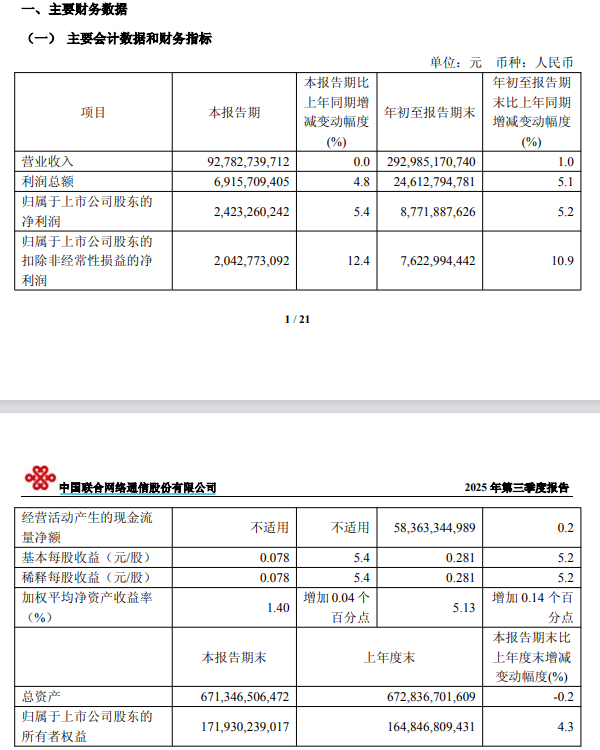
Core Insights - China Unicom reported third-quarter revenue of 92.783 billion yuan, remaining flat year-on-year, with a net profit of 2.423 billion yuan, up 5.4% [1][2] - For the first three quarters, China Unicom's revenue reached 292.985 billion yuan, a 1.0% increase year-on-year, while net profit was 8.772 billion yuan, up 5.2% [1][2] - China Mobile's third-quarter revenue was 250.9 billion yuan, a 2.5% increase year-on-year, with a net profit of 31.1 billion yuan, up 1.4% [4][5] - In the first three quarters, China Mobile's revenue totaled 794.7 billion yuan, a 0.4% increase year-on-year, and net profit was 115.4 billion yuan, up 4.0% [4][5] - China Telecom reported third-quarter revenue of 124.848 billion yuan, a decline of 0.91% year-on-year, with a net profit of 7.756 billion yuan, up 3.60% [6][7] - For the first three quarters, China Telecom's revenue was 394.270 billion yuan, a 0.59% increase year-on-year, and net profit was 30.773 billion yuan, up 5.03% [6][7] Financial Performance Summary - China Unicom's total assets at the end of the reporting period were 671.347 billion yuan, a decrease of 0.2% compared to the previous year [3] - China Mobile's total assets were reported at 20.738 billion yuan, showing no change year-on-year [5] - China Telecom's total assets reached 876.049 billion yuan, an increase of 1.09% compared to the previous year [7] Earnings Metrics - Basic earnings per share for China Unicom were 0.078 yuan, reflecting a 5.4% increase [3] - Basic earnings per share for China Mobile were 1.44 yuan, a 0.7% increase [5] - Basic earnings per share for China Telecom were 0.08 yuan, a 3.60% increase [7]


中国电信(601728):利润稳健增长,深化AI业务能力
HTSC· 2025-10-22 12:25
Investment Rating - The investment rating for the company is "Buy" [6][11]. Core Insights - The company has demonstrated steady profit growth, with a 0.6% year-on-year increase in revenue to RMB 394.3 billion and a 5.0% increase in net profit to RMB 30.8 billion for the first nine months of 2025 [1]. - The company is focusing on enhancing its AI capabilities through its "Xiangrang" platform, which integrates cloud and network services to provide comprehensive intelligent cloud services [1]. - The company is expected to continue leveraging its digital business potential in the AI era, maintaining a positive outlook on its growth prospects [1]. Summary by Sections Financial Performance - For the first three quarters of 2025, the company achieved a revenue of RMB 394.3 billion, a 0.6% increase year-on-year, and a net profit of RMB 30.8 billion, up 5.0% year-on-year [1]. - In Q3 2025, revenue decreased by 0.91% to RMB 124.85 billion, while net profit increased by 3.6% to RMB 7.76 billion [1]. Business Segments - The company has seen robust growth in its core business, with 5G users reaching 290 million and a penetration rate of 66.9% [2]. - The data center business generated RMB 27.5 billion in revenue, a 9.1% increase year-on-year, while intelligent business revenue surged by 62.3% [3]. Profitability and Efficiency - The company's return on equity (ROE) improved by 0.19 percentage points to 6.72%, and the net profit margin increased by 0.31 percentage points to 7.8% [4]. - Cost management has been enhanced through AI capabilities, leading to a 3% reduction in network operation and support costs [4]. Future Outlook - The company is projected to maintain its profit growth, with expected net profits of RMB 34.8 billion, RMB 36.6 billion, and RMB 38.3 billion for 2025, 2026, and 2027, respectively [5]. - The target price for A-shares is set at RMB 9.11, reflecting a 1.8 times price-to-book (PB) ratio for 2025 [5][11].
三大运营商,最新业绩公布
第一财经· 2025-10-22 12:17
Core Insights - China Unicom reported Q3 2025 revenue of 92.78 billion yuan, flat year-on-year, with a net profit of 2.42 billion yuan, up 5.4% [1][2] - For the first three quarters of 2025, revenue reached 292.99 billion yuan, a 1.0% increase, while net profit was 8.77 billion yuan, growing by 5.2% [1][2] - China Mobile's Q3 2025 revenue was 250.9 billion yuan, a 2.5% increase, with a net profit of 31.1 billion yuan, up 1.4% [3][4] - In the first three quarters, China Mobile's revenue was 794.7 billion yuan, a 0.4% increase, and net profit was 115.4 billion yuan, up 4.0% [3][4] - China Telecom reported Q3 2025 revenue of 124.85 billion yuan, down 0.91%, with a net profit of 7.76 billion yuan, up 3.6% [6][7] - For the first three quarters, China Telecom's revenue was 394.27 billion yuan, a 0.59% increase, and net profit was 30.77 billion yuan, up 5.03% [6][7] Financial Performance - China Unicom's total assets at the end of Q3 2025 were 671.35 billion yuan, a slight decrease of 0.2% from the previous year [3] - The weighted average return on equity for China Unicom was 1.40%, an increase of 0.04 percentage points [3] - China Mobile's EBITDA for Q3 2025 was 794 million yuan, a decrease of 1.7%, with an EBITDA margin of 31.7% [6] - China Telecom's net cash flow from operating activities for the first three quarters was 87.31 billion yuan, down 10.37% [7] Earnings Per Share - China Unicom's basic and diluted earnings per share for Q3 2025 were both 0.078 yuan, reflecting a 5.4% increase [2][3] - China Mobile's basic and diluted earnings per share for Q3 2025 were 1.44 yuan and 1.43 yuan, respectively, both up 0.7% [6] - China Telecom's basic earnings per share for Q3 2025 were 0.08 yuan, an increase of 3.60% [7]