CNOOC(00883)

Search documents
港股通(深)净买入2.18亿港元
Zheng Quan Shi Bao Wang· 2026-01-20 15:44
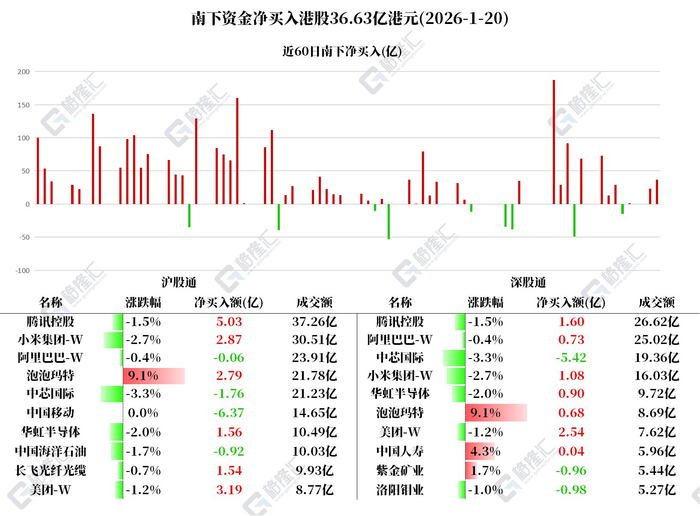
Core Viewpoint - On January 20, the Hang Seng Index fell by 0.29%, closing at 26,487.51 points, while southbound funds through the Stock Connect recorded a net buy of HKD 36.63 billion [1]. Group 1: Market Activity - The total trading volume for the Stock Connect on January 20 was HKD 972.83 billion, with a net buy of HKD 36.63 billion [1]. - The Shanghai Stock Connect accounted for HKD 594.79 billion in trading volume with a net buy of HKD 34.44 billion, while the Shenzhen Stock Connect had a trading volume of HKD 378.04 billion and a net buy of HKD 2.18 billion [1]. Group 2: Active Stocks - In the Shanghai Stock Connect, Tencent Holdings was the most actively traded stock with a transaction amount of HKD 37.26 billion, followed by Xiaomi Group-W and Alibaba-W with transaction amounts of HKD 30.51 billion and HKD 23.91 billion, respectively [1]. - Tencent Holdings had a net buy of HKD 5.03 billion, despite its closing price dropping by 1.48% [1]. - China Mobile recorded the highest net sell amount of HKD 6.37 billion, closing flat [1]. Group 3: Shenzhen Stock Connect Activity - In the Shenzhen Stock Connect, Tencent Holdings also led with a transaction amount of HKD 26.62 billion, followed by Alibaba-W and SMIC with transaction amounts of HKD 25.02 billion and HKD 19.36 billion, respectively [2]. - Meituan-W had the highest net buy amount of HKD 2.54 billion, although it closed down by 1.17% [2]. - SMIC experienced the largest net sell amount of HKD 5.42 billion, closing down by 3.25% [2].





智通港股通活跃成交|1月20日
智通财经网· 2026-01-20 11:01
Core Insights - On January 20, 2026, Tencent Holdings (00700), Xiaomi Group-W (01810), and Alibaba-W (09988) were the top three companies by trading volume in the Southbound Stock Connect, with trading amounts of 3.726 billion, 3.051 billion, and 2.391 billion respectively [1] - In the Shenzhen-Hong Kong Stock Connect, Tencent Holdings (00700), Alibaba-W (09988), and SMIC (00981) led the trading volume, with amounts of 2.662 billion, 2.502 billion, and 1.936 billion respectively [1] Southbound Stock Connect Trading Activity - The top active companies in the Southbound Stock Connect included: - Tencent Holdings (00700) with a trading amount of 3.726 billion and a net buying amount of +0.503 billion [2] - Xiaomi Group-W (01810) with a trading amount of 3.051 billion and a net buying amount of +0.287 billion [2] - Alibaba-W (09988) with a trading amount of 2.391 billion and a net selling amount of -5.778 million [2] - Other notable companies included Pop Mart (09992) and SMIC (00981) with trading amounts of 2.178 billion and 2.123 billion respectively [2] Shenzhen-Hong Kong Stock Connect Trading Activity - The top active companies in the Shenzhen-Hong Kong Stock Connect included: - Tencent Holdings (00700) with a trading amount of 2.662 billion and a net buying amount of +0.160 billion [2] - Alibaba-W (09988) with a trading amount of 2.502 billion and a net buying amount of +7.257 million [2] - SMIC (00981) with a trading amount of 1.936 billion and a net selling amount of -5.420 billion [2] - Other notable companies included Xiaomi Group-W (01810) with a trading amount of 1.603 billion and a net buying amount of +0.108 billion [2]



图解丨南下资金连续10日净买入腾讯,连续12日净卖出中国移动
Ge Long Hui A P P· 2026-01-20 10:07
Group 1 - Southbound funds net bought Hong Kong stocks worth HKD 3.663 billion today [1] - The top net purchases included Tencent Holdings at HKD 663 million, Meituan-W at HKD 573 million, and Xiaomi Group-W at HKD 395 million [1] - Continuous net buying trends were observed for Tencent over 10 days totaling HKD 10.62116 billion and Alibaba over 7 days totaling HKD 4.75655 billion [1] Group 2 - Southbound funds net sold shares of SMIC at HKD 717 million and China Mobile at HKD 637 million [1] - China Mobile has seen continuous net selling for 12 days, amounting to HKD 9.29936 billion [1] - Hua Hong Semiconductor and Xiaomi also experienced net buying trends over multiple days, with Hua Hong totaling HKD 1.33901 billion over 4 days and Xiaomi HKD 1.42914 billion over 3 days [1]

港股20日跌0.29% 收报26487.51点
Xin Hua Wang· 2026-01-20 09:51
Market Overview - The Hang Seng Index fell by 76.39 points, a decrease of 0.29%, closing at 26,487.51 points [1] - The total turnover on the main board was HKD 2,377.66 million [1] - The National Enterprises Index dropped by 39.69 points, closing at 9,094.76 points, a decline of 0.43% [1] - The Hang Seng Tech Index decreased by 66.54 points, closing at 5,683.44 points, a drop of 1.16% [1] Blue-Chip Stocks - Tencent Holdings decreased by 1.48%, closing at HKD 601 [1] - Hong Kong Exchanges and Clearing fell by 1.11%, closing at HKD 427 [1] - China Mobile remained unchanged, closing at HKD 79.3 [1] - HSBC Holdings increased by 1.1%, closing at HKD 128.4 [1] Local Hong Kong Stocks - Cheung Kong Holdings rose by 0.74%, closing at HKD 43.34 [1] - Sun Hung Kai Properties decreased by 0.99%, closing at HKD 110.2 [1] - Henderson Land Development increased by 0.52%, closing at HKD 31.12 [1] Chinese Financial Stocks - Bank of China fell by 0.45%, closing at HKD 4.47 [1] - China Construction Bank decreased by 0.51%, closing at HKD 7.76 [1] - Industrial and Commercial Bank of China dropped by 0.47%, closing at HKD 6.31 [1] - Ping An Insurance rose by 0.88%, closing at HKD 69 [1] - China Life Insurance increased by 4.31%, closing at HKD 33.4 [1] Oil and Petrochemical Stocks - China Petroleum & Chemical Corporation fell by 0.61%, closing at HKD 4.92 [1] - China National Petroleum Corporation decreased by 0.12%, closing at HKD 8.21 [1] - CNOOC Limited dropped by 1.74%, closing at HKD 21.52 [1]



区域风险升温+美元走低,石油ETF鹏华(159697)冲刺连续8天净流入
Sou Hu Cai Jing· 2026-01-20 03:12
Group 1 - The overall performance of the US dollar is weak, with the dollar index falling to around 99, leading to decreased investor confidence in dollar assets due to regional tensions [1] - Key variables affecting oil prices in 2026 include OPEC+ production cuts, macroeconomic policy shifts such as potential Federal Reserve interest rate cuts, and escalating regional political risks that could trigger short-term oil price spikes [1] - The projected core price range for Brent crude oil in 2026 is $55-75 per barrel, while WTI is expected to be $50-70 per barrel, with volatility expected to narrow compared to 2025 [1] Group 2 - As of December 31, 2025, the top ten weighted stocks in the National Petroleum and Natural Gas Index (399439) include major companies such as China National Petroleum, Sinopec, and CNOOC, collectively accounting for 67.11% of the index [2] - The Penghua Oil ETF (159697) closely tracks the National Petroleum and Natural Gas Index, reflecting the price changes of listed companies in the oil and gas sector on the Shanghai and Shenzhen stock exchanges [1][2]


【石油化工】踏上“十五五”新征程,打造具有鲜明海洋特色的世界一流能源集团——中国海油集团跟踪报告之七(赵乃迪/蔡嘉豪/王礼沫)
光大证券研究· 2026-01-18 23:04
Core Viewpoint - China National Offshore Oil Corporation (CNOOC) aims to become a world-class energy resource group with distinct marine characteristics during the 14th Five-Year Plan and is setting ambitious goals for the 15th Five-Year Plan [4]. Group 1: Achievements and Future Goals - During the 14th Five-Year Plan, CNOOC made significant progress in energy security, quality improvement, and technological advancements, successfully completing major objectives [4]. - For the 15th Five-Year Plan, CNOOC will focus on high-quality development, enhancing core competitiveness, and ensuring energy security while addressing the challenges posed by international oil price fluctuations [4][5]. Group 2: Strategic Initiatives for the 15th Five-Year Plan - CNOOC plans to strengthen its oil and gas core business, enhance exploration and production capabilities, and accelerate overseas production [5]. - The company will refine its refining, chemical, and new materials sectors, optimize product structures, and improve fertilizer production [5]. - CNOOC aims to strategically develop "electricity-hydrogen-carbon" businesses and explore marine mineral resources [5]. Group 3: Operational Focus for 2026 - In 2026, CNOOC will prioritize domestic oil and gas production, enhance investment efficiency, and promote innovation through AI applications [6]. - The company will implement reforms to improve organizational management and ensure safety and environmental protection [7]. - CNOOC will strengthen compliance management and risk prevention measures, particularly in overseas operations [7].
石油化工行业周报第 436 期(20260112—20260118):地缘局势动荡驱动油价上行,原油供给过剩预期有望改善-20260118
EBSCN· 2026-01-18 11:48
Investment Rating - The report maintains an "Overweight" rating for the oil and petrochemical industry [5] Core Views - Geopolitical tensions, particularly regarding Iran, have driven significant fluctuations in oil prices, providing a favorable backdrop for oil price recovery [1] - OPEC+ is expected to cautiously increase production in 2026, which may help alleviate the oversupply situation in the oil market [2] - Global oil demand is projected to improve, with the chemical raw material demand expected to dominate the growth in 2026 [3] - The report expresses a positive long-term outlook for major Chinese oil companies and the oil service sector, emphasizing their resilience during price fluctuations [4] Summary by Sections Oil Supply and Demand - OPEC forecasts a demand increase of 1.38 million barrels per day in 2026, with a cautious production increase expected to improve the supply-demand balance [2] - The IEA has raised its 2026 global oil demand growth forecast to 860,000 barrels per day, attributing this to improved macroeconomic conditions [3] Price Trends - As of January 16, 2026, Brent and WTI crude oil futures closed at $64.20 and $59.22 per barrel, reflecting increases of 1.9% and 0.7% respectively from the previous week [1] Investment Recommendations - The report recommends focusing on major Chinese oil companies, including China National Petroleum Corporation, Sinopec, and CNOOC, as well as their associated oil service engineering firms [4]
国资委公开80多家央企负责人薪酬
Sou Hu Cai Jing· 2026-01-17 13:14
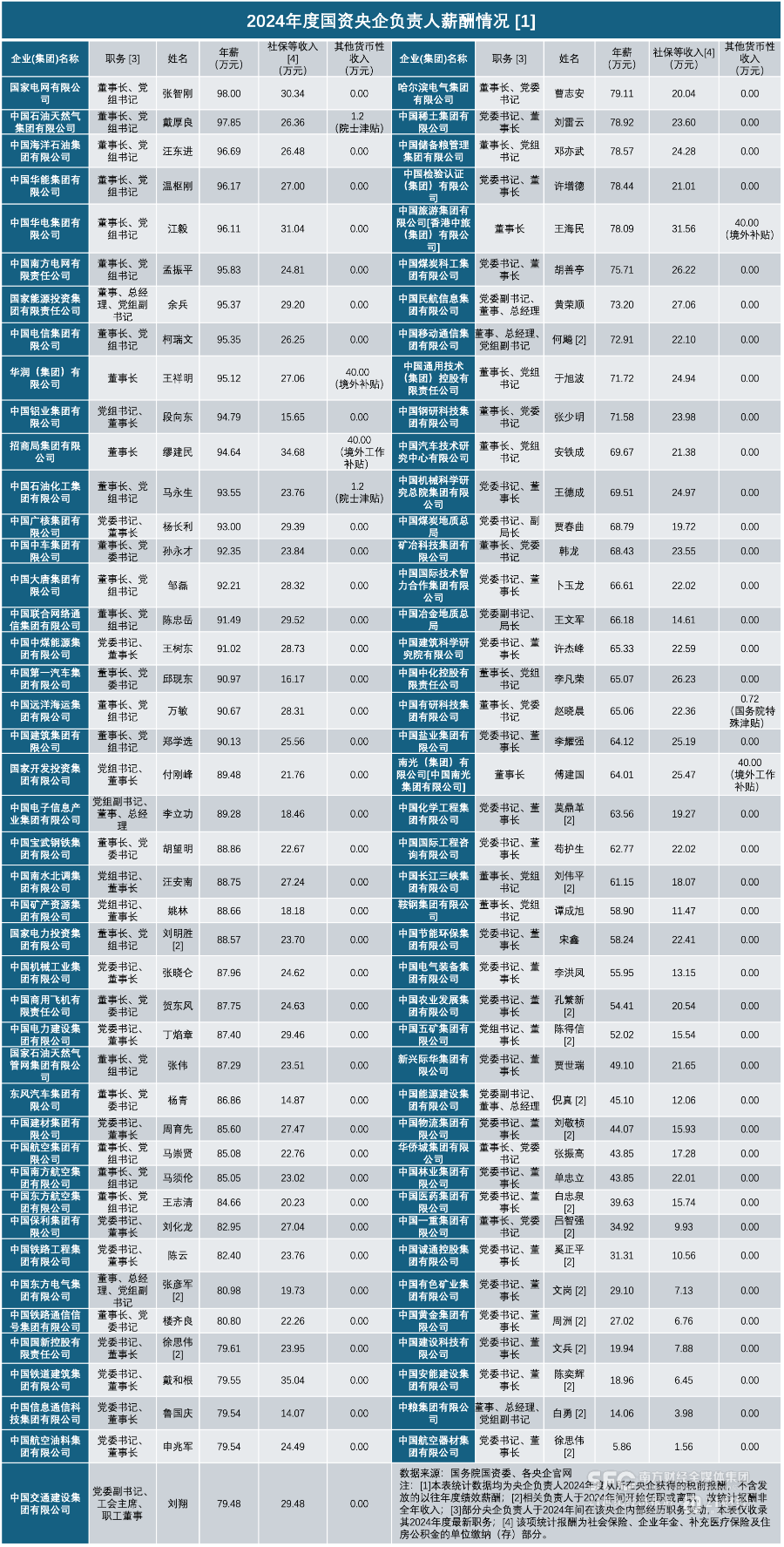
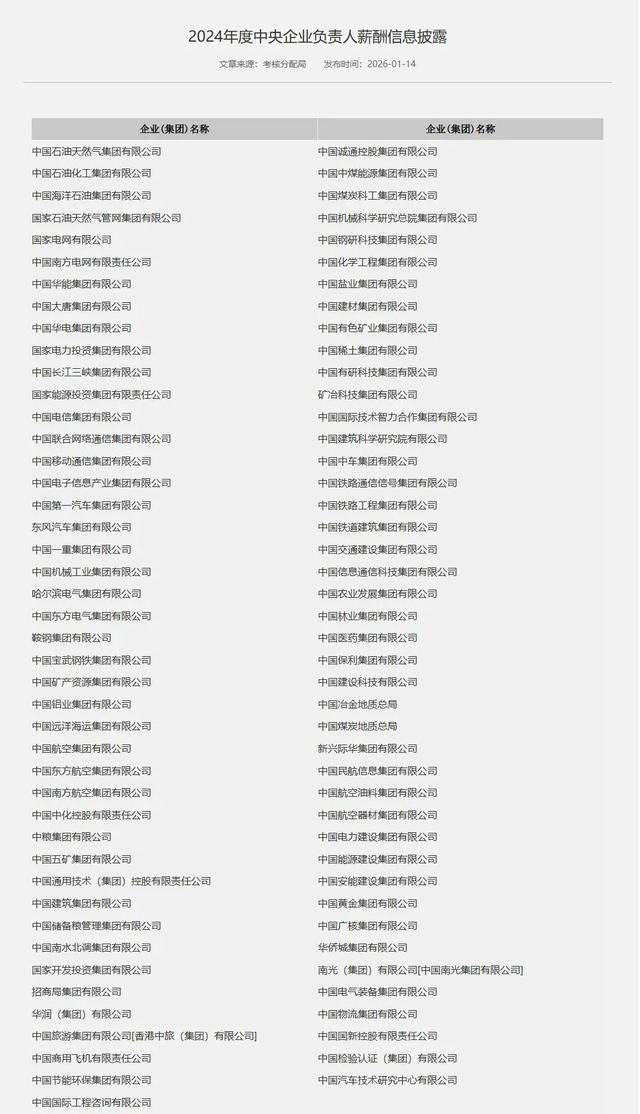
Core Viewpoint - The State-owned Assets Supervision and Administration Commission (SASAC) disclosed the salary information of over 80 central enterprise leaders for the year 2024, indicating a stable salary range without extreme high salaries, showcasing significant industry differentiation [1][5]. Group 1: Salary Disclosure - The disclosure of salary information is part of SASAC's ongoing efforts to enhance transparency in key areas and respond to public concerns [2]. - The overall salary of central enterprise leaders in 2024 remains within a stable range, characterized by "top leaders leading, median concentration, and low compliance," with no extreme high salary phenomena observed [5]. Group 2: Salary Rankings - The top tier of salaries is dominated by leaders from telecommunications and energy central enterprises, with China Mobile's former chairman Yang Jie leading with a pre-tax salary of 1.2582 million yuan, followed by China Telecom and China Unicom chairmen with salaries of 1.2160 million yuan and 1.2101 million yuan respectively [6]. - In the energy sector, PetroChina's chairman Dai Houliang and general manager Hou Qijun both have an annual salary of 978,500 yuan, ranking first among energy central enterprises [7]. - Other notable salaries include China Huaneng Group's chairman Wen Shugang at 961,700 yuan and State Power Investment Corporation's chairman Yu Bing at 953,700 yuan, both of whom are also in the top tier [8]. Group 3: Salary Distribution - The second tier includes core central enterprises in electricity, construction, and automotive industries, with notable figures such as State Grid's chairman Zhang Zhigang earning 735,000 yuan and China National Nuclear Corporation's chairman Yang Changli earning 930,000 yuan [15]. - The third tier consists of central enterprises with strong public welfare attributes, such as China Forestry Group's chairman Shan Zhongli and Overseas Chinese Town Group's chairman Zhang Zhenggao, both earning 438,500 yuan, which is below the average level for central enterprises [16]. Group 4: Salary Variability - Within the same industry, the salary differences among central enterprise executives are manageable, with the highest annual salary for energy central enterprise chairmen (PetroChina at 978,500 yuan) and the lowest (National Pipeline Network at 872,900 yuan) showing a difference of about 100,000 yuan [20].
80多家央企“一把手”2024年年薪披露:最高近百万元, 能源通信行业居前
Hua Xia Shi Bao· 2026-01-17 05:17
Core Viewpoint - The recent disclosure of salary information for over 80 central enterprises by the State-owned Assets Supervision and Administration Commission (SASAC) highlights the structure, level, and distribution of executive compensation, reflecting a commitment to transparency and accountability in state-owned enterprises [2][3]. Salary Structure and Distribution - The highest annual salary for a central enterprise leader in 2024 is 978,500 yuan, held by the chairman of PetroChina, Dai Houliang, followed closely by the former chairman of China Mobile at 972,100 yuan and the former chairman of CNOOC at 966,900 yuan, all from the energy and communication sectors [3]. - Overall, the salary distribution among central enterprise leaders shows a clear stratification, closely related to the industry characteristics and operational challenges, with energy and communication sectors leading in compensation [4]. - Leaders of energy and power central enterprises, such as Huaneng Group and China Southern Power Grid, have salaries exceeding 950,000 yuan, while those in construction, manufacturing, and logistics typically earn between 600,000 and 950,000 yuan, and those in public service sectors earn between 400,000 and 600,000 yuan [3][4]. Industry Differences - There are significant salary disparities among central enterprises based on industry, with energy and communication sectors commanding higher salaries due to their monopolistic nature and substantial impact on the national economy, while sectors like forestry and pharmaceuticals, which focus on social welfare, tend to have lower compensation levels [4]. - Some central enterprises involved in overseas operations, such as China Resources Group, have additional overseas allowances that increase their overall compensation, with the highest total compensation reaching 1,351,200 yuan [4]. Salary Reform and Mechanism - The salary structure for central enterprise leaders consists of a basic salary, performance-based salary, and long-term incentive income, with performance evaluations directly influencing compensation [5][9]. - The 2024 salary determination aligns with the SASAC's performance reform direction, ensuring that compensation is closely tied to performance, with a significant portion of salaries being variable based on performance outcomes [9][10]. - The mechanism for salary determination includes comprehensive assessments of various factors, including safety, social responsibility, and innovation, with penalties for significant operational failures [10]. Transparency and Accountability - The recent salary disclosure is part of ongoing efforts to enhance transparency and accountability in central enterprises, with detailed public reporting of executive names, positions, salaries, and benefits [10]. - To improve public trust, it is suggested that the disclosure should also include the rationale behind salary structures and performance evaluations, not just the figures [10].


央企掌门人年薪披露:20人超90万元,国家电网董事长居首
2 1 Shi Ji Jing Ji Bao Dao· 2026-01-17 00:19
Core Insights - The State-owned Assets Supervision and Administration Commission (SASAC) disclosed the 2024 salary information for 87 central enterprises, revealing that 20 of them have annual salaries exceeding 900,000 yuan, primarily in the energy and power sector [1][4]. Group 1: Salary Disclosure - SASAC published salary data for 87 central enterprises, with notable omissions such as China Aerospace Science and Technology Corporation and China Shipbuilding Industry Corporation [1]. - Among the disclosed enterprises, 20 have annual salaries exceeding 900,000 yuan, with a concentration in the energy and power industries [1][4]. - Nine enterprises headquartered in the Guangdong-Hong Kong-Macao Greater Bay Area also reported salaries, with four exceeding 900,000 yuan [1][9]. Group 2: Top Earners - The highest reported salary is 980,000 yuan for Zhang Zhigang, Chairman of State Grid Corporation, whose salary is split due to a change in position during the year [4][7]. - Other top earners include Dai Houliang from China National Petroleum Corporation at 978,500 yuan, and Wang Dongjin from China National Offshore Oil Corporation at 966,900 yuan [4][7]. - A total of nine enterprises have salaries exceeding 950,000 yuan, all primarily in the energy sector [4][7]. Group 3: Performance Metrics - State Grid Corporation reported a total revenue of 3,945.928 billion yuan and a net profit of 77.298 billion yuan for 2024 [7]. - China Telecom achieved a revenue of 523.6 billion yuan in 2024, marking a 3.1% year-on-year increase [7]. - The performance of these enterprises aligns with SASAC's A-grade assessment for operational performance for the 2024 fiscal year [7]. Group 4: Regional Insights - In the Greater Bay Area, China Southern Power Grid, China Resources Group, China Merchants Group, and China General Nuclear Power Group reported salaries exceeding 900,000 yuan [9][10]. - China Southern Power Grid's Chairman earned 958,300 yuan, while China Resources Group's Chairman received 951,200 yuan, including overseas allowances [9][10]. - China Merchants Group's Chairman reported a salary of 946,400 yuan, also including overseas work allowances [10].