CNOOC(00883)

Search documents
易方达基金张坤Q4持仓出炉:前十大重仓包括腾讯控股、贵州茅台等
Zhong Guo Zheng Quan Bao· 2026-01-22 02:35
Group 1 - The core viewpoint of the news is that E Fund's Blue Chip Select Fund, managed by Zhang Kun, has maintained a stable stock position while adjusting its sector allocations in pharmaceuticals, consumer goods, and technology as of Q4 2025 [1] - The top ten holdings of the fund as of the end of Q4 2025 include Tencent Holdings, Kweichow Moutai, Wuliangye, Alibaba-W, Shanxi Fenjiu, Luzhou Laojiao, Yum China, CNOOC, JD Health, and Focus Media, showing no changes from Q3 2025 [1] - Zhang Kun expresses confidence that both the actual living standards and social security levels in China will significantly improve over the next decade, narrowing the gap with developed countries [1] Group 2 - The current AI wave highlights the importance of a strong domestic demand market in promoting technological innovation, as it attracts global resources, talent, and capital [2] - Subscription revenues, such as the approximately $200 annual fee for C-end users of leading AI models like GPT and Gemini, are crucial for companies' financing and ongoing investment confidence amid debates about an "AI bubble" [2] - A domestic company with leading foundational model capabilities could benefit from a stronger consumer environment, enhancing subscription income and model investment interactions, which may help it catch up with global leaders [2]





港股石油股继续涨势 中石油涨3.3% 中海油涨近3%逼近历史高位
Jin Rong Jie· 2026-01-22 02:31
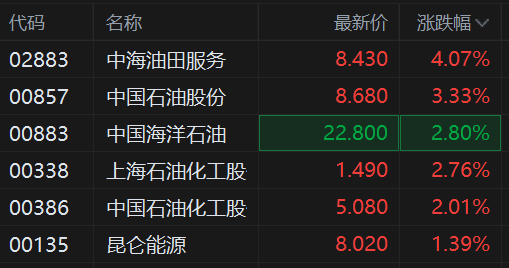
港股石油继续涨势,其中,中海油田服务涨4%,中国石油股份涨3.3%,中国海洋石油、上海石油化工 涨约3%,中国石油化工涨2%,昆仑能源涨1.4%。 本文源自:金融界AI电报 ...


港股“三桶油”走强,中国石油股份(00857.HK)涨3.3%,中国海洋石油(00883.HK)涨2.9%,中国石油化工股份(00386.HK)涨1.8%。
Jin Rong Jie· 2026-01-22 02:18
本文源自:金融界AI电报 港股"三桶油"走强,中国石油股份(00857.HK)涨3.3%,中国海洋石油(00883.HK)涨2.9%,中国石油化工 股份(00386.HK)涨1.8%。 ...

港股异动丨石油股继续涨势 中石油涨3.3% 中海油涨近3%逼近历史高位
Ge Long Hui· 2026-01-22 02:13
Group 1 - The core viewpoint of the news is that the Hong Kong oil sector continues to rise, driven by improved global economic outlook and rising oil prices, despite warnings of potential oversupply from the IEA [1] - The International Energy Agency (IEA) has raised its global oil demand growth forecast for this year to an increase of 930,000 barrels per day, up from the previous estimate of 860,000 barrels per day [1] - The rise in oil prices has led to significant gains in major oil producers' stock prices, with the US energy sector reaching historical highs amid geopolitical uncertainties [1] Group 2 - The stock performance of major oil companies in Hong Kong includes: CNOOC Services up 4.07%, PetroChina up 3.33%, CNOOC up 2.80%, Shanghai Petrochemical up 2.76%, Sinopec up 2.01%, and Kunlun Energy up 1.39% [2]

多家能源化工央企董事长涨薪
第一财经· 2026-01-21 13:36
Core Viewpoint - The article discusses the salary information of executives from seven major energy and chemical state-owned enterprises in China for the year 2024, revealing that their pre-tax salaries are generally below 1 million yuan, with a range from 650,000 to 1 million yuan [3][4]. Salary Overview - The total pre-tax salary of the executives consists of three components: annual salary, social insurance and other benefits, and additional monetary income [3]. - The disclosed salaries for the seven energy and chemical SOE chairpersons range from 800,000 to 1,260,000 yuan [4]. Executive Salary Details - The top three earners among the "Big Three" oil companies are: - Dai Houliang (China National Petroleum Corporation) - 978,500 yuan - Wang Dongjin (China National Offshore Oil Corporation) - 966,900 yuan - Ma Yongsheng (China Petroleum and Chemical Corporation) - 935,500 yuan [5]. - The lowest salary is held by Mo Dingge (China Chemical Engineering Group), who will assume office in March 2024, with a salary of 635,600 yuan [5]. Year-on-Year Salary Changes - The total salary changes for 2024 compared to 2023 are as follows: - China National Petroleum Corporation: 1.89% increase - China Petroleum and Chemical Corporation: 0.38% increase - China National Offshore Oil Corporation: 3.57% increase - China National Coal Group: 1.61% increase - National Oil and Gas Pipeline Group: 3.27% decrease [6]. Performance Correlation - The salary increases for the chairpersons of China National Petroleum Corporation and China National Offshore Oil Corporation align with their companies' performance, as both companies reported significant profits in 2024 [7]. - China National Offshore Oil Corporation achieved a net profit of 137.94 billion yuan, a 11.4% increase year-on-year, while China National Petroleum Corporation reported a net profit of 164.68 billion yuan, a 2.0% increase despite a 2.5% decrease in revenue [8].
多家能源化工央企董事长涨薪
Di Yi Cai Jing· 2026-01-21 11:48
Core Insights - The State-owned Assets Supervision and Administration Commission (SASAC) disclosed the 2024 salary information for 87 central enterprise leaders, including seven energy and chemical companies [1] Group 1: Salary Information - The pre-tax salary of central enterprise leaders consists of three parts: payable annual salary, employer contributions to social insurance, enterprise annuities, supplementary medical insurance, and housing provident fund, as well as other monetary income [1] - The disclosed salaries for the seven energy and chemical central enterprise leaders range from 650,000 to 1,000,000 yuan, with the total annual salary for these leaders falling between 800,000 and 1,260,000 yuan [2][3] Group 2: Top Earners - The top three earners among the seven energy and chemical central enterprise leaders are from the "Big Three" oil companies: China National Petroleum Corporation (CNPC) Chairman Dai Houliang (978,500 yuan), China National Offshore Oil Corporation (CNOOC) Chairman Wang Dongjin (966,900 yuan), and China Petroleum and Chemical Corporation (Sinopec) Chairman Ma Yongsheng (935,500 yuan) [3] - The remaining leaders' salaries are as follows: China Coal Energy Group Chairman Wang Shudong (910,200 yuan), National Oil and Gas Pipeline Group Chairman Zhang Wei (872,900 yuan), China Sinochem Holdings Chairman Li Fanrong (650,700 yuan), and China Chemical Engineering Group Chairman Mo Dingge (635,600 yuan) [3] Group 3: Salary Changes - The total salary for the leaders of the seven energy and chemical central enterprises has shown an increase, with the exception of the National Oil and Gas Pipeline Group Chairman's salary, which declined compared to 2023 [3] - The top three salary increases for 2024 were recorded by China Sinochem Holdings Chairman Li Fanrong (4.08%), CNPC Chairman Dai Houliang (3.89%), and CNOOC Chairman Wang Dongjin (3.57%) [4] Group 4: Company Performance - In 2024, the "Big Three" oil companies collectively achieved a net profit of over 352.93 billion yuan, averaging approximately 964 million yuan per day [5] - CNOOC reported a revenue of 420.51 billion yuan, a year-on-year increase of 0.9%, and a net profit of 137.94 billion yuan, up 11.4%, marking the second-highest performance in the company's history [5] - CNPC's revenue was 2.94 trillion yuan, a decrease of 2.5% year-on-year, primarily due to falling prices of oil, natural gas, and refined oil products, while achieving a net profit of 164.68 billion yuan, a 2.0% increase [6]

北水动向|北水成交净买入139.3亿 北水再度加仓港股ETF 抢筹盈富基金(02800)超41亿港元
Zhi Tong Cai Jing· 2026-01-21 10:08
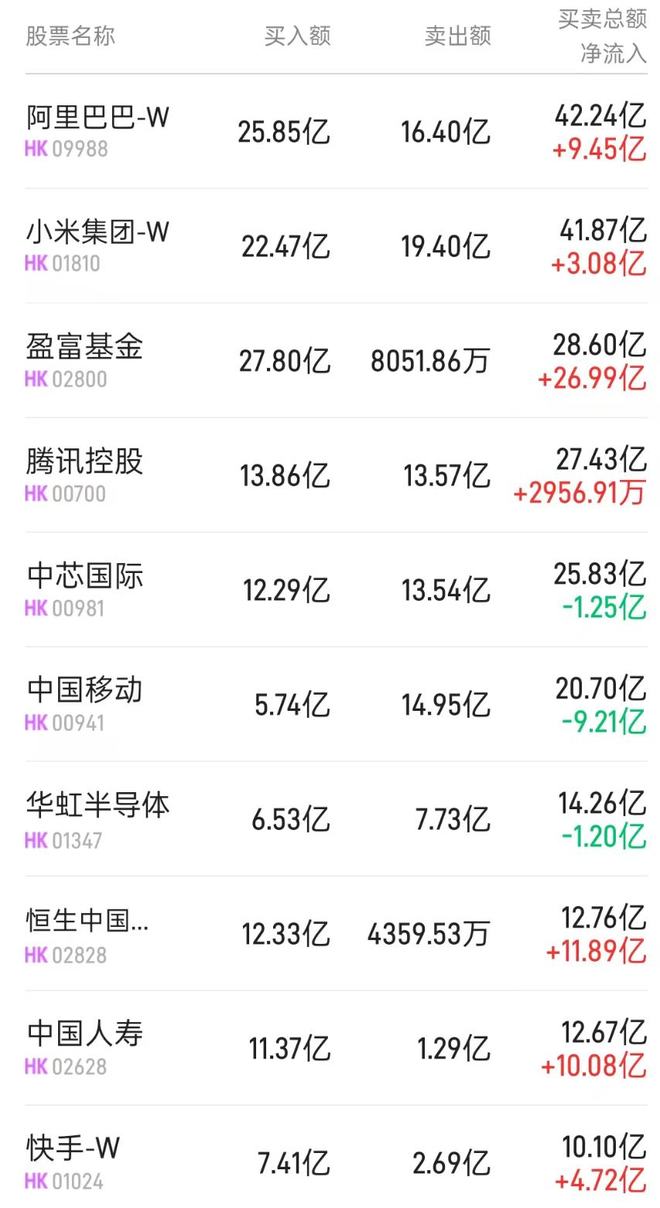
Group 1 - Northbound capital recorded a net buy of HKD 139.3 billion on January 21, with HK Stock Connect (Shanghai) contributing HKD 77.89 billion and HK Stock Connect (Shenzhen) contributing HKD 61.41 billion [1] - The most bought stocks included the Tracker Fund of Hong Kong (02800), Hang Seng China Enterprises (02828), and Alibaba-W (09988), while the most sold stocks were China Mobile (00941), Tencent (00700), and Hua Hong Semiconductor (01347) [1] - Alibaba-W received a net buy of HKD 10.77 billion, with significant growth in its AI model downloads, surpassing 100 million downloads [5] - China Life (02628) saw a net buy of HKD 10.07 billion, driven by positive expectations in the life insurance sector [5] - Kuaishou-W (01024) gained a net buy of HKD 7.33 billion, with its AI product showing a 350% increase in paid user growth [5] Group 2 - Semiconductor stocks showed divergence, with SMIC (00981) receiving a net buy of HKD 3.87 billion, while Hua Hong Semiconductor (01347) faced a net sell of HKD 1.2 billion [6] - TSMC's increased capital expenditure forecast indicates strong long-term demand driven by AI [6] - Shandong Gold (01787) received a net buy of HKD 3.03 billion, with gold prices hitting historical highs amid geopolitical tensions [7] - CNOOC (00883) saw a net buy of HKD 3.64 billion, with ongoing geopolitical tensions affecting oil prices [7] - Xiaomi Group-W (01810) and Meituan-W (03690) received net buys of HKD 5.89 billion and HKD 2.04 billion, respectively, while China Mobile (00941) and Tencent (00700) faced net sells of HKD 9.21 billion and HKD 2.71 billion [7]


中国海油、明阳智能等成立海上风电公司!
Qi Cha Cha· 2026-01-21 06:47
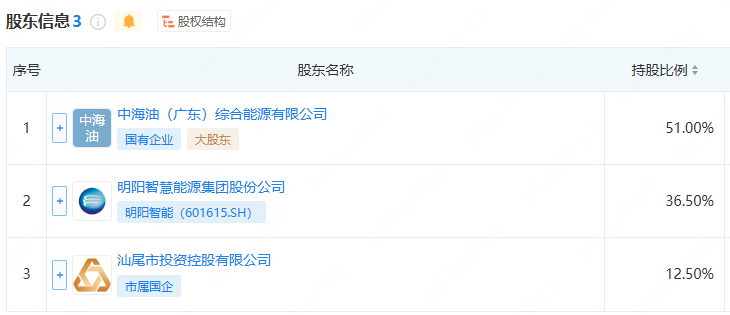
Group 1 - The establishment of CNOOC (Shanwei) Offshore Wind Power Co., Ltd. has been announced, with a registered capital of 50 million yuan, focusing on power generation, transmission, and distribution services, as well as renewable energy technology services [1] - The company is jointly owned by CNOOC (Guangdong) Integrated Energy Co., Ltd. (51%), Mingyang Smart Energy Group Co., Ltd. (36.5%), and Shanwei Investment Holding Co., Ltd. (12.5%) [2] Group 2 - The company aims to engage in various renewable energy sectors, including wind and solar power generation technology services [1] - CNOOC (Guangdong) Integrated Energy Co., Ltd. is identified as the major shareholder, indicating a strong backing from a state-owned enterprise [2]
首个海上膜脱碳工程回收伴生气超2000万方
Zhong Guo Hua Gong Bao· 2026-01-21 02:43
Core Viewpoint - China National Offshore Oil Corporation (CNOOC) has successfully implemented the country's first offshore membrane decarbonization demonstration project, achieving the recovery of over 20 million cubic meters of associated gas and efficient decarbonization, recovery, and resource utilization [1] Group 1: Project Overview - The Huizhou 32-5 platform is one of the high-yield oil platforms in the eastern South China Sea oil field, serving as a pilot for advancing green and low-carbon transformation [1] - The project has innovatively established a technical system for efficient carbon dioxide capture, reinjection, and storage [1] Group 2: Technical Process - The project process includes three main stages: raw gas pretreatment, membrane separation decarbonization, and post-membrane treatment and recovery [1] - The membrane separation decarbonization stage utilizes a self-developed membrane decarbonization device by CNOOC, which occupies less space and consumes less energy, making it highly suitable for offshore platform environments [1] Group 3: Innovation and Impact - In the post-membrane treatment and recovery phase, the project innovatively employs the same well injection and production technology, allowing for the compression and safe reinjection of carbon dioxide without affecting oil extraction [1] - This approach addresses the challenge of resource constraints in offshore platform well slots and provides a replicable and scalable new pathway for carbon storage in offshore oil fields [1]
港股异动丨石油股拉升 中国石油化工创阶段新高 地缘政治紧张油价上涨
Ge Long Hui· 2026-01-21 01:48
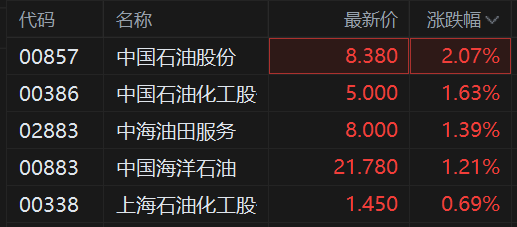
Core Viewpoint - Hong Kong oil stocks experienced a collective rise at the beginning of trading, driven by an increase in international oil prices and geopolitical tensions affecting oil supply [1] Group 1: Market Performance - China Petroleum & Chemical Corporation (Sinopec) saw a price increase of over 2%, while China National Offshore Oil Corporation (CNOOC) rose by 1.2% [2] - China Petroleum (PetroChina) increased by 2.07% to a price of 8.380, and Sinopec rose by 1.63% to 5.000 [2] - China Oilfield Services and Shanghai Petrochemical also showed gains, with increases of 1.39% and 0.69% respectively [2] Group 2: Oil Price Influences - International oil prices rose by over 1.5% in the previous night’s trading [1] - Everbright Securities highlighted the impact of the Federal Reserve's potential interest rate cuts and ongoing global trade conflicts on oil demand expectations for 2026 [1] - The geopolitical risk premium for oil has increased due to heightened tensions in Iran, contributing to rising oil prices [1] Group 3: OPEC+ Decisions - OPEC+ has decided to pause production increases for Q1 2026, which may alleviate market concerns regarding oil supply [1] - Future production levels will be determined based on changes in the oil market [1]