CHINA MOBILE(00941)

Search documents
南向资金今日净买入68.15亿港元 腾讯控股净买入14.12亿港元
Zheng Quan Shi Bao Wang· 2026-01-09 14:35
Core Viewpoint - On January 9, the Hang Seng Index rose by 0.32%, with southbound funds totaling HKD 111.39 billion in trading volume, resulting in a net inflow of HKD 6.81 billion [1] Group 1: Southbound Trading Activity - The total trading volume for southbound funds was HKD 111.39 billion, with buy transactions amounting to HKD 59.10 billion and sell transactions at HKD 52.29 billion, leading to a net buy of HKD 6.81 billion [1] - The Hong Kong Stock Connect (Shenzhen) recorded a total trading volume of HKD 44.30 billion, with net buying of HKD 5.15 billion, while the Hong Kong Stock Connect (Shanghai) had a trading volume of HKD 67.08 billion and a net buy of HKD 1.66 billion [1] Group 2: Active Stocks - Alibaba-W had the highest trading volume among southbound funds at HKD 99.89 billion, but experienced a net sell of HKD 26.22 billion, despite a closing price increase of 2.73% [1] - Tencent Holdings saw a net buy of HKD 14.12 billion, with a closing price decrease of 0.81%, while Xiaomi Group-W had a net buy of HKD 8.70 billion [1] - Kuaishou-W recorded a net buy of HKD 7.76 billion, and Meituan-W and China Mobile faced net sells of HKD 3.67 billion and HKD 3.11 billion, respectively [1] Group 3: Continuous Net Buying - Xiaomi Group-W and Tencent Holdings were the only two stocks with continuous net buying for more than three days, with Xiaomi Group-W having a total net buy of HKD 55.53 billion over seven days, and Tencent Holdings with HKD 42.31 billion over three days [2]


港股通(深)净买入51.55亿港元
Zheng Quan Shi Bao Wang· 2026-01-09 14:34
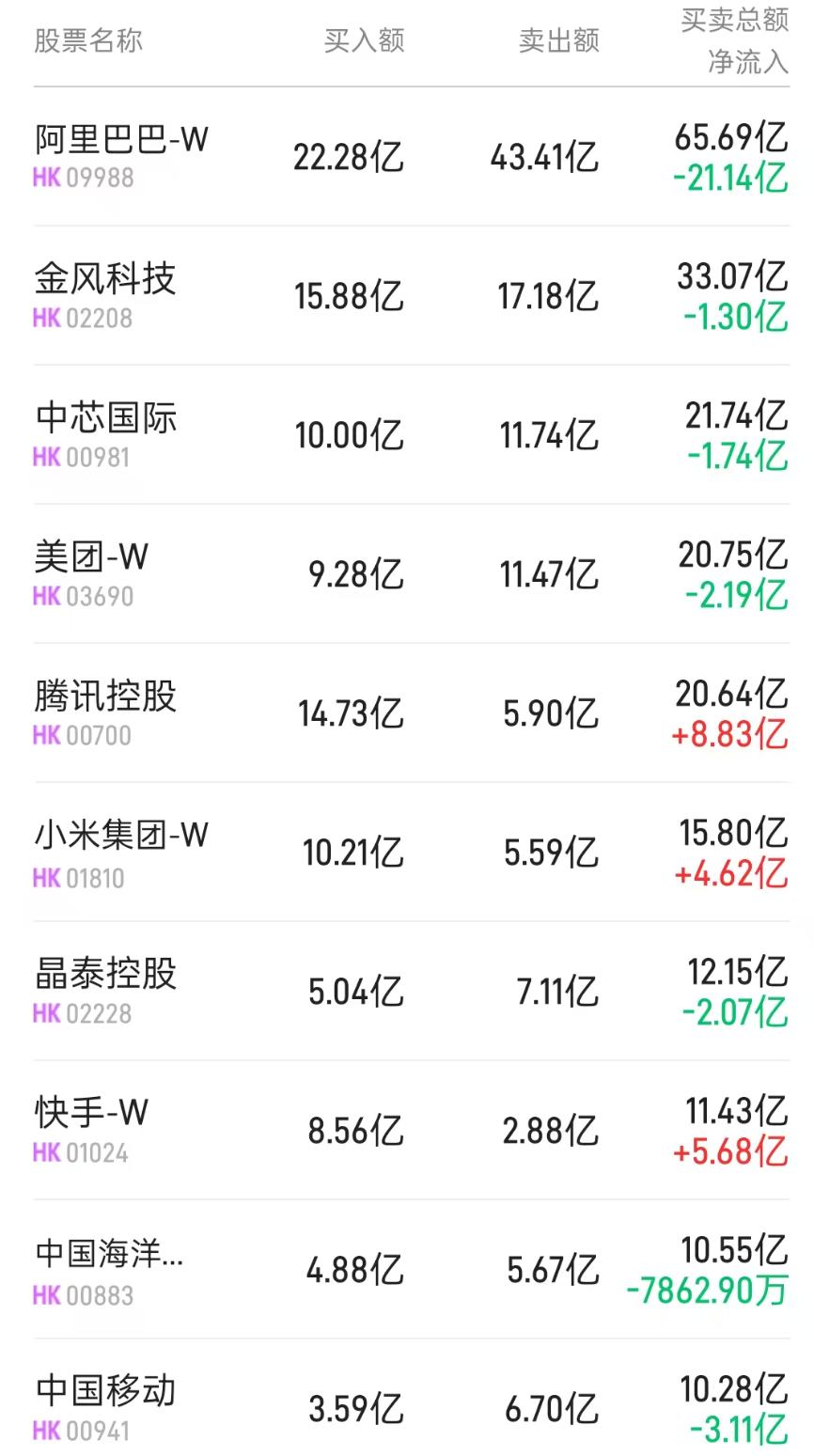
Core Viewpoint - On January 9, the Hang Seng Index rose by 0.32% to close at 26,231.79 points, with a net inflow of HKD 6.815 billion through the southbound trading channel [1] Group 1: Market Activity - The total trading volume for southbound trading on January 9 was HKD 111.389 billion, with a net buying amount of HKD 6.815 billion [1] - The Shanghai Stock Exchange's southbound trading amounted to HKD 67.084 billion, with a net buying of HKD 1.660 billion, while the Shenzhen Stock Exchange recorded HKD 44.305 billion in trading with a net buying of HKD 5.155 billion [1] Group 2: Active Stocks - In the Shanghai Stock Exchange's southbound trading, Alibaba-W had the highest trading volume at HKD 65.69 billion, followed by Goldwind Technology at HKD 33.07 billion and SMIC at HKD 21.74 billion [1] - Tencent Holdings had the highest net buying amount of HKD 0.883 billion, despite a closing price drop of 0.81% [1] - Alibaba-W recorded the highest net selling amount of HKD 2.114 billion, while its closing price increased by 2.73% [1] Group 3: Detailed Stock Data - The top active stocks in the southbound trading on January 9 included: - Alibaba-W: Trading amount of HKD 656.911 million with a net selling of HKD 211.364 million, closing up by 2.73% [3] - Goldwind Technology: Trading amount of HKD 330.673 million with a net selling of HKD 13.003 million, closing up by 3.41% [3] - SMIC: Trading amount of HKD 217.368 million with a net selling of HKD 17.406 million, closing down by 0.73% [3] - Tencent Holdings: Trading amount of HKD 209.478 million with a net buying of HKD 52.898 million, closing down by 0.81% [3]
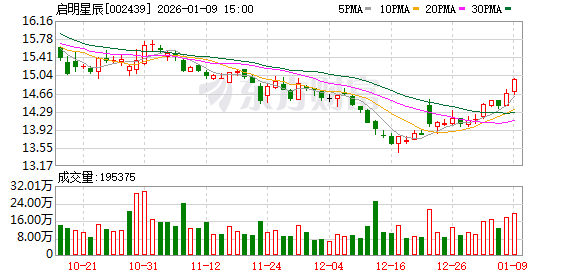
启明星辰:公司携手中国移动积极跟进量子科技等前沿技术
Zheng Quan Ri Bao· 2026-01-09 14:15
Core Viewpoint - The company is actively engaging in quantum technology research, particularly focusing on security threats related to quantum computing, and is integrating these advancements into its products [2]. Group 1: Quantum Technology Initiatives - The company is collaborating with China Mobile to explore cutting-edge technologies in quantum science [2]. - Research is being conducted on security threats posed by quantum computing, leading to product capability upgrades [2]. Group 2: Product Enhancements - The company has upgraded its post-quantum cryptography system, achieving product integration and smooth evolution of post-quantum algorithms [2]. - Quantum key distribution technology has been integrated into the company's VPN products, enhancing key supply and business collaboration capabilities [2]. Group 3: Industry Applications - Successful implementation of quantum security measures has been achieved in critical information infrastructure sectors such as finance and telecommunications [2].



智通港股通活跃成交|1月9日





智通财经网· 2026-01-09 11:22
Group 1 - On January 9, 2026, Alibaba-W (09988), Goldwind Technology (02208), and SMIC (00981) were the top three companies by trading volume in the Southbound Stock Connect, with transaction amounts of 6.569 billion, 3.307 billion, and 2.174 billion respectively [1] - In the Southbound Stock Connect for the Shenzhen-Hong Kong Stock Connect, Alibaba-W (09988), Tencent Holdings (00700), and SMIC (00981) also ranked as the top three, with transaction amounts of 3.420 billion, 2.095 billion, and 1.749 billion respectively [1] Group 2 - The top active companies in the Southbound Stock Connect included Alibaba-W (09988) with a net buy amount of -2.114 billion, Goldwind Technology (02208) with -0.130 billion, and SMIC (00981) with -0.174 billion [2] - In the Shenzhen-Hong Kong Stock Connect, Alibaba-W (09988) had a net buy amount of -0.508 billion, Tencent Holdings (00700) had +0.529 billion, and SMIC (00981) had +0.866 billion [2]
北水动向|北水成交净买入68.15亿 阿里(09988)拟加大淘宝闪购投入 北水全天抛售阿里超26亿港元
智通财经网· 2026-01-09 10:02
Group 1 - The Hong Kong stock market saw a net inflow of 68.15 billion HKD from northbound trading, with 16.6 billion HKD from Shanghai and 51.55 billion HKD from Shenzhen [1] - The most bought stocks included Tencent (00700), Xiaomi Group-W (01810), and Kuaishou-W (01024), while the most sold stocks were Alibaba-W (09988), China Mobile (00941), and Goldwind Technology (02208) [1][2] Group 2 - Alibaba-W (09988) had a net outflow of 26.21 billion HKD, with a total trading volume of 65.69 billion HKD, indicating significant selling pressure [2][7] - Tencent (00700) received a net inflow of 14.11 billion HKD, supported by a report from Morgan Stanley highlighting its AI strategy and high potential for monetization [4][5] - Xiaomi Group-W (01810) attracted a net inflow of 8.69 billion HKD, with plans for 200 billion HKD in R&D investment over the next five years [5] - Kuaishou-W (01024) saw a net inflow of 7.76 billion HKD, driven by strong performance in AI-generated content [5] - Semiconductor company SMIC (00981) had a net inflow of 6.92 billion HKD, following a strategic acquisition that is expected to positively impact earnings [6] - Goldwind Technology (02208) faced a net outflow of 1.94 billion HKD, despite potential positive catalysts from its stake in Blue Arrow Aerospace [7]
图解丨南下资金净买入腾讯和小米,大幅净卖出阿里
Ge Long Hui A P P· 2026-01-09 10:00
Group 1 - Southbound funds net bought Hong Kong stocks worth 6.815 billion HKD today, with notable purchases including Tencent Holdings (1.412 billion HKD), Xiaomi Group (0.869 billion HKD), and Kuaishou (0.776 billion HKD) [1] - Southbound funds have continuously net bought Xiaomi for 7 days, totaling 5.55407 billion HKD, and Tencent for 3 days, totaling 4.23097 billion HKD [1] - Southbound funds have continuously net sold China Mobile for 5 days, totaling 3.45009 billion HKD [1] Group 2 - Alibaba-W experienced a net sell of 2.622 billion HKD, while Meituan-W saw a net sell of 0.366 billion HKD [4] - Tencent Holdings had a net buy of 0.883 billion HKD despite a 0.8% decline in stock price [4] - Kuaishou-W recorded a net buy of 0.568 billion HKD with a stock price increase of 3.9% [4]

智通港股通持股解析|1月9日
智通财经网· 2026-01-09 00:33
Core Insights - The top three companies by Hong Kong Stock Connect shareholding ratios are China Telecom (71.61%), Gree Power (69.82%), and Kaisa New Energy (67.97%) [1] - The largest increases in shareholding over the last five trading days were seen in the Tracker Fund of Hong Kong (+4.898 billion), Xiaomi Group-W (+2.104 billion), and Hang Seng China Enterprises (+2.034 billion) [1] - The largest decreases in shareholding over the last five trading days were recorded for Tencent Holdings (-3.674 billion), China Mobile (-2.390 billion), and Zijin Mining (-792 million) [1] Group 1: Hong Kong Stock Connect Shareholding Ratios - China Telecom (00728) holds 9.938 billion shares with a shareholding ratio of 71.61% [1] - Gree Power (01330) holds 0.282 billion shares with a shareholding ratio of 69.82% [1] - Kaisa New Energy (01108) holds 0.170 billion shares with a shareholding ratio of 67.97% [1] - Tianjin Chuangye Environmental Protection (01065) holds 0.229 billion shares with a shareholding ratio of 67.36% [1] - Other notable companies include China Shenhua (66.29%) and Southern Hang Seng Technology (65.38%) [1] Group 2: Recent Increases in Shareholding - Tracker Fund of Hong Kong (02800) saw an increase of +4.898 billion with a change of +18.6086 million shares [1] - Xiaomi Group-W (01810) increased by +2.104 billion with a change of +5.53495 million shares [1] - Hang Seng China Enterprises (02828) increased by +2.034 billion with a change of +2.19962 million shares [1] - Other companies with significant increases include Ping An Insurance (+2.027 billion) and Kuaishou-W (+1.709 billion) [1] Group 3: Recent Decreases in Shareholding - Tencent Holdings (00700) experienced a decrease of -3.674 billion with a change of -5.9645 million shares [3] - China Mobile (00941) decreased by -2.390 billion with a change of -2.9561 million shares [3] - Zijin Mining (02899) saw a decrease of -792 million with a change of -2.1294 million shares [3] - Other companies with notable decreases include China Unicom (-764 million) and Xinda Biopharmaceuticals (-596 million) [3]


智通港股通资金流向统计(T+2)|1月9日
智通财经网· 2026-01-08 23:38
Group 1 - The top three companies with net inflow of southbound funds are China Ping An (18.33 billion), Alibaba-W (16.16 billion), and China Life (9.48 billion) [1][2] - The top three companies with net outflow of southbound funds are China Mobile (-9.00 billion), Tencent Holdings (-8.08 billion), and Industrial and Commercial Bank of China (-2.89 billion) [1][2] - In terms of net inflow ratio, the top three companies are Honghua Smart Energy (70.89%), Xintian Green Energy (60.54%), and Sichuan Chengyu Expressway (53.70%) [1][2] Group 2 - The top ten companies by net inflow include China Ping An (18.33 billion, 24.94%), Alibaba-W (16.16 billion, 9.53%), and China Life (9.48 billion, 24.39%) [2] - The top ten companies by net outflow include China Mobile (-9.00 billion, -38.55%), Tencent Holdings (-8.08 billion, -5.27%), and Industrial and Commercial Bank of China (-2.89 billion, -16.44%) [2] - The top three companies by net outflow ratio are Southern East Selection (-86.04%), ICBC South China (-62.50%), and Crystal International (-52.67%) [3]


1月7日【港股Podcast】恆指、港交所、兗礦能源、友邦保險、中移動、阿里
Ge Long Hui· 2026-01-08 20:15
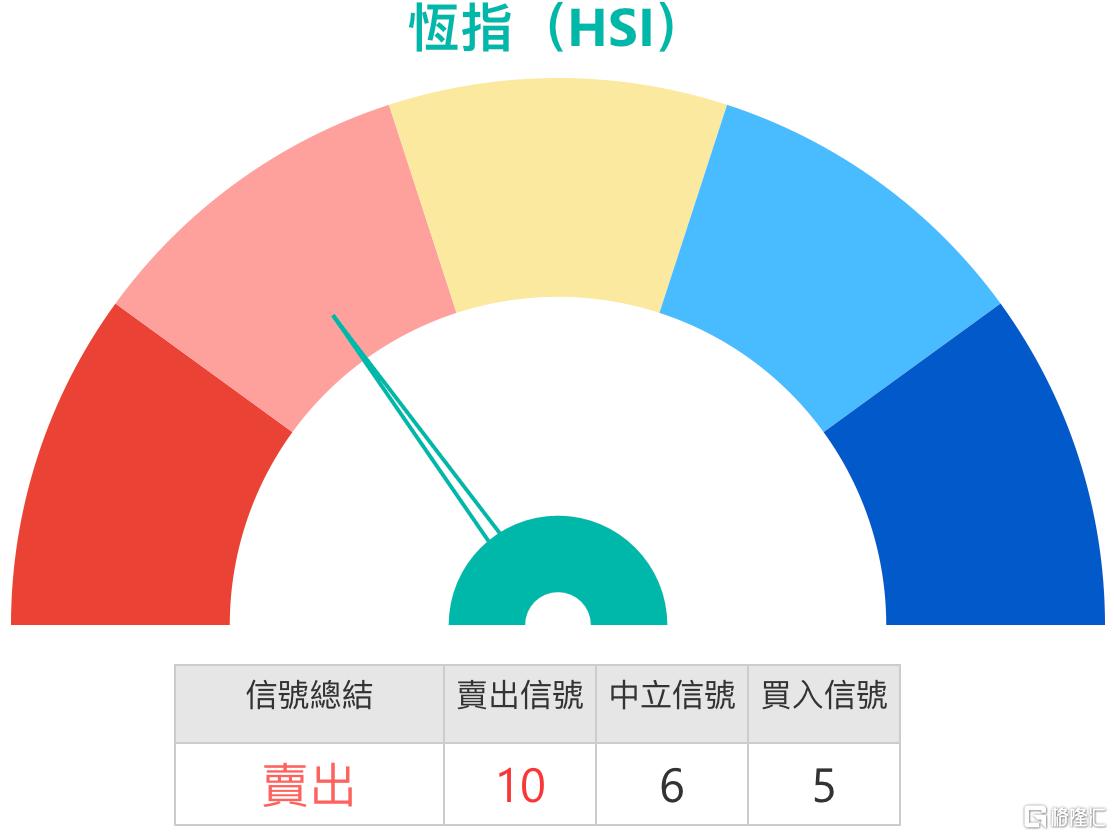
Group 1: Hang Seng Index (HSI) - Bullish investors continue to expect the index to rise to 27,000 points, maintaining their positions in bull certificates with a redemption price of 25,854 points [1][2] - Bearish investors believe the recent small rebound has ended and anticipate a decline of 300-400 points, holding bear certificates with a redemption price of 27,300 points [1][2] - Current technical signals show a predominance of sell signals, with 10 sell signals compared to 5 buy signals, indicating a potentially less optimistic short-term market outlook [2][4] Group 2: Hong Kong Exchanges and Clearing (00388.HK) - The stock price of Hong Kong Exchanges is showing a relatively strong performance, currently trading around 430 HKD, with a potential resistance level at 438 HKD [5] - If the stock can break through the 438 HKD resistance, there is a possibility of reaching 440 HKD [5] - Technical signals indicate a majority of sell signals, with 11 sell signals and 6 buy signals, suggesting a cautious short-term outlook [5][6] Group 3: Yancoal Energy (01171.HK) - Yancoal Energy's stock price has shown strong upward movement, with a significant increase in trading volume [11] - The short-term resistance level is around 11.2 HKD, and if this level is surpassed, the stock could rise to 11.5 HKD [11] - Current technical signals are neutral, indicating no clear direction in the stock's movement [11][15] Group 4: AIA Group (01299.HK) - AIA's stock price has remained relatively stable, with a slight decline, and is currently consolidating at high levels [16] - The resistance level is approximately 89.1 HKD, and if surpassed, the stock could potentially reach 90 HKD or higher [16] - The technical signals are predominantly sell signals, with 10 sell signals and 6 neutral signals, indicating a cautious approach for investors [16][21] Group 5: China Mobile (00941.HK) - China Mobile's stock has experienced increased volatility, currently trading around 81.3 HKD, with a support level at 78.2 HKD [21][22] - If the stock falls below 78.2 HKD, it may decline further to around 74.9 HKD [21][22] - The technical signals are primarily buy signals, with 5 buy signals and 5 sell signals, suggesting some support for bullish positions [22][25] Group 6: Alibaba Group (09988.HK) - Alibaba's stock has seen a notable decline, with increased trading volume during the market downturn [26] - The support level is around 142 HKD, and if breached, the stock could drop to 140 HKD or lower [26] - Although the technical signals indicate a majority buy signals, caution is advised due to the proximity of the redemption price to the support level [26][30]


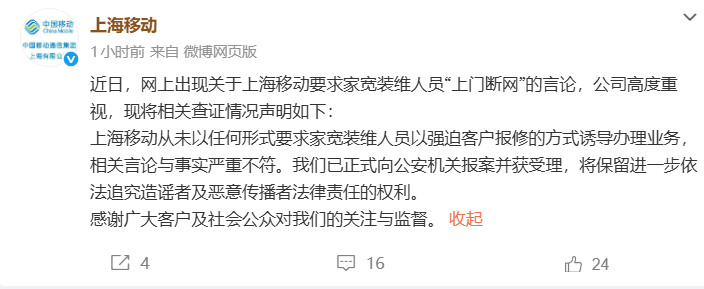
为创收逼迫员工上门断网?上海移动回应:与事实严重不符 已报警
2 1 Shi Ji Jing Ji Bao Dao· 2026-01-08 15:50
Group 1 - The core issue involves allegations against Shanghai Mobile regarding employees being forced to disconnect internet services to boost revenue, which has garnered significant public attention [1] - Shanghai Mobile officially responded on January 8, stating that it has never required its broadband installation and maintenance personnel to induce customers to report repairs in any form, and that such claims are seriously inconsistent with the facts [1] - The company has reported the matter to law enforcement and intends to pursue legal action against those spreading false information [1] Group 2 - A video related to the allegations has been taken down, but some users continue to share screenshots and related content [3]