CSPC PHARMA(01093)

Search documents
港股收评:午后跳水恒指跌1.27%,科技股、金融股普遍弱势!蓝思科技涨8%,快手美团跌超3%,百度网易腾讯跌近2%
Ge Long Hui· 2025-08-27 08:40
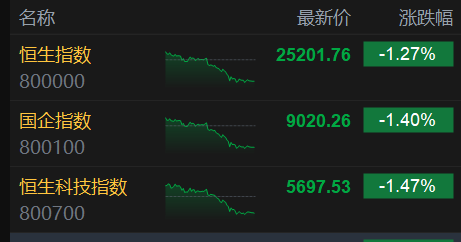
Market Overview - The Hong Kong stock market experienced a significant decline in the afternoon, with the Hang Seng Index dropping by 1.27%, losing over 300 points. The Hang Seng China Enterprises Index and the Hang Seng Tech Index fell by 1.4% and 1.47% respectively, with the former barely holding above the 9000-point mark [2] - Major technology stocks, which serve as market indicators, continued to decline in the afternoon. Kuaishou and Meituan fell over 3%, while JD.com dropped by 2.5%. Baidu, NetEase, and Tencent saw declines close to 2%, and Xiaomi fell by 0.56%. Alibaba managed to stay slightly positive [3] Sector Performance - The financial sector, including banks, insurance companies, and Chinese brokerage firms, collectively underperformed, contributing to the overall market decline. The performance of individual stocks continued to be affected by ongoing earnings reports, with property management and real estate stocks experiencing significant drops [3] - Biopharmaceutical stocks faced a collective downturn, particularly in the innovative drug sector, following comments from Trump regarding the rapid imposition of tariffs on pharmaceuticals. This led to notable declines in various biopharma stocks [3] Specific Stock Movements - Several biopharmaceutical companies saw substantial declines, including Kanghao Ya-B (-8.59%), Qiansirui Biotechnology (-7.42%), and Kangfang Biotechnology (-7.10%). Other notable decliners included Xiansheng Pharmaceutical (-6.79%) and Shiyao Group (-6.36%) [3] - In contrast, the rare earth sector remained strong, benefiting from the implementation of supply reforms and multiple catalysts. Apple’s upcoming event on September 9, where the iPhone 17 series is expected to be launched, led to a rise in Apple-related stocks, with Lens Technology (300433) surging nearly 8% and reaching a new high since its listing [4]





石药集团尾盘跌超7% 肿瘤及神经系统业务下行 二季度收入及净利润均不及预期
Zhi Tong Cai Jing· 2025-08-27 08:04
Core Viewpoint - The stock price of CSPC Pharmaceutical Group (01093) fell over 7% towards the end of trading, reflecting market concerns following the release of disappointing interim results, with a significant decline in revenue and profit [1] Financial Performance - CSPC Pharmaceutical reported total revenue of 13.273 billion RMB for the first half of the year, a year-on-year decrease of 18.5% [1] - The profit attributable to the company's owners was 2.548 billion RMB, down 15.64% year-on-year [1] Market Reaction - The stock price dropped by 6.45% to 9.7 HKD, with a trading volume of 2.213 billion HKD [1] - The market has reacted negatively to the company's second-quarter performance, which fell short of expectations, particularly in the oncology and neurology business lines [1] Analyst Insights - According to a report from CMB International, the company's revenue and net profit in Q2 were below expectations, indicating structural declines in key business areas [1] - The firm downgraded its sales and net profit forecasts for 2025 to 2026 due to weak core business performance and overly optimistic business development expectations [1] - The rating was adjusted to "Neutral," with the target price reduced from 12.9 HKD to 9.3 HKD [1] Future Outlook - The future prospects of CSPC Pharmaceutical are seen as dependent on its commercial collaboration strategy and the commercialization of its pipeline [1] - Market attention is focused on its key asset, SYS6010, but past performance in the development of Class 1 innovative drugs suggests that the company is lagging behind other large pharmaceutical and biotech firms in China [1]
招商证券国际:下调石药集团评级至“中性”目标价降至9.3港元 肿瘤业务逊预期
Zhi Tong Cai Jing· 2025-08-27 08:02
招商证券国际发布研报称,石药集团(01093)今年二季度收入及净利润均不及预期,反映肿瘤和神经系 统业务线的结构性下行,管理层重申EGFR ADC产品(CPO301/SYS6010)为潜在商业发展(BD)催化剂, 但该行认为市场已消化相关预期。招商证券国际下调集团2025至2026年销售及净利润预测,因公司核心 业务表现乏力及BD预期过高,下调评级至"中性"和目标价至9.3港元(原本12.9港元)。 该行表示,展望未来,石药集团的前景取决于商业合作战略及后期管线商业化情况。市场关注其关键资 产SYS6010。然而,回顾石药过去在1.1类创新药物研发的表现,该行认为其在管线临床进展上落后于 中国其他大型制药及部分生物药公司。 鉴于核心业务环比持续下滑,招商证券国际下调集团今明两年的收入和净利润预测,以反映增长及盈利 前景的短期压力,预计2025财年经历深度调整后,2026财年收入将趋于稳定。目标价调整反映盈利调整 及拆股因素,该行根据成药、管线及传统原料药业务的SOTP估值调整目标价,新目标价为9.3港元,分 别对应今明两年19.4倍、17.9倍市盈率。 ...

港股异动 | 石药集团(01093)尾盘跌超7% 肿瘤及神经系统业务下行 二季度收入及净利润均不及预期
智通财经网· 2025-08-27 08:02
Core Viewpoint - The stock price of CSPC Pharmaceutical Group (01093) fell over 7% towards the end of trading, reflecting market concerns following the release of disappointing interim results for the first half of the year [1] Financial Performance - Total revenue for the first half of the year was 13.273 billion RMB, a year-on-year decrease of 18.5% [1] - Profit attributable to shareholders was 2.548 billion RMB, down 15.64% year-on-year [1] Market Reaction - The stock price dropped by 6.45% to 9.7 HKD, with a trading volume of 2.213 billion HKD [1] - The decline in stock price indicates that the market has reacted negatively to the company's financial performance and outlook [1] Analyst Insights - According to a report from CMB International, the second quarter revenue and net profit of CSPC Pharmaceutical did not meet expectations, indicating structural declines in the oncology and neurology business lines [1] - The management reiterated that the EGFR ADC product could be a potential catalyst for business development, but the market has already priced in these expectations [1] - CMB International has lowered its sales and net profit forecasts for 2025 to 2026 due to weak core business performance and overly optimistic business development expectations [1] Future Outlook - The future prospects of CSPC Pharmaceutical depend on its commercial cooperation strategy and the commercialization of its pipeline [1] - Market attention is focused on its key asset SYS6010, but the company has lagged behind other large pharmaceutical and biotech companies in clinical progress for Class 1 innovative drugs [1]
招商证券国际:下调石药集团(01093)评级至“中性”目标价降至9.3港元 肿瘤业务逊预期
智通财经网· 2025-08-27 07:55
智通财经APP获悉,招商证券国际发布研报称,石药集团(01093)今年二季度收入及净利润均不及预期, 反映肿瘤和神经系统业务线的结构性下行,管理层重申EGFR ADC产品(CPO301/SYS6010)为潜在商业 发展(BD)催化剂,但该行认为市场已消化相关预期。招商证券国际下调集团2025至2026年销售及净利 润预测,因公司核心业务表现乏力及BD预期过高,下调评级至"中性"和目标价至9.3港元(原本12.9港 元)。 该行表示,展望未来,石药集团的前景取决于商业合作战略及后期管线商业化情况。市场关注其关键资 产SYS6010。然而,回顾石药过去在1.1类创新药物研发的表现,该行认为其在管线临床进展上落后于 中国其他大型制药及部分生物药公司。 鉴于核心业务环比持续下滑,招商证券国际下调集团今明两年的收入和净利润预测,以反映增长及盈利 前景的短期压力,预计2025财年经历深度调整后,2026财年收入将趋于稳定。目标价调整反映盈利调整 及拆股因素,该行根据成药、管线及传统原料药业务的SOTP估值调整目标价,新目标价为9.3港元,分 别对应今明两年19.4倍、17.9倍市盈率。 ...
港股午后转跌




Di Yi Cai Jing· 2025-08-27 07:14
恒生指数、恒生科技指数双双转跌,华润万象生活跌超8.5%,翰森制药、石药集团、申洲国际、李宁 等均跌4%。 (本文来自第一财经) ...
大行评级|招商证券国际:下调石药集团目标价至9.3港元 评级降至“中性”
Ge Long Hui· 2025-08-27 03:46
展望未来,石药集团的前景取决于商业合作战略及后期管线商业化情况,市场关注其关键资产 SYS6010。然而,回顾石药过去在1.1类创新药物研发的表现,该行认为其在管线临床进展上落后于中 国其他大型制药及部分生物药公司。 招商证券国际发表研究报告指出,石药集团今年二季度收入及净利润均不及预期,反映肿瘤和神经系统 业务线的结构性下行,管理层重申EGFR ADC产品(CPO301/SYS6010)为潜在商业发展(BD)催化剂,但 该行认为市场已消化相关预期。该行下调集团2025至2026年销售及净利润预测,因公司核心业务表现乏 力及BD预期过高,下调评级至"中性",目标价从12.9港元下调至9.3港元。 ...
趋势研判!2025年中国抗流感药物行业产业链、发展背景、市场规模、竞争格局及发展趋势分析:市场竞争日趋激烈[图]
Chan Ye Xin Xi Wang· 2025-08-27 01:20
Overview - The demand for antiviral drugs in China is significantly influenced by the number of influenza cases, with the market size reaching 11 billion yuan in 2023, a year-on-year increase of 150% [1][7] - In 2024, the market size is expected to decrease to 8 billion yuan due to a reduction in influenza cases, with oseltamivir accounting for approximately 78% of the market [1][7] Industry Chain - The upstream of the antiviral drug industry includes suppliers of raw materials such as chemical APIs, traditional Chinese medicine materials, and packaging materials, while the midstream consists of antiviral drug manufacturers, and the downstream includes medical institutions, pharmacies, and e-commerce platforms [4] Development Background - The large population base in China leads to a high susceptibility to influenza, with an estimated 8.59 million cases and 19 deaths in 2024, driving demand for antiviral drugs, especially among the elderly [6][7] - Increased health awareness among the public has led to a greater willingness to purchase antiviral medications during flu season [6] Current Market Situation - The antiviral drug market in China is heavily influenced by influenza case numbers, with a significant expansion in 2023 due to a broader and longer-lasting influenza outbreak compared to pre-COVID-19 times [1][7] - The market is projected to contract in 2024 as influenza cases decline [1][7] Competitive Landscape - The antiviral drug market is currently dominated by neuraminidase inhibitors, with oseltamivir being the primary product, facing increasing competition from generic versions after its patent expired [8][9] - As of August 2025, there are 118 approved oseltamivir products from 69 companies, indicating a highly competitive environment [9] Key Companies - **East Sunshine Pharmaceutical**: Holds a 64.8% market share in the oseltamivir market and a 50.5% share in the overall antiviral market, with a revenue of 4.019 billion yuan in 2024 [10] - **Shijiazhuang Pharmaceutical Group**: Focuses on innovative drugs and reported a revenue of 29.01 billion yuan in 2024, with a gross profit margin of 69.97% [11] Development Trends - The rapid mutation of influenza viruses is driving research towards more effective antiviral drugs with lower resistance rates, particularly RNA polymerase inhibitors [11] - The emergence of innovative domestic drugs is expected to enhance China's position in the global antiviral market, with potential for international expansion of products with independent intellectual property rights [11]

大行评级|美银:上调石药集团目标价至8.1港元 但重申“跑输大市”评级
Ge Long Hui· 2025-08-26 09:18
Core Viewpoint - Bank of America Securities reports that CSPC Pharmaceutical Group's total revenue for the second quarter decreased by 14.3% year-on-year to 6.3 billion yuan, with attributable net profit declining by 24% to 1.1 billion yuan [1] Revenue and Profit Forecasts - The bank has lowered its revenue forecasts for 2025 to 2027 by 25%, 2%, and 11% respectively due to price reductions of core drugs and an increase in the proportion of revenue from raw material products [1] - The gross margin forecast for 2025 has also been reduced, alongside a 42% decrease in the earnings per share (EPS) forecast for 2025 [1] Future Earnings Projections - However, the bank has raised its EPS forecasts for 2026 and 2027 by 32% and 8% respectively [1] Target Price Adjustment - The target price for CSPC Pharmaceutical Group has been adjusted from 6.9 HKD to 8.1 HKD, while maintaining a "underperform" rating due to the price reductions of major drugs [1]
招银国际:料石药集团(01093)持续从药物授权产生收益 上调目标价至12.11港元
Zhi Tong Cai Jing· 2025-08-26 09:17
Core Viewpoint - 招银国际 has raised the target price for 石药集团 (01093) to HKD 12.11, citing continued revenue generation from drug licensing despite a 25% year-on-year decline in core earnings to RMB 12.2 billion for the first half of the year [1][2]. Financial Performance - The core earnings for the second quarter decreased by 22% year-on-year, primarily due to weak sales of 丁苯 (酉太) (NBP), impacted by tighter hospital prescription regulations and the collective procurement of 多美素 and 津优力 [2]. - Management anticipates an improvement in core earnings for the second half of the year, with product sales expected to grow by at least 5% [2]. Licensing and Growth Potential - Since the end of last year, the company has secured six external licensing agreements, with management expecting two more large-scale licenses in the second half, each valued at over USD 5 billion [2]. - The company has established a broad proprietary technology platform, including nanoparticle formulations, antibody-drug conjugates, siRNA, and antibody-fusion proteins, with 40 to 50 assets identified as having licensing potential [2]. - The firm is projected to sustainably generate external licensing revenue in the medium to long term [2].