AGRICULTURAL BANK OF CHINA(01288)

Search documents
二级资本债周度数据跟踪-20260131
Soochow Securities· 2026-01-31 11:00
证券研究报告·固定收益·固收点评 固收点评 20260131 二级资本债周度数据跟踪 (20260126-20260130) [Table_Tag] [Table_Summary] 观点 ◼ 一级市场发行情况: 本周(20260126-20260130)银行间市场及交易所市场无新发行二级资本 债。 ◼ 二级市场成交情况: 本周(20260126-20260130)二级资本债周成交量合计约 2994 亿元,较 上周减少 348 亿元,成交量前三个券分别为 25 中行二级资本债 02BC (179.10 亿元)、25 农行二级资本债 04A(BC)(147.41 亿元)和 25 中行二级资本债 03A(BC)(110.91 亿元)。 分发行主体地域来看,成交量前三为广东省、山东省和山西省,分别约 为 2331 亿元、216 亿元和 140 亿元。 从到期收益率角度来看,截至 1 月 23 日,5Y 二级资本债中评级 AAA-、 AA+、AA 级到期收益率较上周涨跌幅分别为:-1.62BP、-0.15BP、- 1.15BP;7Y 二级资本债中评级 AAA-、AA+、AA 级到期收益率较上周 涨跌幅分别为:3.09B ...


多家银行召开经营管理工作会议为2026年工作“划重点”
Zheng Quan Ri Bao· 2026-01-30 22:49
Core Viewpoint - Multiple banks in China are holding meetings to summarize their 2025 operations and plan for 2026, focusing on high-quality development and aligning with national strategies [1][2]. Group 1: Policy Banks - Policy banks are crucial for implementing national development strategies, with the China Export-Import Bank emphasizing political responsibility and enhancing core competitiveness in overseas operations [1]. - State-owned banks are committed to high-quality development, integrating this focus into all operational processes to support national policies and contribute to the "14th Five-Year Plan" [1]. Group 2: Major Commercial Banks - Major banks are prioritizing their core responsibilities, with the Agricultural Bank of China focusing on supporting rural revitalization and urban-rural integration [2]. - The Bank of China aims to enhance global capabilities in product services, marketing, and compliance, while the China Construction Bank is shifting its focus to support modern industrial systems and high-level opening-up [2]. - Banks like ICBC and Agricultural Bank emphasize the integration of investments in both physical and human capital, while the China Construction Bank is committed to sustainable development and regional coordination [2]. Group 3: Joint-Stock Banks - Joint-stock banks are focusing on leveraging their unique advantages to improve operational efficiency, with Everbright Bank aiming for steady revenue growth and enhanced customer value [3]. - Ping An Bank is focusing on seizing strategic opportunities and integrating technology as a core driver for development [3]. - Risk management remains a priority, with banks emphasizing the importance of a robust asset safety framework and the role of technology in risk prevention and management [3].

2026年如何布局?六大行全面开花,中小银行探求差异化发展路径
Guo Ji Jin Rong Bao· 2026-01-30 16:58
Core Insights - The major state-owned banks and various joint-stock banks in China have held their annual work meetings for 2026, focusing on strategic planning for the upcoming "15th Five-Year Plan" period [1][3] - State-owned banks are adopting a comprehensive layout, while joint-stock banks are pursuing differentiated development based on their strengths [1][5] State-Owned Banks Comprehensive Layout - Six major state-owned banks, including ICBC, CCB, ABC, BOC, PSBC, and BOCOM, have reported stable and positive developments in their 2025 performance, with significant growth in various loan categories [3][4] - Agricultural Bank of China highlighted a continuous increase in county loans, surpassing 10 trillion yuan, and strong growth in personal and small business loans [3] - For 2026, these banks aim to align with the strategic deployment of the 20th National Congress and contribute to the economic and social development goals of the "15th Five-Year Plan" [3][4] Joint-Stock Banks Pursuing Differentiated Development - Joint-stock banks like Everbright Bank, Huaxia Bank, and Ping An Bank are focusing on leveraging their unique advantages for growth [5][6] - Everbright Bank plans to enhance its revenue through specialized financial services and digital transformation [6] - Ping An Bank emphasizes integrating its business with national development strategies and improving operational efficiency while focusing on technology as a core driver [6][7] Regional Banks Focusing on Local Economies - Small and medium-sized banks are concentrating on local economic development and reform initiatives, with many regional banks completing their strategic layouts for 2026 [8][9] - Guangxi Rural Commercial Bank has outlined principles for integrating with local economic development and advancing reforms [9] - Zhejiang Rural Commercial Bank aims to identify key areas for service improvement and enhance its operational efficiency [9]
农业银行:张洪武担任非执行董事任职已生效
Ge Long Hui· 2026-01-30 13:05
格隆汇1月30日丨农业银行(01288.HK)公告,本行收到《国家金融监督管理总局关于张洪武农业银行董 事任职资格的批覆》(金覆[2026]50号)。根据相关规定,张洪武担任本行非执行董事的任职已生效。 ...
农业银行(01288.HK):张洪武担任非执行董事任职已生效
Ge Long Hui· 2026-01-30 13:05
格隆汇1月30日丨农业银行(01288.HK)公告,本行收到《国家金融监督管理总局关于张洪武农业银行董 事任职资格的批覆》(金覆[2026]50号)。根据相关规定,张洪武担任本行非执行董事的任职已生效。 ...
农业银行(01288) - 董事名单与其角色和职能
2026-01-30 12:56
香港交易及結算所有限公司及香港聯合交易所有限公司對本公告的內容概不負責,對其準確性或完整性亦不發表任 何聲明,並明確表示,概不對因本公告全部或任何部份內容而產生或因倚賴該等內容而引致的任何損失承擔任何責 任。 獨立非執行董事 AGRICULTURAL BANK OF CHINA LIMITED 1288 董事名單與其角色和職能 中國農業銀行股份有限公司(「本行」)董事會(「董事會」)成員載列如下。 執行董事 谷 澍 王志恒 劉 洪 林 立 董事會設立7個專門委員會。下表提供各董事會成員在這些委員會中所擔任的職位。 吳聯生 汪昌雲 鞠建東 莊毓敏 張 琦 王沛詩 非執行董事 周 濟 李 蔚 劉曉鵬 張 奇 張洪武 - 1 - | 委員會 | | | 「三農」 | | | 風險 | | | | --- | --- | --- | --- | --- | --- | --- | --- | --- | | | | 戰略規劃 | 金融與 | | | 管理與 | | | | | | 與可持續 | 普惠金融 | 提名與 | | 消費者 | 關聯交易 | 美國區域 | | | | 發展 | 發展 | 薪酬 | 審計 | 權 ...
农业银行(01288) - 委任非执行董事
2026-01-30 12:53
香港交易及結算所有限公司及香港聯合交易所有限公司對本公告的內容概不負責,對其準確性或完整性亦不發表任 何聲明,並明確表示,概不對因本公告全部或任何部份內容而產生或因倚賴該等內容而引致的任何損失承擔任何責 任。 AGRICULTURAL BANK OF CHINA LIMITED 1288 委任非執行董事 茲提述中國農業銀行股份有限公司(「本行」)日期為2025年11月28日的2025年度第二次臨 時股東會(「臨時股東會」)表決結果公告及日期為2025年11月11日的臨時股東會通函。張 洪武先生於臨時股東會上獲選舉為本行非執行董事,待國家金融監督管理總局核准其任 職資格後生效。 張洪武先生的簡歷請參見本行日期為2025年11月11日的臨時股東會通函。 承董事會命 中國農業銀行股份有限公司 劉清 本行收到《國家金融監督管理總局關於張洪武農業銀行董事任職資格的批覆》(金覆[2026] 50號)。根據相關規定,張洪武先生擔任本行非執行董事的任職已生效。 公司秘書 中國北京 2026年1月30日 於本公告日期,本行的執行董事為谷澍先生、王志恒先生、劉洪先生和林立先生;本行的非執行董事為周濟女士、 李蔚先生、劉曉鵬先生、 ...
黄金市场风险抬升 国有大行调整黄金积存业务
Sou Hu Cai Jing· 2026-01-30 11:47
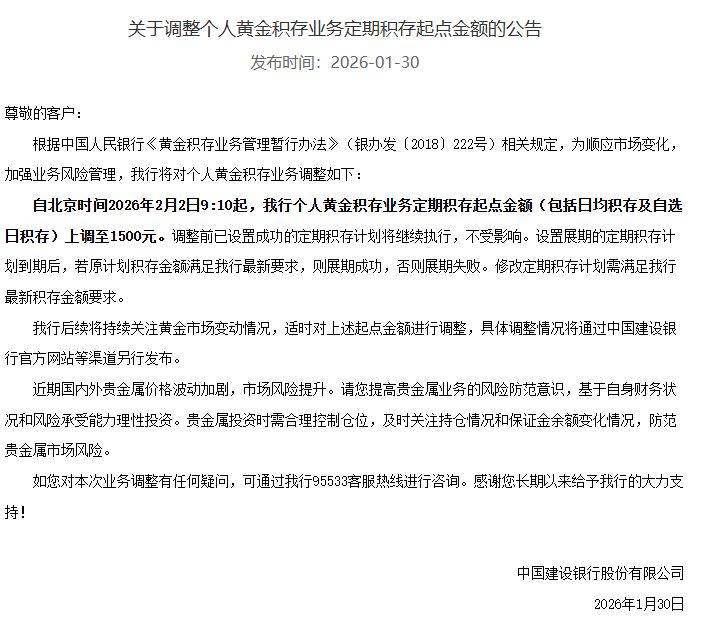
Core Viewpoint - The recent adjustments in personal gold accumulation business by major state-owned banks indicate a response to market volatility and risk management, as gold prices have experienced significant fluctuations recently [1][3][11]. Group 1: Bank Adjustments - China Construction Bank has raised the minimum amount for personal gold accumulation to 1500 yuan, effective February 2, 2026, following similar adjustments by other major banks [1][3]. - Agricultural Bank of China has implemented a risk assessment requirement for clients engaging in gold accumulation transactions, effective January 30, 2026, to enhance consumer protection [7][8]. - Industrial and Commercial Bank of China has also adjusted its risk assessment criteria for clients participating in gold accumulation, requiring a balanced risk profile or higher starting January 12, 2026 [8]. Group 2: Market Trends - Gold prices have seen a significant drop, with a daily decline of over 5% on January 30, 2026, as the market begins to adjust after a period of strong price increases [9][11]. - The international gold price rose approximately 65% throughout 2025, but has started to show signs of correction in early 2026, indicating a potential shift in market dynamics [10][11]. - Analysts suggest that the current gold price increase reflects a broader change in how global risks are priced, with expectations that gold could reach 6000 USD per ounce in the long term, despite short-term volatility [12].

农业银行(601288) - 农业银行关于非执行董事任职的公告
2026-01-30 11:45
中国农业银行股份有限公司 关于非执行董事任职的公告 中国农业银行股份有限公司董事会及全体董事保证本公告内容不存在任何虚假 记载、误导性陈述或者重大遗漏,并对其内容的真实性、准确性和完整性承担法律 责任。 证券代码:601288 证券简称:农业银行 公告编号:临 2026-001 号 中国农业银行股份有限公司董事会 2026 年 1 月 30 日 1 中国农业银行股份有限公司(以下简称"本行")收到《国家 金融监督管理总局关于张洪武农业银行董事任职资格的批复》(金 复〔2026〕50 号)。根据相关规定,张洪武先生担任本行非执行董 事的任职已生效。 张洪武先生的简历请参见本行 2025 年 11 月 11 日刊载于上海证 券交易所网站(www.sse.com.cn)的《中国农业银行股份有限公司 2025 年度第二次临时股东会会议资料》。 特此公告。 ...
又一家大行上调黄金积存业务门槛!
第一财经· 2026-01-30 10:40
Core Viewpoint - The article discusses the recent increase in gold price volatility and the corresponding adjustments made by major banks in China to their gold accumulation business, reflecting a heightened focus on risk management in response to market changes [3][4]. Group 1: Bank Adjustments - China Construction Bank announced an increase in the minimum amount for personal gold accumulation business to 1500 yuan, effective February 2, 2026, following previous increases from 700 yuan to 800 yuan and then to 1000 yuan in 2025 [3]. - Agricultural Bank of China has added risk tolerance assessment requirements for personal customers participating in gold accumulation transactions starting January 30, 2026 [4]. - Industrial and Commercial Bank of China raised the risk assessment level for personal customers from "C1-Conservative" to "C3-Balanced" as of January 12, 2026, and increased the minimum amount for its gold accumulation business from 1000 yuan to 1100 yuan on January 8, 2026 [4]. Group 2: Market Conditions - The international gold price experienced a significant drop starting January 29, 2026, after a period of continuous increase, leading to increased market volatility [3]. - Construction Bank has advised customers to enhance their risk awareness regarding precious metals investments due to the heightened market risks and to manage their positions and margin balances carefully [3].