
AGRICULTURAL BANK OF CHINA(01288)

Search documents
智通港股通持股解析|1月1日




智通财经网· 2026-01-01 00:35
Core Insights - The top three companies by stockholding ratio in the Hong Kong Stock Connect are China Telecom (71.90%), GCL-Poly Energy (69.96%), and Da Zhong Public Utilities (68.75%) [1][2] - The companies with the largest increase in stockholding over the last five trading days include SMIC (+1.092 billion), China Merchants Bank (+1.052 billion), and Hong Kong Exchanges and Clearing (+790 million) [1][2] - The companies with the largest decrease in stockholding over the last five trading days include China Mobile (-3.216 billion), Tencent Holdings (-1.107 billion), and the Tracker Fund of Hong Kong (-465 million) [1][2] Stockholding Ratios - China Telecom (00728) holds 99.79 million shares with a stockholding ratio of 71.90% [2] - GCL-Poly Energy (01330) holds 28.3 million shares with a stockholding ratio of 69.96% [2] - Da Zhong Public Utilities (01635) holds 36.7 million shares with a stockholding ratio of 68.75% [2] - Other notable companies in the top 20 include China Shenhua (66.39%) and China Merchants Energy (64.43%) [2] Recent Trading Activity - The top three companies with increased holdings in the last five trading days are: - SMIC (00981): +1.092 billion, +15.28 million shares [2][3] - China Merchants Bank (03968): +1.052 billion, +19.92 million shares [2][3] - Hong Kong Exchanges and Clearing (00388): +790 million, +1.93 million shares [2][3] - The top three companies with decreased holdings in the last five trading days are: - China Mobile (00941): -3.216 billion, -39.36 million shares [2][3] - Tencent Holdings (00700): -1.107 billion, -1.84 million shares [2][3] - Tracker Fund of Hong Kong (02800): -465 million, -18.01 million shares [2][3]
银行:银行2026年展望:稳中求进
2025-12-31 16:02
Summary of the Conference Call Transcript Industry Overview - The banking sector is entering a phase of high-quality development, with a focus on absolute and relative returns from bank stocks, driven by high dividend yields and asset quality [3][4][20]. Key Points Financial Performance Projections - Expected revenue growth for listed banks in 2026 and 2027 is +2.5% and +3.6% respectively, with net profit growth of +1.9% and +2.6% [4][20]. - Revenue and profit growth are anticipated to improve due to: 1. Narrowing net interest margin pressure 2. Quality-focused credit issuance amid weak demand [4][20]. 3. Stabilization of fee income growth after several years of fee reductions [4][20]. 4. Stable or improving net non-performing loan generation rates [4][11]. 5. Accelerated supply-side reforms leading to a reduction in the number of bank licenses, improving competition and operational landscape [4][11]. Customer Demand and Market Dynamics - The low-interest-rate environment has shifted customer demand, with government and state-owned enterprises becoming significant contributors to leverage, affecting the structure of new social financing [5][10]. - Regulatory policies are influencing the development of inclusive finance, focusing on risk compensation rather than merely increasing customer numbers [5][10]. Risk Factors - Risks associated with real estate developers and retail sectors are highlighted, with potential for greater-than-expected exposure [6][11]. Profitability and Valuation Adjustments - Adjustments to profitability forecasts for 2025 and 2026 have been made, with a focus on net interest income recovery and fee income growth [20][21]. - The expected net interest margin for 2026 is projected to be approximately 1.34%, a decrease of 6 basis points from 2025 [21][22]. - Fee income is expected to grow by 3.6% and 4.9% in 2026 and 2027 respectively, indicating a positive trend in non-interest income [21][22]. Asset Quality and Credit Costs - The net non-performing loan generation rate is expected to stabilize or slightly decline, with structural characteristics of retail and corporate lending continuing [11][21]. - Credit costs are projected to remain stable at around 0.58% for 2026 and 2027, reflecting the balance between corporate and household debt servicing capabilities [21][22]. Investment Recommendations - The report suggests a continued positive outlook for bank stocks, emphasizing the importance of dividend yield and asset quality in investment decisions [3][4][20]. Additional Insights - The banking sector is undergoing a transformation towards high-quality development, with a shift in focus from scale to quality, driven by macroeconomic pressures and regulatory changes [12][20]. - The reduction in the number of banking licenses over the past five years indicates successful risk management efforts within the sector [11][12]. - The report emphasizes the need for banks to adapt their strategies to maintain competitiveness in a changing regulatory and economic environment [12][20].




“每天要加十几个,完不成扣钱或加班”!银行员工为企业微信考核伤脑筋,有人去电商买量,还有同行发帖求“互加”
Mei Ri Jing Ji Xin Wen· 2025-12-31 13:40
Core Viewpoint - Banks are increasingly implementing performance assessments based on the addition of clients on enterprise WeChat, reflecting the pressure on retail banking amid declining revenues and profits in the sector [1][17]. Group 1: Performance Assessment and Pressure - Many banks have set specific targets for adding clients on enterprise WeChat, with some requiring customer managers to add up to 100 clients per month, leading to significant pressure on employees [4][6]. - Employees are sharing their enterprise WeChat QR codes on social media to meet these targets, often incentivized by monetary rewards or penalties for failing to meet the requirements [2][5]. - The assessment mechanisms include strict monitoring and penalties, such as deductions from salaries for not meeting the required number of added clients [6][9]. Group 2: Rationale Behind Enterprise WeChat Adoption - The push for enterprise WeChat is partly to prevent "client privatization," ensuring that client relationships remain with the bank rather than individual employees [9][10]. - Banks view enterprise WeChat as a tool for unified client management, allowing for better data collection and analysis of customer behavior and preferences [9][10]. - The financial industry is facing rising customer acquisition costs, making effective client engagement through platforms like enterprise WeChat increasingly important [10][17]. Group 3: Challenges and Misconceptions - There are significant challenges in the implementation of enterprise WeChat, including the perception that the current assessment system is flawed and does not effectively utilize the platform's potential [13][16]. - Many employees express concerns about the quality of interactions with clients, often resorting to generic content that fails to engage customers meaningfully [15][16]. - The focus on quantitative metrics, such as the number of added clients, often overshadows the need for qualitative interactions that drive actual business results [16][17]. Group 4: Retail Banking Performance - Retail banking is experiencing a downturn, with many banks reporting declines in retail revenue and profits compared to the previous year [17][18]. - Specific banks, such as Ping An Bank and Zhejiang Commercial Bank, have seen significant drops in retail revenue, with some experiencing double-digit declines [18]. - Despite some banks reporting growth in retail profits, this is often due to low comparative bases from the previous year, indicating underlying challenges in the retail banking sector [19][20]. Group 5: Success Stories and Future Outlook - Some banks have successfully leveraged enterprise WeChat to enhance customer engagement, with notable increases in client activity and retention rates [20][21]. - For instance, the Industrial and Commercial Bank of China reported significant growth in the number of clients added through enterprise WeChat, leading to improved customer engagement metrics [20][22]. - The ongoing digital transformation in banking emphasizes the need for effective use of platforms like enterprise WeChat to drive profitability and customer satisfaction [10][17].



又一国有大行浙江省分行原行长落马
第一财经· 2025-12-31 13:18
Core Viewpoint - The article discusses the ongoing anti-corruption efforts within China's financial sector, highlighting the recent investigation of Cheng Jun, the president of Bank of China Zhejiang Branch, for serious violations of discipline and law, marking a significant trend in the scrutiny of high-ranking officials in state-owned banks [3][4]. Group 1: Investigations and Trends - Cheng Jun is the 211th central-level official investigated in 2025, a decrease from 257 in 2024, indicating a tightening of scrutiny on high-ranking officials [3]. - Cheng is the fifth former president of a state-owned bank's Zhejiang branch to be investigated in recent years, following several others who faced similar allegations of serious violations [4]. - In 2025, a total of 65 central management officials were investigated, surpassing the 58 from the previous year, while 722 provincial management officials were also scrutinized [5]. Group 2: Broader Anti-Corruption Efforts - The 20th Central Commission for Discipline Inspection's fourth plenary session emphasized the importance of deepening anti-corruption efforts in 2025, which is seen as a crucial year for the completion of the 14th Five-Year Plan [5]. - In 2024, disciplinary bodies across the country investigated 73 provincial-level and above officials, 4,348 bureau-level officials, 35,000 county-level officials, and 121,000 township-level officials, reflecting a comprehensive approach to tackling corruption [5].



中行、工行、农行、建行、交行、邮储银行集体官宣:这笔钱要计利息!
Mei Ri Jing Ji Xin Wen· 2025-12-31 12:20
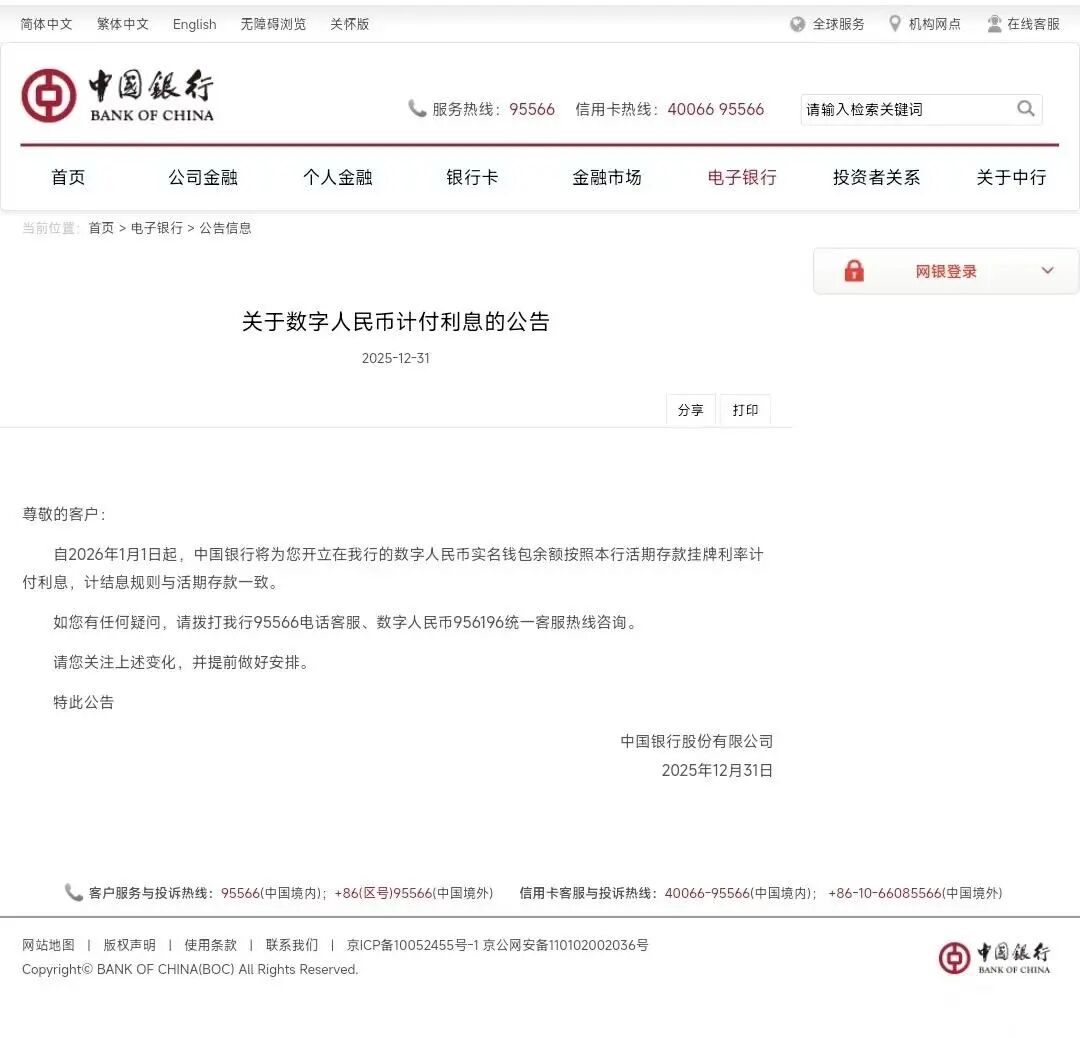
Core Viewpoint - Starting from January 1, 2026, six major state-owned banks in China will begin to pay interest on the balances of digital RMB real-name wallets at the same rate as their current deposit rates, following the same interest calculation rules as regular savings accounts [1][10]. Group 1: Announcement Details - The six banks involved are the Bank of China, Industrial and Commercial Bank of China, Agricultural Bank of China, China Construction Bank, Bank of Communications, and Postal Savings Bank [1]. - The current interest rate for regular savings accounts is noted to be 0.05% [10]. - Interest will be calculated quarterly, with the interest credited to accounts on the 21st of each quarter's last month [10]. Group 2: Wallet Types and Interest Eligibility - Digital RMB wallets are categorized into four types: Type 1, Type 2, and Type 3 are real-name wallets eligible for interest, while Type 4 is an anonymous wallet that does not earn interest [10][12]. - Type 1 wallets require in-person verification and must be linked to a domestic bank account, while Type 2 and Type 3 wallets can be opened remotely with varying identification requirements [12][13][14]. - The new definition of digital RMB indicates a shift from being classified as M0 (cash) to being recognized as a form of deposit currency, allowing for interest accrual [11][12].

商业银行综合竞争力评价报告发布 助力银行业高质量发展
Zhong Guo Jing Ji Wang· 2025-12-31 11:55
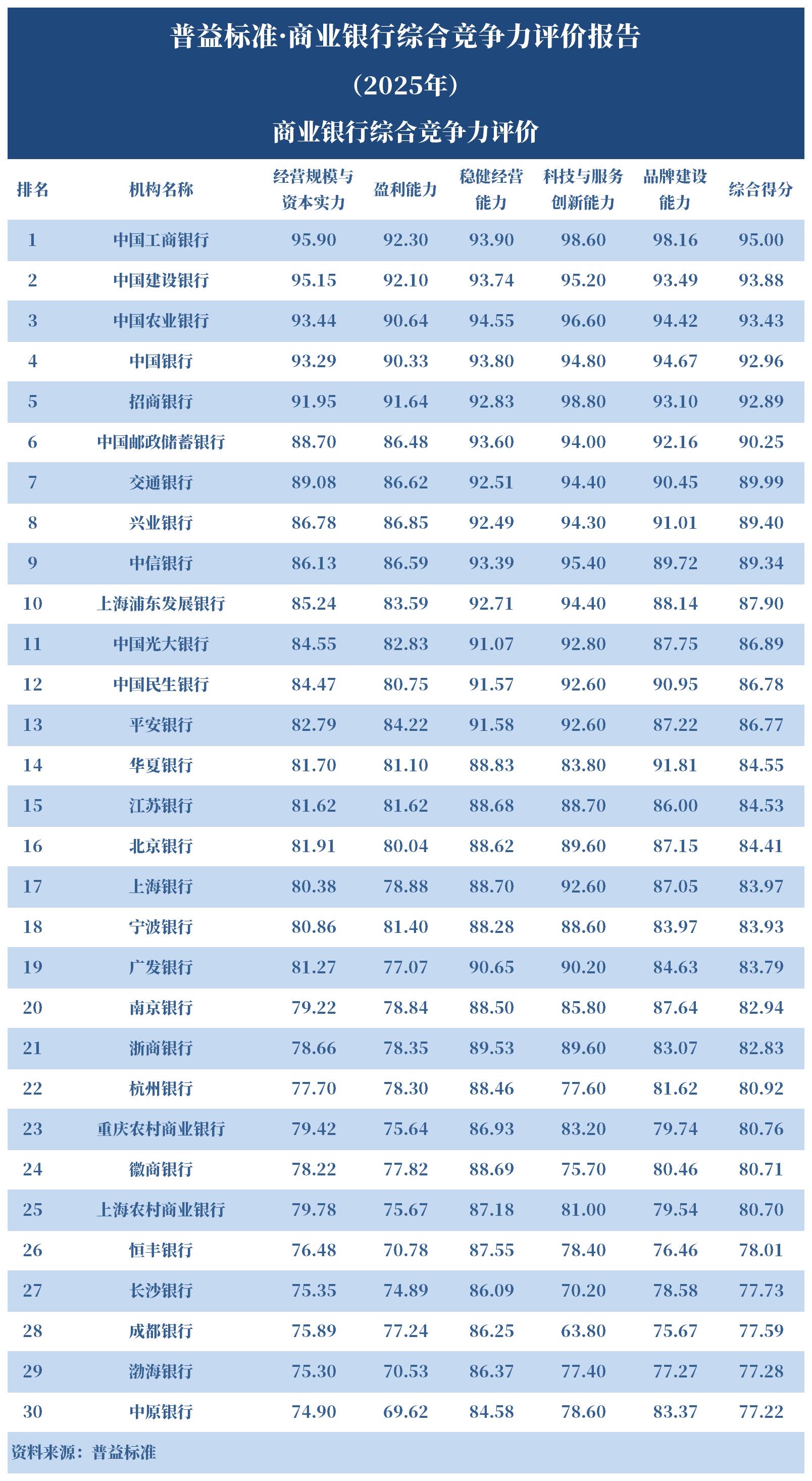
Core Insights - The operating logic of commercial banks is undergoing a profound transformation, facing challenges such as narrowing net interest margins and diverse risk sources, while also seizing strategic opportunities from digital transformation and service model upgrades [1] - The "Comprehensive Competitiveness Evaluation Index System for Commercial Banks" was officially released, aiming to provide a scientific and comprehensive measure of banks' real performance and competitive status in the context of high-quality development [1] Group 1: Evaluation Framework - The evaluation system includes five core modules: operational scale and capital strength, profitability, sound operational capability, technological and service innovation capability, and brand building capability [1] - This framework covers the entire chain from resource support to performance output, risk control compliance to innovation-driven growth, and short-term operations to long-term value [1] Group 2: High-Quality Development - Experts emphasize that high-quality development for commercial banks must move beyond reliance on asset scale growth, focusing instead on stable, endogenous growth under capital constraints [2] - Banks are encouraged to optimize their asset structures and allocate credit resources to strategic national priorities and high-quality customer segments [2] Group 3: Profitability Challenges - The narrowing of net interest margins has become a new normal, necessitating the construction of more resilient and diversified profit models [2] - Banks should strategically accelerate the development of wealth management, investment banking, and transaction finance, which have lower capital consumption and higher customer stickiness [2] Group 4: Technology Investment Evaluation - There is an unprecedented scale of investment in technology resources within the banking sector, requiring a mechanism to evaluate the conversion of technology input into business value [3] - A comprehensive evaluation mechanism should consider the impact of technology on internal management efficiency and external business benefits [3] Group 5: Competitiveness Rankings - The rankings of commercial banks based on their operational scale, profitability, and sound operational capability have been published, with the Industrial and Commercial Bank of China leading in all three categories [4][5][6] - The top five banks in terms of operational scale and capital strength are: 1. Industrial and Commercial Bank of China - 95.90 2. China Construction Bank - 95.15 3. Agricultural Bank of China - 93.44 4. Bank of China - 93.29 5. China Merchants Bank - 91.95 [4][5]
工行、农行、中行、建行、交行、邮储,集体宣布
21世纪经济报道· 2025-12-31 11:44
Core Viewpoint - The digital renminbi will officially end its "interest-free era" as major state-owned banks announce that starting January 1, 2026, the balance in real-name digital renminbi wallets will earn interest based on the current deposit rate [1][4][10]. Group 1: Digital Renminbi Interest Policy - Six major state-owned banks, including ICBC, ABC, BOC, CCB, BOCOM, and PSBC, will implement interest payments on digital renminbi wallet balances according to the current deposit rate starting January 1, 2026 [1][4]. - The interest will be calculated based on the People's Bank of China's regulations for current deposits, with interest credited quarterly [3][4]. - The introduction of this interest policy is part of the People's Bank of China's action plan to enhance the management and service system for digital renminbi [4][10]. Group 2: Transition to Digital Deposit Currency - The implementation of the interest policy marks the transition of digital renminbi from a "digital cash" model to a "digital deposit currency" model [10]. - Previously, digital renminbi was classified as M0, similar to cash, and did not earn interest, limiting its attractiveness compared to bank deposits [10]. - With the new policy, digital renminbi will be treated as a liability of commercial banks, allowing it to support credit activities and deposit expansion mechanisms, thus enhancing its monetary elasticity [10][11]. Group 3: Current Status and Future Prospects - As of November 2025, digital renminbi has processed 3.48 billion transactions with a total transaction amount of 16.7 trillion yuan [8]. - The digital renminbi is being tested in various scenarios, including daily consumption and government services, and is expanding into cross-border payment initiatives [7][8]. - The future digital renminbi will be a modern digital payment and circulation tool, supported by the central bank and possessing attributes of commercial bank liabilities [10][11].

数字人民币迎来升级!2026年1月1日起,实名钱包余额开始计息
Xin Lang Cai Jing· 2025-12-31 11:37
建设银行指出,自2026年1月1日起,该行数字人民币实名钱包余额将按照该行活期存款挂牌利率计付利 息,计结息规则与活期存款一致,并相应修订《中国建设银行数字人民币钱包个人客户服务协议》相关 内容。该行也在公告中介绍到,数字人民币是指中国人民银行发行的法定数字货币和相关支付体系,采 用双层运营架构,由中国人民银行向数字人民币业务运营机构发行,再由数字人民币业务运营机构兑换 给公众。自2026年1月1日起,数字人民币钱包(不含四类钱包)中的钱包余额按照中国人民银行规定的 活期存款计结息规则计付利息,并由乙方依法代扣代缴利息税(如有)。 2026年1月1日起,数字人民币实名钱包余额将开始计付利息。 12月31日,工行、农行、建行、交行、邮储银行等国有银行公布了数字人民币钱包余额计息的规则。 工商银行、农业银行、邮储银行表示,为数字人民币实名钱包余额按照活期存款挂牌利率计付利息,计 结息规则与活期存款一致;交通银行表示,自2026年1月1日起,交通银行将数字人民币实名钱包(包含 一类、二类、三类个人钱包和单位钱包)余额,按照该行公布的活期存款挂牌利率计付利息。如用户开 立的数字人民币钱包为四类个人钱包,则钱包内的余额 ...

六大行官宣 2026年起数字人民币按活期利率计息
Di Yi Cai Jing· 2025-12-31 10:57
Group 1 - From January 1, 2026, digital RMB real-name wallet balances will earn interest based on the current demand deposit rate set by the banks [1] - The current demand deposit rate is 0.05% as per the announcements from major banks [1] - Digital RMB wallets are categorized into four types, with only real-name wallets (Type 1, 2, and 3) eligible for interest, while anonymous wallets (Type 4) do not earn interest [1] Group 2 - There are currently 10 designated operating institutions for digital RMB, including six state-owned commercial banks, two joint-stock commercial banks, and two internet banks [2] - The People's Bank of China is working on expanding the number of operating institutions for digital RMB [2] - A new action plan has been issued by the central bank to enhance the management service system and financial infrastructure for digital RMB, set to be implemented on January 1, 2026 [2]

农行济南泉城支行:精准识别风险 守护客户资金安全
Qi Lu Wan Bao· 2025-12-31 10:31
Core Insights - Agricultural Bank of China (ABC) successfully assisted a corporate client in identifying and avoiding a high-risk transaction, ensuring the safety of the company's funds [1] Group 1: Risk Management - ABC's Jinan Quancheng Branch demonstrated strong risk insight and a responsible service attitude by investigating an unusual transaction involving a commercial acceptance bill [1] - The staff's vigilance led to the discovery that the counterparty's account was flagged as a high money laundering risk account, prompting immediate action [1] Group 2: Client Interaction - Upon identifying the risk, ABC promptly informed the client about potential financial safety and legal compliance risks, leading the client to halt the transaction [1] - The client expressed high appreciation for the professionalism and meticulousness of ABC's employees in handling the situation [1] Group 3: Commitment to Consumer Protection - The incident highlights ABC's proactive and effective approach to protecting financial consumer rights, reinforcing their commitment to risk monitoring and client safety [1] - ABC aims to strengthen risk monitoring and create a secure financial environment for its clients [1]