
AGRICULTURAL BANK OF CHINA(01288)

Search documents
农行内蒙古分行:金融创新服务农牧民增收致富
Zhong Guo Jin Rong Xin Xi Wang· 2025-12-31 06:55
Core Insights - Agricultural Bank of Inner Mongolia has played a crucial role in enhancing the income of farmers and herdsmen through financial services, innovative products, and optimized service models, resulting in a loan balance of 79.2 billion yuan and an annual increase of 14.1 billion yuan as of the end of October this year [1] Group 1: Support for Farmers - The bank has provided targeted financial support to entrepreneurs like Shi Jian, who transformed his livestock business by investing in quality breeding and modern farming techniques, leading to significant economic benefits [2][3] - Shi Jian received a loan of 5 million yuan from Agricultural Bank, which alleviated his financial pressure and supported his business expansion [3] Group 2: Innovation in Traditional Industries - The unique fermented mare's milk product, known as "Cegge," has gained popularity due to its health benefits, leading to the establishment of standardized production facilities by local herders [4] - The bank supported the expansion of a local mare's milk producer, Sai Henqi Mu Ge, with a loan of 500,000 yuan, enabling the upgrade of production equipment and facilities, resulting in annual sales exceeding 2 million yuan and increased income for surrounding herders [4]

三大行集体公告数字钱包生息机制,数字人民币告别“无息时代”
2 1 Shi Ji Jing Ji Bao Dao· 2025-12-31 06:42
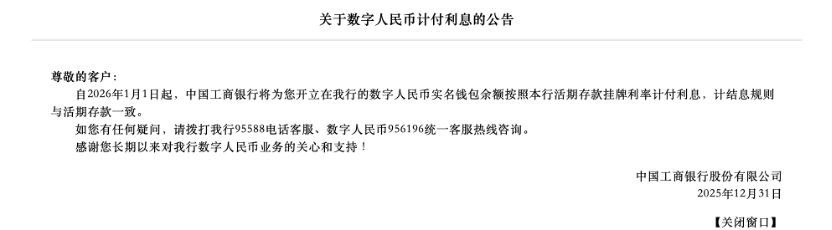
Core Viewpoint - The digital renminbi will officially end its "interest-free era" as of January 1, 2026, with major banks announcing that interest will be paid on the balances of real-name digital renminbi wallets based on the current deposit rates [1][6][10]. Group 1: Interest Payment Policy - Starting January 1, 2026, the balance in real-name digital renminbi wallets will earn interest according to the People's Bank of China's current deposit interest rate [6][7]. - The interest calculation will follow the same rules as regular savings accounts, with interest credited on the 21st of each quarter [6][10]. - Balances in anonymous wallets will not earn interest, maintaining a distinction between different wallet types [6][10]. Group 2: Transition to Digital Deposit Currency - The implementation of the interest payment policy marks the transition from "digital cash" to "digital deposit currency," indicating a significant evolution in the digital renminbi's role [7][10]. - The digital renminbi will now be considered a liability of commercial banks, allowing it to earn interest and be subject to deposit insurance, similar to traditional bank deposits [10]. - This change enhances the monetary elasticity of the digital renminbi, enabling it to support credit activities and deposit expansion mechanisms [10]. Group 3: Background and Development - The policy change is part of a broader initiative by the People's Bank of China to strengthen the management and service system for digital renminbi [7]. - The digital renminbi has been in development for over ten years, expanding its pilot programs from select cities to entire provinces [8]. - As of November 2025, the digital renminbi has processed 3.48 billion transactions, amounting to 16.7 trillion yuan, indicating significant adoption and usage [9].




多家银行官宣:2026年1月1日起,为数字人民币实名钱包余额计付利息
Bei Jing Shang Bao· 2025-12-31 05:25
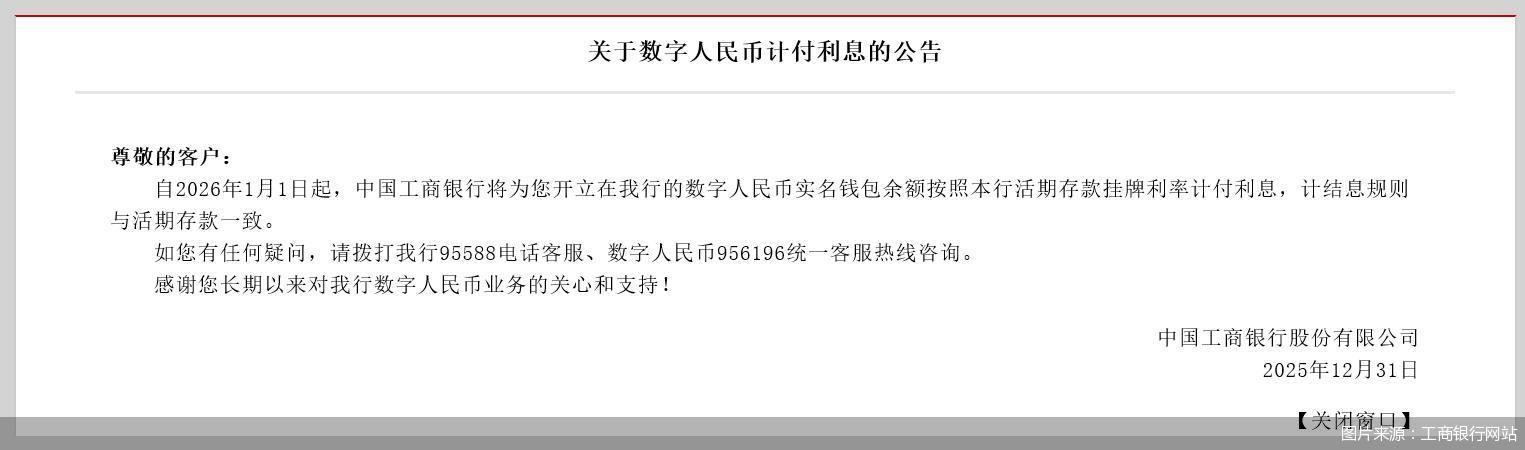
Core Viewpoint - Major Chinese banks including Industrial and Commercial Bank of China, Agricultural Bank of China, Postal Savings Bank of China, Bank of Communications, and China Construction Bank will start paying interest on digital RMB wallet balances at the same rate as current deposit rates from January 1, 2026, marking a significant transition in the digital currency landscape in China [1][4][5] Group 1: Bank Announcements - Industrial and Commercial Bank of China, Agricultural Bank of China, and Postal Savings Bank of China will apply interest to digital RMB wallet balances according to the current deposit rate, with interest calculation rules consistent with those for current deposits [4] - Bank of Communications will also apply the current deposit rate to digital RMB wallet balances, including various types of personal and corporate wallets, while balances in type four wallets will not earn interest [4] - China Construction Bank will revise its customer service agreement to reflect that digital RMB wallet balances will earn interest based on the current deposit rate starting January 1, 2026 [4] Group 2: Digital RMB Framework - The People's Bank of China has introduced a plan to enhance the management and service system for digital RMB, which will officially implement a new measurement framework and operational mechanism on January 1, 2026 [5] - This transition signifies a shift from the "digital cash era" to the "digital deposit currency era" after a decade of research and pilot programs [5]

中国农业银行董事长谷澍:提升AI应用普惠性的若干思考
Zhong Guo Jin Rong Xin Xi Wang· 2025-12-31 03:11
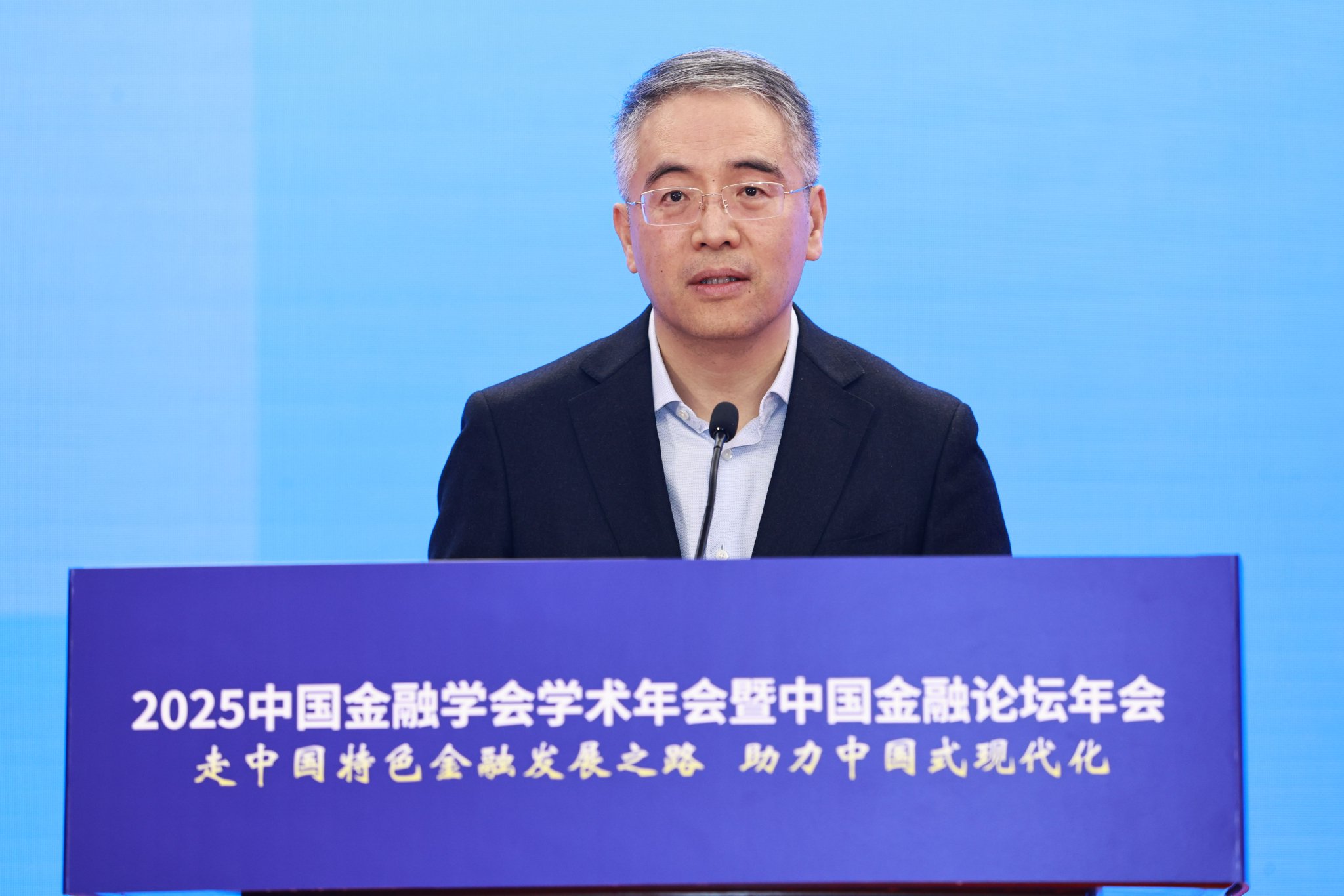
转自:新华财经 谷澍 (2025年12月6日) 谢谢晓慧副会长的介绍。 尊敬的各位来宾,首先借这个机会,感谢各位领导、各位同仁对农业银行的帮助和支持! 党的二十届四中全会审议通过的"十五五"规划建议,8次提及"人工智能",指出要全面实施"人工智能+"行动,全方位赋能千行百业。今年8月,国务院印发 的《关于深入实施"人工智能+"行动的意见》明确要通过"三步走",不断提升新一代智能终端、智能体等应用普及率。金融业应主动融入"人工智能+"发展进 程,当好提升AI应用普惠性的践行者,推动技术创新与业务应用深度融合。当前,人工智能技术迭代演进速度非常快,下一步往哪个方向发展、发展成什 么样,难以形成统一的共识。但普惠是人类始终应当坚持的价值取向。今天我想就提升AI应用的普惠性,谈几点体会。 提升AI应用普惠性的路径,我认为有四方面问题需要考虑。 在12月6日举行的2025中国金融学会学术年会暨中国金融论坛年会上,中国金融学会理事会副会长,中国农业银行董事长谷澍发表"提升AI应用普惠性的若干 思考"主题演讲。 全文如下: 提升AI应用普惠性的若干思考 —在中国金融学会学术年会暨中国金融论坛年会上的发言 从发展趋势看,随着 ...
智通港股沽空统计|12月31日
智通财经网· 2025-12-31 00:24
Group 1 - The core point of the news highlights the top short-selling stocks in the market, with Hang Seng Bank-R, Sun Hung Kai Properties-R, and Lenovo Group-R leading in short-selling ratios at 100% each [1][2] - Alibaba-W, China Merchants Bank, and Baidu Group have the highest short-selling amounts, with figures of 1.242 billion, 1.018 billion, and 746 million respectively [1][2] - The deviation values for Hang Seng Bank-R, Hong Kong Exchanges-R, and Alibaba-W are the highest, recorded at 61.59%, 55.31%, and 48.34% respectively [1][2] Group 2 - The top ten short-selling ratio rankings show that Hang Seng Bank-R, Sun Hung Kai Properties-R, and Lenovo Group-R all have a short-selling ratio of 100% [2] - The top ten short-selling amounts list indicates Alibaba-W leading with 1.242 billion, followed by China Merchants Bank at 1.018 billion and Baidu Group at 746 million [2] - The top ten deviation values list features Hang Seng Bank-R with a deviation of 61.59%, followed by Hong Kong Exchanges-R at 55.31% and Alibaba-W at 48.34% [2]



“消失”的银行监事长
Shang Hai Zheng Quan Bao· 2025-12-30 19:26
Core Viewpoint - The bank supervisory board system, in operation for nearly 30 years, is approaching its end as banks begin to abolish this structure in favor of audit committees, following new regulations from the China Securities Regulatory Commission (CSRC) and the Financial Regulatory Bureau [2][3][4]. Regulatory Framework for Reform - The new Company Law, effective from July 2024, allows financial institutions to replace supervisory boards with audit committees, fundamentally changing the requirement for supervisory boards as mandatory entities [3][4]. - The Financial Regulatory Bureau has issued policies that support the transition, allowing financial institutions to choose between retaining supervisory boards or establishing audit committees to perform supervisory functions [3][4]. Differences in Implementation - There is a differentiation in the approach to abolishing supervisory boards between listed and non-listed banks, with listed banks required to eliminate supervisory boards by 2026, while non-listed banks have the option to retain them [4][5]. - Major state-owned banks have already initiated the process of abolishing supervisory boards, with the five largest banks voting to remove them in April 2025 [5]. Effectiveness and Challenges of Supervisory Boards - The supervisory board has been criticized for its lack of independence, professionalism, and efficiency, often leading to overlapping functions and ineffective oversight [6][7]. - The costs associated with maintaining a supervisory board are significant, with estimates suggesting that listed banks could save millions annually by abolishing this structure [7]. Transition Paths for Supervisory Board Members - Former supervisory board members may transition to roles within the audit committee, take on positions in other financial institutions, or retire from the industry [8]. - The governance mechanism is expected to become more efficient, with fewer decision-making layers and a more direct oversight structure through audit committees [8].




农行陕西省分行:542亿金融活水“贷”动美丽乡村建设
Zhong Guo Jin Rong Xin Xi Wang· 2025-12-30 10:10
Core Insights - The article highlights the transformation of rural areas in Xi'an's Huoyi District, showcasing the impact of financial support from Agricultural Bank of China (ABC) on local businesses and the overall rural revitalization effort [1][2]. Group 1: Financial Support and Impact - ABC has introduced various financial tools to support rural revitalization, significantly aiding small and micro enterprises like "Huayang Guoba" [1]. - The price of palm oil used by "Huayang Guoba" surged from over 8,000 yuan/ton to 19,000 yuan/ton, creating financial strain, which was alleviated by a loan from ABC [1]. - ABC's "Huinong e-loan" program has been pivotal in helping small businesses navigate financial challenges, thereby enhancing local living standards [1]. Group 2: Growth of Local Industries - The hospitality sector, particularly homestays, has seen significant growth, with operators like Geng Shusen investing over 2 million yuan in renovations [2]. - ABC's "no principal renewal loan" policy has extended loan terms from one year to three years, providing essential flexibility for business adjustments [2]. - As of December 20, the loan balance for farmers from ABC in Shaanxi Province reached 54.2 billion yuan, with an annual increase of 13 billion yuan, reflecting strong support for local industries [2].
强化主动合规、突出源头预防 农业银行持续加强全链条合规治理
Zhong Guo Xin Wen Wang· 2025-12-30 07:04
Group 1 - The core viewpoint of the articles emphasizes the commitment of Agricultural Bank to enhance its compliance management system and risk prevention mechanisms to support high-quality development [1][3] - Agricultural Bank is actively implementing regulatory requirements by revising its compliance management basic system and optimizing its compliance management processes, aiming to establish a clear and effective compliance governance structure [1][2] - The bank is focusing on cultivating a strong compliance culture through a series of initiatives, including education and the promotion of compliance best practices, to foster a legal and disciplined environment [2] Group 2 - Agricultural Bank is prioritizing proactive compliance management by establishing differentiated internal control standards and enhancing its internal control prevention system to address key risk points [2] - The bank is committed to integrating compliance into all decision-making and operational processes, aligning with the directives from the 20th Central Committee and the Central Economic Work Conference [3]
农行陕西省分行推动农户贷款助力乡村振兴
Zheng Quan Ri Bao Wang· 2025-12-30 06:48
Group 1 - The product "Huayang Guoba" has gained significant popularity on Douyin, with consumers reportedly waiting 1.5 hours to purchase it [1] - The product is produced by Huayang Food Factory in Xi'an, which has been operating for 17 years and relies heavily on financial support for its operations [1] - The factory's daily cash flow requirement is at least 150,000 yuan, highlighting the financial pressures faced by small businesses in the food industry [1] Group 2 - Agricultural Bank of China Shaanxi Branch has prioritized rural revitalization, focusing on industrial development as a key aspect of this initiative [2] - By December 20, 2025, the bank's agricultural loan balance is projected to exceed 50 billion yuan, with a current balance of 54.2 billion yuan, reflecting a year-on-year increase of 13 billion yuan [2] - The bank has implemented four marketing strategies for agricultural loans, resulting in a customer base increase of 27,000 households in the past year [2] Group 3 - The bank has established a strong presence in rural financial services, with 127 branches having agricultural loan balances exceeding 100 million yuan [3] - There are 40 branches with loan balances over 500 million yuan, and 54 branches have seen an annual increase of over 100 million yuan in loan balances [3] - The bank aims to enhance its services to support rural industries, improve farmers' livelihoods, and promote sustainable rural development [3]
精准滴灌外贸企业 助力稳住外贸基本盘——农行青岛分行“优汇服务惠千家”专项行动成效显著
Xin Lang Cai Jing· 2025-12-30 06:19
Group 1 - The core viewpoint of the articles emphasizes the efforts of Agricultural Bank of China (ABC) Qingdao Branch in implementing the "优汇服务惠千家" initiative to support foreign trade enterprises through enhanced financial services and policy promotion [1][2][3] Group 2 - ABC Qingdao Branch has adopted a customer-centric approach, focusing on demand-driven services and leveraging technology to provide precise support in key areas such as policy dissemination, exchange rate risk management, international settlement, and financing support [1] - The branch has increased its outreach through various channels, including online platforms and offline activities, to promote foreign exchange policies and facilitate trade [1] - A significant achievement includes the processing of cross-border RMB facilitation business amounting to 138 billion yuan, representing a 23% year-on-year increase, and trade foreign exchange receipts and payments facilitation business of 5 billion USD, with a 25% year-on-year growth [1] - The bank has launched digital services for capital project business, including online capital project services and applications for cross-border financial service platforms, enhancing customer remittance efficiency [2] - The focus on small and micro foreign trade enterprises has led to the promotion of credit insurance financing, with 900 million yuan in short-term credit insurance financing processed, marking a 25% increase [2] - ABC Qingdao Branch aims to provide high-quality, efficient, and convenient financial services to foreign trade enterprises, contributing to the economic development of Qingdao [3]