
AIA(01299)

Search documents
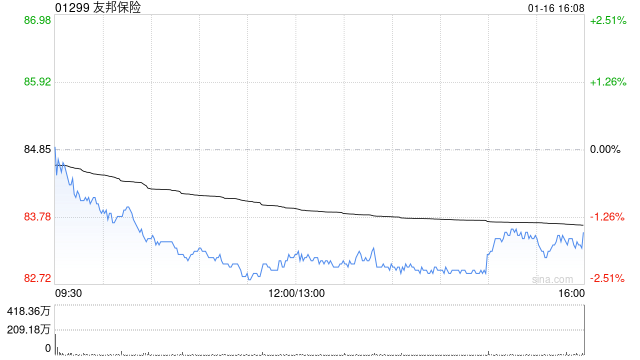
友邦保险获贝莱德增持约2686.93万股 每股作价约83.76港元
Xin Lang Cai Jing· 2026-01-18 08:52
Core Viewpoint - BlackRock has increased its stake in AIA Group Limited (01299) by acquiring approximately 26.87 million shares at a price of HKD 83.7565 per share, totaling around HKD 2.25 billion, resulting in a new holding of approximately 744 million shares, representing a 7.08% ownership stake [1]. Group 1 - BlackRock's acquisition of shares indicates a strong confidence in AIA Group's future performance [1]. - The total investment made by BlackRock amounts to approximately HKD 2.25 billion [1]. - Following the purchase, BlackRock's total shareholding in AIA Group has reached approximately 744 million shares [1].

智通ADR统计 | 1月17日
智通财经网· 2026-01-16 23:57
Group 1 - Major blue-chip stocks mostly declined, with HSBC Holdings closing at HKD 128.695, up 0.15% from the previous close in Hong Kong; Tencent Holdings closed at HKD 612.833, down 0.76% [2] - Tencent Holdings reported a latest price of HKD 617.500, with a decrease of HKD 4.500 or 0.72%; its ADR price is HKD 612.833, reflecting a decline of HKD 4.667 [3] - HSBC Holdings had a latest price of HKD 128.500, increasing by HKD 0.300 or 0.23%; its ADR price is HKD 128.695, showing a slight increase of HKD 0.195 [3] Group 2 - Other notable stocks include China Construction Bank at HKD 7.830, down 0.25%, and Xiaomi Group at HKD 37.100, down 2.01% [3] - AIA Group saw a decline of HKD 1.300 or 1.53%, closing at HKD 83.550; its ADR price is HKD 83.075, down HKD 0.475 [3] - Meituan-W closed at HKD 100.000, down 0.79%, while JD.com saw a decrease of HKD 1.500 or 1.30%, closing at HKD 113.600 [3]




贝莱德增持友邦保险约2686.93万股 每股作价约83.76港元
Zhi Tong Cai Jing· 2026-01-16 11:26
Group 1 - BlackRock increased its stake in AIA Group Limited (01299) by 26,869,334 shares at a price of HKD 83.7565 per share, totaling approximately HKD 2.25 billion [1] - Following the increase, BlackRock's total shareholding in AIA is approximately 744 million shares, representing a stake of 7.08% [1]
贝莱德增持友邦保险(01299)约2686.93万股 每股作价约83.76港元
智通财经网· 2026-01-16 11:24
Group 1 - BlackRock increased its stake in AIA Group Limited (01299) by acquiring 26,869,334 shares at a price of HKD 83.7565 per share, totaling approximately HKD 2.25 billion [1] - Following the acquisition, BlackRock's total shareholding in AIA Group is approximately 744 million shares, representing a stake of 7.08% [1]
以专业守护民生健康 用责任践行金融担当——专访友邦人寿保险有限公司江苏分公司总经理杨东强
Sou Hu Cai Jing· 2026-01-16 05:53
Core Viewpoint - The financial industry in China is transitioning from scale expansion to quality and efficiency improvement, driven by factors such as technological independence, green transformation, aging population, and external competition [1] Group 1: Aging Population and Pension Finance - The aging population and increasing awareness of retirement planning have made pension finance a crucial aspect of the insurance industry, contributing to high-quality economic development [3] - AIA Life Insurance has positioned itself as a benchmark in the foreign life insurance sector, focusing on a comprehensive health and pension protection system [3] - The company aims to become the leading brand in pension finance in Jiangsu by enhancing its strategic investment in this area and strengthening its professional capabilities [3][4] Group 2: Policy Support and Market Response - The "14th Five-Year Plan" emphasizes the need for a robust pension finance system, with commercial insurance playing a vital role in innovation and development [4] - AIA Life has actively engaged in promoting personal pension products, becoming one of the most effective entities in this area since the introduction of tax-advantaged policies [4][5] - By October 2025, AIA Jiangsu had provided personal pension protection to nearly 38,000 residents, with a total coverage exceeding 4.4 billion [5] Group 3: Product Innovation and Market Strategy - AIA Life has launched new pension products, including the "AIA Legacy Annuity Insurance" and "AIA Future 2025," designed to provide stable cash flow for retirement [5][6] - The company emphasizes the importance of risk prevention and the social value of insurance products, which serve as a safety net for families and society [6] - AIA Life's product offerings include customizable medical insurance and innovative critical illness plans, addressing the evolving needs of clients [7] Group 4: Talent Development and Professional Services - The company has initiated a "Pension Planner" program in collaboration with universities to enhance the professional capabilities of its workforce [8] - AIA Jiangsu focuses on attracting high-quality talent and providing systematic training to improve expertise in pension finance and policy interpretation [8] - The goal is to create a team that understands policies, clients, and services, facilitating comprehensive pension planning solutions [8] Group 5: Long-term Vision and Market Position - AIA Life is prepared to leverage the opportunities presented by the "15th Five-Year Plan," aiming to solidify its role as a stabilizing force in the economy and society [9] - The company’s commitment to long-termism and continuous investment in pension finance and traditional insurance products is central to its growth strategy [9][10] - AIA Jiangsu aims to enhance its service capabilities and industry influence through product innovation, talent development, and financial education [10]
智通ADR统计 | 1月15日
智通财经网· 2026-01-14 22:41
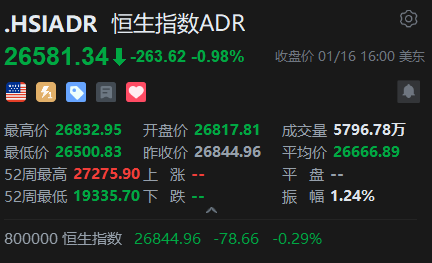
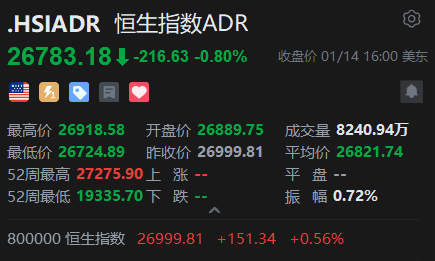
Market Overview - The Hang Seng Index (HSI) closed at 26,783.18, down by 216.63 points or 0.80% as of January 14, 16:00 Eastern Time [1] - The index reached a high of 26,918.58 and a low of 26,724.89 during the trading session, with a trading volume of 82.41 million [1] Major Blue-Chip Stocks Performance - HSBC Holdings closed at HKD 127.501, up by 0.39% compared to the Hong Kong close [2] - Tencent Holdings closed at HKD 632.594, down by 0.06% compared to the Hong Kong close [2] Stock Price Movements - Tencent Holdings (00700) latest price is HKD 633.000, with an increase of HKD 5.500 or 0.88%, but its ADR price is HKD 632.594, showing a decrease of HKD 0.406 [3] - Alibaba Group (09988) latest price is HKD 169.000, up by HKD 9.100 or 5.69%, with an ADR price of HKD 165.595, down by HKD 3.405 [3] - HSBC Holdings (00005) latest price is HKD 127.000, up by HKD 0.600 or 0.47%, with an ADR price of HKD 127.501, up by HKD 0.501 [3] - Other notable movements include Meituan (03690) down by 3.24% and Ctrip Group (09961) down by 6.49% [3]


智通ADR统计 | 1月14日
智通财经网· 2026-01-13 22:43
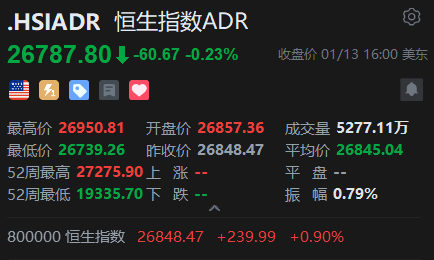
Core Viewpoint - The Hang Seng Index (HSI) experienced a slight decline, closing at 26,787.80, down 0.23% from the previous close, indicating a mixed performance in the Hong Kong stock market [1]. Group 1: Market Performance - The Hang Seng Index closed at 26,787.80, down 60.67 points or 0.23% [1]. - The index reached a high of 26,950.81 and a low of 26,739.26 during the trading session, with a trading volume of 52.77 million shares [1]. - The average price for the session was 26,845.04, with a 52-week high of 27,275.90 and a low of 19,335.70 [1]. Group 2: Major Blue-Chip Stocks - HSBC Holdings closed at HKD 127.188, up 0.62% compared to the previous close [2]. - Tencent Holdings closed at HKD 624.864, down 0.42% from the previous close [2]. - Alibaba Group saw a price increase of 3.63%, closing at HKD 159.900 [3]. - Other notable performances include AIA Group up 0.84% at HKD 84.400 and China Construction Bank up 1.17% at HKD 7.810 [3].

汇丰前主席杜嘉祺继续担任该行顾问,驻留时间超出原计划
Ge Long Hui A P P· 2026-01-13 12:57
Core Viewpoint - Former HSBC Chairman Mark Tucker will continue to serve as an advisor to the bank beyond the originally planned timeframe, while also taking on the role of Chairman at AIA Group [1] Group 1 - Mark Tucker's dual roles have raised questions about potential conflicts of interest, but AIA representatives assert that his external activities are appropriately regulated and disclosed [1] - HSBC spokesperson confirmed that Tucker's continued advisory role complies with all governance and disclosure requirements [1]
友邦人寿董事长张晓宇入选“2025年度寿险行业十大杰出人物”
Sou Hu Cai Jing· 2026-01-13 09:45
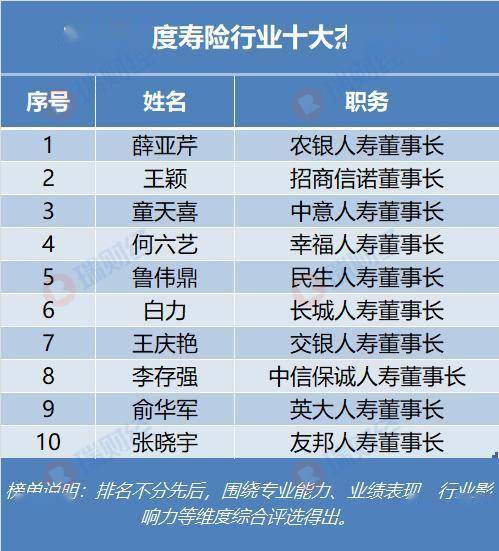
Core Viewpoint - The "Top Ten Outstanding Figures in the Life Insurance Industry for 2025" list has been released, highlighting key leaders based on professional ability, performance, and industry influence [1]. Group 1: Industry Recognition - The list includes notable figures such as Zhang Xiaoyu, Chairman of AIA Life Insurance, who has been recognized for his contributions to the industry [1]. - The ranking is not in any particular order and is based on a comprehensive evaluation of various dimensions including professional capability and industry impact [1]. Group 2: Zhang Xiaoyu's Profile - Zhang Xiaoyu, born in 1976, holds a master's degree in applied mathematics from Fudan University and is a certified actuary in North America [2]. - He joined AIA Insurance in 2000 and has held various positions, including Chief Executive Officer for the China region, overseeing operations and management [2]. - Under his leadership, the company has achieved steady net profit growth and established an independent asset management company to enhance fund management capabilities [2].
大行评级|瑞银:重申友邦“买入”评级 新业务价值可保持合理持续增长
Ge Long Hui· 2026-01-13 08:13
Group 1 - UBS report indicates that AIA Group's new business value is expected to maintain a growth rate of approximately 15% to 17%, which is deemed reasonable and sustainable [1] - Key drivers for this growth include a high single-digit increase in active agents, continuous improvement in agent productivity, and additional upside potential from distribution channels such as bancassurance and brokerage [1] - UBS reiterates a "Buy" rating for AIA with a target price set at HKD 88 [1] Group 2 - Goldman Sachs expresses an optimistic outlook for AIA's growth prospects in the mainland and Hong Kong markets, maintaining a "Buy" rating [2] - DBS has raised AIA's target price to HKD 106 [2]