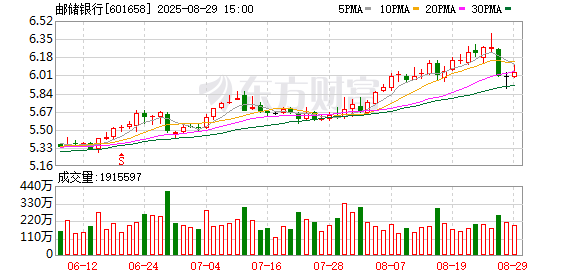
PSBC(01658)

Search documents
邮储银行(01658) - 海外监管公告 监事会决议公告
2025-08-29 08:46
香港交易及結算所有限公司及香港聯合交易所有限公司對本公告的內容概不負責,對其準確性 或完整性亦不發表任何聲明,並明確表示,概不對因本公告全部或任何部份內容而產生或因倚 賴該等內容而引致的任何損失承擔任何責任。 POSTAL SAVINGS BANK OF CHINA CO., LTD. 1658 海外監管公告 監事會決議公告 本公告乃根據《香港聯合交易所有限公司證券上市規則》第13.10(B)條作出。如下公 告已於上海證券交易所網站刊登,僅供參閱。 特此公告。 承董事會命 中國郵政儲蓄銀行股份有限公司 杜春野 聯席公司秘書 中國,北京 2025年8月29日 於本公告日期,本行董事會包括董事長及非執行董事鄭國雨先生;執行董事劉建軍先生及姚紅 女士;非執行董事韓文博先生、劉新安先生、張宣波先生、劉瑞鋼先生、胡宇霆先生、丁向明 先生及余明雄先生;獨立非執行董事溫鐵軍先生、鍾瑞明先生、潘英麗女士、唐志宏先生、洪 小源先生及楊勇先生。 * 中國郵政儲蓄銀行股份有限公司並非一家根據銀行業條例(香港法例第155章)之認可機 構,並不受限於香港金融管理局的監督,亦不獲授權在香港經營銀行及╱或接受存款業 務。 证券代码:601 ...
邮储银行(01658) - 2025 - 中期业绩
2025-08-29 08:45
Overview [Definitions](index=4&type=section&id=Definitions) This section defines key terms used in the report, including "The Bank/PSBC/Postal Savings Bank of China," "China Post Group," and "The Group," along with professional terms like "China Accounting Standards" and "International Financial Reporting Standards," ensuring clear understanding of the report content - "The Bank / PSBC / Postal Savings Bank of China" refers to Postal Savings Bank of China Co., Ltd. and its subsidiaries and branches[16](index=16&type=chunk) - "China Post Group" refers to China Post Group Corporation Limited, the controlling shareholder of the Bank[16](index=16&type=chunk) [Company Profile](index=6&type=section&id=Company%20Profile) The Bank's history dates back to 1919, established in 2007, and listed on HKEX and SSE in 2016 and 2019 respectively, serving over 670 million individual customers - The Bank has a long history, tracing back to postal savings business in 1919, established in 2007, restructured into a joint-stock company in 2012, and listed on HKEX in 2016 and SSE in 2019[20](index=20&type=chunk) - The Bank is a leading large retail bank in China, committed to serving "Sannong" (agriculture, rural areas, and farmers), urban and rural residents, and small and medium-sized enterprises, with nearly **40,000 business outlets** and serving over **670 million individual customers**[20](index=20&type=chunk) [Strategic Positioning and Corporate Culture](index=7&type=section&id=Strategic%20Positioning%20and%20Corporate%20Culture) The Bank aims to build a first-class large retail bank and a leading digital ecological bank serving rural revitalization and new urbanization, guided by a mission of "creating value for customers" - The strategic goal is to build a first-class large retail bank that is trusted by customers, distinctive, stable, secure, innovation-driven, and value-driven[23](index=23&type=chunk) - The strategic vision is to build a leading digital ecological bank serving rural revitalization and new urbanization, empowering high-quality development with FinTech[23](index=23&type=chunk) - The corporate spirit emphasizes "responsibility, resilience, and warmth," with values including "creating value for customers," "integrity as the foundation of business," and "enduring through stability"[23](index=23&type=chunk) [Basic Information of the Company](index=8&type=section&id=Basic%20Information%20of%20the%20Company) This section provides the Bank's basic registration details, legal representatives, contact information, registered and office addresses, stock listing information, and legal advisors - The legal Chinese name is Postal Savings Bank of China Co., Ltd., with Zheng Guoyu as the legal representative and Liu Jianjun as the President[24](index=24&type=chunk) - The A-share stock abbreviation is "PSBC," code **601658**, listed on the Shanghai Stock Exchange; the H-share stock abbreviation is "PSBC," code **1658**, listed on The Stock Exchange of Hong Kong Limited[25](index=25&type=chunk) [Financial Highlights](index=10&type=section&id=Financial%20Highlights) As of June 30, 2025, the Bank achieved robust growth in total assets, customer loans, and deposits, with stable operating income and net profit, maintaining excellent asset quality and meeting capital adequacy requirements Key Financial Data for H1 2025 | Indicator | June 30, 2025 (RMB trillion yuan) | Growth from end of previous year | | :--- | :--- | :--- | | Total Assets | 18.19 | 6.47% | | Total Customer Loans | 9.54 | 6.99% | | Total Liabilities | 17.05 | 6.21% | | Customer Deposits | 16.11 | 5.37% | | **Profitability (RMB billion yuan)** | | | | Operating Income | 1,795.25 | 1.47% year-on-year | | Net Profit | 494.15 | 1.08% year-on-year | | Net Fee and Commission Income | 169.18 | 11.59% year-on-year | | **Asset Quality (%)** | | | | Non-performing Loan Ratio | 0.92 | | | Provision Coverage Ratio | 260.35 | | | **Capital Adequacy Ratio (%)** | | | | Capital Adequacy Ratio | 14.57 | Increased by 0.13 percentage points from end of previous year | | Common Equity Tier 1 Capital Adequacy Ratio | 10.52 | Increased by 0.96 percentage points from end of previous year | - The Bank actively contributes to the "Five Key Areas of Finance," with **technology loan balance exceeding 930 billion yuan**, **agricultural-related loan balance of 2.44 trillion yuan**, **green loan balance of 958.639 billion yuan**, and **over 10 million individual pension fund accounts**[29](index=29&type=chunk) [Overview of Operations](index=16&type=section&id=Overview%20of%20Operations) During the reporting period, the Bank's total assets and liabilities reached new highs, business structure transformation accelerated, profitability grew steadily, asset quality remained sound, and a successful A-share private placement strengthened capital, driving strategic upgrades - **Total assets exceeded 18 trillion yuan**, reaching **18.19 trillion yuan**; **total liabilities exceeded 17 trillion yuan**, reaching **17.05 trillion yuan**[42](index=42&type=chunk) - Loans increased by **622.982 billion yuan** in the first half, a year-on-year increase of **113.113 billion yuan**, with retail loans growing by **1.86%** and corporate loans by **14.83%**[43](index=43&type=chunk) - Net profit attributable to bank shareholders was **49.228 billion yuan**, a year-on-year increase of **0.85%**; operating income was **179.525 billion yuan**, a year-on-year increase of **1.47%**. Non-interest income contribution increased, with net fee and commission income growing by **11.59%** year-on-year and other non-interest income growing by **24.72%** year-on-year[44](index=44&type=chunk) - The non-performing loan ratio was **0.92%**, and the provision coverage ratio was **260.35%**, indicating sufficient risk coverage capability[45](index=45&type=chunk) - Successfully completed an A-share private placement of **130 billion yuan**, with a capital adequacy ratio of **14.57%** and a Common Equity Tier 1 capital adequacy ratio of **10.52%**, effectively enhancing the ability to serve the real economy and resist risks[45](index=45&type=chunk) - Actively promoting the "Five Major Initiatives" including "Serving Strong Counties and Rich Towns," "Urban Business Breakthrough," "Branch Efficiency Enhancement," "Corporate Business Improvement," and "Mobile Banking Comprehensive Breakthrough," along with "Seven Major Reforms"[50](index=50&type=chunk) Discussion and Analysis [Environment and Outlook](index=21&type=section&id=Environment%20and%20Outlook) In H1 2025, global economic growth slowed amid geopolitical conflicts and rate cuts, while China's economy remained stable; the Bank plans to continue steady progress, serve national strategies, and deepen reforms - In the first half of 2025, global economic growth momentum was insufficient, trade barriers increased worldwide, major developed economies entered a rate-cutting cycle, and international financial market volatility intensified[58](index=58&type=chunk) - China's economy maintained stable and progressive operations, with more proactive macroeconomic policies, moderately loose monetary policy, and stable banking sector operations[58](index=58&type=chunk) - In the second half, the Bank will resolutely shoulder its responsibilities as a large state-owned bank, accelerate high-quality development, fully promote reform, innovation, and transformation, and firmly maintain the bottom line of business development[59](index=59&type=chunk)[60](index=60&type=chunk)[61](index=61&type=chunk) [Financial Statement Analysis](index=22&type=section&id=Financial%20Statement%20Analysis) During the reporting period, the Bank achieved stable business growth with total assets of 18.19 trillion yuan and customer loans of 9.54 trillion yuan, maintained stable profitability with operating income of 179.525 billion yuan and net profit of 49.415 billion yuan, and sustained good asset quality with an NPL ratio of 0.92% and a provision coverage ratio of 260.35% - As of the end of the reporting period, **total assets reached 18.19 trillion yuan**, an increase of **6.47%** from the end of the previous year; **total customer loans were 9.54 trillion yuan**, an increase of **6.99%** from the end of the previous year[62](index=62&type=chunk) - During the reporting period, operating income reached **179.525 billion yuan**, a year-on-year increase of **1.47%**; net profit was **49.415 billion yuan**, a year-on-year increase of **1.08%**[62](index=62&type=chunk) - The non-performing loan ratio was **0.92%**, and the provision coverage ratio was **260.35%**, maintaining good asset quality[62](index=62&type=chunk) [Income Statement Analysis](index=22&type=section&id=Income%20Statement%20Analysis) Net profit increased by 1.08% to 49.415 billion yuan, driven by significant growth in net fee and commission income and other non-interest income, despite a decline in net interest income due to rate changes, while operating expenses decreased and credit impairment losses rose Key Income Statement Items Changes for H1 2025 | Item | Jan-Jun 2025 (RMB million yuan) | Jan-Jun 2024 (RMB million yuan) | Change (RMB million yuan) | Change (%) | | :--- | :--- | :--- | :--- | :--- | | Net Interest Income | 139,058 | 142,876 | (3,818) | (2.67) | | Net Fee and Commission Income | 16,918 | 15,161 | 1,757 | 11.59 | | Other Net Non-interest Income | 23,549 | 18,882 | 4,667 | 24.72 | | Operating Income | 179,525 | 176,919 | 2,606 | 1.47 | | Operating Expenses | 99,808 | 107,372 | (7,564) | (7.04) | | Credit Impairment Losses | 21,715 | 16,120 | 5,595 | 34.71 | | Net Profit | 49,415 | 48,885 | 530 | 1.08 | | Net Profit Attributable to Bank Shareholders | 49,228 | 48,815 | 413 | 0.85 | - The decrease in net interest income was mainly due to the reduction in LPR and adjustments to existing mortgage rates, leading to a decline in interest-earning asset yields, though partially offset by scale growth. Net interest margin and net interest spread were **1.70%** and **1.69%**, respectively[66](index=66&type=chunk) - Savings agency fees and other expenses decreased by **8.91%** year-on-year, primarily driven by the Bank's proactive adjustment of savings agency fee rates for RMB individual deposit business[96](index=96&type=chunk) [Balance Sheet Analysis](index=30&type=section&id=Balance%20Sheet%20Analysis) As of the reporting period, total assets grew by 6.47% to 18.19 trillion yuan, with net customer loans at 9.31 trillion yuan; total liabilities increased by 6.21% to 17.05 trillion yuan, driven by customer deposits; and total shareholders' equity rose by 10.58% to 1.14 trillion yuan, primarily due to an A-share private placement Key Balance Sheet Items as of June 30, 2025 | Item | Amount (RMB million yuan) | Proportion (%) | Growth from end of previous year (%) | | :--- | :--- | :--- | :--- | | Total Assets | 18,190,521 | 100.00 | 6.47 | | Net Customer Loans | 9,309,437 | 51.18 | 7.20 | | Financial Investments | 6,170,869 | 33.92 | 2.78 | | Total Liabilities | 17,049,715 | 100.00 (of Total Liabilities) | 6.21 | | Customer Deposits | 16,108,809 | 94.48 (of Total Liabilities) | 5.37 | | Total Shareholders' Equity | 1,140,806 | 6.27 (of Total Assets) | 10.58 | - Total customer loans were **9,536.184 billion yuan**, an increase of **622.982 billion yuan** from the end of the previous year, growing by **6.99%**. Individual loans grew by **1.86%**, and corporate loans grew by **14.83%**[110](index=110&type=chunk)[116](index=116&type=chunk)[119](index=119&type=chunk) - Among financial investments, bond investments were **4,778.29 billion yuan**, an increase of **3.03%** from the end of the previous year; interbank certificates of deposit were **465.629 billion yuan**, an increase of **10.93%** from the end of the previous year[122](index=122&type=chunk) - The increase in total shareholders' equity was mainly due to the issuance of A-shares to the Ministry of Finance, China Mobile Communications Group Co., Ltd., and China State Shipbuilding Corporation Limited[148](index=148&type=chunk) [Cash Flow Statement Analysis](index=40&type=section&id=Cash%20Flow%20Statement%20Analysis) During the reporting period, net cash inflow from operating activities increased by 52.767 billion yuan to 183.699 billion yuan, while net cash outflow from investing activities decreased significantly, and financing activities shifted from net outflow to net inflow of 66.968 billion yuan due to interbank CD and A-share issuances Key Cash Flow Changes for H1 2025 | Item | H1 2025 (RMB billion yuan) | H1 2024 (RMB billion yuan) | Change (RMB billion yuan) | | :--- | :--- | :--- | :--- | | Net Cash Inflow from Operating Activities | 1,836.99 | 1,309.32 | +527.67 | | Net Cash Outflow from Investing Activities | 388.13 | 1,979.33 | -1,591.20 | | Net Cash Inflow/(Outflow) from Financing Activities | 669.68 | (1,086.00) | +1,755.68 | - The increase in net cash inflow from operating activities was mainly due to increased cash received from interbank deposits and bond repurchase transactions compared to the same period last year[154](index=154&type=chunk) - Financing activities shifted from a net outflow to a net inflow, mainly due to the issuance of interbank certificates of deposit and increased cash received from the issuance of A-shares to specific investors during the period[154](index=154&type=chunk) [Other Financial Information](index=40&type=section&id=Other%20Financial%20Information) During the reporting period, the Bank had no significant accounting policy changes, reported no differences in net profit and equity under CAS and IFRS, and issued no discloseable corporate bonds or non-financial enterprise debt financing instruments - No significant changes in accounting policies occurred during the reporting period[155](index=155&type=chunk) - There were no differences in net profit attributable to bank shareholders and equity attributable to bank shareholders at the end of the reporting period between financial statements prepared under China Accounting Standards and International Financial Reporting Standards[156](index=156&type=chunk) [Business Review](index=41&type=section&id=Business%20Review) This section details the Bank's retail, corporate, treasury and asset management, inclusive finance, and subsidiary business developments, highlighting steady growth, focus on "Sannong" and SMEs, digital transformation, and strategic contributions from its controlled subsidiaries - Retail banking business managed **individual customer assets (AUM) of 17.67 trillion yuan**, an increase of **5.87%** from the end of the previous year[159](index=159&type=chunk)[160](index=160&type=chunk) - Corporate customers reached **1.8894 million**, with **total corporate customer financing (FPA) of 6.43 trillion yuan**, an increase of **15.72%**. The Bank served over **100,000 technology-based enterprises**, with **technology loan balance exceeding 930 billion yuan**[190](index=190&type=chunk) - In inclusive finance, **agricultural-related loan balance was 2.44 trillion yuan**, and **inclusive small and micro enterprise loan balance was 1.72 trillion yuan**, both ranking among the top state-owned banks[246](index=246&type=chunk)[247](index=247&type=chunk)[248](index=248&type=chunk) - Treasury and asset management business had **treasury business assets of 7.35 trillion yuan**, and **wealth management product scale exceeded 1.2 trillion yuan**, growing by **17.54%**[226](index=226&type=chunk) [Retail Banking Business](index=41&type=section&id=Retail%20Banking%20Business) The Bank maintained its leading retail banking strategy, with 14.22 trillion yuan in individual deposits and 4.86 trillion yuan in individual loans, enhancing service quality through customer segmentation, management, and technological innovation, while supporting consumption and individual business clients via digital transformation - As of the end of the reporting period, **individual deposits were 14.22 trillion yuan**, an increase of **591.144 billion yuan** from the end of the previous year; **individual loans were 4.86 trillion yuan**, an increase of **88.793 billion yuan** from the end of the previous year[161](index=161&type=chunk) - The scale of wealth customers continued to grow, with **FuJia customers reaching 6.441 million**, an increase of **10.97%**; **DingFu customers reached 41,400**, an increase of **21.28%**[174](index=174&type=chunk) - The number of **individual pension fund accounts exceeded 10 million**, and the issuance of **financial social security cards reached nearly 130 million** cards[180](index=180&type=chunk) - Credit card consumption amounted to **456.442 billion yuan**, with **38.5756 million cards in circulation**, and a **non-performing ratio of 1.55%**[183](index=183&type=chunk) [Corporate Banking Business](index=47&type=section&id=Corporate%20Banking%20Business) The Bank's corporate banking business, driven by customer-centric reforms, achieved double-digit growth in corporate clients, loans, and deposits, actively supporting the real economy, key national development areas, and increasing financial aid for private and technology-based enterprises Key Corporate Banking Business Data for H1 2025 | Indicator | June 30, 2025 (RMB billion yuan) | Growth from end of previous year (%) | | :--- | :--- | :--- | | Corporate Deposits | 18,858.70 | 13.86 | | Corporate Loans | 41,902.61 | 14.83 | | Total Corporate Customer Financing (FPA) | 64,300 | 15.72 | | Corporate Banking Business Income | 407.46 | 19.99 (year-on-year) | - Served over **100,000 technology-based enterprises**, with **technology loan balance exceeding 930 billion yuan**[190](index=190&type=chunk) - Agricultural-related corporate loan balance increased by **15.06%** from the end of the previous year; green wholesale loan balance increased by **11.59%** from the end of the previous year[194](index=194&type=chunk) - Private enterprise loan balance was **2.64 trillion yuan**, ranking among the top state-owned banks in terms of proportion of total customer loans[195](index=195&type=chunk) - Investment banking net fee and commission income was **3.608 billion yuan**, a year-on-year increase of **48.23%**[213](index=213&type=chunk) [Treasury and Asset Management Business](index=55&type=section&id=Treasury%20and%20Asset%20Management%20Business) The Bank's treasury and asset management business aims to be a benchmark interbank financial institution, with nearly 3,300 interbank clients and over 7 trillion yuan in cumulative transactions on its "YouNiTongYing" platform, achieving significant growth in digital bill business, financial market making, and asset custody fees - The number of **interbank clients was nearly 3,300**, and the cumulative transaction volume on the "YouNiTongYing" interbank ecosystem platform exceeded **7 trillion yuan**[228](index=228&type=chunk) Key Treasury and Asset Management Business Data for H1 2025 | Indicator | Jan-Jun 2025 (RMB billion yuan) | Year-on-year Growth (%) | | :--- | :--- | :--- | | Bill Business Non-interest Income | 12.48 | 34.34 | | Market Making Transaction Volume | 8,713.69 | 52.31 | | Precious Metals Business Income | - | 176.36 | | Custody Fee Income | - | >17 | - Bond investment business scale was **4,778.29 billion yuan**, an increase of **3.03%** from the end of the previous year, with government bond investment scale growing by **11.69%**[241](index=241&type=chunk) [Inclusive Finance](index=59&type=section&id=Inclusive%20Finance) The Bank actively advanced inclusive finance, with agricultural-related loans of 2.44 trillion yuan and inclusive small and micro enterprise loans of 1.72 trillion yuan, both leading among state-owned banks, supporting national food security, poverty alleviation, rural development, and digital transformation for small and micro businesses Key Inclusive Finance Data as of June 30, 2025 | Indicator | June 30, 2025 (RMB trillion yuan) | Growth from end of previous year (%) | | :--- | :--- | :--- | | Agricultural-related Loan Balance | 2.44 | 6.53 | | Inclusive Small and Micro Enterprise Loan Balance | 1.72 | 5.15 | - Loan balance in key grain sectors was **224.423 billion yuan**, an increase of **21.28%** from the end of the previous year[250](index=250&type=chunk) - The Bank's total loan balance in poverty-stricken areas was **606.492 billion yuan**, an increase of **41.856 billion yuan** from the end of the previous year[251](index=251&type=chunk) - The "YiQiYing" platform has cumulatively served over **110,000 customers**, assisting enterprises in digital transformation[264](index=264&type=chunk) [Major Controlled Subsidiaries](index=63&type=section&id=Major%20Controlled%20Subsidiaries) The Bank's three controlled subsidiaries—China Post Wealth Management, China Post Consumer Finance, and Youhuiwanjia Bank—pursue differentiated strategies, fulfilling "Five Key Areas of Finance" requirements, driving business transformation, and achieving significant growth in wealth management products, inclusive loans, and user base, while reducing losses - China Post Wealth Management's product scale reached **1,201.925 billion yuan**, an increase of **17.54%** from the end of the previous year, with a net value rate of **98.57%**[268](index=268&type=chunk) - China Post Consumer Finance's comprehensive loan pricing decreased by **21 basis points** from the end of the previous year, issuing **103.8 billion yuan** in inclusive loans[272](index=272&type=chunk) - Youhuiwanjia Bank's cumulative registered users exceeded **20 million**, with a net loss of **118 million yuan**, a year-on-year reduction in loss of **38.74%**[275](index=275&type=chunk) - All subsidiaries actively implemented the requirements of the "Five Key Areas of Finance," making progress in FinTech, green finance, inclusive finance, pension finance, and digital finance[267](index=267&type=chunk)[271](index=271&type=chunk)[275](index=275&type=chunk) [Capability Building](index=66&type=section&id=Capability%20Building) This section outlines the Bank's advancements in FinTech, online banking, branch network, and human resources, emphasizing digital transformation, enhanced mobile banking services, upgraded branch efficiency, and optimized talent development - The Bank comprehensively built digital intelligence advantages, formulating the "China Post Savings Bank Digital Transformation Reform Work Plan" with the vision of creating a digital intelligent ecological bank[282](index=282&type=chunk) - Mobile banking monthly active users (MAU) reached nearly **86 million**, and the number of individual digital RMB APP wallets exceeded **33 million**, ranking first among peers[300](index=300&type=chunk)[312](index=312&type=chunk) - Branches scaled up the application of the cloud counter model, with an average of **43,900 remote reviews and transactions daily**, and smart counter responses to questions cumulatively exceeding **1.25 million times**[316](index=316&type=chunk)[318](index=318&type=chunk)[319](index=319&type=chunk) - As of the end of the reporting period, the Bank had a total of **193,777 employees**, continuously optimizing its talent structure and development[337](index=337&type=chunk) [FinTech](index=66&type=section&id=FinTech) The Bank actively built digital intelligence advantages, implementing a digital transformation plan, embracing "AI+" for large model empowerment, and achieving intelligent applications across various business lines, while launching a third-generation treasury core system, adapting mobile banking for HarmonyOS, and strengthening digital infrastructure and security - The big data platform's real-time data warehouse processed over **5 billion data records daily**, a year-on-year increase of approximately **80%**[280](index=280&type=chunk)[294](index=294&type=chunk) - Fully embracing "AI+", exploring new models empowered by large models, with over **230 scenarios integrated** and under construction, covering various business lines[286](index=286&type=chunk)[287](index=287&type=chunk) - The smart investment banking digital ecosystem cluster was launched, and the bill trading robot "YouXiaoYing" leverages AI technology to empower the entire bill trading process[280](index=280&type=chunk)[288](index=288&type=chunk) - The first batch of business functions for the third-generation treasury core system was launched, increasing system load peak by over **10 times** and reducing single transaction approval time by **97%**[280](index=280&type=chunk)[292](index=292&type=chunk) [Online Banking](index=71&type=section&id=Online%20Banking) The Bank continuously enhanced its personal e-banking services, with mobile banking MAU nearing 86 million and smart assistants deployed nationwide; corporate WeChat and remote banking innovations deepened; credit card app MAU approached 7.5 million; and the digital RMB ecosystem rapidly expanded, with over 33 million personal wallets, leading peers in smart contracts, rural revitalization, and cross-border payments - Mobile banking monthly active users (MAU) reached nearly **86 million**, and the smart assistant was launched nationwide, enhancing the convenience of intelligent services[300](index=300&type=chunk)[301](index=301&type=chunk) - The number of individual digital RMB APP wallets exceeded **33 million**, ranking first among peers[300](index=300&type=chunk)[312](index=312&type=chunk) - Expanded digital RMB smart contract applications, supported rural revitalization, and explored applications in cross-border payments[312](index=312&type=chunk) - Credit card APP monthly active users (MAU) reached nearly **7.5 million**, with over **300 new optimized features** added[300](index=300&type=chunk)[304](index=304&type=chunk) [Branch Network Development](index=74&type=section&id=Branch%20Network%20Development) The Bank optimized its offline channel layout, upgrading branches with 29 new outlets, scaled up cloud counter operations handling 43,900 daily remote transactions, deployed "XiaoYou Assistant" for over 1.25 million smart counter responses, and enhanced elder-friendly services and "YouAi Station" community activities - As of the end of the reporting period, the Bank had **39,188 business outlets**, with **201 brand flagship stores** established[317](index=317&type=chunk) - Scaled up the application of the cloud counter model, with an average of **43,900 remote reviews and transactions daily**, and mobile outreach frequency increased by **67.66%** year-on-year[316](index=316&type=chunk)[318](index=318&type=chunk) - Fully promoted the "XiaoYou Assistant" smart Q&A tool, with smart counter responses to questions cumulatively exceeding **1.25 million times**[316](index=316&type=chunk)[319](index=319&type=chunk) - Opened **7,094 "YouAi Stations"**, organizing over **3,700 themed activities** for traditional festivals, college entrance exams, and cultural tourism[316](index=316&type=chunk)[320](index=320&type=chunk) [Human Resources and Institutional Management](index=77&type=section&id=Human%20Resources%20and%20Institutional%20Management) The Bank prioritizes talent development to support business and strategy, optimizing its workforce structure, nurturing young leaders, enhancing training, and aligning compensation with performance, with 193,777 employees and 7,870 institutions as of the reporting period - As of the end of the reporting period, the Bank had a total of **193,777 employees**, including **179,282 contract employees** and **14,495 dispatched workers**[337](index=337&type=chunk) - The employee age structure was primarily **31-40 years old (45.44%)**, with **bachelor's degrees as the main educational background (76.97%)**, and **female employees accounting for 59.32%**[338](index=338&type=chunk) - As of the end of the reporting period, the Bank had a total of **7,870 institutions**, including the Head Office, **36 first-tier branches**, **325 second-tier branches**, **2,221 first-tier sub-branches**, **5,284 second-tier sub-branches**, and **3 controlled subsidiaries**[340](index=340&type=chunk) [Risk Management](index=79&type=section&id=Risk%20Management) This section details the Bank's risk management framework, comprehensive strategies for various risks (credit, market, IRRBB, liquidity, operational, legal, compliance, AML, IT, reputational, strategic, country, climate), and consolidated risk management, emphasizing a prudent approach, optimized "comprehensive, full-process, all-time, all-domain" system, and intelligent risk control to ensure overall controllable risk levels - The Bank adheres to a prudent and stable overall risk appetite, aiming for a long-term balance between stable growth and risk prevention, ensuring overall controllable risk levels[353](index=353&type=chunk)[354](index=354&type=chunk) - Deeply promoting the digital transformation of risk management, solidly enhancing intelligent risk control capabilities, and applying model tools, big data risk prediction models, and intelligent anti-fraud models[355](index=355&type=chunk) - Continuously advancing the implementation of advanced capital management approaches, strengthening infrastructure construction, and solidifying the quality of model basic data[356](index=356&type=chunk) [Risk Management Organizational Structure](index=79&type=section&id=Risk%20Management%20Organizational%20Structure) The Bank has a clear risk management organizational structure where the Board assumes ultimate responsibility, the Supervisory Board oversees, and senior management implements, supported by committees, with business units holding primary risk prevention duties and risk management departments providing oversight - The Board of Directors bears ultimate responsibility for comprehensive risk management, the Supervisory Board bears supervisory responsibility, and senior management bears implementation responsibility[346](index=346&type=chunk)[347](index=347&type=chunk) - Established a "three lines of defense" internal control system, with the first line being business management departments, the second line being risk management departments, and the third line being audit and discipline inspection departments[351](index=351&type=chunk) [Comprehensive Risk Management](index=81&type=section&id=Comprehensive%20Risk%20Management) The Bank continuously implements financial risk prevention, building proactive risk management capabilities with a prudent appetite, optimizing its "comprehensive, full-process, all-time, all-domain" system, strengthening top-level design, advancing advanced capital management, safeguarding asset quality, and enhancing digital risk control - Adhering to a prudent and stable risk appetite, continuously optimizing the "comprehensive, full-process, all-time, all-domain" risk management system[352](index=352&type=chunk) - Strengthening top-level design for risk management, coordinating the compliance of advanced capital management approaches, and deepening their application in key areas[352](index=352&type=chunk)[356](index=356&type=chunk) - Resolutely safeguarding the bottom line of asset quality control, effectively preventing credit risks in key areas such as real estate, urban investment platforms, cyclical industries, and export trade[352](index=352&type=chunk) - Deeply promoting the digital transformation of risk management, solidly enhancing intelligent risk control capabilities, and applying new technologies such as knowledge graphs and large models[355](index=355&type=chunk) [Credit Risk](index=82&type=section&id=Credit%20Risk) Credit risk, a primary concern from loans, treasury, and off-balance sheet credit, is managed through in-depth research, precise guidance, focused monitoring, system optimization, and coordinated measures, resulting in the disposal of 47.318 billion yuan in non-performing loans and interest during the reporting period - Credit risk primarily arises from loans, treasury business (including interbank deposits, interbank placements, reverse repurchase agreements, corporate and financial bond investments, interbank investments), and off-balance sheet credit business (including guarantees, commitments, etc.)[357](index=357&type=chunk) - During the reporting period, the Bank disposed of **47.318 billion yuan** in principal and interest of on- and off-balance sheet non-performing loans, including **11.209 billion yuan** in cash recovery, **17.320 billion yuan** in bad debt write-offs, and **12.604 billion yuan** in non-performing asset securitization[361](index=361&type=chunk) Non-performing Loan Structure by Collateral Type as of June 30, 2025 | Item | Amount (RMB million yuan) | Proportion (%) | | :--- | :--- | :--- | | Unsecured Loans | 25,810 | 29.55 | | Guaranteed Loans | 6,808 | 7.79 | | Mortgage Loans | 53,921 | 61.73 | | Pledged Loans | 812 | 0.93 | | Total | 87,351 | 100.00 | Non-performing Loan Distribution by Product Type as of June 30, 2025 | Item | NPL Balance (RMB million yuan) | Proportion (%) | NPL Ratio (%) | | :--- | :--- | :--- | :--- | | Subtotal of Individual Loans | 66,919 | 76.61 | 1.38 | | Subtotal of Corporate Loans | 20,432 | 23.39 | 0.49 | | Total | 87,351 | 100.00 | 0.92 | [Market Risk](index=89&type=section&id=Market%20Risk) Market risk, stemming from adverse market price movements, is centrally managed by the Bank using various analytical methods, with strengthened book classification, optimized limit systems, and close monitoring of exchange rates, ensuring stable foreign exchange exposure and overall controllable currency risk - The Bank uses various methods to measure and manage market risk, including exposure analysis, profit and loss analysis, sensitivity analysis, scenario analysis, Value-at-Risk (VaR), and stress testing[383](index=383&type=chunk) - During the reporting period, the Bank's foreign exchange exposure remained relatively stable, with all exchange rate risk indicators meeting regulatory requirements, and overall exchange rate risk being controllable[385](index=385&type=chunk) Currency Concentration (Net Long/Short Position) as of June 30, 2025 | Currency | Net Long/(Short) Position (RMB million yuan) | | :--- | :--- | | USD | 24,047 | | HKD | 1,675 | | Others | 912 | | Total | 26,634 | [Interest Rate Risk in the Banking Book (IRRBB)](index=91&type=section&id=Interest%20Rate%20Risk%20in%20the%20Banking%20Book%20%28IRRBB%29) Interest rate risk in the banking book, arising from adverse changes in interest rates and term structures, is managed by the Bank through prudent strategies, utilizing repricing gap analysis, NII and economic value sensitivity analysis, limits, duration management, and stress testing, ensuring overall stable risk levels within regulatory limits - The Bank's interest rate risk in the banking book primarily arises from mismatches in asset-liability repricing periods and inconsistencies in pricing benchmark changes[390](index=390&type=chunk) - During the reporting period, the Bank's interest rate risk level in the banking book remained stable overall, with all risk indicators within regulatory requirements[390](index=390&type=chunk) Interest Rate Sensitivity Analysis (Change in Net Interest Income) as of June 30, 2025 | Yield Basis Point Change | Change in Net Interest Income (RMB million yuan) | | :--- | :--- | | Up 100 basis points | (26,253) | | Down 100 basis points | 26,253 | [Liquidity Risk](index=92&type=section&id=Liquidity%20Risk) Liquidity risk, the inability to timely obtain sufficient funds at reasonable cost, is managed by the Bank through a robust system, ensuring liquidity needs are met under normal and stressed conditions, supported by stable retail deposits and highly liquid assets, with all key liquidity ratios exceeding regulatory requirements - The primary objective of the Bank's liquidity risk management is to ensure that liquidity needs and external payment obligations can be met in a timely manner at a reasonable cost under both normal operating and stressed conditions[394](index=394&type=chunk) - The Bank's funding sources are primarily retail deposits, ensuring strong liability stability; qualified high-quality bonds account for a higher proportion of assets, providing strong asset liquidity[397](index=397&type=chunk) Liquidity Regulatory Indicators as of June 30, 2025 | Indicator | June 30, 2025 (%) | | :--- | :--- | | Liquidity Ratio | 104.07 | | Liquidity Coverage Ratio | 223.29 | | Net Stable Funding Ratio | 168.56 | [Operational Risk](index=93&type=section&id=Operational%20Risk) Operational risk, stemming from internal processes, personnel, IT systems, and external events, is managed by the Bank through strict regulatory compliance, enhanced risk management tools, detailed process reviews, strengthened monitoring, and loss analysis, ensuring overall low operational risk and loss rates during the reporting period - Operational risk refers to the risk of loss resulting from inadequate or failed internal processes, people and systems, or from external events[400](index=400&type=chunk) - During the reporting period, the Bank's operational risk and operational risk loss rate were both maintained at a low level[400](index=400&type=chunk) [Legal Risk](index=93&type=section&id=Legal%20Risk) Legal risk, arising from non-compliance with laws, regulations, or contracts, is managed by the Bank through a robust legal risk management system, "one case, one strategy" for major litigations, enhanced authorization and intellectual property management, and an integrated "legal review toolbox," ensuring overall controllable legal risk during the reporting period - Legal risk refers to the risk of adverse legal consequences for a commercial bank, such as legal liability, loss of rights, or reputational damage, due to business operations violating laws, regulations, or contractual agreements, unlawful or breach of contract by counterparties, or significant changes in the external legal environment[401](index=401&type=chunk) - During the reporting period, the Bank's legal risk was overall controllable[401](index=401&type=chunk) [Compliance Risk](index=94&type=section&id=Compliance%20Risk) Compliance risk, the potential for negative impacts from non-compliant business or employee conduct, is managed by the Bank through a continuously improved compliance system, focusing on compliance review, robust institutional management, optimized knowledge systems, and enhanced risk monitoring, ensuring overall controllable compliance risk and stable, compliant operations - Compliance risk refers to the possibility that a financial institution or its employees may incur criminal, administrative, or civil legal liabilities, financial losses, reputational damage, or other adverse effects due to business operations or employee conduct violating compliance norms[403](index=403&type=chunk) - During the reporting period, the Bank's business maintained compliant operations and stable development, with overall controllable compliance risk[403](index=403&type=chunk) [Anti-Money Laundering (AML) Risk](index=94&type=section&id=Anti-Money%20Laundering%20%28AML%29%20Risk) AML risk, the potential for business or products to be exploited for illicit activities, is managed by the Bank through strict adherence to AML laws, a risk-based approach, improved mechanisms, and enhanced system tools, ensuring overall controllable AML risk with no major incidents during the reporting period - Money laundering risk refers to the risk arising from businesses or products being exploited by criminals for illegal activities such as money laundering, terrorist financing, and proliferation financing[404](index=404&type=chunk) - During the reporting period, no significant money laundering risk incidents occurred, and money laundering risk was overall controllable[404](index=404&type=chunk) [Information Technology (IT) Risk](index=94&type=section&id=Information%20Technology%20%28IT%29%20Risk) IT risk, arising from natural, human, technical, and management factors in IT use, is a key focus for the Bank, which continuously builds a precise and efficient tech risk management system, strengthens cybersecurity, develops data security monitoring, and conducts regular disaster recovery drills, ensuring stable IT system operations and no major security incidents during the reporting period - Information technology risk refers to operational, legal, and reputational risks arising from natural factors, human factors, technical vulnerabilities, and management deficiencies in the process of utilizing information technology[406](index=406&type=chunk) - During the reporting period, the Bank's information systems operated stably overall, with no major security incidents, and all information technology risk monitoring indicators were normal[406](index=406&type=chunk) [Reputational Risk](index=95&type=section&id=Reputational%20Risk) Reputational risk, stemming from negative perceptions due to bank actions, employee conduct, or external events, is managed by the Bank through a comprehensive risk management system, focusing on proactive identification, monitoring, and response to public opinion, resulting in a positive overall public sentiment and no major reputational incidents during the reporting period - Reputational risk refers to the risk that stakeholders, the public, and media form negative perceptions of the bank due to its actions, employee conduct, or external events, thereby damaging brand value, hindering normal operations, and even affecting market and social stability[407](index=407&type=chunk) - During the reporting period, the Bank's overall public opinion was favorable, with no major reputational incidents occurring[407](index=407&type=chunk) [Strategic Risk](index=95&type=section&id=Strategic%20Risk) Strategic risk, arising from inappropriate business strategies or external environmental changes, is managed by the Bank through a long-term, sustainable development approach, focusing on the "Five Key Areas of Finance," optimizing strategy, business, customer, income, and regional structures, and enhancing strategic management foresight and stability, ensuring overall controllable strategic risk - Strategic risk refers to the risk arising from inappropriate business strategies or changes in the external operating environment[409](index=409&type=chunk) - During the reporting period, the Bank continuously enhanced its strategic risk management capabilities, and strategic risk was overall controllable[409](index=409&type=chunk) [Country Risk](index=95&type=section&id=Country%20Risk) Country risk, stemming from political, economic, or social changes in a country or region leading to debt default or business losses, is managed by the Bank within its comprehensive risk management framework using country risk ratings, limits, and exposure monitoring, with exposures primarily concentrated in low-risk countries, ensuring overall controllable country risk - Country risk refers to the risk that a debtor in a particular country or region is unable or unwilling to repay bank debts, or that the bank's commercial presence in that country or region suffers losses, or that the bank incurs other losses, due to political, economic, or social changes and events in that country or region[410](index=410&type=chunk) - During the reporting period, the Bank's country risk exposure was mainly concentrated in countries and regions with low and relatively low country risk, and overall country risk was controlled at a reasonable level[410](index=410&type=chunk) [Climate Risk](index=96&type=section&id=Climate%20Risk) Climate risk, encompassing physical and transition risks, is highly prioritized by the Bank and integrated into its comprehensive risk management, with continuous implementation of ESG risk management, full credit process integration, four years of high-carbon industry climate risk stress testing, and eight years of ESG and climate risk special investigations, ensuring overall controllable climate risk - Climate risk refers to the potential adverse impacts that climate change may have on natural and socio-economic systems, primarily including physical risk and transition risk[411](index=411&type=chunk) - During the reporting period, the Bank's climate risk was overall controllable[411](index=411&type=chunk) - Conducted climate risk sensitivity stress tests for eight high-carbon industries such as power and steel for **four consecutive years**, and carried out special ESG and climate risk investigations for **eight consecutive years**[412](index=412&type=chunk) [Consolidated Risk Management](index=96&type=section&id=Consolidated%20Risk%20Management) Consolidated risk management involves comprehensive oversight of the banking group and its subsidiaries, all of which are included in the scope, ensuring overall controllable risk. The Bank strengthens risk appetite and limit transmission, optimizes assessment schemes, enhances automated monitoring, and implements risk isolation requirements - Consolidated risk management refers to the continuous optimization of the comprehensive risk management system for the banking group and its subsidiaries, effectively identifying, measuring, monitoring, and controlling the overall risk of the banking group[413](index=413&type=chunk) - As of the end of the reporting period, all of the Bank's subsidiaries were included in the scope of consolidated risk management, and the overall risk of the banking group was controllable[413](index=413&type=chunk) [Capital Management](index=97&type=section&id=Capital%20Management) The Bank aims to maintain robust capital adequacy, meeting regulatory and macro-prudential requirements, by optimizing its capital management system, completing a 130 billion yuan A-share private placement, issuing 30 billion yuan in perpetual bonds, and redeeming 80 billion yuan in perpetual bonds, ensuring all capital ratios and leverage ratios remain compliant - The Bank's capital management objective is to maintain a sound and reasonable level of capital adequacy, continuously meeting regulatory policies and macro-prudential requirements[414](index=414&type=chunk) Capital Adequacy Ratios as of June 30, 2025 | Item | June 30, 2025 (%) | December 31, 2024 (%) | | :--- | :--- | :--- | | Common Equity Tier 1 Capital Adequacy Ratio | 10.52 | 9.56 | | Tier 1 Capital Adequacy Ratio | 12.13 | 11.89 | | Capital Adequacy Ratio | 14.57 | 14.44 | - Successfully completed the issuance of A-shares to specific investors, raising a total of **130 billion yuan**, all used to supplement Common Equity Tier 1 capital[420](index=420&type=chunk) - Issued **30 billion yuan** in write-down perpetual bonds and redeemed **80 billion yuan** in write-down perpetual bonds issued in 2020[420](index=420&type=chunk) Corporate Governance [Share Capital Changes and Shareholder Information](index=101&type=section&id=Share%20Capital%20Changes%20and%20Shareholder%20Information) As of the reporting period, the Bank's total ordinary shares were 120,095,053,492, with A-shares at 83.47% and H-shares at 16.53%; a 130 billion yuan A-share private placement to specific entities was completed to supplement CET1 capital, with China Post Group remaining the controlling shareholder Total Ordinary Shares as of June 30, 2025 | Share Type | Number of Shares | Proportion (%) | | :--- | :--- | :--- | | Total Ordinary Shares | 120,095,053,492 | 100.00 | | A-shares | 100,238,886,492 | 83.47 | | H-shares | 19,856,167,000 | 16.53 | - In June 2025, the Bank completed the issuance of **20,933,977,454 A-shares** to the Ministry of Finance, China Mobile Communications Group Co., Ltd., and China State Shipbuilding Corporation Limited, raising a total of **130 billion yuan**, all used to supplement Common Equity Tier 1 capital[426](index=426&type=chunk) - China Post Group is the controlling shareholder and actual controller of the Bank, with a shareholding and voting rights ratio of **51.87%**[433](index=433&type=chunk)[443](index=443&type=chunk) [Corporate Governance Operations](index=109&type=section&id=Corporate%20Governance%20Operations) The Bank consistently optimizes corporate governance, holding 4 general meetings, 6 board meetings, and 5 supervisory board meetings, with 16 directors, 5 supervisors, and 7 senior executives; the Board proposed an interim cash dividend of RMB 1.230 per 10 shares (tax inclusive), totaling approximately 14.772 billion yuan - During the reporting period, the Bank held **4 general meetings**, **6 board meetings**, and **5 supervisory board meetings**, approving multiple proposals[456](index=456&type=chunk) - The Board of Directors consists of **16 directors**, the Supervisory Board consists of **5 supervisors**, and there are **7 senior management personnel**[457](index=457&type=chunk) - The Board of Directors proposed an interim cash dividend for 2025 of **RMB 1.230 per 10 ordinary shares (tax inclusive)**, with a total cash dividend of approximately **14.772 billion yuan (tax inclusive)**[469](index=469&type=chunk) [Environmental and Social Responsibility](index=112&type=section&id=Environmental%20and%20Social%20Responsibility) The Bank actively implements national "dual carbon" and green development strategies, promoting sustainable, green, and climate finance, with green loan balance reaching 958.639 billion yuan, growing 11.59% year-on-year. It also practices green operations, fosters employee well-being, and promotes a vibrant corporate culture - As of the end of the reporting period, **green loan balance was 958.639 billion yuan**, an increase of **11.59%** from the end of the previous year, with a growth rate consistently higher than the average for all loans for many years[473](index=473&type=chunk) - Successfully issued the first tranche of **5 billion yuan** green financial bonds in 2025 on the national interbank bond market[471](index=471&type=chunk)[477](index=477&type=chunk) - The annual reduction in carbon dioxide equivalent from green loans was **37.7826 million tons**[473](index=473&type=chunk) - The Bank continuously practices green operations, with quarterly green office inspections at the Head Office, promotion of carbon resource management systems, and a photovoltaic power generation system built at the Hefei base[480](index=480&type=chunk)[481](index=481&type=chunk) - The Bank focuses on its employees, organizing diverse cultural activities, promoting the spirit of model workers, continuously advancing women's employee initiatives, and showcasing employee talents in various forms[485](index=485&type=chunk)[486](index=486&type=chunk)[489](index=489&type=chunk)[495](index=495&type=chunk)[497](index=497&type=chunk)[499](index=499&type=chunk) [Significant Matters](index=118&type=section&id=Significant%20Matters) This section covers the Bank's consumer protection, integrity culture, internal control and audit, use of raised funds, major litigation, asset transactions, significant contracts, integrity status, "Quality Improvement, Efficiency Enhancement, and Return" action plan, commitments, auditor appointments, and related party transactions, highlighting continuous improvements in consumer protection, internal controls, and compliant fund usage, with no major litigation or asset acquisitions/disposals - The Bank continuously improved its consumer rights protection mechanisms, innovated financial education and publicity methods, with various levels of institutions cumulatively conducting over **81,000 online and offline financial education activities**, reaching over **540 million consumers**[505](index=505&type=chunk) - The Bank continuously deepened the construction of its internal control system, vigorously promoted intensive and intelligent reforms, and enhanced internal control management. The internal audit system is independent and vertical, serving the Bank's high-quality development with high-quality audit supervision[509](index=509&type=chunk)[511](index=511&type=chunk) - The raised funds were used in accordance with the purposes disclosed in the prospectus, namely to strengthen the Bank's capital base to support its continuous business growth[514](index=514&type=chunk) - During the reporting period, the Bank did not experience any litigation or arbitration that had a significant impact on its operations, nor did it undertake any major asset acquisitions, disposals, or mergers[515](index=515&type=chunk)[516](index=516&type=chunk) - The Bank actively responded to the "Quality Improvement, Efficiency Enhancement, and Return" special action, formulating a valuation enhancement plan to boost investment value through measures such as improving operational quality and efficiency, optimizing cash dividends, and strengthening investor relations management[520](index=520&type=chunk)[521](index=521&type=chunk) - During the reporting period, the Bank, China Mobile Group, and China State Shipbuilding Group diligently fulfilled their strategic cooperation agreements, promoting win-win cooperation[453](index=453&type=chunk) - The Bank signed the "Supplementary Agreement to the Framework Agreement for Agency Business of Agency Outlets (2025 Edition)" with China Post Group, proactively adjusting the savings agency fee rates for RMB individual deposit business[527](index=527&type=chunk) Financial Report and Others [Review Report on Condensed Consolidated Financial Statements](index=127&type=section&id=Review%20Report%20on%20Condensed%20Consolidated%20Financial%20Statements) KPMG has reviewed the Bank's condensed consolidated financial statements in accordance with International Standard on Review Engagements 2410, concluding that nothing came to their attention to suggest the statements are not prepared, in all material respects, in accordance with IAS 34 - KPMG has reviewed the Bank's condensed consolidated financial statements in accordance with International Standard on Review Engagements 2410[544](index=544&type=chunk) - The review concluded that nothing came to their attention that causes them to believe the condensed consolidated financial statements are not prepared, in all material respects, in accordance with International Accounting Standard 34 — Interim Financial Reporting[545](index=545&type=chunk) [Condensed Consolidated Financial Statements](index=128&type=section&id=Condensed%20Consolidated%20Financial%20Statements) This section presents the Bank's condensed consolidated statements of profit or loss and other comprehensive income, financial position, changes in equity, and cash flows for the six months ended June 30, 2025, along with detailed notes, prepared in accordance with IFRS, reflecting financial performance, balance sheet structure, equity changes, and cash flow - The condensed consolidated financial statements include the statement of profit or loss and other comprehensive income, statement of financial position, statement of changes in equity, and statement of cash flows[543](index=543&type=chunk) - The notes to the financial statements provide detailed information on the company's basic information, basis of preparation, significant accounting policies, various income and expense items, earnings per share, cash and bank balances, interbank transactions, derivatives, financial assets, loans, investments, property, deferred tax, liabilities, equity, dividends, cash equivalents, related party relationships and transactions, structured entities, contingent liabilities and commitments, transfer of financial assets, segment reporting, financial risk management, events after the balance sheet date, and reclassification of comparative figures[564](index=564&type=chunk)[571](index=571&type=chunk)[576](index=576&type=chunk)[579](index=579&type=chunk)[580](index=580&type=chunk)[581](index=581&type=chunk)[583](index=583&type=chunk)[586](index=586&type=chunk)[587](index=587&type=chunk)[590](index=590&type=chunk)[591](index=591&type=chunk)[592](index=592&type=chunk)[595](index=595&type=chunk)[596](index=596&type=chunk)[597](index=597&type=chunk)[599](index=599&type=chunk)[601](index=601&type=chunk)[615](index=615&type=chunk)[630](index=630&type=chunk)[633](index=633&type=chunk)[634](index=634&type=chunk)[638](index=638&type=chunk)[642](index=642&type=chunk)[646](index=646&type=chunk)[647](index=647&type=chunk)[648](index=648&type=chunk)[650](index=650&type=chunk)[651](index=651&type=chunk)[656](index=656&type=chunk)[662](index=662&type=chunk)[678](index=678&type=chunk)[679](index=679&type=chunk)[683](index=683&type=chunk)[685](index=685&type=chunk)[688](index=688&type=chunk)[689](index=689&type=chunk)[692](index=692&type=chunk)[720](index=720&type=chunk)[725](index=725&type=chunk)[727](index=727&type=chunk)[737](index=737&type=chunk)[743](index=743&type=chunk)[761](index=761&type=chunk)[864](index=864&type=chunk)[867](index=867&type=chunk) [Condensed Consolidated Statement of Profit or Loss and Other Comprehensive Income](index=128&type=section&id=Condensed%20Consolidated%20Statement%20of%20Profit%20or%20Loss%20and%20Other%20Comprehensive%20Income) For the six months ended June 30, 2025, the Bank reported operating income of 179,525 million yuan, net profit of 49,415 million yuan, and net profit attributable to bank shareholders of 49,228 million yuan, with net interest income at 139,058 million yuan and net fee and commission income at 16,918 million yuan, resulting in total comprehensive income of 46,626 million yuan Condensed Consolidated Statement of Profit or Loss and Other Comprehensive Income for H1 2025 | Item | 2025 (RMB million yuan) | 2024 (RMB million yuan) | | :--- | :--- | :--- | | Operating Income | 179,525 | 176,919 | | Net Profit | 49,415 | 48,885 | | Net Profit Attributable to Bank Shareholders | 49,228 | 48,815 | | Net Interest Income | 139,058 | 142,876 | | Net Fee and Commission Income | 16,918 | 15,161 | | Total Comprehensive Income for the Period | 46,626 | 51,383 | | Basic and Diluted Earnings Per Share (RMB yuan) | 0.43 | 0.44 | [Condensed Consolidated Statement of Financial Position](index=130&type=section&id=Condensed%20Consolidated%20Statement%20of%20Financial%20Position) As of June 30, 2025, the Bank's total assets were 18,190,521 million yuan, total liabilities were 17,049,715 million yuan, and total shareholders' equity was 1,140,806 million yuan, with customer loans and advances at 9,309,437 million yuan, financial investments at 6,170,869 million yuan, and customer deposits at 16,108,809 million yuan Condensed Consolidated Statement of Financial Position as of June 30, 2025 | Item | June 30, 2025 (RMB million yuan) | December 31, 2024 (RMB million yuan) | | :--- | :--- | :--- | | Total Assets | 18,190,521 | 17,084,910 | | Customer Loans and Advances | 9,309,437 | 8,684,144 | | Financial Investments | 6,170,869 | 6,004,127 | | Total Liabilities | 17,049,715 | 16,053,261 | | Customer Deposits | 16,108,809 | 15,287,541 | | Total Shareholders' Equity | 1,140,806 | 1,031,649 | [Condensed Consolidated Statement of Changes in Equity](index=132&type=section&id=Condensed%20Consolidated%20Statement%20of%20Changes%20in%20Equity) For the six months ended June 30, 2025, equity attributable to bank shareholders increased from 1,029,669 million yuan to 1,138,639 million yuan, primarily due to current period profit of 49,228 million yuan, ordinary share issuance of 129,962 million yuan, perpetual bond issuance of 29,998 million yuan, and perpetual bond redemption of 80,000 million yuan Condensed Consolidated Statement of Changes in Equity for H1 2025 | Item | January 1, 2025 (RMB million yuan) | Change (RMB million yuan) | June 30, 2025 (RMB million yuan) | | :--- | :--- | :--- | :--- | | Equity Attributable to Bank Shareholders | 1,029,669 | +108,970 | 1,138,639 | | Profit for the Period | - | +49,228 | - | | Issuance of Ordinary Shares | - | +129,962 | - | | Issuance of Perpetual Bonds | - | +29,998 | - | | Redemption of Perpetual Bonds | - | -80,000 | - | | Dividends Declared and Paid to Ordinary Shareholders | - | -11,294 | - | | Distributions to Holders of Perpetual Bonds | - | -6,135 | - | [Condensed Consolidated Statement of Cash Flows](index=135&type=section&id=Condensed%20Consolidated%20Statement%20of%20Cash%20Flows) For the six months ended June 30, 2025, the Bank reported net cash inflow from operating activities of 183,699 million yuan, net cash outflow from investing activities of 38,813 million yuan, and net cash inflow from financing activities of 66,968 million yuan, with cash and cash equivalents balance at period-end of 551,306 million yuan Condensed Consolidated Statement of Cash Flows for H1 2025 | Item | 2025 (RMB million yuan) | 2024 (RMB million yuan) | | :--- | :--- | :--- | | Net Cash Flow from Operating Activities | 183,699 | 130,932 | | Net Cash Flow Used in Investing Activities | (38,813) | (197,933) | | Net Cash Flow from / (Used in) Financing Activities | 66,968 | (108,600) | | Cash and Cash Equivalents at End of Period | 551,306 | 277,632 | [Notes to the Condensed Consolidated Financial Statements](index=137&type=section&id=Notes%20to%20the%20Condensed%20Consolidated%20Financial%20Statements) These notes detail the Bank's company information, basis of preparation, significant accounting policies, various income and expense items, earnings per share, cash and bank balances, interbank transactions, derivatives, financial assets, loans, investments, property, deferred tax, liabilities, equity, dividends, cash equivalents, related party transactions, structured entities, contingencies, asset transfers, segment reporting, financial risk management, post-balance sheet events, and reclassification of comparative figures - The Bank's condensed consolidated financial statements are prepared in accordance with International Accounting Standard 34 — Interim Financial Reporting issued by the International Accounting Standards Board and the relevant disclosure requirements of the Rules Governing the Listing of Securities on The Stock Exchange of Hong Kong Limited[570](index=570&type=chunk) - For the six months ended June 30, 2025, the accounting policies and measurement methods adopted in the Group's condensed consolidated financial statements are consistent with those followed in the preparation of the Group's 2024 annual consolidated financial statements[571](index=571&type=chunk) - The notes provide detailed disclosures on the composition, changes, and risk management of various financial assets and liabilities, including customer loans, financial investments, deposits, and debt securities[601](index=601&type=chunk)[615](index=615&type=chunk)[651](index=651&type=chunk)[656](index=656&type=chunk) - The notes also include important information such as related party transactions, structured entities, contingent liabilities and commitments, and transfers of financial assets[692](index=692&type=chunk)[720](index=720&type=chunk)[725](index=725&type=chunk)[727](index=727&type=chunk)[737](index=737&type=chunk) [Appendix: Supplementary Information](index=260&type=section&id=Appendix%3A%20Supplementary%20Information) This appendix provides unaudited supplementary financial information, including liquidity ratios, currency concentration, international claims, and total overdue customer loans, along with Pillar 3 disclosures under the "Capital Rules for Commercial Banks," covering key prudential indicators, risk-weighted assets, capital instruments, and leverage and liquidity ratios - Supplementary information includes liquidity ratios, currency concentration, international claims, and total overdue customer loans and advances[869](index=869&type=chunk)[870](index=870&type=chunk)[871](index=871&type=chunk)[875](index=875&type=chunk) - Pillar 3 information, as required by the "Capital Rules for Commercial Banks," is disclosed, including key prudential regulatory indicators for consolidated supervision, an overview of risk-weighted assets, main features of capital instruments, capital composition, leverage ratio, liquidity coverage ratio, and net stable funding ratio[881](index=881&type=chunk)[883](index=883&type=chunk)[885](index=885&type=chunk)[887](index=887&type=chunk)[890](index=890&type=chunk)[895](index=895&type=chunk)[900](index=900&type=chunk)[902](index=902&type=chunk)[905](index=905&type=chunk)[907](index=907&type=chunk)[911](index=911&type=chunk)[912](index=912&type=chunk)[914](index=914&type=chunk)[921](index=921&type=chunk)[923](index=923&type=chunk) Key Prudential Regulatory Indicators as of June 30, 2025 | Indicator | June 30, 2025 (%) | | :--- | :--- | | Common Equity Tier 1 Capital Adequacy Ratio | 10.52 | | Tier 1 Capital Adequacy Ratio | 12.13 | | Capital Adequacy Ratio | 14.57 | | Leverage Ratio | 5.92 | | Liquidity Coverage Ratio | 223.29 | | Net Stable Funding Ratio | 168.56 |
邮储银行:营收同比增长1.50% 净利润同比增长1.08%
Mei Ri Jing Ji Xin Wen· 2025-08-29 08:44
每经AI快讯,8月29日,中国邮政储蓄银行公布的2025年半年报(A股)显示,截至6月末,邮储银行资 产总额达18.19万亿元,较上年末增长6.47%,负债总额达17.05万亿元,较上年末增长6.21%;营业收入 1794.46亿元,同比增长1.50%;净利润494.15亿元,增长1.08%;中间业务收入169.18亿元,同比增长 11.59%;净息差1.70%,继续保持行业领先;不良贷款率0.92%,拨备覆盖率260.35%,资本充足率 14.57%,核心一级资本充足率10.52%,分别较上年末提升0.13个、0.96个百分点。 (文章来源:每日经济新闻) ...

邮储银行(601658) - 2025 Q2 - 季度财报
2025-08-29 08:35
1 0 0 1 0 0 1 0 1 1 1 0 0 0 1 1 1 0 1 0 1 1 0 0 1 1 1 1 0 1 0 1 1 0 0 1 1 1 1 0 1 0 1 0 0 1 0 0 1 0 1 1 1 0 0 0 1 1 1 0 1 0 1 1 0 0 1 1 1 1 0 1 0 1 0 0 1 0 0 1 0 1 1 1 0 0 0 1 1 1 0 1 0 1 0 0 1 0 0 1 0 1 1 1 0 0 0 1 1 1 0 1 0 1 1 0 0 1 1 1 1 0 1 0 1 1 0 0 1 1 1 1 0 1 0 1 0 0 1 0 0 1 0 1 1 1 0 0 0 1 1 1 0 1 0 1 1 0 0 1 1 1 1 0 1 0 1 0 0 1 0 0 1 0 1 1 1 0 0 0 1 1 1 0 1 0 1 0 0 1 0 0 1 0 1 1 1 0 0 0 1 1 1 0 1 0 1 0 0 1 0 0 1 0 1 1 1 0 0 0 1 1 1 0 1 0 1 1 0 0 1 1 1 1 0 1 0 1 1 0 0 1 1 1 1 0 1 0 1 0 0 1 0 0 1 0 ...
延伸服务触角,破解融资难题——邮储银行湖北省分行以普惠金融助力实体经济高质量发展
Xin Hua She· 2025-08-29 04:42
Core Viewpoint - The report highlights how Postal Savings Bank of China (PSBC) in Hubei Province is leveraging inclusive finance to support the high-quality development of the real economy, particularly focusing on technology-driven small and medium-sized enterprises (SMEs) [1] Group 1: Economic Growth and Financial Support - Hubei Province's GDP grew by 6.2% year-on-year in the first half of the year, outperforming the national average by 0.9 percentage points, driven by technological innovation from numerous SMEs [1] - In the first seven months of the year, PSBC issued a total of 15.1 billion yuan in technology financial loans in Hubei, ranking first among financial institutions in the province [1][3] Group 2: Innovative Financing Solutions - PSBC introduced a "pure credit loan" policy that significantly streamlined the loan application process for SMEs, exemplified by a case where a company received 5 million yuan within a day [2] - As of July 31, PSBC had issued 5.535 billion yuan in knowledge value credit loans, with a total credit line exceeding 8 billion yuan, marking a leading growth rate among provincial financial institutions [3] Group 3: Tailored Financial Services - PSBC is providing customized financial solutions to support the growth of technology-driven enterprises, such as issuing 40 million yuan in "technology credit loans" to a packaging company to facilitate expansion and upgrades [4] - The bank's proactive approach includes direct engagement with SMEs to understand their unique challenges, leading to timely financial support [6] Group 4: Digital Transformation Support - PSBC is promoting a one-stop digital management platform, "Yiqiying 2.0," to help SMEs reduce costs and improve efficiency in various operational aspects, with over 4,000 new clients served in the first half of the year [7] - The bank aims to provide at least 200 billion yuan in loans to the real economy by 2025, focusing on sectors like new materials and artificial intelligence [7][8]
多家银行宣布下调存款利率
Sou Hu Cai Jing· 2025-08-28 16:52
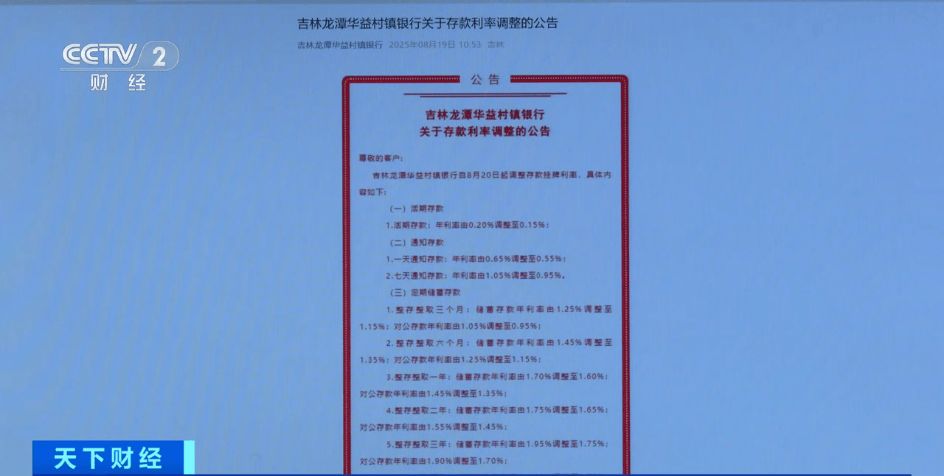
Core Viewpoint - Multiple small and medium-sized banks in China have announced reductions in RMB deposit rates, with decreases ranging from 10 to 20 basis points, reflecting a response to previous rate cuts by larger commercial banks and the need to address downward pressure on net interest margins [1][5]. Group 1: Deposit Rate Adjustments - Jiangsu Bank and Nanjing Bank have adjusted their three-year fixed deposit rates from 1.85% to 1.75% [1]. - Highmi Hui Min Village Bank in Shandong has lowered the annual interest rates for personal fixed deposits of 6 months, 1 year, and 2 years by 10 basis points, while the rates for 3-year and 5-year deposits have been reduced by 20 basis points [2]. - Jilin Longtan Huayi Village Bank has also adjusted its deposit rates, lowering the annual interest rate for demand deposits from 0.2% to 0.15%, and reducing rates for various fixed deposit terms by 10 to 20 basis points [3]. - Zhejiang Shengzhou Ruifeng Village Bank and Jilin Baishan Hunjing Hengtai Village Bank have similarly announced reductions in deposit rates, primarily between 10 to 20 basis points [4]. Group 2: Market Context and Trends - The recent rate cuts by small and medium-sized banks are seen as a follow-up to earlier reductions by major banks, which included a maximum cut of 25 basis points [5]. - As of May, the six major banks have set their demand deposit rates at 0.05%, with three-year and five-year deposit rates at 1.25% and 1.3%, respectively [5].



多家银行宣布下调存款利率
券商中国· 2025-08-28 15:32
Core Viewpoint - Multiple small and medium-sized banks in China have announced reductions in RMB deposit interest rates, with decreases ranging from 10 to 20 basis points [1][8]. Summary by Sections Deposit Rate Adjustments - Jiangsu Bank and Nanjing Bank have adjusted their three-year fixed deposit rates from 1.85% to 1.75% [2][3]. - Jilin Longtan Huayi Village Bank has lowered its interest rates for various deposit terms, with the three-year and five-year rates down by 20 basis points [5]. - Shandong Gaomi Huimin Village Bank has also reduced its rates for personal fixed deposits across multiple terms, with three-year and five-year rates down by 20 basis points [6]. Market Trends - The recent rate cuts by small and medium-sized banks are seen as a follow-up to earlier reductions by major commercial banks, which had cut rates by up to 25 basis points [8][9]. - The current interest rates for major banks are 0.05% for demand deposits and 1.25% and 1.30% for three-year and five-year fixed deposits, respectively [9]. Implications for Investors - According to a researcher from China Postal Savings Bank, the downward pressure on deposit rates is expected to continue, prompting residents to consider their investment experience, capabilities, and risk preferences to achieve better returns [8].

还剩3天!你也许能少付一笔利息钱
Sou Hu Cai Jing· 2025-08-28 11:43
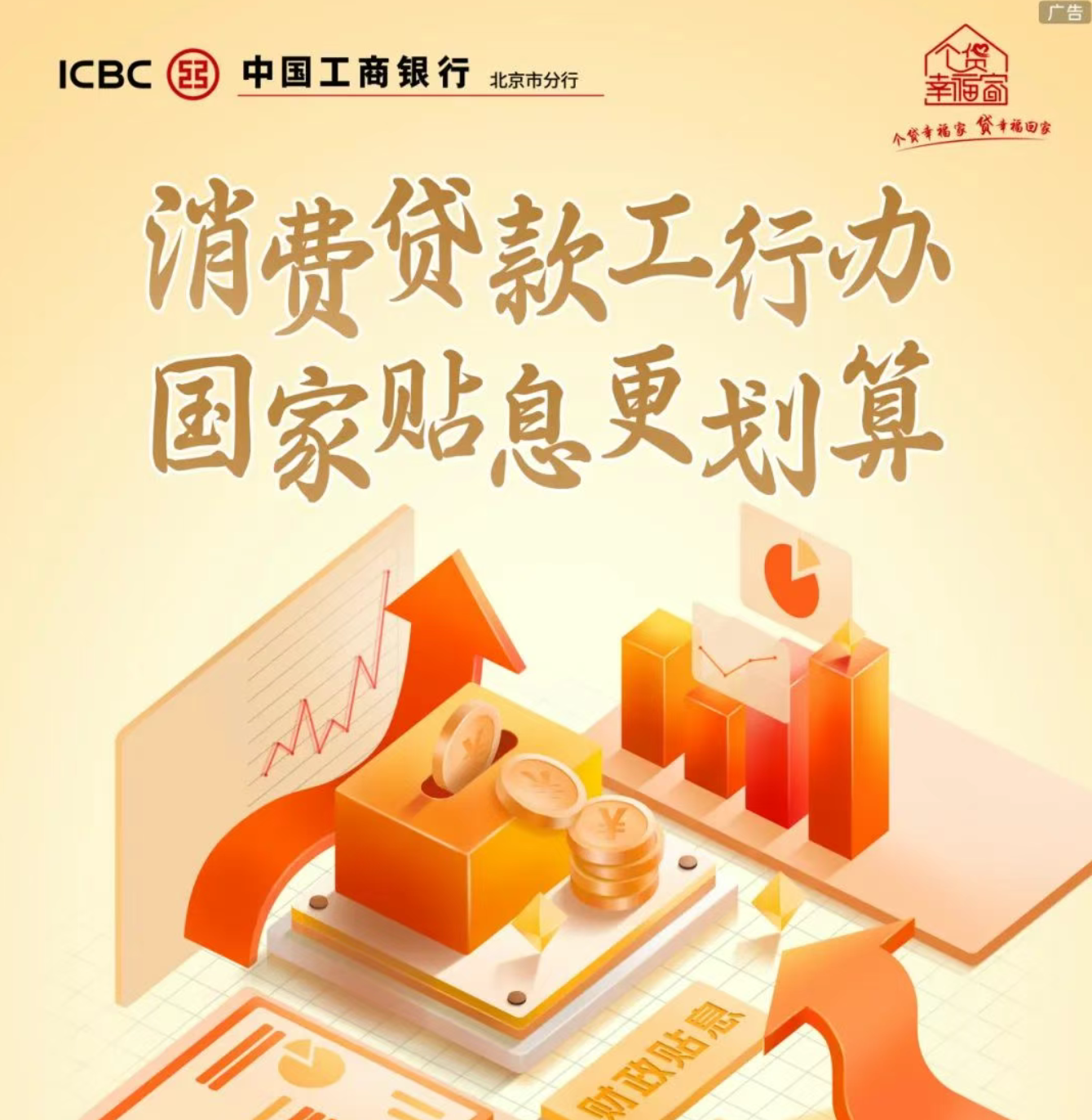
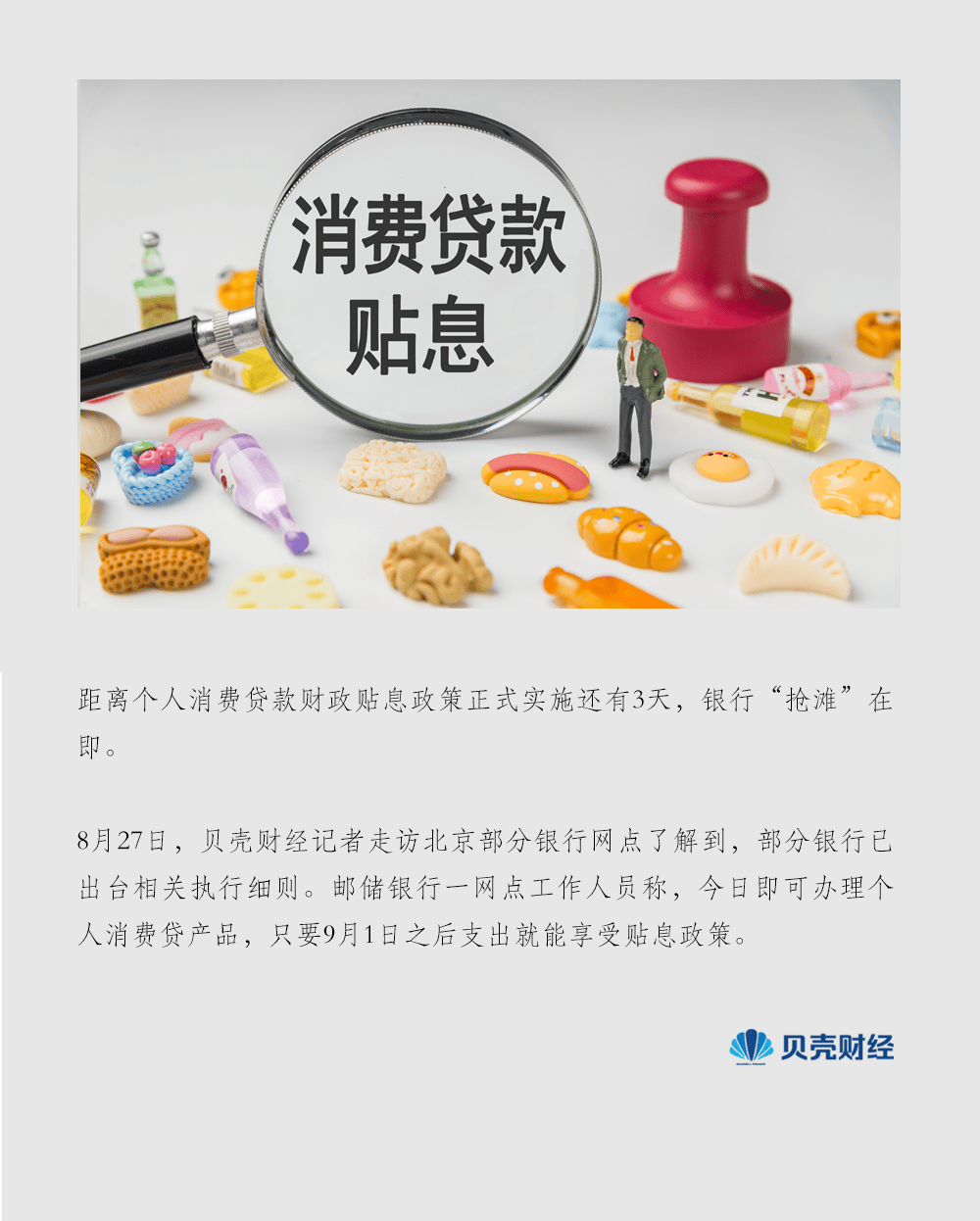
Core Viewpoint - The implementation of the personal consumption loan interest subsidy policy is imminent, with banks preparing to offer related products and services to consumers [3][4]. Group 1: Policy Implementation - The personal consumption loan interest subsidy policy is set to be officially implemented on September 1, with several banks already preparing their products [3]. - Banks like Postal Savings Bank and Shanghai Pudong Development Bank have clarified that the subsidy will be directly deducted from the loan interest at the time of payment [4][7]. - The Industrial and Commercial Bank of China (ICBC) has not yet specified the details of the subsidy but is promoting its consumption loan products [4][6]. Group 2: Loan Details and Limits - The subsidy applies to personal consumption loans issued by banks, excluding credit cards, with a maximum subsidy limit of 3,000 yuan per borrower [6][11]. - For loans under 50,000 yuan, the maximum subsidy is capped at 1,000 yuan [7][11]. - ICBC's personal credit consumption loan product "Rong e Borrow" offers a maximum limit of 1 million yuan with interest rates starting as low as 3% [6]. Group 3: Compliance and Monitoring - Banks emphasize the importance of compliance regarding the use of loan funds, prohibiting any diversion to stock or real estate markets [9]. - Financial institutions are encouraged to enhance monitoring of loan purposes and fund flows to prevent misuse of the subsidy [10]. - Regulatory recommendations include the establishment of a credit monitoring system to improve oversight of loan usage and to deter fraudulent activities [10][11].

邮储银行周口市分行:“金融东风”助力企业跨洋出海
Huan Qiu Wang· 2025-08-28 08:19
Core Insights - The article highlights the success of Hu Sanjie Spicy Soup, a traditional brand from Xiaoyao Town, Xihua County, Zhoukou City, Henan Province, which has expanded its reach internationally with the support of Postal Savings Bank [1][2] - The brand's journey from local street food to a standardized product available in supermarkets is marked by significant financial support from Postal Savings Bank, which provided over 4 million yuan in loans to help the company overcome liquidity challenges [1] Group 1 - Hu Sanjie Spicy Soup has evolved from a small restaurant to a recognized brand, with its signature dish gaining popularity both domestically and internationally [1] - The company faced financial difficulties in 2015 while upgrading equipment and expanding production, leading to a liquidity crisis [1] - Postal Savings Bank responded quickly by providing a loan of 1.5 million yuan, which helped the company stabilize and continue its growth trajectory [1] Group 2 - The bank's support has enabled the company to package and ship its products globally, emphasizing the importance of financial backing in the success of small and medium enterprises [2] - Postal Savings Bank's Zhoukou branch is committed to supporting the development of private and small enterprises, aiming to address financing challenges and contribute to the high-quality development of the local economy [2] - The bank's efficient loan application process and dedicated staff have been crucial in facilitating the growth of Hu Sanjie Spicy Soup [2]
消费贷贴息落地倒计时!银行细则相继公布“直接扣减”即将上线
Bei Ke Cai Jing· 2025-08-28 05:17
Core Viewpoint - The implementation of the consumer loan interest subsidy policy is approaching, with several banks already preparing related products and guidelines to ensure compliance and prevent misuse of funds [4][21]. Group 1: Bank Actions and Policies - Postal Savings Bank and Shanghai Pudong Development Bank have clarified that the subsidy will be directly deducted from the loan interest at the time of collection [2][10]. - Industrial and Commercial Bank of China (ICBC) has begun promoting its consumer loan products with the slogan emphasizing the benefits of the national subsidy, although specific details on the subsidy implementation are still pending [6][8]. - The subsidy policy allows for a maximum of 3,000 yuan in interest subsidies per borrower, with specific limits based on the loan amount [11][23]. Group 2: Loan Usage and Compliance - The subsidy is intended for personal consumption loans used in designated areas such as home appliances, education, and healthcare, with strict controls to prevent funds from being diverted to prohibited sectors like real estate and stock markets [3][15][16]. - Banks are implementing measures to ensure that loan funds are used appropriately, including monitoring transaction information and prohibiting fraudulent activities [17][20]. Group 3: Financial Implications - The annual subsidy rate is set at 1%, with the maximum subsidy not exceeding 50% of the loan contract interest rate, which is expected to lower effective interest rates for consumers [21][22]. - The financial burden of the subsidy is shared between central and local governments, with the central government covering 90% and local governments 10%, which may encourage local government participation [23].