PSBC(01658)

Search documents
固收专题研究:怎么把握10年二级资本债投资机会?
Guolian Minsheng Securities· 2026-02-01 02:25
1. Report Industry Investment Rating No information provided in the content. 2. Core View of the Report The report delves into the investment opportunities of 10 - year secondary capital bonds. It analyzes the development history of commercial bank secondary capital bonds, the issuance and trading condition of 10 - year secondary capital bonds, the main investors, and provides investment strategies from both allocation and trading perspectives [4][7][49]. 3. Summary According to the Directory 10 - year Commercial Bank Secondary Capital Bond Decryption - **Development History of Commercial Bank Secondary Capital Bonds**: The development of China's commercial bank secondary capital bonds can be divided into four stages. From 2004 - 2012, it was the "old - style sub - debt" stage; from 2013 - 2019, "new - style secondary capital bonds" emerged; from 2020 - 2023, the market's risk perception deepened; from 2024 to the present, the market entered a new innovation cycle [4][8][9]. - **The "Past and Present" of 10 - year Secondary Capital Bonds**: The first 10 + 5 - year secondary capital bond was issued by Agricultural Bank of China in March 2019. Since 2019, only state - owned large - scale banks and state - owned joint - stock banks have issued 10Y secondary capital bonds. The state - owned large - scale banks are the main issuers, with Agricultural Bank of China having the largest issuance volume. In terms of the stock, the secondary capital bonds with a remaining term of 3 - 5 years have the largest stock, followed by those with a remaining term of 7 - 10 years [18][22][24]. - **Secondary Transaction Situation of 10 - year Secondary Capital Bonds**: From January 1, 2025, to January 13, 2026, the secondary capital bonds with a term of 3 - 5 years were the most actively traded, followed by those with a term of 1 - 3 years. The 7 - 10 - year secondary capital bonds ranked fourth in terms of trading volume. The 9 - 10 - year secondary capital bonds had the largest trading volume among long - term bonds, and the 10 - year secondary capital bonds issued by Agricultural Bank of China had the best liquidity [30][32][33]. - **Who is Buying 10 - year Secondary Capital Bonds**: Insurance institutions are the main buyers of 10Y secondary capital bonds, with a net increase of about 1.6 billion yuan in 7 - 10Y secondary capital bonds in the past year. However, due to accounting treatment issues, insurance funds are more cautious in asset allocation. The increase in trading volume in the past month may be due to insurance companies' net purchases. In addition, securities companies, insurance companies, and fund products are the top three buyers in the past month, but the net purchase scale of securities companies is negative, indicating a stronger trading nature [36][42][43]. Investment Strategies for 10 - year Secondary Capital Bonds - **From the Perspective of Allocation**: The report uses interest rate spread and variety premium as key indicators to measure the relative value of 10Y secondary capital bonds. In terms of interest rate spread, when the funds are loose and the interest rate spread is high, the yield of 10Y secondary capital bonds may decline. In terms of variety premium, the trend of 10Y secondary capital bonds is highly consistent with that of ultra - long local bonds, with a "volatility amplification" effect in some periods [50][52][54]. - **From the Perspective of Trading**: The report reviews the term spread, the order of yield peaks of 10Y secondary capital bonds and other varieties, and the spread indicators between secondary capital bonds and urban investment bonds. Since 2025, the term spread between 10Y and 5Y secondary capital bonds has moved in the same direction as the 10Y secondary capital bond. In the interest rate upward cycle since 2023, 10Y secondary capital bonds have risen and fallen in the same direction as other varieties; in the downward cycle, almost all varieties reach the stage low at the same time. When the spread between 10Y secondary capital bonds and 10Y urban investment bonds turns negative, the yield of 10Y secondary capital bonds often has room to decline [59][66][76]. - **Summary of Trading Strategies**: The report provides a basic framework for investment decisions by reviewing historical experiences from the perspectives of allocation and trading, and summarizing the core judgment indicators and rules for the interest rate to reach the stage peak and bottom [81][82][83].



2026年如何布局?六大行全面开花,中小银行探求差异化发展路径
Guo Ji Jin Rong Bao· 2026-01-30 16:58
2025年银行的工作成效如何?2026年经营业务将如何安排? 《国际金融报》记者注意到,1月下旬以来,六家国有大行、多家股份行和中小银行密集召开了 2026年度工作会议,承前启后,为迎接"十五五"开局之年做好布局。分机构类型来看,国有大行布局更 为全面,股份行立足优势追求差异化发展,中小银行则更侧重地方经济和改革化险。 例如,光大银行称,将坚持错位发展打造特色优势,推动营收稳健增长,提升客户经营价值,推动 存款成本改善,促进金市业务专业化经营,着力提高财富管理、投行、托管业务等中间业务收入贡献, 持续做好为基层赋能服务,加快推动数字化智能化转型。 平安银行则表示,将坚定贯彻党建引领业务发展,紧跟国家发展方向,积极融入集团"综合金融 +医疗养老"战略,锚定"全面深化改革落地、全效发挥综金优势、全力改善业绩表现"的发展目标,围 绕"两个坚持、两个把握",即坚持"零售做强、对公做精、同业做专"战略不动摇;坚持降本增效、从严 治行要求不放松;把握"十五五"战略机遇,发掘新形势下银行发展新动能;把握科技革命时代机遇,将 科技战略作为银行发展核心驱动力,全面提升经营质效。 华夏银行称,2026年全行要紧紧围绕主要经营目标 ...

邮储银行无锡市分行:智慧金融赋能美好生活
Sou Hu Cai Jing· 2026-01-30 05:56
Core Insights - Postal Savings Bank of China Wuxi Branch is actively promoting the upgrade of digital RMB services to empower local digital economy development [1][2] Group 1: Strategic Initiatives - The bank signed a strategic cooperation agreement with Jiangyin Big Data Association to explore the integration of data elements and financial services [1] - A total of 1,000 customized hardware wallets were launched to provide safer and more convenient payment options for specific groups [1] Group 2: Focus on Public Welfare - Public transportation is a key area for promoting digital RMB, with successful partnerships established with Wuxi Metro and urban bus systems to enable digital RMB payment [1] - Citizens can now use the digital RMB app for instant payments, enhancing the safety, efficiency, and sustainability of their travel experience [1] Group 3: Financial Inclusion and Growth - The extensive scene construction has led to rapid business growth, with an expected addition of 87,400 digital wallets by 2025 and a cumulative transfer amount of 1.961 billion yuan [1] - Monthly active users of digital wallets are projected to reach 353,600, with promotional discounts available at large supermarkets for users of Postal Savings digital RMB wallets [1]

11 家大行去年理财代销增超万亿
Jing Ji Guan Cha Wang· 2026-01-30 02:45
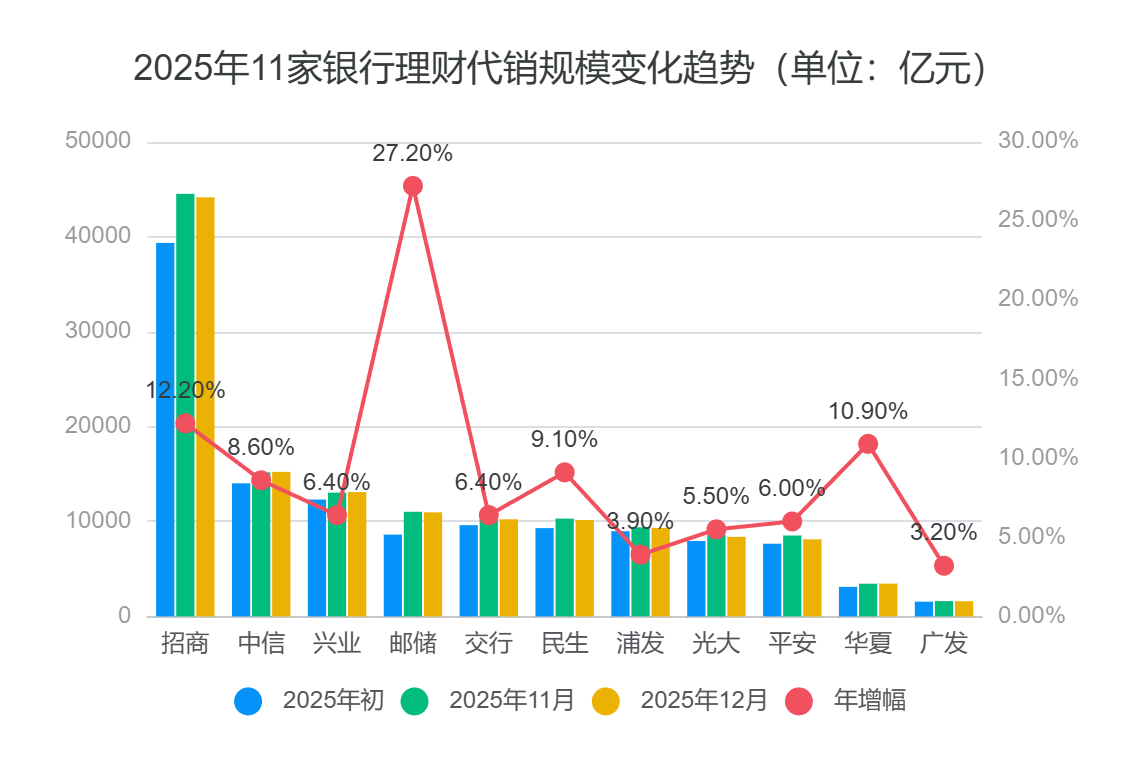
Core Viewpoint - The report highlights a decline in the scale of bank wealth management sales in December 2025, with a total of 13.46 trillion yuan, a decrease of 1.05% from November, but an increase of 10% from the beginning of the year. The growth is attributed to a "deposit migration" logic, indicating a shift in customer preferences towards wealth management products [2][6]. Group 1: Bank Performance - Postal Savings Bank showed a remarkable growth rate of 27.2%, leading among the 11 national banks, while China Merchants Bank followed with a 12.2% increase [2][4]. - In absolute terms, China Merchants Bank led with a wealth management sales scale of 4.41 trillion yuan, followed by CITIC Bank and Industrial Bank, each exceeding 1 trillion yuan [2][4]. - The ranking of the 11 banks remained relatively stable, with Postal Savings Bank rising from 7th to 4th place by the end of the year [2][4]. Group 2: Market Dynamics - The overall wealth management sales scale of the 11 banks increased by 1.22 trillion yuan, reflecting a 10% growth from the beginning of the year, with three banks (Postal Savings, China Merchants, and Huaxia) achieving growth rates above 10% [5][6]. - The average yield of wealth management products fell below 2% for the first time, at 1.98%, yet the number of investors increased by 14.37%, indicating a strong demand for stable-return products [8][9]. - The "deposit migration" narrative remains a key driver for the growth of wealth management, as banks focus on deeper market penetration and optimizing customer service [9][10]. Group 3: Future Outlook - Predictions suggest that by the end of 2026, the wealth management scale could reach approximately 38 trillion yuan, with a growth rate of around 12% [11]. - The average risk index is expected to gradually rise, and the proportion of long-term products is anticipated to increase, while T+0 products will decrease [11].





去银行办社保业务,东城区“社银合作”服务网点增至7家
Bei Jing Ri Bao Ke Hu Duan· 2026-01-30 02:42
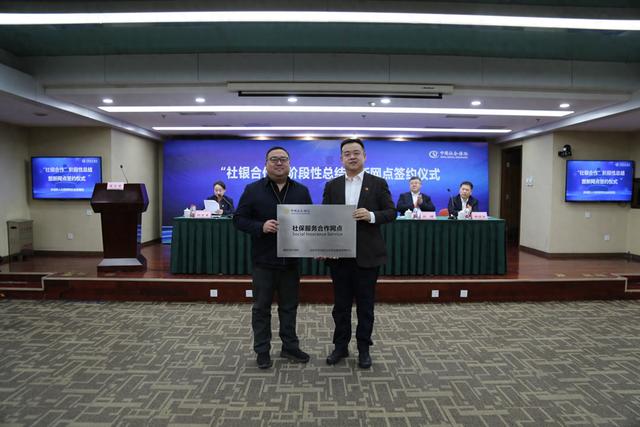
Core Viewpoint - The "Social Security and Banking Cooperation" initiative in Dongcheng District has shown significant progress, with new partnerships established and high satisfaction rates among the public [1][3]. Group 1: Initiative Overview - The "Social Security and Banking Cooperation" initiative has been operational for over 9 months, resulting in 126,100 service visits and a public satisfaction rate of 98.02% [3]. - The initiative aims to provide convenient social security services to the public while enhancing efficiency for social security and promoting development for banks [3]. Group 2: New Partnerships - Postal Savings Bank and Bank of China have recently joined the "Social Security and Banking Cooperation" network, increasing the total number of service points to 7 [1][6]. - The existing network includes Industrial and Commercial Bank of China, China Construction Bank, Bank of Communications, Beijing Bank, and Beijing Rural Commercial Bank, serving a total of 35,000 insured units and over 1.67 million insured individuals [6]. Group 3: Service Areas - The service network covers key areas along the central axis, including Zhongguancun Dongcheng Park, "Hangkongyuan" Technology Park, Dongzhimen, Wangfujing-Longfusi, Tiantan, and Yongdingmenwai [6]. - This strategic placement aims to provide high-frequency and low-risk social security services to the local population [6].
邮储银行:推进“六化”升级 打好“六场攻坚战”
Jin Rong Shi Bao· 2026-01-30 02:10
Core Viewpoint - The Postal Savings Bank of China (PSBC) is focusing on strategic development during the "15th Five-Year Plan" period, emphasizing the implementation of Xi Jinping's thoughts and the directives from the 20th National Congress of the Communist Party of China [1][2] Group 1: Achievements and Strategic Focus - During the "14th Five-Year Plan" period, PSBC achieved significant results in overall development, value creation, reform transformation, operational management, and market scale, enhancing service quality to the real economy [1] - The bank aims to leverage the strategic opportunities of the "15th Five-Year Plan" by advancing six upgrades: specialization, lightweight, comprehensive, ecological, refined, and digital intelligence [2] Group 2: Development Goals and Initiatives - PSBC plans to shift from scale-driven growth to value-driven growth by creating a "second growth curve" and pursuing dual-line integration and development [2] - The bank will focus on six key battles: optimizing asset-liability structure, enhancing capital quality and efficiency, improving income quality, controlling costs, enhancing customer management, and strengthening risk control capabilities to achieve balanced, stable, and sustainable development [2] Group 3: Importance of 2026 - The year 2026 marks the beginning of the "15th Five-Year Plan," making it crucial for PSBC to effectively execute its reform and development tasks, which are significant for long-term success [2] - The bank is committed to closely aligning with the central leadership and maintaining a high-efficiency pace to foster a new development model and elevate its growth to new heights [2]
你的“年终奖”到账了吗?银行打响理财市场“抢收”大战
Xin Lang Cai Jing· 2026-01-30 00:54
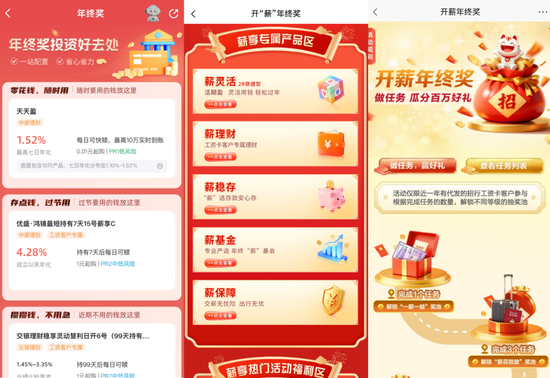
Core Viewpoint - Multiple banks are targeting the year-end bonuses of workers by launching exclusive financial products and promotional activities to attract customers [2][5][10]. Group 1: Year-End Bonus Financial Products - Several banks, including Postal Savings Bank, Bank of Communications, and China Merchants Bank, have introduced dedicated sections in their mobile banking apps for year-end bonus financial products [5][6][7]. - For example, Postal Savings Bank offers products like "Daily Earnings" with a maximum annualized rate of 1.52% and a low-risk product with an annualized rate of 4.28% [6]. - China Merchants Bank has a "Year-End Bonus" section that includes tasks for customers to unlock rewards, specifically targeting customers with salary accounts [7]. Group 2: Asset Allocation Strategies - Some banks are providing asset allocation strategies for year-end bonuses, suggesting a breakdown of funds into categories such as daily expenses, safety nets, stable investments, and growth investments [8]. - For instance, the Guangdong branch of China Construction Bank recommends allocating 10%-20% for daily expenses, 5%-10% for safety, 40%-60% for stable investments, and 10%-20% for growth [8]. Group 3: Market Trends and Data - As of the end of 2025, the total scale of the bank wealth management market reached 33.29 trillion yuan, an increase of 11.15% from the beginning of the year, with the number of investors growing by 14.37% [12][13]. - The report indicates that low-risk and medium-low-risk products dominate the market, with 95.73% of the total wealth management products falling into these categories [14]. - In 2025, wealth management products generated a total return of 730.3 billion yuan for investors, with an average yield of 1.98% [14].
多家银行调整个人客户上金所延期合约保证金比例
Zheng Quan Ri Bao Zhi Sheng· 2026-01-29 17:05
1月21日,邮储银行发布《关于再次调整我行个人客户上海黄金交易所延期合约保证金比例的通知》 称,自北京时间2026年1月22日收盘清算时起,该行将对代理个人上金所业务(包括黄金延期合约和白 银延期合约)的交易保证金比例进行调整。其中:Ag(T+D)、Au(T+D)、Au(T+N1)、Au (T+N2)、mAu(T+D)合约保证金比例均从80%调整为120%。事实上,这已是邮储银行在一个月内 第三次对该行个人客户上金所延期合约保证金比例进行调整。 本报记者 杨洁 近期,多家银行发布调整个人客户上海黄金交易所(以下简称"上金所")延期合约保证金比例的通知。 1月28日,建设银行发布通知称,自2026年1月29日(星期四)收盘清算时起,Au(T+D)、mAu (T+D)、Au(T+N1)、Au(T+N2)、NYAuTN06、NYAuTN12、Ag(T+D)合约的保证金比例从 44%调整为60%。 建设银行官方客服对记者表示,近期国内外贵金属价格波动加剧,市场风险提升,为顺应市场变化,保 护投资者权益,该行对个人客户上金所延期合约交易保证金比例进行调整,并提示投资者做好仓位控 制,理性投资。 工商银行1月27日发布通 ...
11大行去年理财代销增超万亿元
21世纪经济报道· 2026-01-29 12:08
编辑|方海平 21世纪经济报道记者独家获得的一份银行理财代销规模数据显示, 2025年12月,11家全国性 银行代销理财规模13.46万亿元,较11月下降1.05%,较年初增长10%。 从年末两个月的数据 来看,银行理财仍然呈现"季末收缩"特征。从全年数据来看,理财规模增长背后"存款搬家"逻 辑仍然较强。 其中,邮储银行增势强劲,全年增幅达27.2%,增速在统计内的11家银行中居于首位,且断层 式领先, 增速第二的是冠有"零售之王"之称的招商银行,其较年初增长12.2%。业内人士分 析,发力广泛且下沉的渠道、战略重心转向"产品配置"等或成大幅增长的关键。 从绝对代销规模上来看,2025年12月,招商银行以4.41万亿元的规模独占鳌头;第二梯队,中 信、兴业、邮储、交行、民生规模也在万亿以上,其中中信、兴业分别达到1.5万亿、1.3万亿 的量级,另外三家均在1万亿级别;浦发、光大、平安三家规模接近万亿,分别在8000万到 9300万水平;华夏、广发规模较低,分别为3400万及1600万左右。 11家银行理财代销座次较年初相对稳定,仅邮储银行实现"飞升" ,超越交行、民生、浦发, 由年初的第7位升至年末的第4位。 ...

21独家|去年银行理财代销大增 邮储劲增27%超越交行等
2 1 Shi Ji Jing Ji Bao Dao· 2026-01-29 09:49
Core Insights - The report highlights a decline in the scale of bank wealth management sales, with a total of 13.46 trillion yuan by December 2025, down 1.05% from November but up 10% from the beginning of the year [1][7] - Postal Savings Bank showed remarkable growth, leading with a 27.2% increase, while China Merchants Bank followed with a 12.2% increase [1][5] - The overall growth in wealth management sales is attributed to a "deposit migration" trend, where customers are shifting their funds into wealth management products [7][10] Group 1: Bank Performance - By December 2025, China Merchants Bank led with a wealth management sales scale of 4.41 trillion yuan, followed by CITIC Bank and Industrial Bank, both exceeding 1 trillion yuan [1][2] - Postal Savings Bank's rise in ranking from 7th to 4th among the 11 banks indicates a significant shift in market dynamics [2][4] - The total growth in wealth management sales among the 11 banks amounted to 1.22 trillion yuan, with a year-on-year increase of 10% [7][6] Group 2: Factors Driving Growth - The growth of Postal Savings Bank's wealth management sales is linked to strategic reforms and an expansion of distribution channels, with approximately 40,000 outlets enhancing customer reach [5][6] - The shift in focus from "product sales" to "product configuration" aims to cater to high-net-worth clients, which is seen as a crucial strategy for growth [5][10] - The demand for stable, low-volatility wealth management products remains strong, particularly in a low-interest-rate environment, driving customer interest [9][10] Group 3: Market Trends - The report notes a seasonal pattern in bank wealth management, characterized by "quarter-end contraction" and "quarter-beginning recovery," influenced by regulatory requirements [8][10] - Despite a slight contraction in December, the overall wealth management scale showed resilience, indicating strong underlying demand [8][9] - Predictions suggest that the wealth management scale could reach approximately 38 trillion yuan by the end of 2026, with a projected growth rate of around 12% [12]