大金融板块

Search documents
A股V型反弹,超4500股上涨,军工概念多股涨停,算力芯片爆发,沐曦股份飙涨16%
21世纪经济报道· 2026-03-24 04:12
Core Viewpoint - The A-share market shows signs of recovery with significant movements in various sectors, indicating potential investment opportunities in specific industries and companies [1][5][6]. Market Performance - On March 24, A-share indices opened high but briefly turned negative before recovering, with the Shanghai Composite Index up 0.95% and the Shenzhen Component Index up 0.26% at midday [1]. - The total trading volume in the Shanghai and Shenzhen markets reached 1.32 trillion yuan, with over 4,500 stocks rising [1]. Sector Highlights - The green energy sector continues to strengthen, with notable performances from companies like Huadian Liaoning Energy and Shaoneng Co., which have seen multiple consecutive gains [5]. - The military industry also showed strength, with stocks like Great Wall Military Industry and Hunan Tianyan hitting the daily limit [5]. - The computing chip sector rebounded significantly, with companies like Muxi Co. and Moer Thread seeing gains of over 16% and 9%, respectively [6]. - The financial sector experienced localized movements, particularly in non-bank financials, with several brokerage firms expecting over 50% year-on-year profit growth [6]. Investment Recommendations - Institutions suggest focusing on "certainty" in investment strategies, emphasizing sectors with pricing power such as advanced manufacturing, chemical, and energy [7][8]. - Key areas for investment include sectors benefiting from energy price increases, such as coal, electricity, and chemicals, as well as advanced manufacturing sectors like new energy and military [8]. - The focus on low-volatility assets is increasing, with recommendations for traditional low-volatility dividends and sectors with improving profit margins in the chemical industry [9]. Long-term Outlook - Despite short-term market volatility, the long-term investment logic remains intact, with structural opportunities still worth pursuing [10].


五大重磅!证监会,重拳出击
Sou Hu Cai Jing· 2026-01-06 08:29
Market Performance - The three major indices collectively rose, with the Shanghai Composite Index reaching a ten-year high, closing up 1.5% [1] - The market saw over 4,100 stocks rise, with 143 stocks hitting the daily limit, indicating strong market momentum [1] - The trading volume in the Shanghai and Shenzhen markets reached 2.81 trillion yuan, an increase of 260.2 billion yuan from the previous trading day [1] Sector Highlights - The commercial aerospace sector experienced significant gains, with multiple stocks hitting the daily limit, including Luzhou Investment and Beidou Star Communication [1][6] - The non-bank financial sector saw a strong performance, with insurance, securities, and fintech segments leading the gains [3] - The brain-computer interface concept continued its strong performance, with several stocks achieving consecutive gains [4] Future Outlook - Analysts believe that the non-bank financial sector has substantial recovery potential, with current valuation levels still below long-term trends [3] - The market is expected to maintain a strong upward structure, with opportunities for low-cost entries during short-term fluctuations [6] - The A-share market is projected to have further upward potential, supported by favorable macroeconomic conditions and improved corporate earnings [12][13]
大金融板块本周逆势上涨,证券保险ETF(512070)、香港证券ETF(513090)等产品受资金关注
Sou Hu Cai Jing· 2025-12-19 10:46
Market Performance - The CSI 300 Non-Bank Financial Index increased by 3.5%, while the CSI All Share Securities Company Index and the Hong Kong Securities Index both rose by 1.1%, and the CSI Bank Index increased by 1.0% [1][3] - The Securities Insurance ETF (512070) and the Hong Kong Securities ETF (513090) saw net inflows of 650 million yuan and 160 million yuan, respectively, during the week [1] Policy Impact - The National Financial Regulatory Administration's notification regarding the adjustment of risk factors for insurance companies has lowered the risk factors for long-term holding assets such as the CSI 300, Dividend Low Volatility, and STAR Market, which is expected to cultivate patient capital and support technological innovation [1] - The implementation of this policy is anticipated to continuously drive medium to long-term capital into the market, enhancing the equity allocation capacity of insurance funds [1] Index Metrics - The index price-to-book (P/B) ratios are as follows: CSI All Share Securities Company Index at 1.5x, CSI Bank Index at 0.7x, CSI 300 Non-Bank Financial Index at 1.5x, and the CSI Hong Kong Securities Investment Theme Index at 1.0x [3][4] - The P/B ratio percentiles indicate that the CSI All Share Securities Company Index is at 31.7%, the CSI Bank Index at 33.8%, the CSI 300 Non-Bank Financial Index at 28.2%, and the CSI Hong Kong Securities Investment Theme Index at 58.1% [3] Historical Performance - Year-to-date performance shows the CSI 300 Non-Bank Financial Index has increased by 11.2%, while the CSI Bank Index has risen by 6.8%, and the CSI All Share Securities Company Index has gained 2.4% [6] - Over the past three years, the CSI 300 Non-Bank Financial Index has increased by 45.0%, while the CSI Bank Index has risen by 37.2% [6]

收盘丨A股三大指数集体反弹,大金融板块午后发力
Di Yi Cai Jing· 2025-12-17 07:21
Market Overview - The total trading volume in the Shanghai and Shenzhen markets reached 1.81 trillion yuan, an increase of 87 billion yuan compared to the previous trading day [6] - All three major A-share indices strengthened in the afternoon, with the Shanghai Composite Index rising by 1.19%, the Shenzhen Component Index by 2.4%, and the ChiNext Index by 3.39% [1][2] Sector Performance - The energy metals sector showed strong performance throughout the day, with lithium mining stocks leading the gains [2] - The computing hardware concept stocks surged in the afternoon, with companies like Zhongci Electronics and Huanxu Electronics hitting the daily limit [2] - The financial sector also saw significant gains, with Huatai Securities approaching the daily limit and China Pacific Insurance rising over 4% [4] Individual Stock Highlights - Notable stock performances included: - Yidong Electronics up by 20.01% at 52.78 yuan - Lian Te Technology up by 20.00% at 174.00 yuan - Huaguang New Materials up by 18.34% at 55.30 yuan [3] Capital Flow - Major capital inflows were observed in the communication, non-ferrous metals, and securities sectors, while outflows were noted in aerospace, agriculture, and automotive sectors [9] - Specific stocks with significant net inflows included N Muxi-U, Zhongji Xuchuang, and Xinyi Sheng, with inflows of 1.708 billion yuan, 1.425 billion yuan, and 1.396 billion yuan respectively [9] Institutional Insights - Guotai Junan stated that the medium to long-term slow bull market remains unchanged, suggesting investors maintain a balanced allocation and be patient [9] - Everbright Securities noted that the Shanghai Composite Index approached the lower end of the fluctuation range, indicating a potential gradual rebound [9] - Galaxy Securities highlighted that the current valuation of the securities sector is at a historical low, suggesting a defensive rebound strategy [9]

机构称券商板块景气度有望上行,关注证券保险ETF(512070)、证券ETF易方达(512570)等配置价值
Sou Hu Cai Jing· 2025-12-05 11:01
Core Viewpoint - The financial sector is experiencing significant movements, with securities and brokerage stocks collectively rising, indicating a potential upward trend in the brokerage sector's performance amid ongoing market volatility and increased international business expansion by Chinese brokerages [1][3]. Market Performance - The CSI All Share Securities Index increased by 1.2% this week, while the CSI Bank Index decreased by 1.1%. The CSI 300 Non-Bank Financial Index rose by 2.7%, and the Hong Kong Securities Investment Theme Index saw a 0.9% increase [3]. - Year-to-date performance shows the CSI All Share Securities Index up by 1.1%, the CSI Bank Index up by 7.6%, and the CSI 300 Non-Bank Financial Index up by 6.1% [6]. Industry Trends - Chinese brokerages have been increasing capital for overseas subsidiaries, reflecting a strategic shift towards international business to enhance competitiveness in a globalized market [1]. - The brokerage sector is transitioning from simple channel services to comprehensive financial services, which is expected to improve the overall industry outlook [1]. Valuation Metrics - The price-to-book (PB) ratio for the CSI All Share Securities Index is 1.4x, while the CSI Bank Index stands at 0.7x. The market valuation indicates that the securities sector is relatively more expensive compared to the banking sector [3][4]. - The CSI All Share Securities Index's PB ratio is in the 27.5th percentile, suggesting it is relatively cheap compared to historical levels [3]. Historical Performance - Over the past three years, the CSI All Share Securities Index has seen a cumulative increase of 24.7%, while the CSI Bank Index has increased by 33.8% [6]. - The long-term performance since inception shows the CSI All Share Securities Index down by 16.0%, while the CSI Bank Index has increased by 665.7% [6].

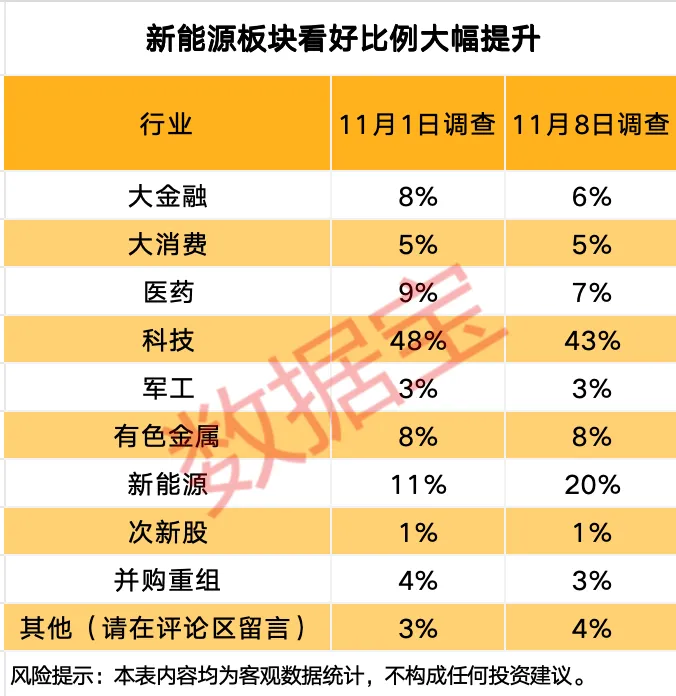
数据宝下周A股调研出炉:新能源板块看好比例大幅提升
Zheng Quan Shi Bao Wang· 2025-11-09 13:08
Core Insights - The survey conducted by Securities Times Data Treasure indicates a mixed sentiment among investors regarding A-share market movements, with a notable increase in optimism towards the new energy sector [1] Group 1: Investor Sentiment - 23% of surveyed investors increased their positions, while 18% reduced their holdings, and 5% completely exited their positions; 54% maintained their current holdings [1] - Approximately 52% of respondents believe that A-shares will rise above 4000 points and stabilize, while 28% expect a rise followed by a decline [1] Group 2: Sector Outlook - The proportion of investors optimistic about the new energy sector has significantly increased from 11% to 20%, marking a 9 percentage point rise [2] - Other sectors such as technology, pharmaceuticals, and large financials have seen a decrease in positive sentiment, with technology dropping from 48% to 43%, pharmaceuticals from 9% to 7%, and large financials from 8% to 6% [2]
中美新一轮关税博弈或如何演绎?
ZHONGTAI SECURITIES· 2025-10-12 14:06
Report Summary 1. Report Industry Investment Rating No information provided in the given content. 2. Core Viewpoints of the Report - The new round of Sino - US tariff game has suddenly escalated. Trump's actions have political motives and negotiation considerations, aiming to force China to make concessions and reshape the negotiation framework with higher tariffs. The persistence of this round of friction may be stronger than that in April [7]. - In the market, there are certain risk - aversion features in the capital market after the holiday, but long - term funds may still be providing support. The market has not entered a systematic de - leveraging stage. The mid - term investment mainlines are clear, including technology and semiconductor industries, resource assets such as rare earth and gold, and large financial sectors like banks and securities [8]. 3. Summary According to Relevant Catalogs Market Review - **Market Performance** - Most major market indices rose last week, with the Shanghai Composite Index having the largest increase of 0.37%. Among major industries, the utility index and energy index performed relatively well, with weekly increases of 3.69% and 3.13% respectively, while the telecommunications service index and information technology index performed weakly, with decreases of 2.79% and 2.22% respectively [9][13]. - Among 30 Shenwan primary industries, 17 rose. The industries with larger increases were non - ferrous metals, coal, and steel, rising 4.44%, 4.41%, and 4.18% respectively. The industries with larger decreases were media, electronics, and power equipment, falling 3.83%, 2.63%, and 2.52% respectively [9][16]. - **Trading Volume** - The average daily trading volume of the Wind All - A Index last week was 26029.82 billion yuan (the previous value was 21876.96 billion yuan), at an extremely high historical level (98.00% of the three - year historical quantile) [9][19]. - **Valuation Tracking** - As of October 10, 2025, the valuation (PE_TTM) of the Wind All - A Index was 22.47, an increase of 0.13 from the previous week, at the 92.50% quantile of the past five - year history. Among 30 Shenwan primary industries, 17 saw a recovery in valuation (PE_TTM) [9][23]. Market Observation - **Analysis of the Sino - US Tariff Game** - Trump's actions in threatening to impose "significantly increased tariffs" on Chinese goods have both political motives and negotiation considerations. He hopes to force China to make concessions and reshape the negotiation framework. The persistence of this round of friction may be stronger than that in April due to China's stance, Trump's lower political pressure, and the uncertainty of the APEC summit [7]. - In the market, there are risk - aversion features, but long - term funds may still be providing support, and the market has not entered a systematic de - leveraging stage. The mid - term mainlines are technology and semiconductor industries, resource assets such as rare earth and gold, and large financial sectors [8]. - **Investment Recommendations** - Due to the sudden and persistent nature of this round of Sino - US friction, investors should not simply copy the "quick bottom - fishing" strategy in April. The adjustment space of the index is expected to be controllable. The mid - term mainlines are technology and semiconductor industries, resource assets such as rare earth and gold, large financial sectors, and the Hong Kong stock market may have phased allocation opportunities in high - dividend and new - consumption sectors [8]. Economic Calendar - This week, important domestic economic data to be released include China's export and import annual rates in US dollars, trade balance, new RMB loans, social financing scale, M2 money supply year - on - year, CPI, and PPI. Overseas, important data include the US unadjusted CPI year - on - year, PPI year - on - year, retail sales year - on - year, and core retail sales month - on - month. There are also important events such as speeches by the Fed Chairman and the Fed's financial regulatory vice - chairman [25].
美联储今夜降息!对中国市场与汽车行业影响全解析
Sou Hu Cai Jing· 2025-09-17 14:24
Group 1: Federal Reserve Rate Cut - The Federal Reserve is expected to announce a rate cut of 25 basis points, marking the first cut in nine months, aimed at addressing signs of economic slowdown rather than a full-blown crisis [1][2] - The current economic context is characterized by "stagflation," with slowing growth and relatively high inflation, as indicated by a core PCE year-on-year growth of 2.86% and a core CPI growth of 3.2% [2] Group 2: Impact on Chinese Assets - The rate cut is anticipated to have a threefold positive impact on Chinese assets, including expanded monetary policy space, stabilization and appreciation of the RMB exchange rate, and accelerated capital reallocation [2][5] - The Chinese capital market is expected to see a wave of foreign capital inflow, benefiting from the easing of external monetary policy constraints [5] Group 3: Opportunities in A-shares and H-shares - In the A-share market, three sectors are identified as clear beneficiaries: technology growth sectors (TMT, semiconductors, AI), large financial sectors (banks, brokerages, insurance), and high-dividend stocks (electricity, oil, state-owned enterprises) [2][10] - The H-share market is more sensitive to external liquidity, with significant foreign capital allocation towards software, services, and technology hardware sectors, driven by advancements in AI technologies [3] Group 4: Automotive Industry Benefits - The automotive industry is poised to benefit from both policy and funding advantages, with a target of achieving approximately 32.3 million vehicle sales in 2025, a year-on-year growth of about 3% [6] - The expected sales of new energy vehicles (NEVs) are projected to reach around 15.5 million, reflecting a growth of approximately 20% [6] - The rate cut will lower financing costs for automakers, enhance consumer confidence, and support overall consumption, particularly in the automotive sector [7][8] Group 5: Commodity and Bond Market Effects - The rate cut is expected to positively influence the commodity and bond markets, with industrial metals like copper and aluminum anticipated to break upward, and gold prices receiving short-term support [9] - The bond market is likely to see a clear downward trend in interest rates, enhancing the investment value of government and interest rate bonds [9] Group 6: Asset Allocation Strategy - Experts recommend prioritizing equity assets in the current environment, particularly in technology growth, high-dividend blue chips, and large financial sectors, while suggesting moderate allocation to bond assets [10] - Investors are advised to be cautious of potential overvaluation in certain sectors due to pre-existing rate cut expectations [10]
新老产品齐上阵 公募基金抢抓建仓机遇
Shang Hai Zheng Quan Bao· 2025-08-19 19:25
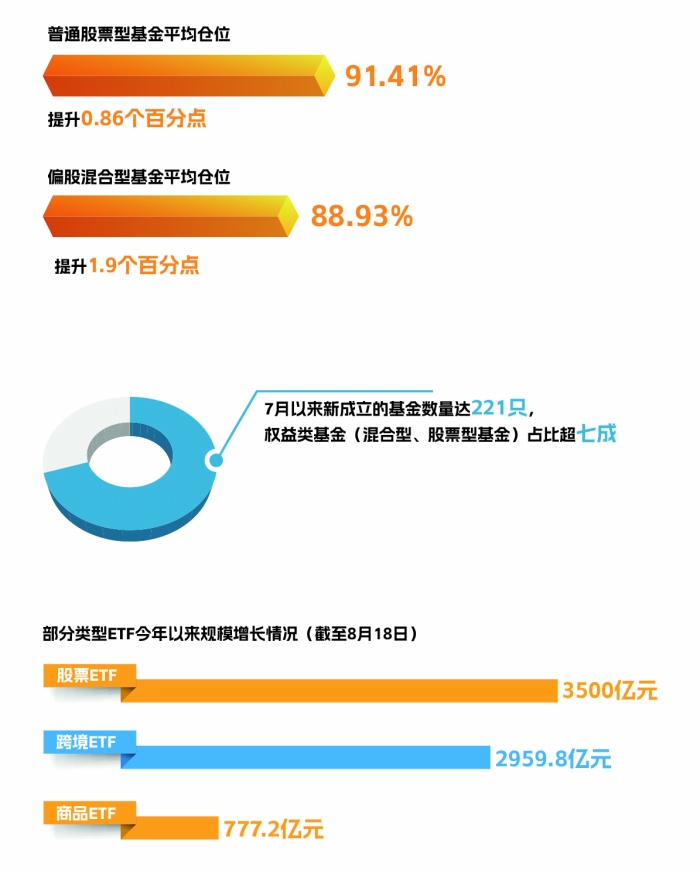
Group 1 - The core viewpoint indicates that public funds are increasing their market entry efforts, with active equity funds' stock positions reaching a high for the year [2][5] - Newly established funds are rapidly building positions, with many products achieving over 10% returns within approximately one month of establishment, capitalizing on market uptrends [2][3] - As of August 15, the average stock position of ordinary equity funds is approximately 91.41%, an increase of 0.86 percentage points from August 8, while the average position of equity hybrid funds is about 88.93%, up by 1.9 percentage points [5] Group 2 - Several newly established funds have reported significant returns, with 10 products achieving over 5% returns since inception, and 4 of these exceeding 11% [3][4] - The Invesco Great Wall Growth Mixed Fund, established on June 27, has achieved a return of 18.61% since inception, while other funds like the Harvest Growth Win Mixed Fund and the E Fund Growth Progress Mixed Fund have returns of 14.4% and 13.13%, respectively [3] - Fund managers are optimistic about the market outlook, as the rapid building of positions in new funds reflects confidence in future market performance [4][5] Group 3 - Public funds are focusing on growth sectors, particularly increasing allocations in the telecommunications industry, which has seen the most significant accumulation over the past three months [5] - There is a noted decrease in allocation to the consumer sector, with the food and beverage industry's allocation reaching a low point in recent years [5] - Institutions maintain an optimistic outlook for the market, anticipating a steady recovery in the economic fundamentals and a revaluation of Chinese assets [5]
券商密集调研三大行业成“心头好”
Xin Hua Wang· 2025-08-12 06:28
Group 1 - The core viewpoint is that the A-share market is stabilizing, and growth stocks are expected to rebound, with a focus on sectors less affected by external factors and more aligned with internal growth, particularly in the large financial sector [1][4]. Group 2 - The electronic industry is the most favored by brokerages, covering 127 stocks, followed closely by the pharmaceutical and mechanical equipment industries, with 125 and 124 stocks respectively [2]. - Brokerages have conducted research on 1,061 stocks this year, significantly higher than the 740 stocks researched in the same period last year [2]. - The top three brokerages in terms of research frequency are CITIC Securities, CICC, and CITIC Jiantou, with 386, 373, and 323 research instances respectively [3]. Group 3 - Brokerages are optimistic about the A-share market's future, with expectations of a recovery driven by strong performance in growth stocks, particularly in sectors like photovoltaics, wind power, smart driving, and digital economy [4]. - There are indications of multiple bottom signals in the A-share market, suggesting a potential new upward cycle as external negative factors ease [4]. - The valuation of A-shares is nearing historical lows, indicating that market rebounds are likely to continue, with a focus on previously oversold stocks and growth sectors like new energy and semiconductors [4].