
PSBC(01658)

Search documents
邮储银行中层调整涉及多家省分行行长
Xin Lang Cai Jing· 2025-11-10 09:08
Core Insights - Postal Savings Bank of China reported total assets of 18.61 trillion yuan as of September 30, 2025, representing an 8.9% increase from the end of the previous year [1] - The bank achieved a revenue of 265.08 billion yuan in the first three quarters of this year, reflecting a year-on-year growth of 1.82%, while net profit reached 76.794 billion yuan, showing a similar upward trend [1] - The bank is undergoing significant personnel changes, including the resignation of non-executive director Han Wenbo and various leadership adjustments across its branches [2][4] Financial Performance - For the first three quarters, the net interest margin narrowed to 1.68%, yet remains the highest among the six major state-owned banks [6] - Interest income for the period was 210.505 billion yuan, a decrease of 2.07% year-on-year, although the decline rate has slowed compared to the mid-year figures [6] - Non-interest income has increased as the bank focuses on diversifying its revenue streams and enhancing its retail business while expanding corporate and funding operations [6] Cost Management - Business and management expenses for the first three quarters totaled 152.167 billion yuan, down by 4.165 billion yuan or 2.66% year-on-year [6] - The cost-to-income ratio improved to 57.40%, a reduction of 2.65 percentage points compared to the same period last year [6] Asset Quality - As of September 30, 2025, the bank's non-performing loan balance stood at 91.009 billion yuan, an increase of 10.690 billion yuan from the end of the previous year [6] - The non-performing loan ratio was 0.94%, still the lowest among the six major banks, although it increased by 0.04 percentage points from the previous year [6] - The provision coverage ratio was reported at 240.21% [6] Organizational Changes - The bank is implementing reforms focusing on organizational structure, network operations, market service systems, incentive mechanisms, digital transformation, risk management, and operational management [5] - The bank aims to strengthen its first-level branches' operational capabilities and optimize personnel allocation as part of its "one branch, one sub-branch" reform pilot [5]

从增量扩面到提质控险 银行业普惠金融迈向差异化精准服务
2 1 Shi Ji Jing Ji Bao Dao· 2025-11-10 04:21
Core Insights - The report highlights the significant growth and development of inclusive finance in China, particularly focusing on small and micro enterprises and rural areas, with a notable annual growth rate of over 20% in inclusive micro loans during the 14th Five-Year Plan period [1][2] - As of June 2025, the balance of inclusive micro loans reached 36 trillion yuan, which is 2.3 times that of the end of the 13th Five-Year Plan, with a decrease in interest rates by 2 percentage points [1][2] - The average interest rate for newly issued inclusive micro loans was 3.48% as of June 2025, reflecting a decrease of 66 basis points year-on-year [1][2] Group 1: Digital Empowerment - Digital technology has been a key driver for the development of inclusive finance, with banks utilizing big data and AI to enhance loan approval efficiency and reduce financing costs [2][7] - The market structure among banks is changing, with large commercial banks holding a 45.11% share of inclusive micro loans, while rural financial institutions have seen a decline in their market share [2][3] - The average growth rate of inclusive micro loans has been slowing down, with a decrease from 30.9% in 2020 to 12.3% by mid-2025 [2][3] Group 2: Performance of Listed Banks - Among listed banks, Agricultural Bank of China, Industrial and Commercial Bank of China, and Beijing Bank reported the highest growth rates in inclusive micro loans at 18.50%, 17.30%, and 17.27% respectively [3][4] - In contrast, some banks, including Shanghai Bank and Zhengzhou Bank, experienced negative growth rates of -3.97% and -2.06% [3][4] - The performance of different banks varies significantly, with state-owned banks generally showing stronger growth in inclusive micro loans compared to smaller banks [3][4] Group 3: Interest Rates and Risk Management - The interest rates for newly issued inclusive micro loans have decreased across various banks, with the highest rate at 4.20% and the lowest at 2.94% [7][8] - The gap in interest rates between large and small banks is narrowing, with some large banks' rates aligning closely with those of smaller banks [8][9] - The report emphasizes the importance of risk management in the inclusive finance sector, with several banks focusing on improving asset quality and managing non-performing loans [9][10]



你的支付优惠用了吗?各大银行加入双十一“狂欢”,算的什么账?
Sou Hu Cai Jing· 2025-11-08 00:51
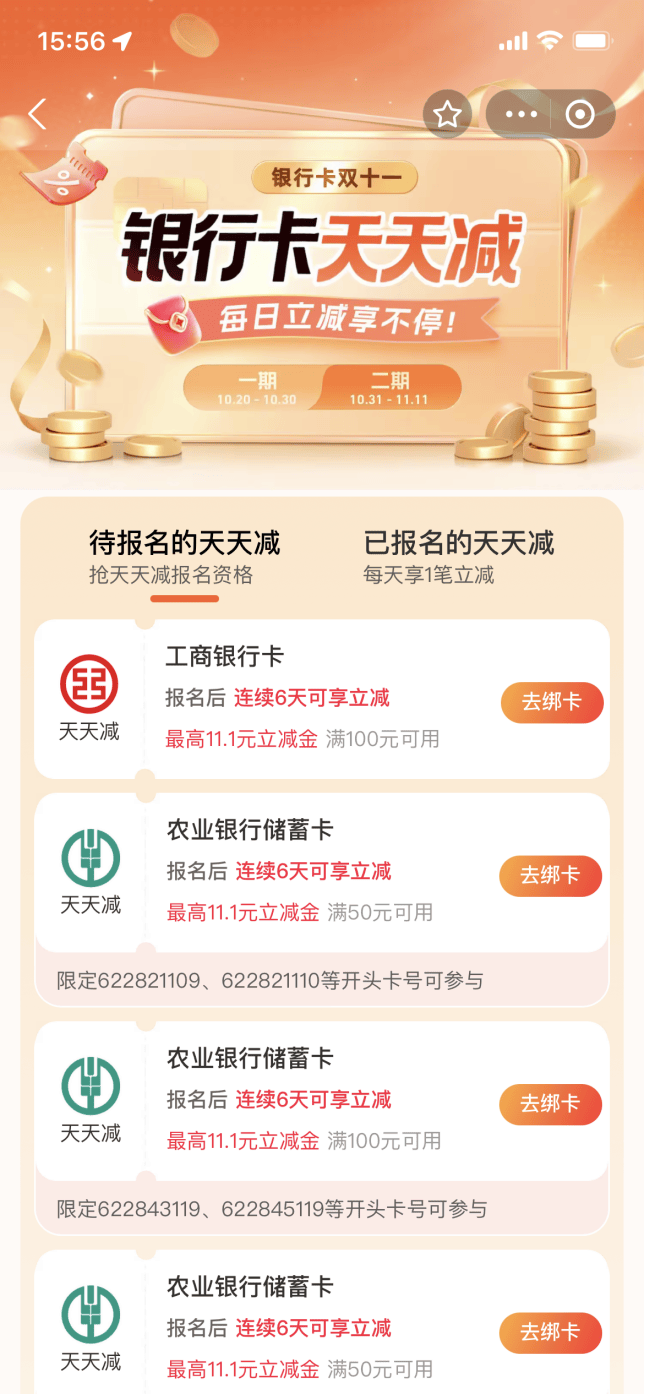
Core Viewpoint - The annual Double Eleven shopping season has officially started, with major commercial banks launching various promotional activities to stimulate consumer spending and boost business before the year-end [1][2]. Group 1: Promotional Activities by Banks - Major banks such as China Construction Bank, Bank of China, Agricultural Bank of China, and others have introduced cashback, discounts, installment benefits, and exclusive offers to attract consumers [1]. - Construction Bank offers a maximum discount of 400 yuan for credit card customers using installment payments on platforms like Alipay and Taobao, while Bank of China provides a random discount of up to 118 yuan for transactions made through Alipay [2]. - Other banks, including China Merchants Bank and Ping An Bank, have also launched various cashback and discount campaigns to engage customers during this shopping season [2]. Group 2: Strategic Insights - Experts suggest that the banks' promotional strategies represent a cost-effective method to acquire and retain customers, activating dormant accounts with low-cost random discounts [5]. - The focus on marketing during peak shopping seasons aims to enhance the usage of bank cards over third-party payment channels, thereby driving growth in credit and debit card transactions [5]. - Recommendations for banks post-Double Eleven include offering temporary credit limit increases and integrating with government consumption voucher programs to enhance customer experience and engagement [5].





上市银行大类资产配置跟踪:信贷投放稳健,债券配置灵活性提升
Ping An Securities· 2025-11-07 08:10
Industry Investment Rating - The investment rating for the banking sector is "Outperform" [1] Core Insights - The proportion of corporate loans has increased, while retail demand recovery is being monitored. As of mid-2025, the proportion of corporate loans among listed banks rose by 1.65 percentage points from the end of 2024 to 60.2%. The manufacturing sector's loans accounted for 18.5% of corporate loans, reflecting a recovery in the operations of manufacturing enterprises [3][12] - The flexibility in bond allocation has increased, with bond trading helping to stabilize market fluctuations. In the first half of 2025, listed banks saw a significant decline in other comprehensive income and fair value changes due to interest rate fluctuations. Some banks, primarily state-owned, increased bond trading to enhance investment returns and stabilize net profit growth [3][6] - Asset quality pressure is manageable, with a focus on risks in the retail sector. The overall asset quality remains stable, with the non-performing loan (NPL) ratio for A-share listed banks holding steady at 1.15% as of Q3 2025. However, the average NPL ratio for retail loans increased by 15 basis points to 1.58% compared to the end of 2024 [3][6] Summary by Sections Corporate Loan Structure - The overall asset structure of listed banks shows an increase in loan allocation, with the loan proportion rising by 0.1 percentage points from the end of 2024. State-owned banks increased interbank asset allocation, while small and medium-sized banks focused more on loan issuance [12][19] - Corporate loans remain the primary focus of credit allocation, with corporate loans accounting for 91.1% of all new loans in the first nine months of 2025. Short-term corporate loans made up 33.7% of new corporate loans [17][18] Bond Investment Preferences - The preference for flexible bond allocation has increased, with banks primarily investing in government bonds and central bank bills. The proportion of OCI accounts has risen, indicating a shift towards more flexible investment strategies [6][3] Asset Quality and Risk Monitoring - The asset quality of the banking sector is stable, with a non-performing loan ratio of 1.15% as of Q3 2025. The retail loan sector has shown slight increases in NPL ratios, necessitating ongoing monitoring of risks in this area [3][6]



邮储银行跌0.85%,成交额7.95亿元,近5日主力净流入-4860.25万
Xin Lang Cai Jing· 2025-11-07 08:05
Core Viewpoint - Postal Savings Bank of China (PSBC) has shown a decline in stock price and trading volume, indicating potential investor caution amid recent market movements [1][3]. Financial Performance - For the first nine months of 2025, PSBC reported a net profit of 765.62 billion yuan, reflecting a year-on-year growth of 0.98% [7]. - The bank's cumulative cash dividends since its A-share listing amount to 1,377.96 billion yuan, with 773.95 billion yuan distributed over the past three years [8]. Dividend Yield - PSBC's dividend yields over the past three years were 5.58%, 6.00%, and 4.61%, indicating a consistent return to shareholders [2]. Shareholder Structure - As of September 30, 2025, the number of shareholders decreased by 13.09% to 142,600, while the average circulating shares per person increased by 15.29% to 478,570 shares [7]. Market Activity - The stock experienced a net outflow of 66.32 million yuan today, with a continuous reduction in main capital over the past two days [3][4]. - The average trading cost of PSBC shares is 5.14 yuan, with the stock price approaching a resistance level of 5.86 yuan, suggesting potential for a price correction if this level is not surpassed [5]. Company Overview - PSBC, established on March 6, 2007, and listed on December 10, 2019, primarily offers banking and financial services in China, with personal banking contributing 65.15% to its revenue, corporate banking 22.71%, and funding operations 12.10% [6].
邮银协同推进物流金融行动 畅通产业循环助力实体经济高质量发展
Ren Min Wang· 2025-11-07 07:47
Core Viewpoint - The collaboration between China Postal Savings Bank and China Post is enhancing the "finance + logistics" service model, injecting new momentum into the real economy and supporting industrial circulation [1] Group 1: Logistics Financial Services in Shandong - Shandong's postal and banking collaboration is breaking traditional boundaries, transitioning from single services to comprehensive solutions [2] - The "1+1+1" management model pairs each customer with a postal and banking manager to create tailored solutions, effectively integrating resources [2] - The "Jinchai Loan" product was developed to address the financial pressures faced by automotive dealers, with comprehensive logistics support from China Post [2][3] - China Postal Savings Bank has granted credit of 8.9 billion yuan to nine subsidiaries of China National Heavy Duty Truck Group, with 392 dealers utilizing the "Jinchai Loan" [3] Group 2: Innovative Services in Chongqing - In Chongqing, the postal and banking collaboration has introduced a "medical factoring + logistics" service model, gaining positive customer feedback [4] - The partnership with a major pharmaceutical company has led to extensive logistics support, enhancing service depth and trust [4][5] - A layered management mechanism has been established to coordinate service resources effectively [5] Group 3: Logistics Financial Development in Hebei - Hebei's postal and banking collaboration focuses on the automotive industry, addressing the urgent need for integrated logistics and financial services [7] - Customized logistics financial solutions are being developed for major automotive manufacturers, enhancing service quality [8] - The "In-Factory Pass," "Store Pass," "Outbound Easy," and "Production and Sales Pass" projects have been successfully implemented, creating a multi-layered logistics financial service system [8]
邮储银行11月6日获融资买入9845.89万元,融资余额8.43亿元
Xin Lang Cai Jing· 2025-11-07 03:51
Core Viewpoint - Postal Savings Bank of China (PSBC) experienced a decline in stock price and trading volume, indicating potential investor caution and market volatility [1] Financing Summary - On November 6, PSBC had a financing buy-in amount of 98.45 million yuan and a financing repayment of 109 million yuan, resulting in a net financing outflow of 10.52 million yuan [1] - The total financing and securities balance for PSBC reached 848 million yuan, with the current financing balance at 843 million yuan, accounting for 0.21% of the circulating market value, which is below the 20th percentile level over the past year [1] Securities Lending Summary - On November 6, PSBC repaid 170,600 shares in securities lending and sold 26,100 shares, with a selling amount of 152,700 yuan based on the closing price [1] - The remaining securities lending volume was 774,200 shares, with a balance of 4.53 million yuan, exceeding the 70th percentile level over the past year, indicating a relatively high position [1] Company Overview - PSBC, established on March 6, 2007, and listed on December 10, 2019, provides banking and related financial services in China, focusing on personal banking, corporate banking, and fund operations [2] - The revenue composition of PSBC includes 65.15% from personal banking, 22.71% from corporate banking, and 12.10% from fund operations, with other businesses contributing 0.04% [2] Financial Performance - As of September 30, PSBC reported a net profit attributable to shareholders of 76.562 billion yuan, reflecting a year-on-year growth of 0.98% [2] - The total cash dividends distributed by PSBC since its A-share listing amount to 137.796 billion yuan, with 77.395 billion yuan distributed over the past three years [3] Shareholder Information - As of September 30, 2025, the number of PSBC shareholders decreased by 13.09% to 142,600, while the average circulating shares per person increased by 15.29% to 478,570 shares [2] - Major shareholders include Hong Kong Central Clearing Limited and various ETFs, with notable reductions in their holdings compared to previous periods [3]
银行差异化应对“黄金征税”新政,黄金理财风向有变
Sou Hu Cai Jing· 2025-11-06 10:02
Core Viewpoint - The new gold tax policy, effective from November 1, 2025, distinguishes between "investment" and "non-investment" uses of gold, leading to significant adjustments in banking operations and investor behavior [1][2]. Group 1: Impact on Banking Operations - Major banks have temporarily suspended certain gold-related services, such as招商银行's "金生利" and工商银行's gold accumulation services, in response to the new tax policy [1][3]. - The new tax policy allows for VAT exemption on standard gold transactions through designated exchanges, while non-investment uses will incur a reduced VAT of 6% [2]. Group 2: Changes in Investor Behavior - Investors are shifting towards more rational investment strategies, with banks advising clients to limit gold investments to about 10% of their portfolios and to adopt a long-term holding approach [4]. - The demand for gold has surged, leading to increased prices and longer delivery times for gold products, with some banks adjusting their pricing strategies accordingly [3][4]. Group 3: Alternative Investment Products - With restrictions on physical gold, banks are promoting "paper gold" products, which allow for virtual trading of gold without the need for physical delivery, providing a more flexible investment option [6][9]. - "Paper gold" includes various forms such as gold accounts, gold ETFs, and gold futures, which offer advantages like low transaction costs and high liquidity [9].

国有大型银行板块11月6日跌0.46%,邮储银行领跌,主力资金净流出6185.65万元
Zheng Xing Xing Ye Ri Bao· 2025-11-06 08:51
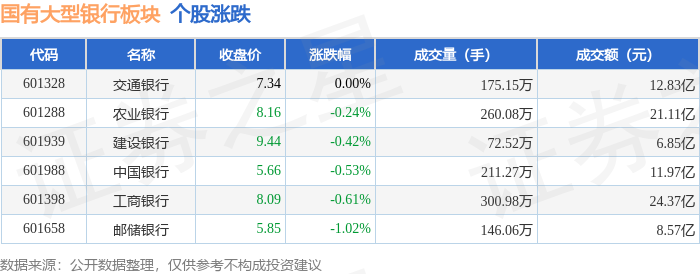
Core Insights - The state-owned large bank sector experienced a decline of 0.46% on November 6, with Postal Savings Bank leading the drop [1] - The Shanghai Composite Index closed at 4007.76, up 0.97%, while the Shenzhen Component Index closed at 13452.42, up 1.73% [1] Bank Performance Summary - **Bank of Communications (601328)**: Closed at 7.34, unchanged; trading volume of 1.75 million shares, total transaction value of 1.283 billion [1] - **Agricultural Bank of China (601288)**: Closed at 8.16, down 0.24%; trading volume of 2.6008 million shares, total transaction value of 2.111 billion [1] - **China Construction Bank (601939)**: Closed at 9.44, down 0.42%; trading volume of 725,200 shares, total transaction value of 685 million [1] - **Bank of China (601988)**: Closed at 5.66, down 0.53%; trading volume of 2.1127 million shares, total transaction value of 1.197 billion [1] - **Industrial and Commercial Bank of China (601398)**: Closed at 8.09, down 0.61%; trading volume of 3.0098 million shares, total transaction value of 2.4371 billion [1] - **Postal Savings Bank (601658)**: Closed at 5.85, down 1.02%; trading volume of 1.4606 million shares, total transaction value of 857.1 million [1] Fund Flow Analysis - The state-owned large bank sector saw a net outflow of 61.8565 million from institutional investors and a net outflow of 115 million from speculative funds, while retail investors had a net inflow of 177 million [1] - **Bank of Communications**: Net inflow from institutional investors of 44.968 million, net outflow from speculative funds of 1.25 billion, and net inflow from retail investors of 79.8107 million [2] - **Bank of China**: Net inflow from institutional investors of 16.3932 million, net outflow from speculative funds of 10.0614 million, and net outflow from retail investors of 6.3318 million [2] - **Industrial and Commercial Bank of China**: Net inflow from institutional investors of 7.3789 million, net inflow from speculative funds of 348.77 million, and net outflow from retail investors of 1.08666 million [2] - **Postal Savings Bank**: Net outflow from institutional investors of 5.412 million, net outflow from speculative funds of 342.014 million, and net inflow from retail investors of 39.6134 million [2] - **Agricultural Bank of China**: Net outflow from institutional investors of 100 million, net inflow from speculative funds of 53.8183 million, and net inflow from retail investors of 46.2417 million [2]

邮储银行湖南长沙市分行: 赋能新业态 服务新发展
Jin Rong Shi Bao· 2025-11-06 03:33
Core Viewpoint - Postal Savings Bank of China (PSBC) Changsha Branch focuses on innovation and public welfare, enhancing financial services to support local economic development and meet diverse financial needs of enterprises [1][2][3][4][6] Group 1: Financial Innovation and Services - The bank emphasizes product innovation, achieving breakthroughs in wealth management and supply chain finance, utilizing 12 functional modules for centralized account management [2] - A customized wealth management model has been introduced, facilitating 1 billion yuan in company financial self-balancing business, while directing funds to support non-standard financing for local enterprises [2] - The supply chain financing model has successfully facilitated over 60 million yuan in commercial bills for 13 suppliers, promoting win-win development between core enterprises and their upstream suppliers [2] Group 2: Inclusive Financial Network - The bank is committed to social responsibility, focusing on protecting the rights of migrant workers and rural revitalization through targeted financial products and services [3] - A wage guarantee regulatory service for migrant workers has been implemented, covering 25 construction units, ensuring their wages while strengthening public deposits [3] - The "Huinong Loan" policy has been utilized to provide customized financing solutions for key agricultural enterprises, effectively addressing their funding challenges [3] Group 3: Support for Innovation and Industry Development - PSBC Changsha Branch has launched specialized products for technology innovation, providing 10 million yuan in credit support to a high-tech enterprise in the Ningxiang Economic Development Zone [4] - The bank has established a "de-core" list of core enterprises to provide up to 5 million yuan in pure credit loans to eligible small and micro enterprises in the supply chain [4] Group 4: Comprehensive Financial Service Ecosystem - The bank integrates financial services into consumption and livelihood scenarios, creating an "online + offline" service model [6] - Focused on local characteristics, the bank has implemented exclusive payment tools to streamline financing, order management, and fund settlement processes in industries like medical devices and agriculture [6] - A financial ecosystem has been developed in educational settings, achieving a 90% penetration rate in targeted schools, enhancing financial services for teachers through customized credit card offerings [6]