VANKE(02202)
Search documents
万科一笔20亿元债券寻求展期 将召开持有人会议
Zheng Quan Ri Bao Wang· 2025-11-27 07:58
Core Viewpoint - Vanke is seeking to extend a bond worth 2 billion yuan that is set to mature, indicating liquidity pressures and market concerns regarding its cash flow situation [1][2]. Group 1: Bond Extension and Market Reaction - Vanke is requesting an extension for its 2 billion yuan bond, "22 Vanke MTN004," which was issued on December 16, 2022, with a 3% interest rate and a maturity date of December 15, 2025 [1]. - The bondholder meeting to discuss the extension is scheduled for December 10, with a record date of December 9 [1]. - The market has reacted to this extension request, leading to fluctuations in the prices of Vanke's domestic bonds, reflecting investor concerns about the company's financial health [1]. Group 2: Debt Obligations and Support - By December 2025, Vanke will have two bonds maturing, "22 Vanke MTN004" and "22 Vanke MTN005," totaling 5.7 billion yuan in principal and 5.871 billion yuan including interest [2]. - In 2026, Vanke has over 12 billion yuan in domestic debt due for repayment [2]. - Vanke's major shareholder, Shenzhen Metro Group, has provided significant liquidity support, totaling approximately 30.796 billion yuan in loans to Vanke [2]. Group 3: Management's Perspective and Future Outlook - The new chairman of Vanke, Huang Liping, emphasized the need to focus on risk management and navigate the challenges posed by the transition from old to new development models in the real estate sector [3]. - The company is expected to face a painful adjustment period due to burdens from previous high-growth phases, which will continue to pressure its operational performance [3]. - Shenzhen Metro Group is committed to supporting Vanke in managing risks and ensuring sustainable development in accordance with market and legal principles [3].
万科距离债务重组还有多远?
3 6 Ke· 2025-11-27 07:21
Core Viewpoint - Vanke is on the brink of debt restructuring, which could significantly impact the entire real estate industry if it fails [2][14]. Group 1: Debt Situation - Vanke is reportedly facing severe debt issues, with indications that the central government may guide the Shenzhen government to handle Vanke's debt in a market-oriented manner [2]. - Vanke has announced a creditors' meeting to discuss the extension of its "22 Vanke MTN004" bond, indicating a potential beginning of a debt restructuring process [3][14]. - The company has a total interest-bearing debt of 362.93 billion yuan, which has not decreased compared to the previous year, highlighting the need for external financing to alleviate debt pressure [11][12]. Group 2: Shareholder Support - Vanke's major shareholder, Shenzhen Metro Group, has changed its approach by setting limits on the loans it provides to Vanke, indicating a shift from unlimited support to more structured financial assistance [5][6]. - Shenzhen Metro Group has provided approximately 20 billion yuan in loans to Vanke, with part of the funding sourced from banks and the State-owned Assets Supervision and Administration Commission [6][7]. - The increased collateral requirements from Shenzhen Metro Group signal a clear move towards risk isolation, reflecting the need to manage financial exposure [7]. Group 3: Financial Performance - In the first half of 2025, Vanke achieved sales of 69.11 billion yuan, with a repayment rate exceeding 100%, but this represents only 28% of the total sales for the entire year of 2024 [8][9]. - The company's financing capabilities have declined, with only 24.9 billion yuan in new financing and refinancing in the first half of the year compared to 94.8 billion yuan for the entire previous year [12][13]. - Vanke's ability to generate cash flow is diminishing, as indicated by the need for significant external financing to manage its debt obligations [10][12]. Group 4: Future Outlook - Vanke is likely to pursue partial debt restructuring, focusing on bonds and non-standard debts that are nearing maturity, while also seeking asset sales to extend its financial viability [14][15]. - The company holds valuable assets, including stakes in Vanke Cloud and ProLogis Logistics, but the slow monetization of these assets poses a challenge for immediate cash flow needs [15].
【真灼财经】美国整体消费支出下降;万科寻求人民币债券展期
Sou Hu Cai Jing· 2025-11-27 07:09
Economic Overview - The Federal Reserve's Beige Book indicates a further decline in overall consumer spending in the U.S. in recent weeks [3] - Initial jobless claims in the U.S. fell to 216,000, the lowest since mid-April, outperforming economists' expectations [3] Market Performance - U.S. stock markets continued to rise, driven by strong technology stocks and increased expectations for a rate cut by the Federal Reserve in December [1] - The Nasdaq index closed at 23,214.69, up 0.82% for the day and 20.22% year-to-date [2] - The S&P 500 index closed at 6,812.61, up 0.69% for the day and 15.83% year-to-date [2] - The Dow Jones Industrial Average closed at 47,427.12, up 0.67% for the day and 11.48% year-to-date [2] Interest Rates - Morgan Stanley economists have adjusted their rate predictions, now expecting the Federal Reserve to cut rates in December rather than waiting until January [4] - U.S. 2-year Treasury yield reported at 3.4750, down 18.07% year-to-date [2] Commodity Market - Oil prices increased, recovering from a one-month low, as investors assessed the outlook for oversupply and progress in Russia-Ukraine peace talks [1] - Gold prices hovered near a one-week high, supported by rising expectations for interest rate cuts [1] Corporate Developments - Vanke has sought to extend the maturity of its 2 billion RMB bond due on December 15, raising concerns about government support [8] - Intel refuted allegations from TSMC regarding a former executive leaking trade secrets, emphasizing strict policies against the use or transfer of confidential information [6]
万科境内债盘初大跌
Di Yi Cai Jing· 2025-11-27 06:43
Core Viewpoint - The Shenzhen Stock Exchange announced significant declines in several bonds related to Vanke, with "22 Vanke 02" dropping over 20%, and "21 Vanke 02", "21 Vanke 06", and "22 Vanke 04" each falling over 30%, leading to temporary trading suspension [1] Group 1 - "22 Vanke 02" bond experienced a decline of more than 20% [1] - "21 Vanke 02", "21 Vanke 06", and "22 Vanke 04" bonds each saw declines exceeding 30% [1] - The trading of these bonds was temporarily suspended during the trading session [1]
突发,万科可能出现黑天鹅事件,债券单日重挫29.51%遭紧急停牌
Sou Hu Cai Jing· 2025-11-27 06:16
Group 1 - Vanke's bond "Vanke 02" experienced a sharp decline of 29.51%, triggering a temporary suspension, reminiscent of the panic seen before Evergrande's crisis [1] - Multiple Vanke bonds have faced significant drops, with "Vanke 04" falling over 20% and others like "Vanke 06" and "Vanke 01" dropping over 12%, indicating a broader issue within the company's debt structure [3] - International rating agencies have downgraded Vanke's credit rating, with Moody's lowering it from "Caa1" to "Caa2" and Fitch to "CCC-", highlighting a drastic reduction in available cash from 84 billion yuan at the end of 2024 to 69 billion yuan by mid-2025 [3] Group 2 - Vanke faces imminent debt pressure, needing to address approximately 22 billion yuan in bonds maturing or redeemable within the next 6 to 12 months, with 5.7 billion yuan due in December being critical [5] - Although Vanke has nearly 70 billion yuan in cash, around 40 billion yuan is tied up in pre-sale regulatory funds, limiting its ability to service debt, compounded by restricted financing channels [5] - The company's sales have plummeted, with a 46% year-on-year drop in sales to 69.1 billion yuan in the first half of 2025, significantly exceeding the industry average decline [5] Group 3 - A structural change in financing models has occurred, shifting from traditional "total-to-total" financing to project mortgage loans, which restricts fund availability at the group level while existing debts must still be repaid [7] - Vanke has initiated various self-rescue measures, including signing 6.43 billion yuan in bulk transactions and promoting current housing sales, but the revenue from its operational services remains insufficient compared to its debt scale [7] - The 300 billion yuan loan from Shenzhen Metro Group provides temporary relief but comes with structural constraints that limit Vanke's asset flexibility [9] Group 4 - The shift in real estate policy since 2022 has moved from "saving enterprises" to "protecting projects," with significant funds allocated for project delivery rather than rescuing companies [9] - The credit differentiation in the industry has intensified, with state-owned enterprises enjoying lower financing costs while private developers like Vanke continue to face negative net financing [9]
万科20亿债券寻求展期
Hua Er Jie Jian Wen· 2025-11-27 06:02
Core Insights - Vanke is seeking to extend the maturity of its 2 billion yuan medium-term notes, indicating ongoing financial distress and the need for debt restructuring [1][3] - The company's stock and bond prices have experienced significant volatility, with sharp declines observed in recent trading sessions [1][2] - Despite support from its major shareholder, Shenzhen Metro Group, Vanke's operational pressures remain severe, with negative cash flow and declining sales [2][3] Financial Performance - For the first three quarters of the year, Vanke reported a net cash flow from operating activities of -5.889 billion yuan, with a net outflow of nearly 2.8 billion yuan in Q3 alone [2] - Contract sales decreased by 44.6% year-on-year, exacerbating the company's financial challenges [2] - The net cash flow from financing activities was -20.321 billion yuan, highlighting the difficulties in raising funds despite shareholder loans totaling approximately 30.8 billion yuan [2] Management Actions - Vanke's new chairman acknowledged the company's struggle to manage its high leverage, debt, and turnover, emphasizing the need for a market-oriented and legal approach to financial support [3] - The company is undergoing significant organizational restructuring, reducing management layers to enhance decision-making efficiency [4] - Vanke is actively working to optimize its asset portfolio, generating 22.8 billion yuan in new saleable value through resource exchanges and is divesting non-core businesses [4]
万科债暴跌20%!机构却在悄悄布局?
Sou Hu Cai Jing· 2025-11-27 05:43
Group 1 - Vanke's bonds experienced a dramatic decline, with several bonds such as "21 Vanke 04", "22 Vanke 02", and "22 Vanke 04" dropping over 20%, triggering a temporary trading halt [1][2] - A loan agreement worth up to 22 billion yuan was signed between Vanke and Shenzhen Metro Group a month prior, but this amount is insufficient compared to the total debt obligations of 236.91 billion yuan [2] - The volatility in Vanke's bond market signals that institutional investors are conveying a message through these price movements, indicating underlying market dynamics [3] Group 2 - Despite a bull market lasting six months with an index increase of over 20%, less than 40% of individual stocks outperformed the market, highlighting the challenges of making profits in a rising market [4] - The "disposition effect" in behavioral finance suggests that investors tend to sell winning stocks too early while holding onto losing stocks for too long, with a reported 81% loss rate among retail investors from January to August [6] - The real risk in a bull market is not losing money but rather not making enough profit, which can lead to vulnerability during market corrections [6] Group 3 - The concept of "institutional shaking" is crucial for understanding market behavior, where large funds engage in actions that may appear risky but are actually strategic [7] - An example from the "solid-state battery" sector showed that after a significant price increase, institutional buying behavior indicated a "shakeout" pattern, which often corresponds with market lows [9] Group 4 - Analyzing Vanke through a quantitative lens reveals that while the bond market is turbulent, certain trading behaviors suggest differing market sentiments among specific accounts [12] - Investors are encouraged to focus on identifying institutional intentions rather than speculating on Vanke's debt repayment capabilities, advocating for the establishment of a personal quantitative observation system [12] Group 5 - Three data-driven recommendations for investors include: monitoring anomalies in stock movements, maintaining behavioral profiles of key stocks, and quantifying market sentiment to avoid subjective biases [13]
万科债务展期是第一步,业内预计→
第一财经· 2025-11-27 05:08
Core Viewpoint - Vanke's stock and bond prices have significantly declined due to the announcement of debt extension, indicating potential financial distress and a shift in reliance on state-owned support [3][4]. Group 1: Debt Situation - Vanke announced a bondholder meeting to discuss the extension of the "22 Vanke MTN004" bond, with a principal repayment date set for December 15, 2025, and a remaining balance of 2 billion [3]. - The company faces substantial short-term repayment pressure, with a total of 5.7 billion in domestic bonds maturing in December 2025, including the 2 billion bond under discussion [5]. - The extension of the bond is seen as a significant turning point, suggesting that state-owned support may no longer be available, leading to a likely debt restructuring [4][5]. Group 2: Financial Performance - For the first three quarters of the year, Vanke reported a revenue of 161.39 billion, a year-on-year decrease of 26.61%, and a net loss of 28.02 billion, down over 80% [6]. - In the first ten months, Vanke's sales amounted to 115.28 billion, reflecting a decline of over 40%, with monthly sales remaining at around 10 billion [6]. - As of the end of the third quarter, Vanke had repaid 28.89 billion in public debt, with cash holdings of 65.68 billion and total interest-bearing liabilities of 362.93 billion [6]. Group 3: Future Outlook - The company is expected to face a peak in debt repayment over the next two years, with over 12 billion in domestic bonds due in the first quarter of 2026 and additional repayments of over 12 billion in 2026 and 7 billion in 2027 [6]. - Analysts suggest that external support may be limited, and Vanke will need to explore market-based solutions for debt resolution, such as asset sales and refinancing [5][6].
万科股价大跌,多只债券临时停牌
Zhong Guo Zheng Quan Bao - Zhong Zheng Wang· 2025-11-27 05:01
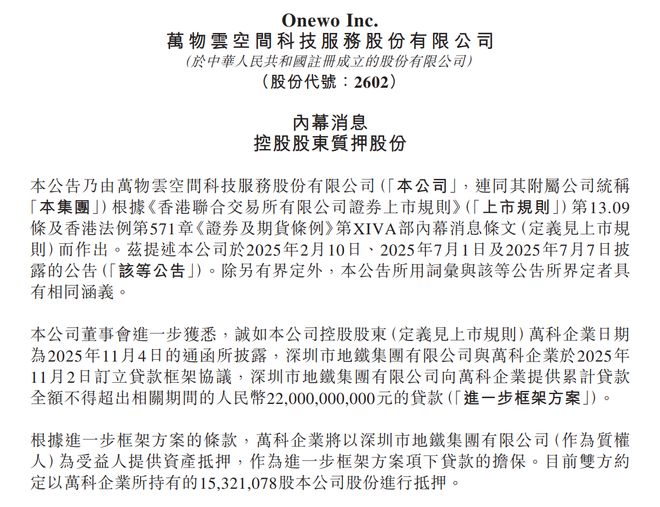
Core Viewpoint - Vanke's stock price has significantly declined, reaching a new low since August 2015, with a drop of 5.43% to 5.57 CNY per share, and its bonds have also experienced substantial losses, triggering temporary trading suspensions [1][2]. Group 1: Stock Performance - On November 27, Vanke A shares opened lower, hitting a low of 5.37 CNY per share, marking a decline of 5.43% by the close [1]. - Vanke's Hong Kong shares fell over 8% during the same trading session [1]. Group 2: Bond Trading - Multiple Vanke bonds, including "22 Vanke 02," "22 Vanke 06," and "21 Vanke 04," were temporarily suspended from trading after their prices dropped by 30% or more compared to the previous closing price [2][3]. - The Shenzhen Stock Exchange announced the temporary suspension at 9:34 AM and resumed trading at 3:27 PM [2]. Group 3: Debt Management - Vanke plans to hold a bondholders' meeting to discuss the extension of 20 billion CNY medium-term notes, which has attracted market attention [3]. - A meeting is scheduled for December 10 to discuss the extension of "22 Vanke MTN004," with a principal repayment date set for December 15, 2025, and an outstanding balance of 20 billion CNY at an interest rate of 3% [4]. Group 4: Risk Mitigation Efforts - Vanke's chairman stated that the company is working to systematically resolve risks, with a framework agreement approved for a loan of up to 22 billion CNY from its major shareholder, Shenzhen Metro Group, to repay public debt and interest [5]. - As of now, Shenzhen Metro Group has provided 21.376 billion CNY in unsecured loans, and Vanke is required to provide collateral for any future borrowings [5].
万科债务展期是第一步 业内预计后续仍有可能走向债务重组
Di Yi Cai Jing· 2025-11-27 04:57
Core Viewpoint - Vanke's stock and bonds have significantly declined due to the announcement of debt extension, indicating potential financial distress and a shift in reliance on state-owned support [1][2]. Group 1: Stock and Bond Performance - On November 27, Vanke A and Vanke Enterprises experienced initial declines of over 8%, which later narrowed to 4% and 5% respectively by midday [1]. - Several of Vanke's bonds were suspended from trading after their prices dropped by 30% or more, with a temporary halt announced by the Shenzhen Stock Exchange [1]. Group 2: Debt Extension Announcement - Vanke announced a bondholder meeting to discuss the extension of the "22 Vanke MTN004" bond, with a principal repayment date set for December 15, 2025, and a remaining balance of 2 billion at an interest rate of 3% [1]. - An insider from a domestic rating agency indicated that the decision to extend the debt is significant, suggesting that state-owned support may no longer be available, leading to a likely debt restructuring [1][2]. Group 3: Financial Pressure and Support - Vanke faces substantial short-term repayment pressure, with a total of 5.7 billion in domestic bonds maturing by December 2025, including the 2 billion bond under extension [2]. - The major shareholder, Shenzhen Metro, has provided significant support, totaling 30.8 billion in loans to Vanke as of November 12, 2025, to assist in repaying maturing debts [2]. Group 4: Future Debt Obligations - Vanke's financial outlook remains challenging, with 28.9 billion in public debt repaid by the end of Q3, and cash holdings of 65.7 billion against total interest-bearing liabilities of 362.9 billion [3]. - Upcoming debt obligations include 1.1 billion in domestic bonds due in Q1 2026, with over 12 billion in domestic bonds and 7 billion in overseas bonds maturing in 2027 [3]. Group 5: Industry Perspective - Analysts suggest that external support may be coming to an end, and Vanke will need to address its debt through market-driven solutions such as asset sales and refinancing [3][4]. - The real estate industry is shifting towards a more sustainable model, requiring companies to make careful decisions regarding investments and operations [4].