
China Life(02628)

Search documents
中国人寿(02628) - 董事会会议通告
2026-03-06 08:30
於 中 華 人 民 共 和 國 註 冊 成 立 之 股 份 有 限 公 司 (股份代號:2628) 香港交易及結算所有限公司及香港聯合交易所有限公司對本公告的內容概不負責,對其準確性或完整性 亦不發表任何聲明,並明確表示,概不對因本公告全部或任何部分內容而產生或因倚賴該等內容而引致 的任何損失承擔任何責任。 中 國 人 壽 保 險 股 份 有 限 公 司 China Life Insurance Company Limited ( ) 承董事會命 中國人壽保險股份有限公司 邢家維 公司秘書 蔡希良、利明光、劉暉、阮琦 胡錦、胡容、牛凱龍 林志權、翟海濤、陳潔、盧鋒 董事會會議通告 獨立非執行董事: 中國人壽保險股份有限公司(「本公司」)董事會(「董事會」)茲通告謹定於 2026 年 3 月 25 日(星期三)舉行董事會會議,以考慮及通過本公司截至 2025 年 12 月 31 日止年度之末期業績,以及建議派付末期股息,並處理任何其他事項。 香港,2026 年 3 月 6 日 於本公告日期,本公司董事會由以下人士組成: 執行董事: 非執行董事: ...
两会政府工作报告学习解读与投资看点
2026-03-06 02:02
Summary of Key Points from the Conference Call Industry Overview - The conference call primarily discusses the macroeconomic outlook and government policies impacting various sectors, particularly focusing on the construction, energy, and real estate industries. Core Insights and Arguments 1. **GDP Growth Target**: The GDP growth target for 2026 is set at 4.5%-5.0%, aligning with expectations. However, there is a notable gap in fiscal spending versus debt increase, necessitating reliance on tax revenue recovery and central government support for local tax sources [1][2][3]. 2. **Dual Carbon Policy**: The dual carbon policy has shifted from "energy consumption control" to "carbon emission control," enhancing quantitative constraints. This is expected to benefit sectors like carbon accounting software, carbon trading, smart grids, and hydrogen energy [1][4]. 3. **Coal Sector Outlook**: The coal sector is viewed as having a "second growth curve," driven by AI-related electricity demand growth, which offsets dual carbon pressures. Domestic and import supply reductions are anticipated, with coal prices expected to rise from a bottoming phase, suggesting over 50% upside potential for coal stocks [1][20][21]. 4. **Debt Market Expectations**: The bond market has already priced in the subdued fiscal expectations, with a short-term forecast for 10-year government bond yields to retreat to 1.85%-1.9%. There remains room for interest rate cuts throughout the year [1][12][14]. 5. **Construction and Building Materials**: The focus is on major projects under the "15th Five-Year Plan," with significant investment opportunities in western development, major canals, and high-standard farmland construction. The construction materials sector is nearing a profitability inflection point, with leading companies like Oriental Yuhong expected to benefit [1][22][26]. 6. **Consumer Sector Trends**: Consumer spending is expected to show a "high-low" rhythm, with potential weakness in Q2. Opportunities in high-end travel and service consumption are highlighted, particularly with the expansion of spring break trials [2][15]. 7. **Investment Directions**: The report emphasizes investment in new infrastructure, urbanization, and livelihood improvements, with a focus on projects like major railways and hydropower. The total investment in these areas is projected to exceed 8 trillion yuan [22][24]. 8. **Real Estate Policy Changes**: The real estate sector's focus has shifted from risk prevention to stabilizing the market, with a new emphasis on a "people-centered" approach. The reform of housing provident funds is highlighted as a key support mechanism [27][30][31]. Other Important but Potentially Overlooked Content 1. **Tax Revenue Recovery**: The anticipated recovery in tax revenue due to price increases and economic expansion is crucial for addressing the fiscal gap [2][3]. 2. **AI and Energy Demand**: The demand for coal is expected to increase due to AI-driven electricity needs, indicating a shift in energy consumption patterns [20]. 3. **Urban Renewal Initiatives**: The report outlines significant urban renewal projects, with a focus on old neighborhood renovations and infrastructure safety, potentially driving demand for construction materials [23][34]. 4. **Green Energy Initiatives**: The introduction of "green fuels" and a multi-energy approach is noted, with major state-owned enterprises involved in clean energy projects [24]. 5. **Market Sentiment**: The overall market sentiment reflects cautious optimism, with expectations for gradual recovery in various sectors, particularly in construction and real estate [1][10][12]. This summary encapsulates the key points discussed in the conference call, providing insights into the macroeconomic environment and sector-specific developments that may influence investment strategies moving forward.





大型保险央企注资跟踪:推迟至2027年后,配合新准则与偿二代三期实施结果
ZHONGTAI SECURITIES· 2026-03-05 11:26
Investment Rating - The industry investment rating is maintained at "Overweight" [2] Core Insights - The report indicates that the injection of capital into state-owned large insurance companies is expected to be postponed until after 2027, aligning with the implementation of new accounting standards and the third phase of solvency regulation [5][6] - The anticipated capital injection aims to alleviate the pressure on financial metrics caused by capital supplementation, particularly in the context of a low interest rate environment [5] - The report highlights a "triangle of impossibility" faced by insurance companies, particularly life insurers, which must navigate the need to improve solvency ratios while increasing equity allocations without external capital supplementation [5][6] Summary by Sections Industry Overview - The total market capitalization of the industry is approximately 32,974.79 billion [2] - The report notes that the capital injection for state-owned large commercial insurance companies is likely to be at least delayed until 2027, with a total expected capital injection of around 1 trillion, of which 180 billion remains for insurance companies [5][8] Financial Projections - The estimated capital injection for major state-owned insurance companies, including China Life, China Ping An, and China Taiping, is projected to be approximately 1,800 billion, which would enhance their solvency ratios significantly [5][6] - The report estimates that the capital injection will account for about 14.8% of the net assets of these companies by the end of 2026, boosting solvency ratios by approximately 20.7 percentage points [6][8] Market Dynamics - The report discusses the impact of the new accounting standards and solvency regulations on the industry, predicting increased volatility in net assets post-2026 as these changes are implemented [5][6] - It emphasizes the importance of monitoring potential solvency risks as the industry transitions to new regulatory frameworks [5][6]


险资终于悟了:炒股哪有百亿买楼当包租公香
投中网· 2026-03-05 06:49
Group 1 - The core viewpoint of the article is that insurance capital is increasingly investing in commercial real estate, signaling a shift in investment strategy towards stable rental income rather than high capital appreciation [4][5][7]. - Insurance companies have significantly increased their investments in equity markets, with a notable increase of 1.6 trillion yuan in stock and securities investment, raising the total to 5.7 trillion yuan by the end of 2025 [19][20]. - The article highlights that insurance capital is actively participating in various commercial real estate transactions, with over 80 billion yuan in recent deals, indicating a robust interest in this sector [5][11]. Group 2 - A consortium of seven insurance companies, including Taikang Life and AIA, has invested 8.6 billion yuan in a fund aimed at acquiring shopping centers in Beijing, Wuxi, and Wuhan, which have stable rental rates and high occupancy [8][9][10]. - The article lists several significant transactions, including a 10.8 billion yuan acquisition of a commercial property in Shanghai and a 2.45 billion yuan purchase in Hangzhou, showcasing the trend of insurance capital entering the commercial real estate market [12][13][16]. - The insurance sector is also diversifying into private equity, with a reported investment of nearly 110 billion yuan in private equity funds, reflecting a 55.85% year-on-year increase [28]. Group 3 - Insurance companies are expected to maintain their investment strategies in 2026, with a focus on stable assets such as real estate and high-dividend stocks, while also exploring opportunities in technology and healthcare sectors [21][22]. - The article notes that insurance capital is increasingly acting as cornerstone investors in IPOs, with significant participation in recent listings, indicating a strategic approach to secure stable returns from new market entrants [31][32]. - The overall investment strategy remains focused on generating consistent cash flow, with insurance capital adapting to market conditions by shifting their investment focus while still seeking reliable income sources [33].


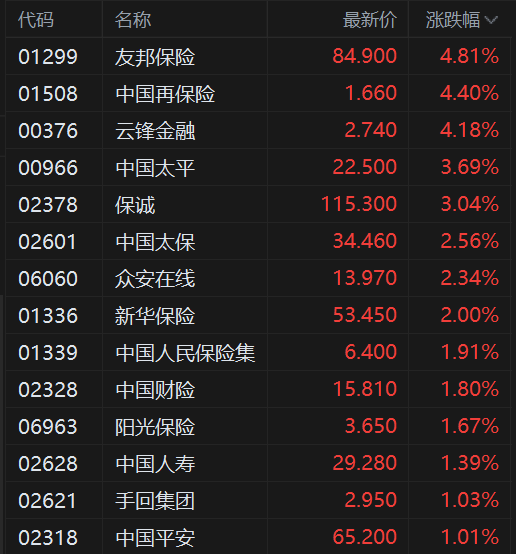
港股保险股止跌反弹 友邦保险涨超5%
Jin Rong Jie· 2026-03-05 03:27
Group 1 - The insurance stocks that had been declining have rebounded, with AIA Group rising over 5% [1] - China Reinsurance and Yunfeng Financial both increased by over 4% [1] - China Pacific Insurance rose by 3.7%, while China Life, New China Life, and ZhongAn Online gained over 2% [1] - China People's Insurance, China Property & Casualty Insurance, Sunshine Insurance, China Life Insurance, and Ping An Insurance all saw increases of over 1% [1]


保险深度:股市及利率影响几何?
East Money Securities· 2026-03-05 03:27
Investment Rating - The report maintains a "Strong Buy" rating for the non-bank financial sector, indicating a positive outlook for investment opportunities in this industry [3]. Core Insights - The Chinese insurance industry has shown rapid growth, with total investment assets reaching 38.5 trillion yuan by the end of Q4 2025, reflecting a year-on-year growth rate of 15.7% [20][21]. - The allocation of investment assets has shifted significantly towards bonds, which increased from 33.3% in Q1 2019 to 50.4% in Q4 2025, while the share of stocks and funds rose from 12.4% to 15.4% during the same period [26][20]. - The performance of insurance companies is highly sensitive to fluctuations in equity markets and interest rates, with both static and dynamic impacts on their financial performance [36]. Summary by Sections 1. Overview of the Insurance Industry Investment Status - The insurance industry has maintained a compound annual growth rate of 18.6% in investment assets from 2004 to 2025, with a notable recovery in growth rates following a low point in 2021 [20]. - The proportion of investment assets allocated to life insurance companies has remained around 90% since 2022, indicating their dominance in the market [21]. 2. Sensitivity Analysis of Equity Market Upturn - A 10% increase in equity investment prices could lead to an average pre-tax profit increase of 38.7%, with China Pacific Insurance showing the highest sensitivity at 83.4% [2]. - If equity investment prices rise by 10% alongside a 10% increase in equity allocation, the average pre-tax profit could increase by 81.2%, with China Pacific Insurance again leading at 175.2% [2]. 3. Sensitivity Analysis of Interest Rate Increases - A 50 basis point increase in market interest rates could result in an average pre-tax profit increase of 0.7%, with China Life and China Pacific showing significant positive elasticity [2][3]. 4. Economic Assumption Sensitivity Analysis - An increase in investment return rates and risk discount rates by 50 basis points could enhance new business value by an average of 35%, with China Life and New China Life showing the highest sensitivity [12]. 5. Liability Cost Analysis - The average new policy liability cost is estimated at 2.76%, with Ping An and China Life having the lowest costs [12]. - The report suggests that effective management of liability costs will enhance the long-term profitability of insurance companies [12]. 6. Investment Recommendations - The report highlights that the insurance sector is currently undervalued and suggests a systematic allocation of investments in this sector due to its high beta elasticity and resilience [12].

港股异动丨保险股止跌反弹 友邦保险涨超5% 机构依然看好低估值保险股估值修复机会
Ge Long Hui· 2026-03-05 03:13
Group 1 - Insurance stocks that had been declining have rebounded, with AIA Group rising over 5%, China Reinsurance and Yunfeng Financial up over 4%, and China Taiping increasing by 3.7% [1][1] - Guotai Junan released a report expressing optimism about undervalued insurance stocks and their valuation recovery opportunities, driven by strong demand for insurance savings from residents and expected improvements in liability costs [1][1] - GF Securities reported that domestic equities and securities investment funds are favored by insurance institutions for 2026, with a positive outlook on the A-share market and plans for slight increases in A-share allocations [1][1] Group 2 - The long-term interest rates have been stable in the range of 1.79%-1.90% since 2026, which is expected to improve profitability for insurance companies as they optimize asset management strategies [1][1] - The report from Guotai Junan maintains an "overweight" rating for the insurance industry, anticipating a turning point in the cost of existing liabilities due to stable long-term interest rates and capital market improvements [1][1] - The majority of insurance institutions are optimistic about high-grade industrial bonds, perpetual bonds, and convertible bonds for this year, indicating a shift in investment strategy [1][1]

保险观点更新:强β情绪释放,重回起涨点,估值性价比再现-20260304
ZHONGTAI SECURITIES· 2026-03-04 15:10
Investment Rating - The industry investment rating is "Overweight" [11] Core Insights - Recent pressure on insurance stock prices is seen as a short-term emotional release, with a focus on companies like China Pacific Insurance, China Life, Ping An, and New China Life that have experienced significant adjustments [5] - The insurance sector has shown strong beta characteristics, with recent geopolitical risks causing market volatility, but the selling pressure has largely been alleviated [5] - The PEV valuations of major insurance companies have returned to relatively low levels, indicating potential for rebound as the market stabilizes [5][7] Summary by Relevant Sections Market Overview - The insurance sector's total market value is approximately 32,974.79 billion [3] - The recent decline in insurance stocks has brought them back to the starting point from December 2025, with PEV valuations for major companies like Ping An, China Life, China Pacific, and New China Life at 0.65, 0.71, 0.53, and 0.65 respectively, reflecting historical valuation percentiles of 31%, 25%, 34%, and 50% [5][10] Financial Performance Predictions - The average net profit growth for listed insurance companies in 2025 is expected to be around 25.1%, with a double-digit growth in dividends per share (DPS) [5] - Key financial metrics for major companies in 2025 include: - China Ping An: Net profit of 1,358 billion, DPS of 2.73 - China Life: Net profit of 1,533 billion, DPS of 0.71 - China Pacific: Net profit of 509 billion, DPS of 1.18 - New China Life: Net profit of 356 billion, DPS of 3.42 [10] Investment Recommendations - The report suggests focusing on companies such as China Pacific Insurance, Ping An, China Life, New China Life, and China Property & Casualty Insurance due to their attractive valuations and growth potential [5]
小摩:中资保险股落后大市 偏好中国平安(02318)及中国人寿
智通财经网· 2026-03-04 02:20
Group 1 - The core viewpoint of the reports indicates that after the Lunar New Year holiday, the performance of Chinese H-share insurance companies has lagged behind the market due to concerns over short-term profit risks, lack of data points, and macroeconomic trends post-holiday [1] - Key catalysts expected to revive the sector include discussions on enhancing shareholder total returns, optimistic guidance from management regarding life insurance sales prospects for FY2026, robust solvency capital status for Q4 2025, decreasing funding costs, and increased confidence in the recovery of the Contractual Service Margin (CSM) [1] - The preference is given to China Ping An (02318) for its life insurance sales recovery and attractive valuation, as well as China Life (02628) for its strong life insurance sales growth outlook and discussions on enhancing shareholder returns [1] Group 2 - The firm believes that insurance companies are not required to issue profit forecasts unless there is a change in annual net profit exceeding 50%, with projected net profit growth for China Life, China Ping An, and China Pacific Insurance (02601) at 47%, 19%, and 10% respectively for FY2025 [2] - The focus is on sustainable earnings growth leading to per-share dividend increases, and the increased volatility of net profit under new accounting standards has made companies more cautious about voluntarily issuing profit forecasts [2] - The current market consensus for FY2026 net profit forecasts shows a projected decline of 9%, indicating limited risk for further downward adjustments at this stage [2]
小摩:中资保险股落后大市 偏好中国平安及中国人寿
Zhi Tong Cai Jing· 2026-03-04 01:58
Core Viewpoint - After the Lunar New Year holiday, the performance of Chinese H-share insurance companies has lagged behind the market, with concerns over short-term profit risks and a lack of data points regarding monthly premium income [1] Group 1: Market Concerns - Short-term profit risks are highlighted as major insurance companies have not yet released positive profit forecasts [1] - There is a lack of data points due to the absence of disclosed monthly premium income [1] - The macroeconomic trends following the Lunar New Year holiday are under scrutiny [1] Group 2: Expected Catalysts - The sector is expected to regain momentum as the earnings announcement period approaches, driven by five key catalysts [1] - Increased discussions on total shareholder returns [1] - Management's optimistic guidance on life insurance sales prospects for fiscal year 2026 [1] - Solid solvency capital status for Q4 2025 [1] - Decrease in funding costs [1] - Enhanced confidence in the recovery of the Contractual Service Margin (CSM) for life insurance reserves [1] Group 3: Company Preferences and Ratings - The company prefers China Ping An (601318) due to its life insurance sales recovery and attractive valuation, as well as China Life (601628) for its strong life insurance sales growth and discussions on enhancing shareholder returns [1] - Morgan Stanley has assigned "Overweight" ratings to both China Ping An and China Life H-shares, with target prices of HKD 100 and HKD 40, respectively [1] Group 4: Profit Forecasts and Market Consensus - Morgan Stanley states that insurance companies are not required to issue profit forecasts unless annual net profit changes exceed 50% [2] - The firm predicts net profit growth for China Life, China Ping An, and China Pacific Insurance (601601) for fiscal year 2025 at 47%, 19%, and 10% respectively [2] - The market consensus for fiscal year 2026 net profit forecasts shows a projected decline of 9%, indicating limited risk for further downward adjustments at this stage [2]