
增量资金入市

Search documents
市场仍在反弹窗口中
鲁明量化全视角· 2026-03-01 06:14
Group 1 - The market is currently in a rebound window, with significant gains observed in major indices: Shanghai Composite Index increased by 1.98%, and CSI 500 Index rose by 4.32% during the first week after the Spring Festival [3] - Despite ongoing inflation, liquidity remains supportive of the A-share market's upward trend, with a notable decline in the 10-year US Treasury yield by 30 basis points over the past month [3] - The geopolitical situation, particularly the US military actions against Iran, is influencing global commodity prices and may lead to distortions in demand, impacting domestic industrial prices in China [3] Group 2 - The current positioning suggests a high allocation in both the main board and small-cap sectors, with a balanced style judgment [2] - The short-term market rebound is expected to continue, driven by domestic monetary policy and the nature of the current price increases, with a recommendation to maintain high positions in A-shares [4] - The core strategy performance for 2025 shows a total return of 33.90%, outperforming the benchmark by 16.24%, indicating strong investment management capabilities [5]


国金证券:25全年股票+基金+长股投增长近2万亿 Q4单季增长千亿
智通财经网· 2026-02-25 03:08
Core Viewpoint - The report from Guojin Securities indicates a positive trend in the fundamentals of the asset-liability sides for the insurance industry by 2026 and in the medium to long term, with a focus on the benefits from market upturns and stable long-term interest rates, suggesting room for valuation increases and a positive outlook for leading insurance companies with strong performance and low liability costs [1] Group 1: Industry Overview - As of the end of 2025, the total scale of funds utilized by the insurance industry reached 38.48 trillion yuan, reflecting a year-on-year growth of 15.7% and a quarter-on-quarter increase of 2.7%, indicating steady growth [2] - The proportion of bonds and bank deposits has increased, while the share of equity assets, including stocks, remained stable, with a slight decrease in funds and long-term stock investments [2] - By the end of Q4 2025, the combined proportion of stocks, funds, and long-term stocks reached 23.0%, an increase of 2.6 percentage points year-on-year, with a total scale increase of 1.97 trillion yuan [2] Group 2: Investment Trends - It is estimated that 650 billion yuan of incremental funds will enter the market in 2026, with varying levels of stockpiling among companies, such as Ping An, which is expected to invest 20% of new premiums in the A-share market [3] - Major state-owned enterprises like China Life, Taiping, Xinhua, and PICC are expected to continue investing 30% of their new premiums in A-shares, with some companies potentially increasing this to 40% [3] - Non-listed companies are anticipated to have low overall positions but limited incremental funds, with an assumption that 40% of the incremental funds will enter the stock market [3]

公募新发规模已创近四年新高!马年增量资金蓄势待发
Bei Jing Shang Bao· 2026-02-23 13:03
Core Insights - The A-share market is set to welcome the first trading day of the Year of the Horse with a significant number of new fund launches, indicating a strong market sentiment and potential for growth in 2026 [1][3]. Fund Issuance - On February 24, the first trading day, 18 new funds were launched, with a total of 35 new funds expected to debut in the first week [3]. - In the first two months of 2026, a total of 245 new public funds were issued, with a scale nearing 210 billion yuan, marking a record high for the same period in nearly four years [1][4]. - The structure of the new funds is predominantly equity-focused, with 24 out of 35 funds being equity funds, accounting for over 68% of the total [3]. Market Sentiment and Trends - Analysts express optimism for the market's performance in 2026, attributing it to a strong stock market and increased investor demand for equity funds due to favorable past performances [5][6]. - The growth in new fund issuance is seen as a reflection of a long-term trend of household savings shifting towards capital markets, which is expected to continue throughout the year [6]. Performance Expectations - The market is anticipated to maintain a positive trajectory, with predictions of the index remaining above 4,000 points, which would further attract outside capital [7]. - The A-share market is expected to benefit from a seasonal "spring offensive" following the Lunar New Year, supported by positive performances in overseas markets [7][8]. Sector Insights - Technology stocks are highlighted as a leading sector for the Year of the Horse, with potential for continued strong performance, particularly for companies with core technologies [8]. - Investors are advised to be cautious of high valuations in growth stocks and to focus on the premium levels of fund products when investing [8].

非银金融行业:增量资金持续入市,关注非银板块配置机会
GF SECURITIES· 2026-02-08 04:29
Core Insights - The report emphasizes the continuous influx of incremental funds into the market, highlighting investment opportunities in the non-bank financial sector [1][7] - The industry rating remains at "Buy," indicating a positive outlook for the sector [2] Group 1: Market Performance - As of February 6, 2026, the Shanghai Composite Index closed at 4065.58 points, down 1.27%, while the Shenzhen Component Index fell 2.11% [12] - The average daily trading volume in the Shanghai and Shenzhen markets was 2.41 trillion yuan, reflecting a 3.38% decrease [7] Group 2: Industry Dynamics and Weekly Commentary Insurance Sector - The performance of listed insurance companies is expected to continue high growth, with a marginal improvement in long-term interest rate spreads [18] - China Ping An Group increased its stake in China Life H shares, indicating positive industry trends [18] - The first quarter of 2026 is anticipated to show better-than-expected performance for some insurance companies due to a low base in the first half of 2025 [18] Securities Sector - A significant increase in new accounts was observed in January 2026, with 491.58 million new A-share accounts opened, a 213% year-on-year increase [19] - The balance of margin trading reached a historical high, providing strong support for interest income in the securities industry [22] - The Hong Kong IPO market is active, with 384 companies applying for listings as of February 6, 2026, and a daily trading volume of 2202 billion yuan in January, a 94% year-on-year increase [24][28] Group 3: Investment Recommendations - The report suggests focusing on specific stocks within the insurance sector, including China Ping An (A/H), China Life (A/H), and New China Life (A/H) [18] - In the securities sector, recommended stocks include Guotai Junan (AH), CICC (H), and Huatai Securities (AH) due to their potential for performance improvement [7][18]



近九成投顾看涨全年 市场风格显现均衡迹象
Shang Hai Zheng Quan Bao· 2026-02-03 18:19
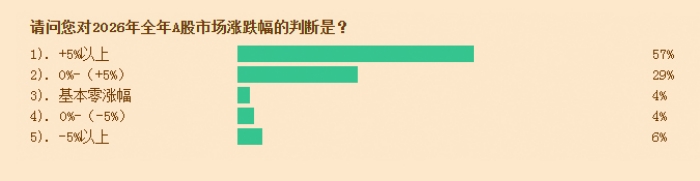
Core Viewpoint - Investment advisors are optimistic about the A-share market in 2026, with nearly 90% expecting an upward trend, and a consensus forming around economic recovery and increased capital inflow [6][7][13]. Group 1: Market Outlook - 88% of investment advisors are bullish on the A-share market for 2026, with 58% expecting an index increase of over 5% [6][14]. - Advisors predict a structural market characterized by fluctuations, with 46% expecting repeated index oscillations and significant gains in certain sectors [14][16]. - The consensus on macroeconomic recovery is strengthening, with 80% of advisors holding optimistic or neutral views on the economy [10][33]. Group 2: Asset Allocation - 67% of advisors recommend increasing allocations to equities, with 68% favoring stocks in the first quarter of 2026 [21][19]. - Advisors are shifting from a focus on growth stocks to a more balanced approach, with 42% expecting growth and dividend styles to converge [16][19]. - High dividend stocks are gaining attention, with 37% of advisors considering them reasonably valued, reflecting a shift in market sentiment [18][19]. Group 3: Investment Strategies - The predominant strategy remains flexible thematic investment, with 47% of advisors advocating for this approach, while 29% are focusing on value investing [22][33]. - Advisors suggest maintaining a higher equity position, with 80% recommending a minimum of 50% equity allocation for clients [22][33]. - The preference for direct stock investments is increasing, with 47% of advisors suggesting this method [21][19]. Group 4: Client Performance and Sentiment - 82% of advisors reported that their clients achieved profits in 2025, a significant increase of 23 percentage points from 2024 [29][27]. - High-net-worth clients are showing increased confidence, with 19% planning to increase their investments, indicating a rising risk appetite [31][27]. - The sentiment towards gold investments is also positive, with 57% of advisors expecting gold prices to continue rising [25][26].
两市成交额冲击4万亿!证券ETF(159841)昨日全天获资金申购超1.5亿份,机构:多路场外增量资金入市值得期待
Xin Lang Cai Jing· 2026-01-15 01:21
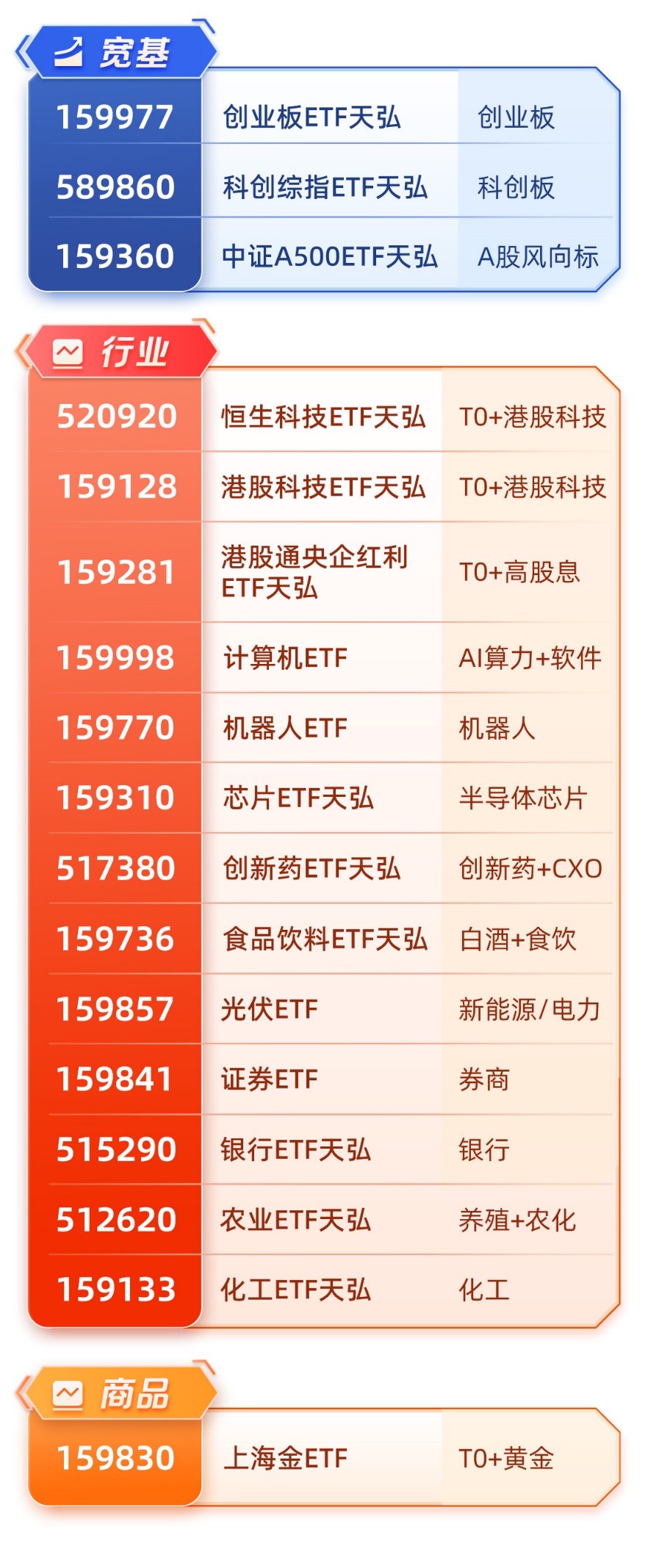
Core Viewpoint - The A-share market is experiencing a bullish trend, with significant trading volume and inflows into securities ETFs, indicating strong investor participation and potential for continued growth in the brokerage sector [2][3]. Group 1: ETF Performance - As of January 14, 2026, the Securities ETF (159841) saw a subscription of 155 million units, with a turnover rate of 8.07% and a total transaction volume of 832 million yuan [1]. - Over the past week, the Securities ETF (159841) experienced a growth of 59.08 million yuan in scale and an increase of 19.8 million units in shares, reflecting significant growth [2]. - The latest net inflow into the Securities ETF (159841) was 60.64 million yuan, with a total of 386 million yuan attracted over the last five trading days [2]. Group 2: Market Trends - The A-share market's trading volume reached 3.94 trillion yuan on January 14, marking an increase of 290.4 billion yuan from the previous trading day, maintaining high trading activity [2]. - Despite fluctuations in major indices, the overall trading enthusiasm remains strong, indicating robust market participation [2]. Group 3: Institutional Perspectives - Huaxi Securities maintains a bullish outlook, suggesting that the A-share market is in a favorable position for growth, with expectations of increased external capital inflows [3]. - UBS expresses optimism for the A-share market in the first quarter, citing loose liquidity and potential for valuation recovery throughout 2026, supported by strong innovation and policy backing [3].
A股分析师前瞻:增量资金入市,春季做多的时间窗口连续不断
Xuan Gu Bao· 2026-01-11 13:37
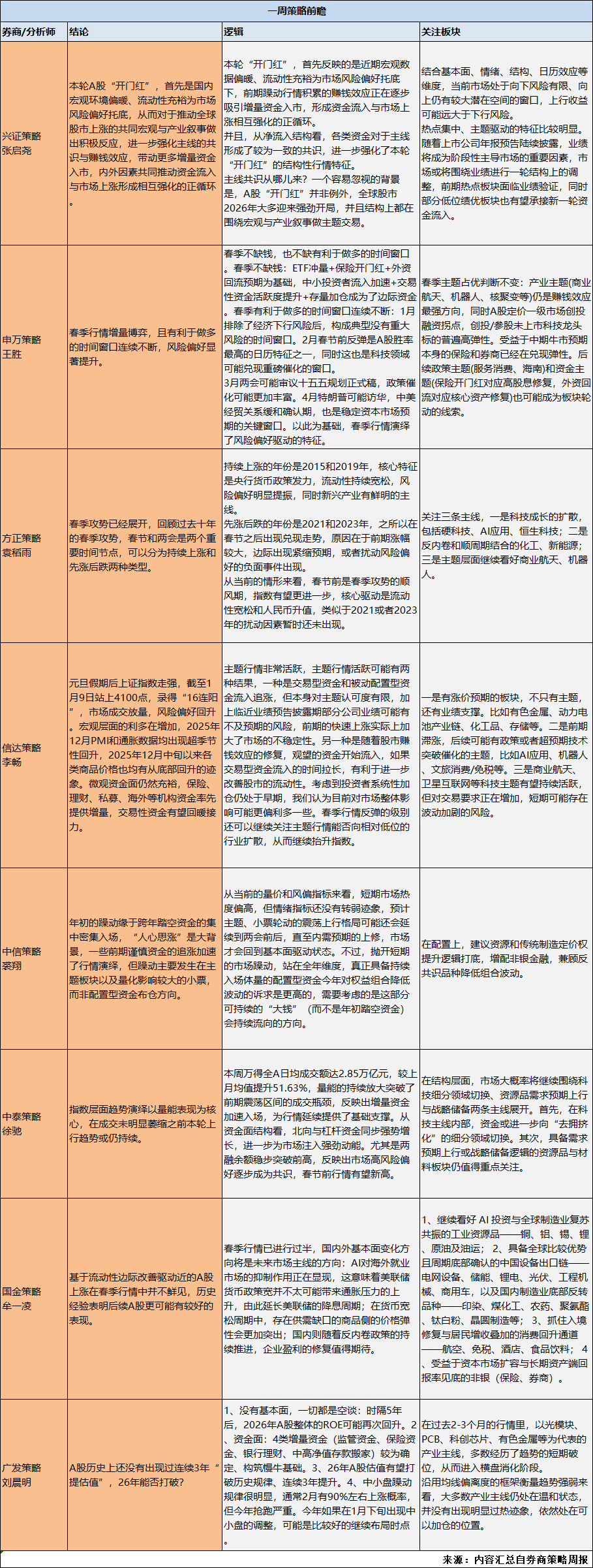
Group 1 - The core viewpoint is that the spring season presents a favorable environment for investment, characterized by ample liquidity and positive macroeconomic indicators, which are expected to drive market performance [1][2] - The analysis indicates that the current market is experiencing a "spring rally," supported by increased inflows from various types of investors, including ETFs, insurance funds, and foreign capital, which collectively enhance market risk appetite [1][2] - The upcoming political events, such as the Two Sessions and potential visits from foreign leaders, are anticipated to provide additional policy catalysts that could further stimulate market activity [1][2] Group 2 - The short-term market sentiment is currently high, with indicators suggesting that the upward trend may continue until the Two Sessions, driven by improved domestic demand expectations [2][3] - Historical data suggests that A-shares have not experienced three consecutive years of valuation increases, but 2026 may break this trend, with a potential recovery in overall ROE [2][4] - Various sectors, particularly those related to technology and materials, have shown signs of short-term consolidation after previous upward trends, indicating a potential for further investment opportunities [2][4] Group 3 - The analysis highlights that the current market dynamics are influenced by a combination of macroeconomic factors and investor sentiment, creating a positive feedback loop that encourages further capital inflow [1][2] - The spring season is marked by a series of favorable time windows for investment, with specific months identified as having historically high success rates for market performance [1][2] - The focus on thematic investments, particularly in sectors like commercial aerospace and robotics, is expected to remain strong, with potential for significant returns as these industries continue to develop [3][4]
固收-系列电话会
2026-01-08 16:02
Summary of Conference Call Records Industry Overview - The fixed income strategy is facing challenges due to increased interest rate volatility, leading to the ineffectiveness of single-duration strategies and limited space for credit spreads. The fixed income plus strategy is gaining attention, but the traditional fixed income plus sector is limited in capacity and facing a contraction issue [1][3]. Key Insights and Arguments - **Mixed Investment Strategy**: A mixed investment strategy combining stocks and bonds can optimize risk and return. International experiences, such as the Morningstar Core Plus Bond fund, suggest that increasing equity assets can enhance returns. The long-term return of China's equity market is promising, but it is characterized by high volatility. The National Social Security Fund has achieved an average annual return of 7.39% through mixed investments [1][5]. - **Policy Guidance for Long-term Funds**: Policies guiding long-term funds into the market are encouraging institutions to increase equity allocations. Large insurance companies are expected to invest 30% of new premiums into A-shares annually. By the end of 2025, the proportion of stock and fund investments by life insurance companies is projected to reach about 15%, resulting in an estimated annual inflow of over 100 billion yuan into the A-share market [1][6]. - **Impact of Incremental Funds**: Incremental funds are expected to have a rapid corrective effect on undervalued assets. For instance, the banking sector is favored by insurance funds due to its low valuation and high dividends, with the price-to-book ratio expected to recover from 0.52 to 0.74, indicating a cumulative increase of nearly 64% from 2024 to 2025 [1][7]. - **Valuation Comparison**: As of November 2025, the PE TTM of the CSI 300 index is 13.92, significantly lower than the S&P 500 index at 28. This indicates that Chinese equity assets offer high cost-performance compared to global markets [1][8]. - **Concentration in Growth Sectors**: The ChiNext board focuses on high-end manufacturing, with the top seven constituent stocks being leading blue-chip companies. The dynamic PE for 2026 is expected to be around 25 times, reflecting an increase in concentration and a slow bull market similar to the Nasdaq 100 index [1][4][10]. Additional Important Insights - **Challenges for Traditional Fixed Income Strategies**: The traditional fixed income strategies are challenged by increased interest rate volatility and limited credit spread expansion, making it difficult for investors to find yield [2][3]. - **Emerging Tools in Fixed Income Plus Market**: New tools in the fixed income plus market include convertible bond ETFs and a focus on fixed proportion stock-bond ETFs, which are expected to attract long-term capital due to their low fees and high transparency [1][13][14]. - **Rebalancing Strategy Benefits**: Implementing a rebalancing strategy can significantly reduce the volatility of an asset portfolio, enhancing overall stability by adjusting asset proportions based on market movements [1][18]. - **Future of Multi-Asset Allocation**: The trend towards multi-asset allocation is characterized by high transparency and liquidity, which will lower the entry barriers for individual investors and promote innovation among institutions [1][25]. - **Performance of Dividend Low Volatility Index**: The dividend low volatility index has shown stable historical performance, with a 5-year annualized return of 4% and a volatility of only 1%, indicating its robustness compared to other indices [1][24]. This summary encapsulates the key points from the conference call records, highlighting the challenges and opportunities within the fixed income and equity markets, as well as the implications of policy changes and investment strategies.
三大利好齐发,政策护航2026年A股牛市
Huaxin Securities· 2025-12-09 11:11
Group 1 - The report highlights that since June, the A-share market has entered a main rising phase, driven by technology, with the ChiNext Index and the STAR 50 Index both rising over 60% to their current peaks. However, by October, the market began to show signs of consolidation, raising concerns about the potential end of the bull market [2][12] - Recent regulatory announcements regarding insurance, public funds, and securities firms have provided three major positive signals, boosting market confidence and supporting the A-share bull market into 2026 [2][12] Group 2 - Positive Policy I: The National Financial Regulatory Administration has lowered risk factors for insurance companies, encouraging long-term capital to enter the market. This adjustment reduces the minimum capital requirements for insurance companies holding stocks from the CSI 300, Low Volatility Dividend 100, and STAR Market, potentially releasing over 70 billion yuan in incremental capital for the bull market [3][13] - Positive Policy II: New performance assessment guidelines for public funds focus on actual investor returns, promoting public funds as patient capital. The guidelines include fee reductions, performance benchmarks, and long-term assessment metrics, which are expected to enhance the attractiveness of public funds and facilitate the inflow of more household savings into the market [4][14] - Positive Policy III: The relaxation of leverage restrictions for quality securities firms is anticipated, which may enhance capital utilization efficiency and profitability. This policy aims to shift the industry from price competition to value competition, potentially increasing the capital available for the bull market [5][15] Group 3 - The report anticipates that the combination of these three policies will accelerate the inflow of incremental capital from insurance, public funds, and securities firms, improving liquidity and reinforcing the foundation of the A-share bull market. The outlook for the 2026 bull market remains optimistic, supported by macro-level strategic backing, technological breakthroughs, and micro-level liquidity easing [8][16]
大利好!A股,又有增量资金来了!
Sou Hu Cai Jing· 2025-12-08 04:05
Group 1 - The private equity industry in China experienced a surge in new product registrations in November, with 1,285 products registered, marking a nearly 30% month-on-month increase and the second-highest monthly record of the year [1] - The stock private equity position index reached 82.97% as of November 21, 2025, a significant increase of 1.84% from the previous week, setting a new annual high and a 185-week record [2] - The number of stocks reaching historical highs increased to 57 in the week of December 1-5, 2025, showing a recovery trend despite a recent market pullback [4] Group 2 - The 2025 National Medical Insurance Drug List added 114 new drugs, including 50 innovative drugs, with an overall success rate of 88%, significantly up from 76% in 2024 [3] - The People's Bank of China has increased its gold reserves for the 13th consecutive month, with reserves reported at 7.412 million ounces as of the end of November [5] - A new satellite manufacturing facility in Wenchang International Space City is set to produce 1,000 satellites annually, enhancing the satellite production ecosystem in China [6] Group 3 - This week, five new stocks are set to be issued, including one from the Shanghai main board, one from the Sci-Tech Innovation Board, one from the Shenzhen main board, and two from the Growth Enterprise Market [7] - Nearly 400 billion yuan worth of locked shares will be unlocked this week, with ten companies having over 1 billion yuan in locked share value [9] - The upcoming Federal Reserve meeting on December 9-10 is expected to result in a 25 basis point cut in policy rates [10]
