
BANK COMM(03328)

Search documents
交通银行吴忠分行创新产品优化服务助力奶企纾困解难
Zhong Guo Jin Rong Xin Xi Wang· 2026-02-03 10:19
转自:新华财经 结合奶制品消费端实际,交通银行吴忠分行积极发挥金融机构提振消费职能作用,联合地方商务部门, 制定《"金融助力,乳业振兴"交通银行支持奶产业纾困、提振消费力行动方案》,开展"1元换购100元 乳制品优惠活动",从消费端贡献"交行力量"。吴忠市利通区政府相关负责人评价:"交通银行助企纾 困、提振消费的做法,是积极响应稳增长促发展决策部署的具体实践,通过创新奶产业金融产品和服 务,丰富金融消费场景,为地方奶产业高质量发展贡献了金融力量。"(王学红) 编辑:赵鼎 交通银行吴忠分行积极探索农业设施产权抵押贷款业务路径,主动对接吴忠市政府奶产业纾困基金政 策,联合市农业农村局、市财政局及国有担保公司建立"政策共研、风险共担、信息共享"机制。通过政 银企座谈会、产业链调研等方式,精准掌握企业融资痛点,定向支持奶牛养殖场购置饲草饲料、升级环 保设施,保障奶源供应和牧场日常运营。 该行通过"政府风险补偿基金+银行信贷+担保增信"组合模式,降低企业融资门槛,在每年8月、9月青 贮采购关键节点,开辟绿色审批通道,对经营正常但暂时遇困的企业做到"应贷尽贷、应续尽续",切实 维护产业链稳定。截至2025年末,该行新增纾 ...

交通银行(03328) - 月报表 - 截至二零二六年一月三十一日止股份发行人的证券变动月报表
2026-02-03 08:30
FF301 股份發行人及根據《上市規則》第十九B章上市的香港預託證券發行人的證券變動月報表 | | | 致:香港交易及結算所有限公司 公司名稱: 交通銀行股份有限公司 呈交日期: 2026年2月3日 I. 法定/註冊股本變動 | 1. 股份分類 | 普通股 | 股份類別 | H | | | 於香港聯交所上市 (註1) | | 是 | | | --- | --- | --- | --- | --- | --- | --- | --- | --- | --- | | 證券代號 (如上市) | 03328 | 說明 | H股 | | | | | | | | | | 法定/註冊股份數目 | | | 面值 | | | 法定/註冊股本 | | | 上月底結存 | | | 35,011,862,630 | RMB | | | 1 RMB | | 35,011,862,630 | | 增加 / 減少 (-) | | | | | | | RMB | | | | 本月底結存 | | | 35,011,862,630 | RMB | | | 1 RMB | | 35,011,862,630 | | 2. 股份分類 | 普通股 | ...
佳木斯重庆两地均被罚 交通银行开年已累计9度收罚单
Zhong Guo Jing Ji Wang· 2026-02-03 07:26
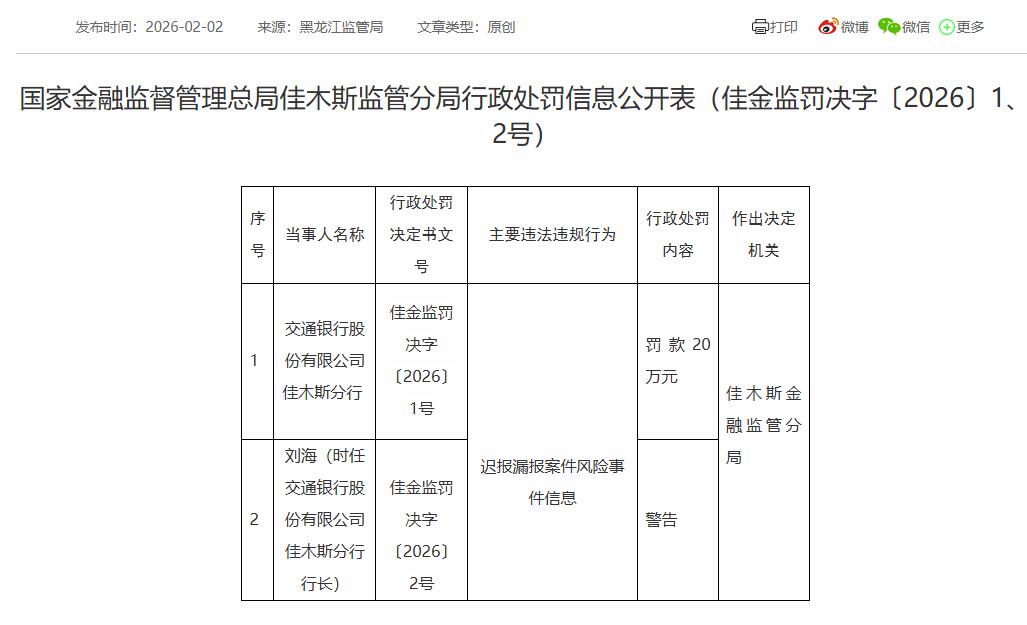
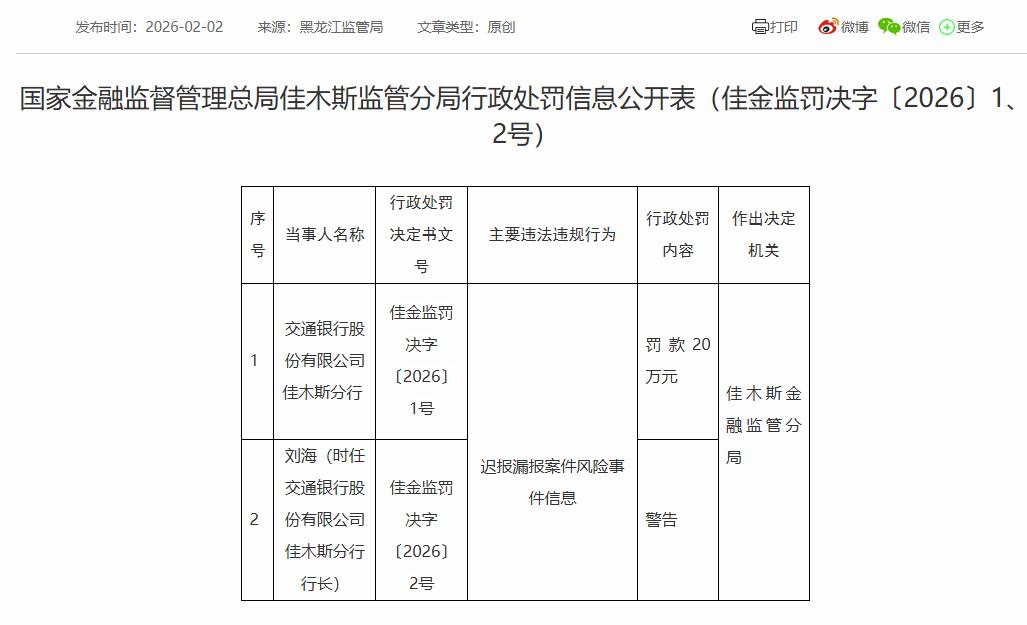
中国经济网北京2月3日讯 国家金融监督管理总局网站昨日公布的佳木斯监管分局行政处罚信息公开表(佳金监罚决字〔2026〕1、2号)显示,交 通银行(601328)股份有限公司佳木斯分行迟报漏报案件风险事件信息被罚款20万元,刘海(时任交通银行股份有限公司佳木斯分行行长)被警 告。 | 序 | 当事人名称 | 行政处罚 决定书文 | 主要违法违规行为 | 行政处罚 | 作出决定 | | --- | --- | --- | --- | --- | --- | | 름 | | | | 内容 | 机关 | | | | 름 | | | | | 1 | 交通银行股 份有限公司 佳木斯分行 | 佳金监罚 决字 | | 罚款20 | | | | | [2026] | | 万元 | 佳木斯金 | | | | 1号 | | | 融监管分 | | | 刘海(时任 | | 识报漏报案件风险事 | | 局 | | | 交通银行股 | 佳金监罚 | 件信息 | | | | 2 | 份有限公司 | 洪字 | | 营告 | | | | 佳木斯分行 | [2026] | | | | | | 行长) | 2号 | | | | 国家金融监督管理总局 ...

佳木斯重庆两地均被罚 交通银行开年已累计9度收罚单
Zhong Guo Jing Ji Wang· 2026-02-03 07:22
中国经济网北京2月3日讯 国家金融监督管理总局网站昨日公布的佳木斯监管分局行政处罚信息公开表(佳金监罚决字〔2026〕1、2号)显 示,交通银行股份有限公司佳木斯分行迟报漏报案件风险事件信息被罚款20万元,刘海(时任交通银行股份有限公司佳木斯分行行长)被警告。 | 序 | 当事人名称 | 行政处罚决 | 主要违法违规 | 行政处罚 | 作出决定 | | --- | --- | --- | --- | --- | --- | | 름 | | 定书文号 | 行为 | 内容 | 机关 | | 1 | 交通银行股份有限公 司重庆合川支行 | 合川金管罚 焚 字 (2026) 1 | 贷款"三查" 不尽职 | 罚款30万 元 | 合川金融 监管分局 | | | 刘协力(时任交通银 | | | | | | 2 | 行股份有限公司重庆 合川支行副行长) | 름 | 贷款"三查" 不尽期 | 营告 | | 1月6日,国家金融监督管理总局网站公布陕西监管局行政处罚信息公示表显示,交通银行股份有限公司陕西省分行及相关责任人员存在以下 主要违法违规行为:发放固定资产贷款不审慎、银行承兑汇票授信后管理不到位、超过借款人实际需求发放流 ...
交通银行上海市分行与上海交通大学国家大学科技园签署全面战略合作协议
Zhong Guo Jin Rong Xin Xi Wang· 2026-02-03 05:57
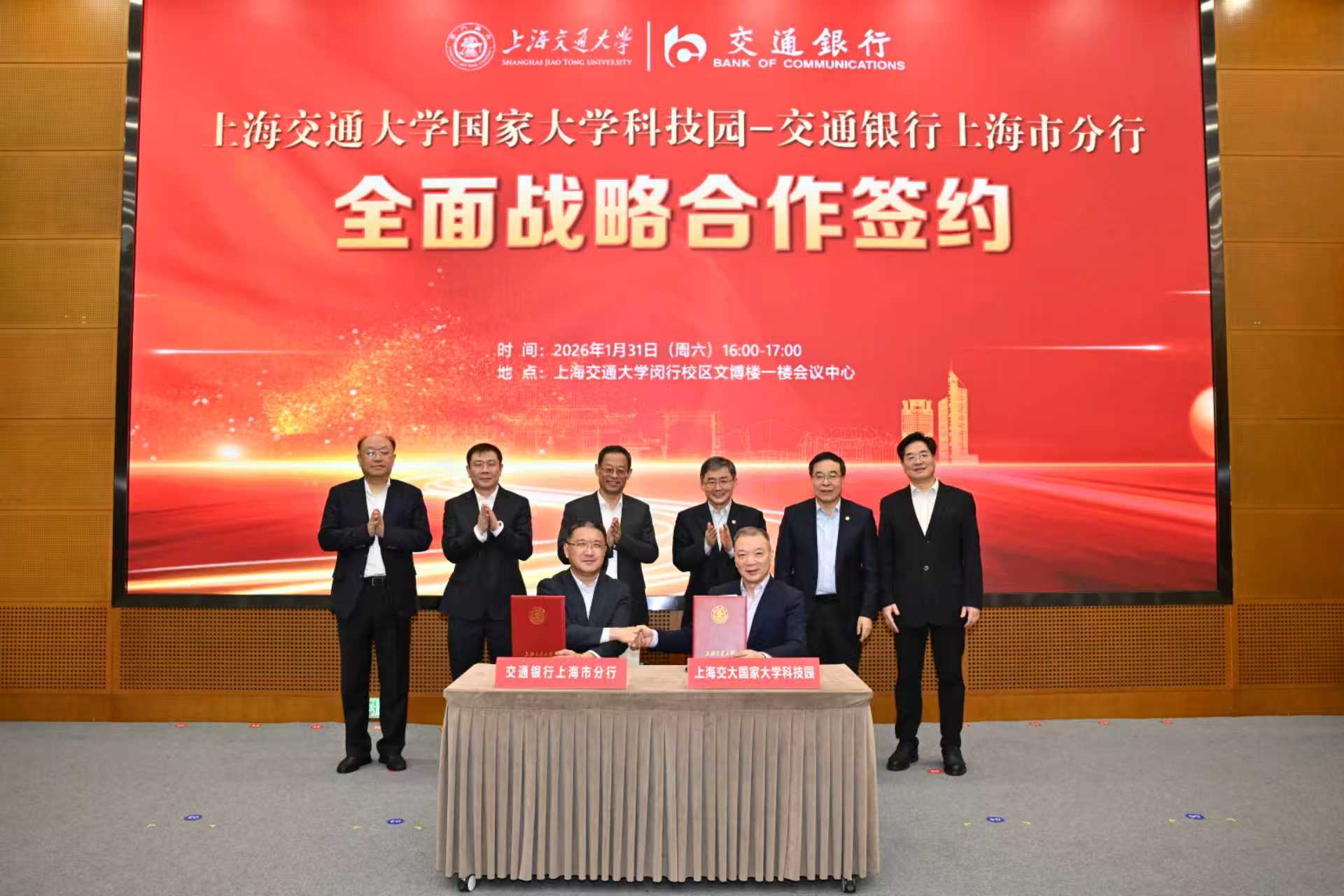
近日,交通银行上海市分行与上海交通大学国家大学科技园举行全面战略合作签约仪式。双方将紧扣国家科技创新、服务上海"五个中心"建设等开展深入合 作。 上海交通大学党委副书记、校长、中国科学院院士丁奎岭表示,交通银行与上海交通大学有着良好合作基础,此次签约标志着双方合作迈入新阶段。他指 出,大学科技园作为学校重要的科创服务平台,在推动科技成果转化方面具有重要作用。当前学校正在推动国家大学科技园改革重塑,期待交通银行的科技 金融有力赋能园区及科创企业,加速金融资本与科技创新的结合,为上海国际科创中心、金融中心建设提供更大支持。 交通银行党委副书记、行长张宝江指出,交通银行与交通大学有着特殊的渊源,本次签约是深化双方合作,助力科技强国建设的又一有力举措,交通银行将 尽己所能提供更加优质的全方位金融服务,通过聚焦重点产业、赋能园区建设、服务在园企业,助力前沿科技走出校园、引领产业、创造未来,书写"教育- 科技-金融"良性循环的新篇章。 转自:新华财经 签约仪式上,上海交大企业发展集团总裁蒋宏与交通银行上海市分行行长杨勇签署《全面战略合作协议》。根据协议,双方将依托上海交大科研人才优势与 交行金融资源禀赋,联合共建科创孵化 ...
国有大行部署2026年经营工作,重点聚焦何处?
Xin Lang Cai Jing· 2026-02-03 01:29
Core Viewpoint - The recent meetings of major state-owned banks in China emphasized "high-quality development" as a key theme for 2025 and outlined strategic focuses for 2026, including enhancing credit issuance and effectively managing risks in key areas [1][3][4]. Group 1: High-Quality Development - Several banks, including Agricultural Bank and China Bank, reported successful completion of their targets for 2025, indicating progress in high-quality development [1][3]. - The banks plan to focus on five major financial initiatives and prioritize credit issuance while managing risks effectively in 2026 [1][3]. Group 2: Service Focus - Agricultural Bank highlighted its commitment to serving the "three rural issues" as a priority, while China Bank aims to consolidate and expand its global advantages [5][6]. - Construction Bank emphasized the integration of commercial and investment banking, as well as public and private banking, to enhance service adaptability [7]. Group 3: Risk Management and Innovation - The banks are focusing on enhancing their risk management frameworks through digitalization and intelligent systems to address credit risks in key sectors like local government debt and real estate [10][11]. - Agricultural Bank and Industrial and Commercial Bank are both committed to increasing loan support in critical areas, including rural finance and consumer sectors [4][10]. Group 4: Reform and Efficiency - The banks are targeting reforms to improve customer and employee satisfaction, with a focus on enhancing operational efficiency and reducing costs [8]. - Postal Savings Bank aims to leverage strategic opportunities during the 14th Five-Year Plan period to enhance its service capabilities and achieve sustainable growth [7].



2026年经营部署如何“划重点”?六大行全扫描
Xin Lang Cai Jing· 2026-02-03 00:48
Core Viewpoint - The major banks in China are transitioning from the "14th Five-Year Plan" to the "15th Five-Year Plan," focusing on serving the real economy and preventing financial risks while adapting to their own development needs [1][2]. Group 1: Transition from "14th Five-Year Plan" to "15th Five-Year Plan" - In 2025, banks aimed to complete the "14th Five-Year Plan" with a focus on risk prevention and stable performance [1]. - For 2026, banks are shifting their focus to the "15th Five-Year Plan," with institutions like ICBC and Bank of Communications outlining their strategic plans for this new phase [1]. Group 2: Support for Key Areas - Banks are increasing loan disbursements and bond investments, particularly in areas like domestic demand expansion, technological innovation, and support for small and micro enterprises [2]. - Agricultural Bank of China emphasizes serving rural areas and has reported a continuous increase in county loans, exceeding 1 trillion yuan for four consecutive years, with a total balance surpassing 10 trillion yuan [2]. Group 3: Risk Prevention Strategies - Financial institutions are prioritizing risk prevention, particularly in local government debt and real estate sectors, with specific measures outlined by Agricultural Bank and China Construction Bank [4]. - China Bank is focusing on centralized credit risk management and proactive trend risk control to maintain asset quality [4]. Group 4: Digital Transformation - Digital transformation is a common focus among state-owned banks, with initiatives aimed at enhancing operational capabilities and integrating AI into business processes [5][6]. - Postal Savings Bank is advancing a comprehensive upgrade strategy that includes digitalization and aims to create a "second growth curve" [6]. Group 5: Shift from Scale Expansion to Value Creation - In 2026, banks are moving from a focus on scale expansion to value creation, with institutions like Postal Savings Bank emphasizing a shift from scale-driven to value-driven strategies [7]. - The consensus among banks is to improve efficiency and reduce costs through digital transformation, especially in a low-interest-rate environment [7].
房地产融资协调“白名单”机制两周年:主办银行制成核心
Feng Huang Wang· 2026-02-03 00:41
Group 1 - The core viewpoint of the article highlights the establishment and implementation of a coordinated financing mechanism for urban real estate, which aims to streamline financing processes and ensure that reasonable financing demands are met by banks [1][3] - The "white list" mechanism has been in place for two years, with the main bank system being recognized as a key component for real estate project financing, ensuring that information sharing among banks is improved and reducing the risk of over-lending [2][3] - Recent data indicates that while the financing support for "white list" projects has been significant, the growth rate of new loans has slowed down considerably compared to the initial year of implementation [4][5] Group 2 - As of the end of last year, banks in Beijing had provided loans totaling 215.6 billion yuan for 219 "white list" projects, while Hunan province reported 1,830.9 billion yuan in loans for 1,386 projects, demonstrating the effectiveness of the financing coordination mechanism [4][5] - The overall loan amount for "white list" projects exceeded 7 trillion yuan, supporting nearly 20 million housing units, but the growth in loan amounts has significantly decreased, with only 1.4 trillion yuan added in the last six months of the previous year [4][5] - The recent adjustments to the "white list" financing mechanism include allowing for a five-year extension on loans for qualifying projects, which aims to alleviate short-term repayment pressures for real estate companies while maintaining cautious lending practices for new projects [6][7]
最新!黄金与白银价格新高后剧烈波动 多家银行紧急调整!
Sou Hu Cai Jing· 2026-02-03 00:05
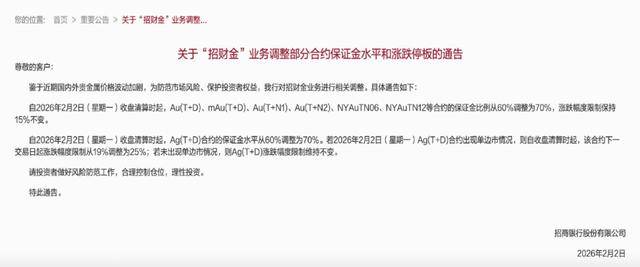
Core Viewpoint - Recent fluctuations in international gold and silver prices have prompted banks to adjust their operations and issue risk warnings to protect investors amid significant market volatility [1][2][4][5][6][7] Group 1: Market Fluctuations - On February 2, gold futures dropped below $4,500 per ounce, with silver prices experiencing a cumulative decline of approximately 40% from the peak on January 29, while gold prices fell by about 20% [1] - The recent volatility in precious metals is attributed to macroeconomic expectations, technical overbought conditions, and profit-taking by some investors, indicating a high volatility phase in the market [7] Group 2: Bank Responses - China Merchants Bank announced an increase in margin requirements for various gold and silver contracts from 60% to 70% to mitigate market risks [1] - The bank also suspended new account openings and new positions in its "Zhaocai Gold" business due to the changing market conditions [2] - Other banks, including Postal Savings Bank of China and Agricultural Bank of China, have issued similar warnings and adjusted their business practices to enhance risk management and protect client interests [2][4][5] Group 3: Risk Management Strategies - Banks are implementing a multi-layered approach to risk management, including increasing entry barriers, limiting leverage, and guiding rational investment behaviors [7] - The adjustments made by banks reflect a proactive stance in managing risks associated with precious metals trading, aiming to maintain market stability and protect investor interests [7]


国有六大行密集强化黄金投资业务风险管控
Zheng Quan Ri Bao· 2026-02-02 16:43
Core Viewpoint - The recent volatility in gold prices has prompted major state-owned banks in China to adjust their gold-related business practices, enhancing risk management and guiding investors towards rational participation in the market [1][2][4]. Group 1: Adjustments by State-Owned Banks - Major state-owned banks, including ICBC, ABC, BOC, CCB, and others, have implemented changes to their gold-related business, including increasing entry thresholds, transaction limits, and risk assessment requirements [2][4]. - ICBC announced on February 1 that due to significant fluctuations in domestic and international precious metal prices, investors should maintain a rational investment mindset and avoid impulsive trading [2]. - CCB raised the minimum amount for personal gold accumulation to 1,500 yuan starting February 2, citing increased market risks [3]. Group 2: Market Analysis and Long-Term Value - Despite short-term price fluctuations, experts believe that gold and other precious metals still hold long-term investment value due to global risk aversion and changes in asset allocation logic [1][5]. - The precious metals market has shown an upward trend since 2026, with gold and silver performing particularly well, although recent price volatility has raised concerns about future market behavior [5]. - Analysts suggest that while short-term pressures may exist, long-term factors such as declining real interest rates and persistent inflation will continue to support gold prices [5][6]. Group 3: Investor Guidance - Investors are advised to focus on risk management, including understanding market volatility, monetary policy changes, and liquidity risks associated with investment products [6]. - It is emphasized that investors should assess their risk tolerance and avoid excessive leverage, choosing investment tools that align with their financial situations [6].