
BANK COMM(03328)

Search documents
关于新增中国银河证券股份有限公司为建信旗下部分交易型开放式指数证券投资基金的申购赎回代理券商的公告
Shang Hai Zheng Quan Bao· 2025-11-27 19:09
Group 1 - The announcement states that from November 28, 2025, China Galaxy Securities Co., Ltd. will act as a subscription and redemption agent for certain exchange-traded open-end index funds under CCB Fund Management Co., Ltd. [1] - Investors can conduct business related to the aforementioned funds at the sales institutions' outlets, and they are advised to refer to the relevant business rules and processes of the company and sales institutions [1] - The contact information for CCB Fund Management Co., Ltd. is provided, including a customer service hotline and website [1] Group 2 - A notice regarding the convening of a communication-based meeting for the fund holders of CCB Runli Enhanced Bond Fund is issued, with voting scheduled from December 19 to December 29, 2025 [2][3] - The meeting will discuss the proposal to adjust the income distribution principles of the fund, which requires approval from more than half of the voting rights held by participants [6][21] - The rights registration date for fund holders to participate in the meeting is set for December 18, 2025 [7] Group 3 - The voting process will be conducted via written paper ballots, and specific instructions for filling out and submitting the ballots are provided [8][9] - The counting of votes will be supervised by authorized personnel and notarized by a public notary [12] - The resolution from the meeting will take effect upon approval and will be reported to the China Securities Regulatory Commission [15][22] Group 4 - The proposal to adjust the income distribution principles includes changes to the frequency and conditions of profit distribution, allowing for more flexibility in the distribution process [23][24] - The new distribution principles will allow the fund manager to propose distribution plans based on actual conditions, with a default option of cash dividends unless otherwise specified by the fund holders [24] - The adjustments aim to better protect the interests of fund holders and will be communicated through the appropriate channels [25]


工行、农行、中行、建行、交行、邮储,集体停售!
Mei Ri Jing Ji Xin Wen· 2025-11-27 13:40
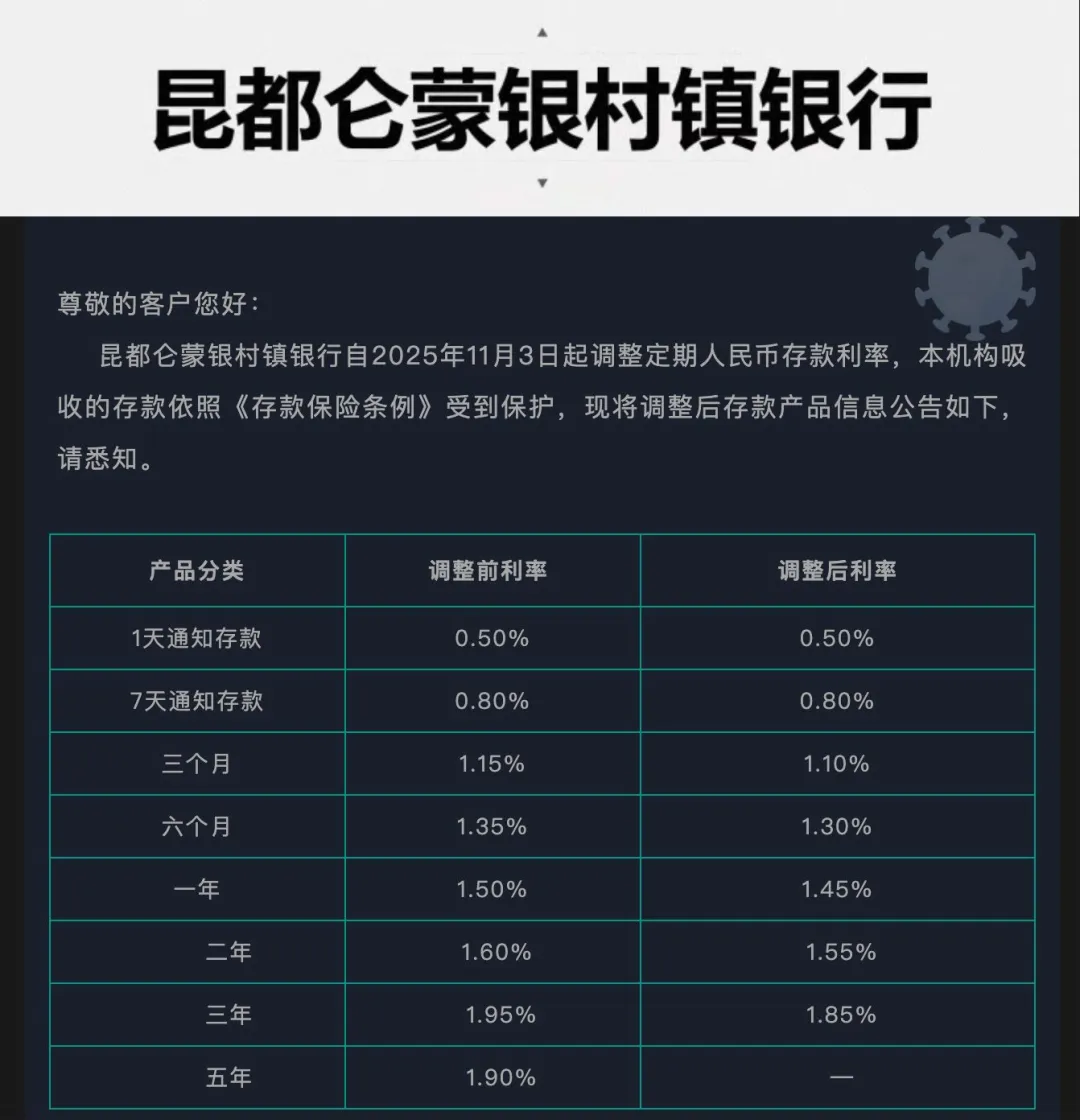
Core Viewpoint - The major state-owned banks in China have collectively removed five-year large-denomination time deposits, indicating a trend of declining long-term deposit products in the banking industry [1][2][4] Group 1: Changes in Deposit Products - The six major state-owned banks have eliminated five-year large-denomination time deposits, with only three-year products remaining, which have seen interest rates drop to between 1.5% and 1.75% [1] - The first bank to announce the cancellation of five-year time deposits was Tongyu County Mengyin Village Bank, which will stop offering this product starting November 5, 2025 [1] - Other banks, including at least seven private banks, have also begun to remove five-year time deposits, reflecting a broader trend in the industry [3][4] Group 2: Interest Rate Adjustments - The interest rates for various deposit products have been adjusted downwards, with one-year and two-year rates reduced by 5 basis points to 1.45% and 1.55%, respectively, and the three-year rate decreased by 10 basis points to 1.85% [3] - The adjustments are a response to the pressure on net interest margins faced by banks, as the yield on assets (like loan rates) is declining while the cost of liabilities (like deposit rates) remains rigid [2][4] Group 3: Industry Context and Implications - The banking industry is experiencing a "two-sided squeeze" where declining loan rates and high competition for deposits are pressuring net interest margins, leading to the reduction of long-term high-interest deposit products [4] - A survey indicated that 62.3% of urban depositors prefer to save more, a slight decrease from the previous quarter, suggesting a shift in savings behavior due to lower interest rates [4] - Analysts predict that while long-term deposits will not completely disappear, they will exhibit differentiated supply characteristics, with state-owned banks likely retaining five-year deposits as service tools but at potentially lower rates [5]




交通银行蚌埠分行落地全省首份“长三角跨区域联合授信”标准化协议
Zhong Guo Jin Rong Xin Xi Wang· 2025-11-27 05:36
Group 1 - The core viewpoint of the news is the establishment of a standardized cross-regional joint credit mechanism in the Yangtze River Delta, aimed at facilitating financing for enterprises undergoing industrial transfer [1][2] - The signing of the first standardized agreement for "Yangtze River Delta Cross-Regional Joint Credit" between the Bank of Communications branches in Bengbu and Ningbo marks a significant step in financial integration innovation in Anhui [1][3] - The joint credit mechanism addresses challenges in credit resource allocation due to the separation of R&D and manufacturing, as well as headquarters and subsidiaries, thereby supporting industrial transfer and collaborative development of the industrial chain [2] Group 2 - The agreement focuses on five innovative arrangements: standardized credit limits, pricing, approval processes, management, and supporting mechanisms to ensure balanced and efficient fund allocation [2] - The first cross-regional joint credit business aims to provide a joint credit of 500 million yuan for a transferring enterprise from Zhejiang, expected to be finalized by December this year [3] - The initiative is designed to create a virtuous development mechanism of "financial collaboration - industrial linkage - regional win-win," enhancing financing support for industrial transfer projects in the Yangtze River Delta [3]
交通银行发布代销北银理财有限责任公司理财产品公告
Jin Tou Wang· 2025-11-27 03:19
2025年11月27日,交通银行(601328)发布公告称,根据《理财公司理财产品销售管理暂行办法》 中"理财公司与代理销售机构合作,理财公司与代理销售机构应当在代理销售合作协议签订10个工作日 内,至少通过本公司、代理销售机构的官方渠道予以公告。"的要求,特此公告:交通银行已与北银理 财有限责任公司签订理财产品代理销售协议,将依法合规代理销售北银理财有限责任公司依法发行的理 财产品。具体代销产品可通过交通银行门户网站www.bankcomm.com查询(查询路径:首页-个人业务- 投资服务-个金产品信息披露-代销产品-公募理财)。 ...
下架五年期 短期也“告急” 银行弃旧爱:“大额存单”去哪了
Shen Zhen Shang Bao· 2025-11-26 23:04
Core Viewpoint - The trend of large-denomination certificates of deposit (CDs) disappearing from the market is evident, with major banks removing long-term products to manage net interest margin pressures and adapt to changing monetary policies [1][2][3] Group 1: Market Changes - Major state-owned banks and national joint-stock banks have removed five-year large-denomination CDs from their offerings, with only short-term products available [1] - The availability of three-year large-denomination CDs is also tightening, with some banks halting new issuances [1][2] - The current offerings are primarily focused on one-year or shorter terms, with some banks only providing three-month or six-month products [2] Group 2: Reasons for Changes - The primary reason for banks discontinuing long-term large-denomination CDs is to alleviate the increasing pressure on net interest margins due to declining loan rates [2] - By reducing high-cost liabilities associated with long-term CDs, banks aim to optimize their liability structure and control overall funding costs [2][3] - This adjustment is seen as a proactive measure by banks in response to macroeconomic conditions and regulatory guidance [2] Group 3: Future Outlook - The role and form of large-denomination CDs are expected to undergo significant changes, with a shift towards shorter-term products becoming more common [3] - The interest rate advantage of large-denomination CDs is likely to diminish, aligning more closely with regular fixed-term deposits [3] - A long-term downward trend in deposit rates is anticipated, driven by monetary policy aimed at reducing financing costs for the real economy [3]


交通银行大宗交易成交486.36万元
Zheng Quan Shi Bao Wang· 2025-11-26 15:16
Core Viewpoint - On November 26, a block trade of 630,000 shares of Bank of Communications was executed at a price of 7.72 yuan, representing a premium of 0.78% over the closing price of 7.66 yuan for the day [1] Summary by Category Block Trade Details - The total transaction amount for the block trade was 4.8636 million yuan [1] - The buyer and seller for this transaction were both from CITIC Securities Co., Ltd., Beijing Zizhuyuan Road Securities Branch [1] - In the last three months, the stock has seen a total of 10 block trades, with a cumulative transaction amount of 135 million yuan [1] Stock Performance - The closing price of Bank of Communications on the day of the trade was 7.66 yuan, down 0.78% [1] - The daily turnover rate was 0.58%, with a total trading volume of 1.153 billion yuan [1] - There was a net outflow of 4.9728 million yuan in main funds for the day, while the stock has increased by 1.73% over the past five days, with a total net inflow of 390 million yuan [1] Margin Trading Data - The latest margin financing balance for the stock is 1.586 billion yuan, which has decreased by 27.8239 million yuan over the past five days, reflecting a decline of 1.72% [1]
交通银行取得基于令牌分层转化的移动端免密认证专利
Sou Hu Cai Jing· 2025-11-26 11:29
Group 1 - The core point of the article is that Bank of Communications Co., Ltd. has obtained a patent for a mobile terminal password-free authentication method based on token hierarchical transformation, with the patent granted on January 2023 [1] - The patent is identified by the authorization announcement number CN 116233845 B [1] - Bank of Communications was established in 1987 and is located in Shanghai, primarily engaged in monetary financial services [1] Group 2 - The registered capital of Bank of Communications is approximately 74.26 billion RMB [1] - The bank has made investments in 170 enterprises and participated in 5,000 bidding projects [1] - The bank holds 453 trademark information records and 274 patent information records, along with 138 administrative licenses [1]
交通银行今日大宗交易溢价成交63万股,成交额486.36万元
Xin Lang Cai Jing· 2025-11-26 09:36
Group 1 - The core point of the news is that Bank of Communications executed a block trade of 630,000 shares on November 26, with a transaction value of 4.8636 million yuan, representing 0.42% of the total trading volume for the day [1][2] - The transaction price was 7.72 yuan, which is a premium of 0.78% compared to the market closing price of 7.66 yuan [1][2]

外汇展业改革参与银行增至26家 三季度工行等4家入列
2 1 Shi Ji Jing Ji Bao Dao· 2025-11-26 07:00
Core Insights - The foreign exchange business reform has been positively received by commercial banks and the public, with 26 banks participating as of September 2025, covering various types of banks across the country [1][2] Group 1: Reform Implementation and Participation - As of September 2025, 26 banks are involved in the foreign exchange business reform, including 5 large banks, 9 joint-stock banks, 4 city commercial banks, and 8 foreign banks [1] - The newly added banks in the third quarter include Industrial and Commercial Bank of China, Deutsche Bank, Mizuho Bank, and Mitsubishi UFJ Financial Group [2] Group 2: Benefits of the Reform - The reform has reduced the burden on enterprises, allowing them to handle foreign exchange transactions more efficiently, with some businesses experiencing a significant reduction in processing time from days to minutes [3] - Banks have improved their customer identification and service capabilities, leading to a reduction in average processing time for transactions by over 50% [3] - The reform has enhanced regulatory quality, with banks establishing risk monitoring systems to better track cross-border transactions and identify abnormal activities early [3] Group 3: Future Directions - The State Administration of Foreign Exchange plans to further enhance the foreign exchange management system, focusing on convenience, openness, security, and intelligence [4] - Future efforts will include expanding the coverage of the reform to benefit more enterprises and integrating various facilitation policies [4] - The application of new technologies such as artificial intelligence and big data will be encouraged to improve efficiency in foreign exchange services [4]

第十九届金洽会“园区行”收官 推动金融服务精准直达
Xin Hua Cai Jing· 2025-11-26 05:00
Core Insights - The 19th Golden Fair's "Park Tour" event in Huangpu's Wuliqiao Street aims to deliver financial services directly to enterprises, marking the conclusion of this year's series of activities [1] - The event highlights the importance of the Golden Fair as a platform for financial services to support the real economy in Shanghai, aligning with Huangpu District's goals of optimizing the business environment and promoting high-quality development [1] Group 1 - The event focused on addressing the financial needs of small and micro enterprises, which remain largely untapped, with discussions on optimizing financial costs for companies like Shanghai KooBan Biotechnology Co., Ltd. and Shanghai Wind Leader New Energy Co., Ltd. [1] - Financial consultants from various institutions provided insights on supporting small and micro enterprises through comprehensive financial solutions, including debt financing and policy-backed guarantees [2] - The Golden Fair has evolved its format to enhance the connection between financial institutions and real enterprises, emphasizing the commitment of Shanghai's financial sector to serve the real economy [2]
