
INTEL(04335)

Search documents
收下特朗普的89亿美元,英特尔真成美国国企了?
Sou Hu Cai Jing· 2025-08-25 16:15
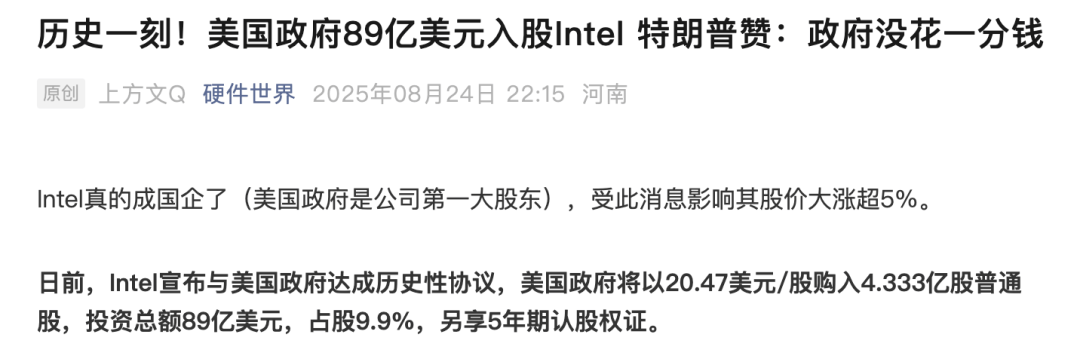
Core Viewpoint - The situation surrounding Intel's recent government investment is complex, revealing deeper issues within the company and the semiconductor industry as a whole [2][8]. Group 1: Intel's Current Challenges - Intel has faced significant difficulties in recent years, particularly from 2014 to 2019, where its manufacturing process stagnated at 14nm while competitors like TSMC and Samsung advanced rapidly [2]. - The company's market value has plummeted by approximately $150 billion, equating to a loss comparable to the valuation of OpenAI, with its stock price dropping nearly 50% since early last year [4]. - Intel's market position has deteriorated significantly, with AMD's market cap now over twice that of Intel and Nvidia's approaching 40 times Intel's valuation [4]. Group 2: Government Investment Details - The U.S. government has invested $8.9 billion in Intel, which is divided into two parts: $5.7 billion from the CHIPS Act and $3.2 billion from a new allocation for a defense-related semiconductor project [10][12]. - This investment is characterized as a "passive investment," meaning the government will not have board seats, voting rights, or governance control, merely acting as a financial investor [14]. - A five-year warrant agreement allows the government to purchase an additional 5% of Intel's shares at $20 per share if Intel loses control of its manufacturing business [16][18]. Group 3: Implications of the Investment - The government's primary goal appears to be preserving Intel's manufacturing capabilities, which are crucial for U.S. national interests, rather than exerting direct influence over the company's operations [20]. - The investment strategy reflects a desire to support domestic manufacturing and potentially revive Intel's position in the semiconductor market [20]. - Despite the challenges, the government’s investment could be seen as a safety net, ensuring that even if Intel struggles, the government will not incur a loss [21].

效仿英特尔协议,美国主权财富基金或入股更多公司
Xin Lang Cai Jing· 2025-08-25 15:12
Group 1 - The White House is considering a model of equity investment in companies, similar to its recent investment in Intel, which may extend beyond the semiconductor industry [1] - The investment in Intel, amounting to nearly $8.9 billion, is part of the 2022 CHIPS Act and will be converted into equity without granting the government voting rights or operational control [1][4] - This type of transaction could become a significant component of the U.S. sovereign wealth fund plan, which aims to manage public assets and ensure long-term economic competitiveness [1] Group 2 - The U.S. government has historically provided funds to companies without returns for taxpayers, but Intel is expected to leverage its cash flow for improved profitability [2] - The government’s investment in Intel, which makes it the largest shareholder with a 9.9% stake, is seen as a strategic move to bolster the semiconductor sector and enhance the U.S. economy [4][5] - Despite the investment, analysts suggest that it does not change Intel's long-standing competitive disadvantages in the market, particularly against rivals like TSMC and Samsung [5]
英特尔与特朗普的微妙博弈-华尔街日报
2025-08-25 14:36
Summary of Intel's Recent Developments Company Overview - **Company**: Intel Corporation (Ticker: INTC) - **Industry**: Semiconductor and Chip Manufacturing Key Points and Arguments 1. **Leadership Crisis**: Intel's CEO, Lip-Bu Tan, faced pressure to resign due to past ties with the Chinese military, as demanded by former President Donald Trump shortly after Tan took office [2][4][39]. 2. **Emergency Meeting**: In response to Trump's demand, Intel's leadership quickly arranged a meeting with the White House, where Tan sought to reassure Trump of his loyalty to the U.S. and the importance of Intel to the American economy [3][5][44]. 3. **Government Stake**: As a result of the meeting, the U.S. government proposed converting nearly $9 billion in grants into a 10% equity stake in Intel, making the government the largest shareholder [6][49]. 4. **Investment from SoftBank**: Japan's SoftBank Group agreed to invest $2 billion in Intel, aiming to strengthen ties with the Trump administration [8][47]. 5. **Stabilization of Leadership**: By the end of the two-week crisis, Tan's position appeared secure, and Intel's situation seemed more stable [8][12]. Financial and Operational Challenges 1. **Core Business Issues**: Analysts suggest that Intel's financial position remains precarious, with concerns that converting grants to equity could dilute shareholder value without new customer commitments [11][12]. 2. **Historical Context**: Intel has struggled to keep pace with competitors like Nvidia and TSMC, missing out on key market opportunities in mobile and AI technologies [15][21]. 3. **Layoffs and Cost-Cutting**: Intel announced plans to lay off 15% of its workforce and cancel billions in planned investments, indicating severe operational challenges [33][34]. Government and Industry Dynamics 1. **Chips Act Benefits**: Intel became the largest beneficiary of the Chips Act, qualifying for approximately $11 billion in grants and loans for various projects [21]. 2. **Future of Manufacturing**: The U.S. government aims to help Intel start manufacturing advanced chips domestically, but Tan indicated that significant customer commitments are necessary before such investments can be made [56]. 3. **Pressure on Tech Companies**: There is speculation that Trump may encourage other tech companies to collaborate with Intel, as Tan has been meeting with potential customers like Apple [55][56]. Additional Insights 1. **Market Valuation**: Despite a recent rebound in stock price, Intel's market valuation is approximately $110 billion, significantly lower than its peak during the dot-com bubble, with a 50% decline since the start of the previous year [24]. 2. **Uncertain Future**: The agreement with the government raises questions about Intel's governance and future direction, especially regarding its manufacturing segment [50][52]. 3. **Public Perception**: Trump's initial demand for Tan's resignation and subsequent support highlights the unpredictable nature of corporate governance under political influence [7][60]. This summary encapsulates the critical developments surrounding Intel, emphasizing the interplay between corporate leadership, government intervention, and market challenges.

英特尔警告:美国政府持股或将拖累国际业务前景
Hua Er Jie Jian Wen· 2025-08-25 14:06
Core Viewpoint - The unconventional intervention by the Trump administration to convert government funding into equity stakes in companies, specifically Intel, has raised concerns among businesses about potential risks to their operations and future government support [1][2]. Group 1: Government Equity Stake - Intel has expressed that the U.S. government's 10% equity stake could pose risks to its business, potentially harming international sales and limiting access to future government funding [1][2]. - The transaction involves the government purchasing Intel shares at $20.8 each, a discount from the previous closing price of $24.8, totaling approximately $8.9 billion [1]. Group 2: Regulatory Concerns - Intel warned that the government's significant ownership could subject the company to additional regulations or restrictions from other countries, particularly in Asia, which could threaten its extensive overseas operations [2]. - The company is uncertain whether this transaction will lead other government entities to convert existing funding into equity investments or if they will be reluctant to provide future funding [2]. Group 3: Shareholder Impact - The issuance of shares to the government below current market prices may dilute existing shareholders' equity and reduce their voting power [3]. - The government's special status as a shareholder could significantly influence Intel's governance and strategic decisions, raising investor concerns about the company's autonomy [3].
特朗普称英特尔股份未花分文价值110亿美元
Xin Lang Ke Ji· 2025-08-25 13:58
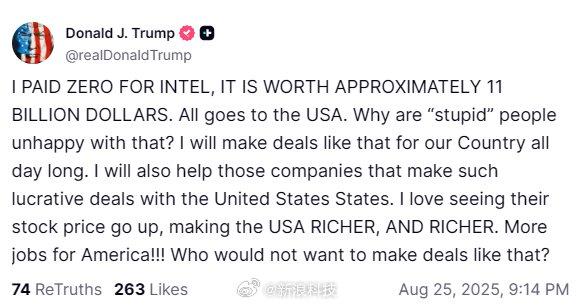
【#特朗普称英特尔股份我一分没花#】美国总统特朗普在社交媒体上发文称:"我获取英特尔股份分文 未花,而它的价值约合 110 亿美元,且所有收益都将归美国所有。为什么那些'愚蠢'的人会对此不满? 我会一整天都为我们国家促成这类交易。我还会为那些与美国达成此类高利润交易的公司提供支持。我 很乐意看到它们的股价上涨,让美国变得越来越富有,为美国创造更多就业机会!!!谁会不希望达成 这样的交易呢?" ...
英特尔警告美政府入股风险:国际销售等业务或受影响
Feng Huang Wang· 2025-08-25 13:52
在美国政府决定将对英特尔的补助转换为股权后,英特尔在一份证券文件中列出了新的"风险因素"。 英特尔表示,目前尚不确定这一交易是否会导致其他政府机构尝试将现有补助转换为股权投资,或使它 们不愿意支持未来的补助。(作者/箫雨) 凤凰网科技讯 北京时间8月25日,据路透社报道,英特尔公司周一表示,美国政府持有其10%股权可能 会对其业务构成风险,从可能损害其国际销售,到限制其未来获得政府补助。 ...
美股低开 热门中概股普涨 英特尔涨逾2%
Ge Long Hui A P P· 2025-08-25 13:48
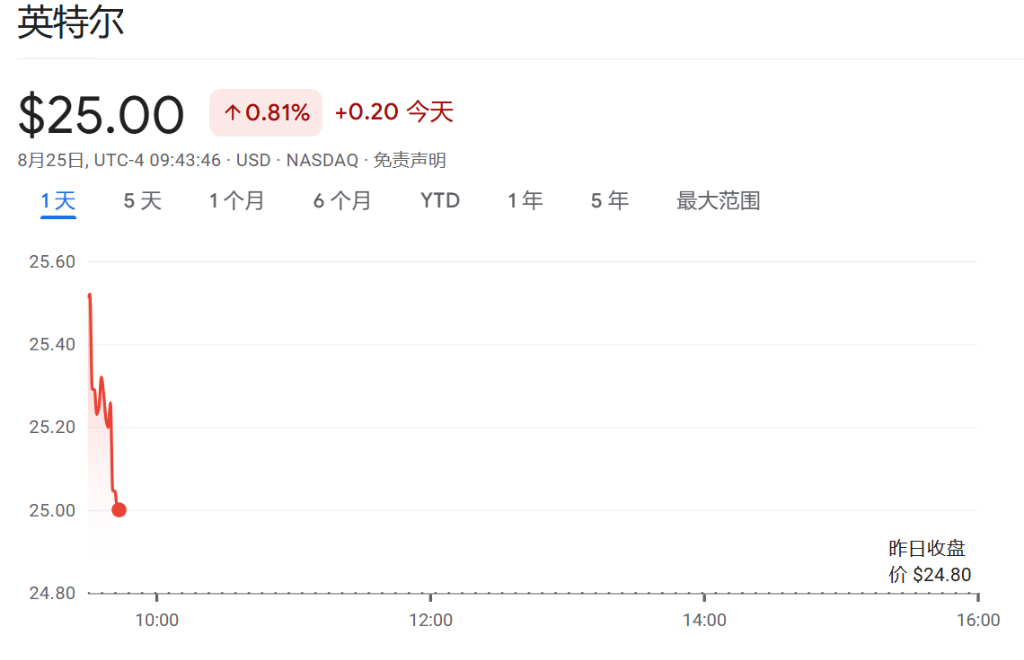
Market Overview - The Dow Jones fell by 0.19%, the S&P 500 decreased by 0.15%, and the Nasdaq dropped by 0.14% at the market open [1] - The Nasdaq Golden Dragon China Index saw an initial increase of approximately 1.2% [1] Chinese Stocks - Popular Chinese stocks experienced gains, with NIO rising by 5.46%, Alibaba increasing by 1.94%, FANGDD up over 2%, and Beike rising over 3% [1] Cryptocurrency Sector - Bitcoin has declined for the third consecutive day, leading to a downturn in digital currency-related stocks, with Riot Platforms falling by 3.2% and Marathon Digital decreasing by 3.4% [1] Intel - Intel's stock rose by over 2% following the announcement that the U.S. federal government will acquire a 10% stake in the company, with a total investment of approximately $8.9 billion [1] Keurig Dr Pepper - Keurig Dr Pepper's stock dropped by 7.6% after the company announced plans to acquire JDE Peet's, a Dutch coffee and tea company, for about $18 billion [1]
特朗普:英特尔股份我一分未花 很乐意看到它们的股价上涨
Ge Long Hui A P P· 2025-08-25 13:40
格隆汇8月25日|特朗普:"我获取特朗普股份分文未花,而它的价值约合110亿美元,且所有收益都将 归美国所有。为什么那些'愚蠢'的人会对此不满?我会一整天都为我们国家促成这类交易。我还会为那 些与美国达成此类高利润交易的公司提供支持。我很乐意看到它们的股价上涨,让美国变得越来越富 有,为美国创造更多就业机会!!!谁会不希望达成这样的交易呢?" ...
美股三大指数开盘集体低开,英特尔涨逾2%
Xin Lang Cai Jing· 2025-08-25 13:40
美股三大指数开盘集体低开,道琼斯指数跌0.24%,标普500指数跌0.17%,纳斯达克综合指数跌 0.19%。拼多多跌超1%,公司Q2净利大超预期,但高管称本季度利润或不可持续。英特尔涨逾2%,美 国联邦政府已决定收购其10%的股份,总投资额约89亿美元。房地产中概股走高,房多多涨超2%,贝 壳涨超3%。 ...
美股三大指数开盘集体低开,道琼斯指数跌0.24%,拼多多跌超1%,英特尔涨逾2%
Mei Ri Jing Ji Xin Wen· 2025-08-25 13:40
Group 1 - The U.S. stock market opened lower on August 25, with the Dow Jones index down by 0.24%, the S&P 500 index down by 0.17%, and the Nasdaq Composite index down by 0.19% [1] - Pinduoduo saw a decline of over 1%, while Intel experienced an increase of more than 2% [1] - Chinese real estate stocks performed well, with Fangdd rising over 2% and Beike increasing by more than 3% [1]


